
What We Heard from Urban Indigenous People
We invited urban Indigenous communities to attend an engagement dialogue regarding the IJS and share their stories and insights regarding justice challenges and opportunities for Indigenous people from coast to coast to coast with us in a virtual meeting.
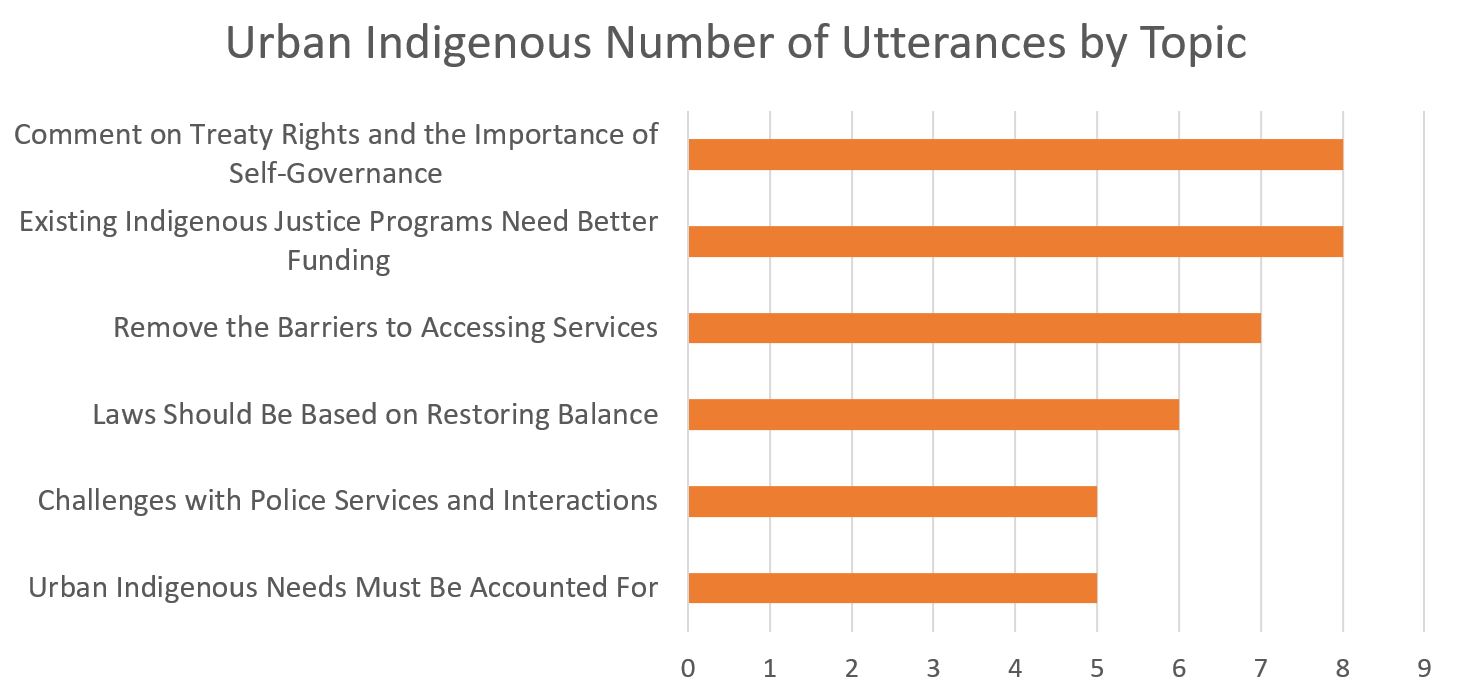
The chart below displays unique topics raised by Urban Indigenous people throughout our conversation.
Text version
Bar chart representing the number of times 6 common themes were raised during the engagement session with urban Indigenous people:
- Comment on treaty rights and the importance of self-governance: 8 times
- Existing Indigenous justice programs need better funding: 8 times
- Remove the barriers to accessing services: 7 times
- Laws should be based on restoring balance: 6 times
- Challenges with police services and interactions: 5 times
- Urban Indigenous needs must be accounted for: 5 times
The session started with a discussion regarding Indigenous laws. Participants acknowledged that the colonial legal system does not see legal responsibilities in the same way that Indigenous worldviews think of laws and legal structures. We heard that there is a greater emphasis on balance and responsibility in the Indigenous legal traditions, and that it is important that any reclamation of Indigenous legal structures respect the community-mindedness and restorative justice frameworks that underpin Indigenous laws. Participants also noted that while laws are often said to stem from the stories passed down from Creator to the Ancestors, the legal traditions of Indigenous people have always adapted and developed to suit modern times, and that traditional Indigenous law can be effective and applicable today.
“Not all of our laws started with Creation. We can adapt our laws based on what's needed for our communities and what we learn from our communities and what we need to do to live life in a good way and in balance and with respect of all of our relations, being all of creation.
“When I think of Indigenous law, it's about responsibility. And I know in a colonial world, we live in a world of rights. But through Indigenous law, what I've learned is our birth is a right and that we have a lot of responsibilities, not only just to the land, but to the community, to our family, our tribe, the society as a whole. And so I feel that's my knowledge from Indigenous law and how I integrate it (sic) into my own life is my responsibility in my actions through the way I live my life.”
It was further explained that for a system of Indigenous and Canadian laws to coexist and work together collaboratively, there must be tremendous respect for treaties. Participants stressed that treaties still apply to individuals living off-reserve and away from their communities, and that their rights as Indigenous people do not stop because they are living in urban centres. Participants also reminded Justice Canada that many cities are settled on traditional Indigenous lands, and that the treaties that govern those lands have not been respected by the government and need to be reviewed and honoured much like land claims in more rural areas. Overall, we heard a lot of frustration regarding the ways in which treaties have been violated and the path to self-governance and self-determination has been slow and incomplete.
Participants noted that urban Indigenous people face different challenges, often needing more support to connect to a community. They must rely on the Indigenous Friendship Centers and other urban programs; therefore, funding for these services and facilities must be a priority. Other program priorities include those that help reconnect with communities and provide access to Elders, Grandmothers and Aunties. As a greater concentration of Indigenous people is found in urban settings than in Indigenous communities, attendees felt that emphasis should be placed on supporting urban Indigenous populations, and that currently programs and policies often focus on Indigenous people who live on or near their home territories.
People stressed that urban Indigenous support programs are essential, and as part of this community support, it was suggested that funding should be allocated for legal aid and justice supports in the form of Gladue and pre- and post-charge diversion program offices that could be located within Friendship Centers. System navigators and court workers need more power to refer clients more easily to programs that may help them move through the system or avoid the justice system altogether, and people coming into contact with the justice system need Indigenous wrap around services that can ensure that they understand what is happening and make informed choices regarding their justice options.
“The higher-level issue of where is the Indigenous community in relation to the justice system? What are their powers of oversight over, where is the accountability that can be taken as far as if there are abuses? One of the things that we constantly get as an organization that represents off-reserve non-status groups they tend to have a lot less official recognition compared band reserve and councils and such. So having that official recognition, having more or of that structure being a formal part of a lot of the proceedings, being able to have that form of accountability.”
Educational campaigns need to help educate people on the colonial systems, its history, and why urban centers have a more significant population of Indigenous people. Because inter-generational trauma is prevalent and often misunderstood, there is a need for pre- and post-charge diversions adapted to the unique needs and challenges of urban Indigenous populations and trauma-informed interventions in safe spaces outside courthouses. From Indigenous perspectives, well-rounded legal education for court workers and paralegals on criminal law, contract and treaty laws, tort laws, and constitutional laws must be mandatory, and more Indigenous court workers should be brought on board. Participants prioritized the integration of trauma-informed approaches. There were also calls for the streamlining of bureaucratic processes that are often impediments to access. For example, there should not be separate processes or individual applications for services; instead, all these services need to be centralized.
- Date modified: