
Evaluation of the Youth Justice Initiative Funding Components
APPENDIX D:
Program Logic Model for the YJI Funding Components
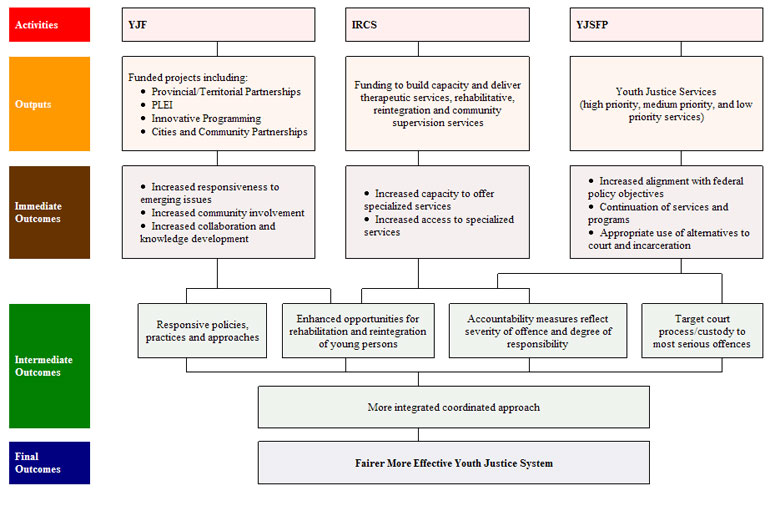
Source: Department of Justice Canada. (2008, September). Youth Justice Initiative Evaluation Framework. p. 26.
Text version
The Youth Justice Fund funds projects under the following categories:
- Provincial / Territorial Partnerships;
- Public Legal Education and Information;
- Innovative Programming; or
- Cities and Community Partnerships.
The funded projects are expected to result in the following immediate outcomes:
- Increased responsiveness to emerging issues;
- Increased community involvement; and,
- Increased collaboration and knowledge development.
The immediate outcomes contribute to the following intermediate outcomes:
- Responsive policies, practices and approaches; and
- Enhanced opportunities for rehabilitation and reintegration of young persons.
Those outcomes in turn contribute to a more integrated and coordinated approach and finally, to a fairer, more effective youth justice system.
The Intensive Rehabilitative Custody and Supervision program provides funding to build capacity and deliver therapeutic services, rehabilitative, reintegration and community supervision services.
The funding results in two immediate outcomes:
- increased capacity to offer specialized services; and
- increased access to specialized services.
The immediate outcomes contribute to the following intermediate outcomes:
- Enhanced opportunities for rehabilitation and reintegration of young persons; and,
- Accountability measures that reflect the severity of the offence and degree of responsibility.
Those outcomes in turn contribute to a more integrated and coordinated approach and finally, to a fairer, more effective youth justice system.
The Youth Justice Services Funding Program provides funding for youth justice services, which are separated into high, medium and low priority services.
The funded services result in the immediate outcomes of:
- Increased alignment with federal policy objectives;
- Continuation of services and programs; and,
- Appropriate use of alternatives to court and incarceration.
The immediate outcomes contribute to three intermediate outcomes:
- Enhanced opportunities for rehabilitation and reintegration of young persons;
- Accountability measures that reflect the severity of the offence and degree of responsibility; and,
- Target court process / custody to the most serious offences.
Those outcomes in turn contribute to a more integrated and coordinated approach and finally, to a fairer, more effective youth justice system.
- Date modified: