
Evaluation of the Indigenous Courtwork Program
4. Findings
4.1. Relevance
4.1.1. Continued Need for the ICW Program
There is a strong continued need for the ICW Program, which is largely attributed to the growing overrepresentation of Indigenous people in the criminal justice system, and the continuing high demand for ICW services. Nearly all key informants report a major need for the ICW Program. Most commonly identified factors contributing to the needs include legacy of colonization and discrimination, socio-economic factors, complexity of the justice system, limited access to legal representation, as well as need for information to support Gladue Principles and culturally relevant services.
In 1999, in R. v. Gladue and again in R. v. Ipeelee, the Supreme Court of Canada stated that Section 718.2(e) of the Criminal Code was enacted in response to alarming evidence that Indigenous people were incarcerated disproportionately to non-Indigenous people in Canada. The Court stressed that this Section is a remedial provision, enacted specifically to oblige the judiciary to make special efforts to find reasonable alternatives to imprisonment for Indigenous offenders, and to consider the background and systemic factors that bring Indigenous people into contact with the justice system.
Despite the Gladue decision, the number of Indigenous offenders as a percent of people admitted into the correctional system in Canada has continued to increase. The proportion of adults admitted to provincial/territorial custody who are Indigenous increased from 20% in 2007-08 to 25% in 2014-15, while the percentage of youth who are Indigenous increased 27% from to 33%.Footnote 12 The rate of admission (related to their representation in the population) was almost nine times higher for Indigenous adults (who account for 3% of the adult population) than the Canadian average and about five times higher for youth (who account for 7% of the youth population). Overrepresentation is even more pronounced amongst Indigenous females, particularly female youth. For example, in 2014-15, Indigenous adult men accounted for 24% of adult male custody admissions, while Indigenous adult women accounted for 38% of adult female custody admissions; male Indigenous youth accounted for 34% of male youth custody admissions, while female Indigenous youth accounted for 49% of female youth custody admissions.
The literature identifies various factors that contribute to the overrepresentation of the Indigenous people in the justice system. Key factors include the legacy of colonization, socio-economic and cultural marginalization, as well as systemic discrimination in policing, justice and corrections. Footnote 13 A higher rate of guilty pleas has also been found to contribute to the overrepresentation of Indigenous people in custody. A recent study by the Department of Justice suggests that higher rates of guilty pleas among Indigenous people have significant implications, not only on incarceration rates, but also on future employment, housing, family and community, and re-contact with the justice system. Footnote 14 Although there are no national statistics on guilty pleas, research identifies several factors that impact the likelihood of Indigenous people pleading guilty. These include incentives in the justice system (e.g., plea bargains, cultural and systemic advantages placed on taking responsibility and cooperation, and access to restorative justice), as well as cultural and socio-economic vulnerabilities such as limited understanding of the meaning and potential consequences of pleading guilty, a desire to ‘to get it over with’, and a distrust of the justice system. Footnote 15
When asked about the life circumstances or factors that contributed to their charges, the clients who were interviewed most commonly talked about challenging family relationships, behavioral issues (e.g., anger management), and health issues including addiction problems. Research conducted by Public Safety Canada (2017) suggests that certain mental health disorders and substance abuse are highly correlated with the likelihood of contact with the criminal justice system and the rate of re-offending. About 80% of federal offenders have experienced or currently have substance abuse issues. Footnote 16 Another study suggests that, while the proportion of Indigenous inmates with serious mental illness has fluctuated (between 5% and 14% from 1996–2009), the significant over-representation in self-injurious incidents indicate that there are serious mental health needs in this population (in 2012-13, Indigenous offenders were involved in more than 35% of all self-harming incidents).Footnote 17,Footnote 18
A recent report by Flannigan et al. (2016) suggests that individuals with FASD are overrepresented in the justice system due to their invisibility (the justice system struggles to recognize the disability) and challenges in conforming to custodial expectations, which lead to higher rates of recidivism. FASD is a common but highly under-recognized condition, which can range from serious neurological abnormalities to mild and ‘hidden’ cognitive and motor skills functional deficits such as language difficulties, academic challenges, and memory impairment. The report estimated that FASD prevalence among correctional populations ranges from 10% to 23%, a rate which is ten times higher than in the general population. Footnote 19 Some studies found a very high incidence of fetal alcohol syndrome among Canadian Indigenous people. Footnote 20 The rates of FASD are also found to be higher for Indigenous children who lived in low-income situations, who experienced food insecurity, or who lived with foster parents. Footnote 21 This is particularly concerning given that 48% of the 30,000 children and youth in foster care across Canada are Indigenous and those children are overrepresented in care in the criminal justice system Footnote 22. Some justice and court officials surveyed as part of this evaluation noted that the justice system has become a default mechanism for dealing with a substantial number of people with social and health needs, a role for which it is not equipped.
The continuing overrepresentation and challenges faced by Indigenous people in the justice system contribute to a high demand for services offered by Courtworkers. The ICW Program served an average of 56,000 clients with a charge Footnote 23 annually from 2011-12 to 2015-16. An additional 17,000 clients without a charge were served, on average, in 2014-15 and 2015-16. Footnote 24
Ninety-seven percent of justice and court officials, key informants and Courtworkers indicated a major need for the ICW Program. In addition to the level of overrepresentation, these representatives attributed the need for services to address:
- The complexity of the justice system and court proceedings, particularly for Indigenous people who do not trust the system and face many challenges in navigating the process. It was noted that there is a strong need for services that provide information about court proceedings, help clients to understand the process, provide interpretation, and explain their rights and responsibilities. During one of the case studies, the courtroom was compared to a hospital room where things happen very quickly; for most people, the language is difficult to understand, particularly for those with lower levels of education and literacy who face socioeconomic disadvantages.
- The limited access to legal representation and advice. Many Indigenous clients are ineligible for legal aid (their earnings may be above the level required to access legal aid) or do not know how to apply for legal services, and face challenges in understanding their charge and making informed decisions about their cases.
- The need for culturally relevant assistance. The presence of Indigenous Courtworkers in the court facilitates more culturally appropriate services, helps to calm the anxiety and confusion that clients often feel, improves communication, and builds trust by helping reduce miscommunication and frustration for both Indigenous people and court officials.
- The importance of providing information and assistance to support justice and court officials in consistently applying Gladue Principles. There is need for services that provide information about the unique circumstances of the accused, advise counsel of relevant Gladue factors in individual cases, locate the client, and support them. Furthermore, some representatives surveyed highlighted the importance of having an Indigenous person talk to the clients and gather relevant information. The trust, confidence and rapport that Courtworkers build with clients are perceived as critical by court officials who otherwise would not have been able to gather that same information due to time constraints, cultural differences and mistrust of court officials.
The ICW Program is largely responsive to the needs of Indigenous people who are in contact with the justice system, particularly those requiring information and guidance through the court process. The limitations of the ICW Program are related to its capacity to consistently meet the needs of clients, specifically clients with complex needs who require additional, wrap-around services and supports, and across the courts (family courts, specialized courts) and communities (geographic reach).
The ICW Program meets the needs of clients by providing in-court and out-of-court services, facilitating the flow of information to all involved (clients, justice officials, accused and their families, victims and witness), and linking clients to community programs. In 2015-16, the year for which most regions reported data, the 150,000 Footnote 25 services provided were relatively evenly split between in-court and out-of-court services.
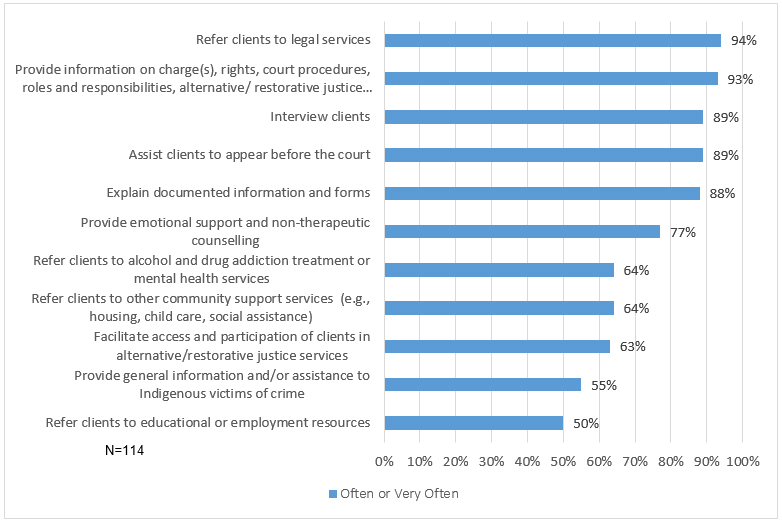
As indicated in the following chart, Courtworkers reported delivering a wide range of services and information that clients may need. Ninety-four percent of Courtworkers indicated that they often or very often refer clients to legal services, while 93% indicated that they often or very often provide clients with information on charge(s), rights, court procedures, roles and responsibilities, alternative and restorative justice options, and sentencing. Other services that are often delivered include interviewing clients, assisting them to appear before the court, and explaining documentation and forms.
Chart 1: Percent of Courtworkers who Indicate that they Often or Very Often Provided Various Types of Services
Question: Using a scale of 1 to 5, where 1 is rarely, 3 is sometimes and 5 is very often, how often do you provide the following services?
Text version – Chart 1: Percent of Courtworkers who Indicate that they Often or Very Often Provided Various Types of Services
The survey of courtworkers (2017) asks the question: “Using a scale of 1 to 5, where 1 is rarely, 3 is sometimes and 5 is very often, how often do you provide the following services?” A total of 114 respondents indicated the following average responses for often or very often:
- Refer clients to legal services (94%)
- Provide information on charge(s), rights, court procedures, roles and responsibilities, alternative/restorative justice (93%)
- Interview Clients (89%)
- Assist clients to appear before the court (89%)
- Explain documented info and forms (88%)
- Provide emotional support and non-therapeutic counselling (77%)
- Refer clients to alcohol and drug addiction treatment or mental health services (64%)
- Refer clients to other community support services (e.g. housing, child care, social assistance) (64%)
- Facilitate access and participation of clients in alternative/restorative justice services (63%)
- Provide general information and or assistance to Indigenous victims of crime (55%)
- Refer Clients to educational or employment resources (50%)
Source: Survey of Courtworkers (2017)
The evaluation did not find significant differences between men and women in terms of the types of in-court and out-of-court services, information or referrals provided by Courtworkers or required by clients. However, about one-third of Courtworkers noted that there are differences by gender in the types of charges and circumstances leading to charges which impact the type of community supports and programming needed. In addition, they noted that there are fewer programs available for women dealing with anger management and a lack of programs targeting domestic violence. Men also tend to have less access to housing programs, Indigenous-focused parenting support, and programs to deal with emotional and mental health issues.
Program and survey data confirms some of these differences. For example, data shows that adult men were more likely to report having previous convictions (65% for men versus 46% for women - there was no difference by gender among youth). The men surveyed were more likely to report needing help with connecting to community services or dealing with physical, mental and psychological issues (32% of women surveyed said they did not need help connecting with the community resources as compared to 22% of men; 38% of women said they did not need help dealing with physical and mental health issues as compared to 28% of men). In the interviews, women and men were equally likely to talk about alcohol and drug addictions that led to their charges; however, more women talked about relationship challenges with their partner and were nearly three times more likely to report having accessed community programs such as counseling, alcohol and drug treatment programs than men.
Some differences were also noted amongst other sub-groups of clients including:
- Clients with complex needs including people who are homeless or have challenges related to FASD, addiction and mental health issues tend to require more time and more extensive out-of-court services (e.g., wrap-around services; assistance in navigating through various social and human services and programs). During the case studies, Courtworkers spoke of the effort required to work with clients who do not have a permanent address, particularly the time required to locate and follow up with clients and provide them with transportation to court. There is also a need to collaborate extensively with community services to communicate client needs and circumstances, as well as the urgency of their situations. Some clients, such as FASD clients, may not receive the assistance they need partially because Courtworkers may not be trained to recognize or understand the underlying behavioral and mental health issues. In addition, there are long waiting lists for FASD assessments, and there may be a lack of FASD specific supports and programming in the community.
- Youth who require a case management approach (working closely with youth caseworkers) and the longer time to assess needs, gain trust, and link youth with culturally appropriate supports and resources. Courtworkers interviewed noted that, for youth in foster care, the Courtworker may be the first connection that youth have with their culture or Indigenous ancestry. In such cases, the Courtworkers not only assist them through the court process but also help them reengage with their culture.
- Repeat offenders and those who plead guilty may require more extensive support in areas such as developing healing plans, collecting information and/or writing Gladue reports, and working with the community to link them with appropriate diversion programs and restorative justice. A high percentage of these clients previously received services from the ICW Program (65% of clients served in 2014-15 and 79% served in 2015-16 were repeat clients). Footnote 26
Both Courtworkers and justice officials noted that there is a need for more wrap-around services, particularly for ICW clients with complex needs, and repeat offenders who are more likely to be challenged by underlying social issues such as poverty, addictions and mental health.
Most justice and court officials (71%) and key informants (86%) reported that the ICW Program has been successful or very successful in meeting the needs of ICW clients. Those who noted the Program was somewhat successful identified two main factors as constraining the success, including high staff turnover and geographic reach. Services are not available in all communities, particularly outside major urban areas, or for all Indigenous people in need of assistance. While there are some regional differences with respect to the Program reach, most regions reported gaps in providing full coverage of their courts. The gaps were attributed to resources constraints, the high demand for services, the need for travel, and underserved or unserved rural communities. About a quarter of judicial and court officials suggested that the ICW Program should do more to ensure adequate and consistent coverage for all courts.
The large majority of key informants identified an unmet need for support related to family justice matters (91%), Gladue information (94%) and specialized courts (89%). Courtworkers (10%) also reported gaps in addressing the family court needs, as well as engaging youth and building trust in the justice system.
To explore innovative approaches in addressing some of the emerging needs and gaps in programming, key informants talked about utilizing the Project Fund resources. Yellowhead Tribal Community Corrections Society in Alberta recognized the need to better support Indigenous clients with complex needs and developed Kind Heart Services, a project funded in part through the ICW Project Fund, to provide mentoring to individuals who have been positively assessed for FASD. Other examples of pilot programs designed to address gaps in services include the Indigenous Youth Engagement with Bench and Bar in Ontario project, and the Bridging the Gap for Restorative Understanding project in Saskatchewan.
4.1.2. Alignment with Government Priorities, Roles and Responsibilities
The ICW Program is well aligned with the priorities of the federal government, as well as the priorities and core responsibilities of the Department of Justice, as evidenced by increased level of funding and the Government of Canada’s focus on renewed relationship with Indigenous communities.
Increasing the use of restorative justice processes and other initiatives as a means to reduce the rate of incarceration among Indigenous Canadians is a priority for the federal government (identified in the Minister of Justice and Attorney General of Canada Mandate Letter, 2015). The recent increase of $4 million per year in the budget for the ICW Program, introduced in Budget 2016, illustrates that the ICW Program is considered a priority for the federal government. In the 2016-17 Report on Plans and Priorities, the Department of Justice outlined key supporting initiatives related to renewing the relationship with Indigenous people. These initiatives include addressing gaps in services for Indigenous people throughout the criminal justice system and developing and implementing a strategy for the reconciliation framework informed by the Calls to Action of the Truth and Reconciliation Commission (TRC) of Canada’s Final Report.
All federal government representatives surveyed (n=6) agreed that the ICW Program is consistent with the federal government’s commitment to implement the Calls to Action from the TRC, including eliminating overrepresentation of Indigenous adults and youth in the justice system, as well as focus on youth and other vulnerable groups, such as those with mental health disabilities.
The objectives of the ICW Program are consistent with the Department of Justice’s strategic outcome of ensuring “a fair, relevant and accessible justice system”. Achievement of this outcome is a shared responsibility between federal, provincial, territorial and municipal partners and a broad range of stakeholders across Canada. In fulfilling its responsibility, the federal government provides funding for the delivery of programs such as the ICW Program. Provincial governments have a responsibility for the administration of justice and co-fund the justice program in their respective provinces.
4.2. Achievement of Expected Outcomes
As previously highlighted, the needs and challenges of Indigenous people involved with the justice system are numerous, diverse and complex. The ICW Program is addressing some of these challenges by providing culturally relevant information to clients, informing justice and court officials of the circumstances of their client, facilitating communication, and serving as a link to community services. As a front-line service, the ICW Program plays an important role in achieving the overall objective of making the criminal justice system fair, just and culturally relevant; however, its impact depends on the availability and effectiveness of other community programs and the attitudes of those working in the justice system.
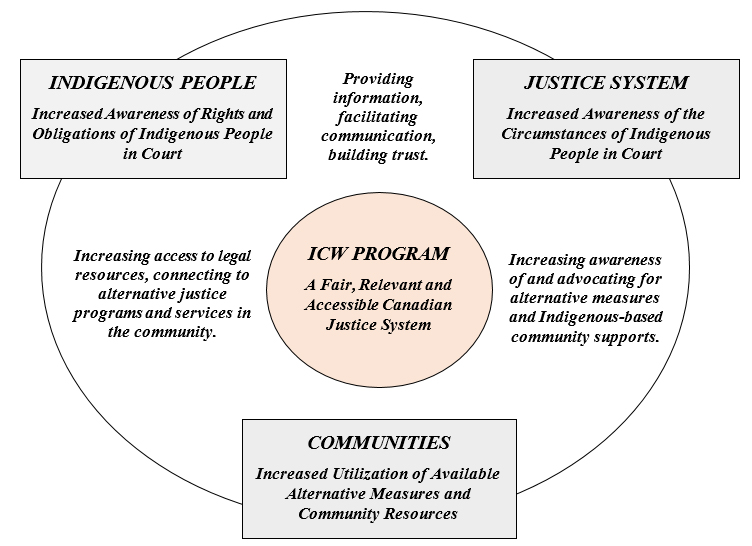
The following chart provides visual representation of the ICW structure and linkages it makes between the clients, court system and the communities. The evaluation findings related to the impacts the ICW Program has in each area are also presented in the chart.
Figure 1 : Impacts of Indigenous Courtwork Program Services on Clients, the Justice System and Communities
Text version – Figure 1 : Impacts of Indigenous Courtwork Program Services on Clients, the Justice System and Communities
The Figure is a circular shape with a circle in the centre stating “ICW Program - A Fair, Relevant and Accessible Canadian Justice System.” On either side of the centre circle from left to right is the text “Increasing access to legal resources, connecting to alternative justice programs and services in the community” and “Increasing awareness of and advocating for alternative measures and Indigenous based community supports.” Starting at the top left there is a square box with the text “Indigenous People - Increased Awareness of Rights and Obligations of Indigenous People in Court”. To the right of the box, in the centre, is the text “Providing information, facilitating communication, building trust.” To the right of this text is another box “Justice System - Increased Awareness of the Circumstances of Indigenous People in Court”. At the bottom-centre is the text “Communities - Increased Utilization of Available Alternative Measures and Community Resource.”
Increased Awareness of Rights and Obligations of Indigenous People in Court
The information and assistance provided to clients by Courtworkers increased awareness of their rights and obligations. ICW clients reported receiving a range of information which they generally found helpful in understanding the meaning of the plea, their charges, court procedures, and what lawyers and judges said to them. As a result, clients gained more confidence in the system and were better able to make informed decisions about their options. While nearly all clients reported satisfaction with the information received, 50% suggested that it would have been more useful to talk to Courtworkers as soon as they were arrested and charged.
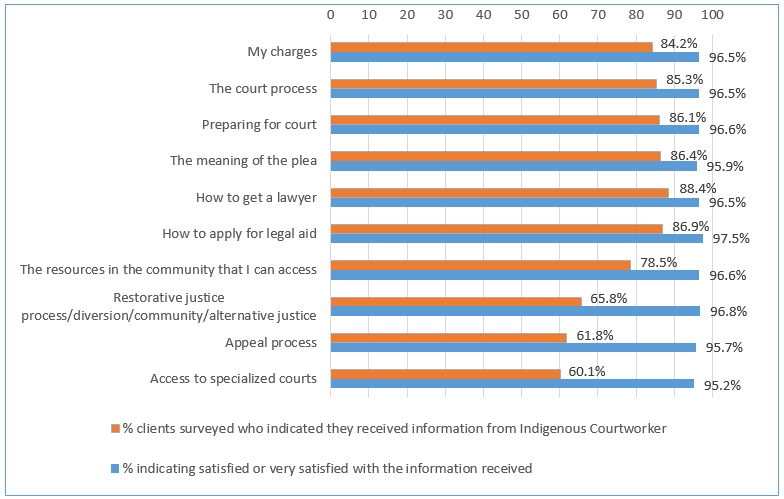
As illustrated in Chart 2, clients reported receiving information on a variety of topics depending on their case and needs, and were satisfied or very satisfied with the specific information they received from the Courtworkers. Clients surveyed most commonly reported receiving information from the Courtworkers about how to get a lawyer (88.4%), the meaning of the plea (86.4%), preparing for court (86.1%), the court process (85.3%), and their charges (84.2%). Clients also reported receiving information about resources in the community (78.5%), the restorative justice process (65.8%), the appeal process (61.8%), and specialized courts (60.10%).
Chart 2: Satisfaction of Indigenous Courtwork Program Clients with the Information Provided by Courtworkers
Question: Tell us about the information you received from the Indigenous Courtworker (If so, how satisfied were you with the information you received?)
Text version – Chart 2: Satisfaction of Indigenous Courtwork Program Clients with the Information Provided by Courtworkers
The ICW Client Survey asked the question “Tell us about the information you received from the Indigenous Courtworker (If so, how satisfied were you with the information you received?)” Chart 2 shows data for both “% of clients surveyed who indicated they received information from Indigenous Courtworker” and “% indicating satisfied or very satisfied with the information received ”. Respondents had the following average responses to this question:
- My charges (Received information 84.2%; Satisfied or very satisfied 96.5%)
- The court process (Received information 85.3%; Satisfied or very satisfied 96.5%)
- Preparing for court (Received information 86.1%; Satisfied or very satisfied 96.6%)
- The meaning of the plea (Received information 86.4%; Satisfied or very satisfied 95.9%)
- How to get a lawyer (Received information 88.4%; Satisfied or very satisfied 96.5%)
- How to apply for legal aid (Received information 86.9%; Satisfied or very satisfied 97.5%)
- The resources in the community that I can access (Received information 78.5%; Satisfied or very satisfied 96.6%)
- Restorative justice process / diversion / community / alternative Justice (Received information 65.8%; Satisfied or very satisfied 96.8%)
- Appeal process (Received information 61.8%; Satisfied or very satisfied 95.7%)
- Access to specialized courts (Received information 60.1%; Satisfied or very satisfied 95.2%)
Source: ICW Client Survey (2017)
The information and assistance provided by Courtworkers are perceived by clients, justice and court officials, as well as Courtworkers as impacting clients’ understanding of their rights and obligations and making informed decisions about their case. For example:
- 93% of justice and court officials and 95% of Courtworkers reported some impact or major impact on making ICW clients aware of their rights and obligations. As shown in Chart 3 below, over 90% of clients surveyed and about 75% of clients interviewed reported that the information and other assistance received helped them better understand their rights and obligations (e.g., understand the meaning of the plea, how to get a lawyer or legal aid, etc.).
- 91% of justice and court officials and 96% of Courtworkers reported the ICW Program had some impact or a major impact in helping ICW clients make informed decisions with respect to their circumstances before the courts. Over three quarters of ICW clients (78.7%) indicated the services helped them better understand the meaning of the plea (a few clients said that they would have pled guilty without a Courtworker), and getting a lawyer (legal aid) (70.4%). Some clients mentioned that without a Courtworker’s help, they would not have known what to do or where to go.
- 90% of justice and court officials and 97% of Courtworkers reported some impact or a major impact in terms of improving communication between ICW clients and persons involved in the administration of the criminal justice system. Most clients surveyed (81%) reported that Courtworkers helped them understand what the lawyer and the judge said about their case (bail, sentencing, conditions).
- 82% of justice and court officials and 93% of Courtworkers reported some impact or major impact on helping ICW Program clients make informed decisions about pursuing alternative measures, such as Indigenous therapeutic court/specialized courts, or restorative justice.
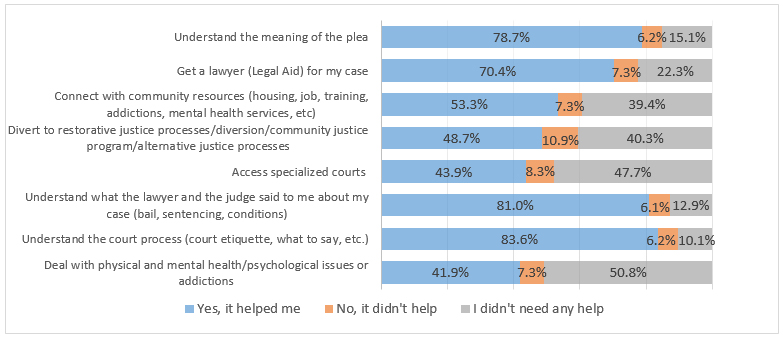
As indicated below, 83.6% of clients indicated that information provided by the Courtworker helped them to understand the court process, 81% said it helped them to understand what the lawyer and the judge said to them about their case, 78.7% indicated that it helped them to understand the meaning of the plea, and 70.4% indicated it helped them get a lawyer.
Chart 3 : Client Perceptions of the Helpfulness of the Information Received from Courtworkers
Question: The information I received from the Courtworker helped me to…
Text version – Chart 3 : Client Perceptions of the Helpfulness of the Information Received from Courtworkers
Respondents to the ICW Client Survey were asked the question “The information I received from the Courtworker helped me to…” The average responses to this question were as follows:
- Understand the meaning of the plea - yes, it helped me (78.7%); no, it didn’t help (6.2%); I didn’t need any help (15.1%)
- Get a lawyer (legal aid) for my case - yes, it helped me (70.4%); no, it didn’t help (7.3%); I didn’t need any help (22.3%)
- Connect with community resources (housing, job training, addictions, mental health services, etc.) - yes, it helped me (55.3%); no, it didn’t help (7.3%); I didn’t need any help (22.3%)
- Divert to restorative Justice Canada access specialized courts - yes, it helped me (48.7%); no, it didn’t help (10.9%); I didn’t need any help (40.3%)
- Access specialized courts - yes, it helped me (43.9%); no, it didn’t help (8.3%); I didn’t need any help (47.7%)
- Understand what the lawyer and the judge said to me about my case (bail, sentencing, conditions) - yes, it helped me (81%); no, it didn’t help (6.1%); I didn’t need any help (12.9%)
- Understand the court process (court etiquette, what to say etc) - yes, it helped me (83.6%); no, it didn’t help (6.2%); I didn’t need any help (10.1%)
- Deal with physical and mental health / psychological issues or addictions - yes, it helped me (41.9%); no, it didn’t help (7.3%); I didn’t need any help (50.8%)
Source: ICW Client Survey (2017)
Half of the clients surveyed (50%) reported that it would have been most helpful to talk to a Courtworker as soon as the police arrested and charged them, rather than speak with one for the first time during a court appearance. During the case studies, some participants also noted that the services have been very successful in helping Indigenous people once they were charged; however, little assistance is available during the pre-charge stage, bail negotiation and in remand. Some clients surveyed (9%) reported it would be useful to have increased visibility of Courtworkers in the communities (e.g., increase participation in community meetings, outreach activities, presentations).
Recognizing the need for early intervention, an Indigenous Bail Worker position was created by Yellowhead Tribal Community Corrections Society in Edmonton and by Native Counselling Services in Calgary through the cost-sharing agreement. The Bail Workers assist Indigenous people in Remand Centres and help to create a bail plan (e.g., interview clients to identify their needs, identify Gladue factors, and help legal counsel find available community supports and programs). It is too early to assess the effectiveness of this position. Further discussions and sharing of best practices and learnings could be done via the TWG.
Increased Awareness of the Circumstances of Indigenous People in Court
The information provided to justice and court officials by the Courtworkers increased their understanding of the circumstances of the Indigenous accused persons before the court as well as the implications of cultural and historical considerations. By doing so, the Courtworkers contribute to ensuring that Gladue Principles are implemented in the decision making.
Eighty percent of justice and court officials and 94% of Courtworkers indicated that information provided helped those working in the justice system be more informed about the circumstances of the Indigenous accused, including family, employment and economic situation, housing, health issues, and education. Furthermore, 79% of justice and court officials and 95% of Courtworkers indicated that information provided by Courtworkers helped those working in the justice system be better informed about cultural and historical considerations such as the impacts of residential schools and childhood traumas. Some justice officials also highlighted the importance of Courtworkers providing information about Indigenous persons before the court and their circumstances, particularly in the regions where there is limited access to Gladue writers. In rural and remote communities, Courtworkers also often provide interpretation services.
On a scale of 1 to 5, where 1 is not at all, 3 is to some extent and 5 is to a great extent, to what extent has the ICW Program helped to inform Justice and court officials about: |
% Providing Rating of 3 or More |
|
|---|---|---|
Justice and Court Officials |
Courtworkers |
|
The circumstance of the ICW clients as they pertain to the decision-making process in court (e.g., information concerning bail, sentencing, etc.) |
80% |
94% |
Cultural and historical consideration and social issues (i.e., residential schools) when dealing with or sentencing Indigenous accused |
79% |
95% |
Source: Justice and Court Officials Survey (2017); Courtworker Survey (2017)
The justice officials who were less likely to say Courtworkers provide them with the information about the accused, generally noted that the Courtworkers do not always have time to fully understand their clients’ backgrounds and communities before presenting to the court; in addition, they may act as an advocate for a client rather than providing factual information about their clients’ circumstances.
Some justice and court representatives (n=10) noted that they are generally aware of the historical injustices and implications for the Indigenous accused, and they see less of a priority for a program in that area. The majority believe that the most important and valuable role of the Courtworker is helping judicial and court officials understand the personal story of the Indigenous person standing in front of them. During one case study, a few justice and court officials talked about realizing that some accused never had an opportunity to tell their stories or even consider how the events from their past impacted their behavior. About half of all justice and court officials surveyed noted that Courtworkers are very effective in interviewing their clients and gathering important and relevant information because they are more likely to understand (linguistically and culturally) the experiences of Indigenous people and build trust with clients. A few Courtworkers interviewed as part of the case studies talked about how their clients are proud people regardless of what they may be facing, and may not want to talk in court or with the defense counsel about their situations. They are much more likely to talk to an Indigenous person, especially if the Courtworker can speak their language. In some cases, particularly with youth, it can take a long time to build trust, conduct appropriate needs assessment and gather all the necessary information.
Increased Utilization of Available Alternative Measures and Community Resources
The ICW Program has increased the use of alternative measures and community resources. Linking ICW clients to appropriate services has become an increasingly important part of the Courtworkers’ role, given the greater focus on restorative justice and recognition of complex needs of those struggling with mental health and addiction issues. Limited availability of the community programs, and limited time and resources combined with competing priorities, are constraining the development of a more integrated and collaborative approach.
Over 80% of justice and court officials and over 90% of Courtworkers reported that the ICW Program helps (at least to some extent) inform justice and court officials about the availability and capacity of restorative justice programs and services, and other resources in the community.
On a scale of 1 to 5, where 1 is not at all, 3 is to some extent and 5 is to a great extent, to what extent has the ICW Program helped to inform Justice and court officials about: |
% Providing Rating of 3 or More |
|
|---|---|---|
Justice and Court Officials |
Courtworkers |
|
Legal and community/social resources available in the community |
86% |
94% |
The capacity of alternative/restorative justice programs and services available in the community |
82% |
95% |
Source: Justice and Court Officials Survey (2017); Courtworker Survey (2017)
Justice and court representatives surveyed praised the knowledge and up-to-date information that Courtworkers present about available services. Courtworkers provide information on what services and support are available, when they are available, why they are appropriate for the client, and how the client will be supervised to ensure participation. The information is then used by the judge or Crown prosecutor to recommend those services. A few prosecutors provided examples from the court where a judge would ask a Courtworker for specific information about the community, Elders, existing support, transportation options and living situations of the accused before providing approval for a particular program or community service. In some urban centers, Courtworkers have catalogued the existing resources. One court official talked about an Indigenous person who was approved for a restorative justice program based on information the Courtworker provided, and efforts to bring different parties together to make the process work in a way that would significantly benefit the client.
Clients received referrals that are specific to their needs.Footnote 27 The most common referrals were to legal resources (reported by 56% of clients), followed by treatment and community resources (21%), restorative justice processes (16%), and specialized courts (12%). About 55% of clients surveyed reported that they had legal representation (lawyer) to help them with the case. Of those who applied for legal aid (62%), about 70% were granted the service. In some cases, the availability of such resources (e.g., limited availability, long waiting lists, or limited access in terms of distance, appropriateness, etc.) impacts the level of referrals, or whether clients follow through and access the resources. Courtworkers interviewed during case studies noted that for clients with complex needs (addictions, mental health, FASD, housing), having timely access to the resources is key. In one case study, Courtworkers and stakeholders spoke about a small window of opportunity to get clients into treatment programs when they are ready to make a change. If the resources are not available or accessible, the opportunity may be lost.
The extent to which the ICW Program has increased use of such services is linked to the strength of the relationships and partnerships developed between the Courtworkers and the communities they serve. The majority of SDAs and provincial representatives surveyed (80%) reported that the ICW Program has been successful or somewhat successful in building linkages and partnerships with other justice and human organizations and services. They noted that key partnerships have been established with legal services and other agencies that provide services to Indigenous people. These partnerships have been developed through networking and provincial efforts to establish interagency committees and working groups. Most of the success was attributed to the Courtworkers who have developed good working relationships with service providers in the community.
An increased focus on Gladue, Ipeelee and Ladue Supreme Court of Canada Decisions, as well as the release of the TRC Report, has resulted in a greater recognition of the importance of restorative justice and diversion programs, and greater community involvement in supporting Indigenous accused and the victims. According to some key informants and Courtworkers, this has impacted the role of the Courtworkers with respect to the increased need for their involvement in the communities, building partnerships and working with their clients to ensure their access to community services.
Courtworkers surveyed (90%) reported that they have developed linkages or partnerships with other justice and social services organizations or services in their communities, including youth services, health services (mental health, drug and alcohol counselling services, etc.), social services (housing, employment services), other specific government programs and services (family and children services, victim and witness assistance programs), legal services (police departments, Crown prosecutors) and First Nations specific services (Indigenous businesses, First Nations wellness programs).
In some regions, the focus has been on establishing strong partnerships with youth services, linking youth to Indigenous youth workers, and reengaging them with their cultures and communities. For example, in Nanaimo, British Columbia, Courtworkers refer the youth they work with to Changing Directions for Youth Program. The Indigenous Youth Support worker then works to assess the risk factors and, together with the youth, creates an action plan to minimize or possibly eliminate future involvement in criminal activity.
In Ontario, a pilot project was implemented to support youth in group homes, most of whom come from northern communities, by engaging them in a series of workshops and training activities, and providing them with an opportunity to teach local justice and court officials about cultural teachings, ceremonies and challenges they face. The project is a collaborative effort between the Courtworker, the Gladue Case Manager, the Youth Justice Worker, and the Adult and Youth Restorative Justice Worker. A few justice officials interviewed during the case study highlighted the need to engage youth in a meaningful way and have youth voices heard in the court. An example was provided of a youth who rapped his story in court. Again, the trajectory from children in care to youth, and then to adult criminal court was highlighted as a concern.
Most representatives, key informants, justice officials and Courtworkers recognize a need to increase the level of collaboration and integration across various partners and programs. Courtworkers noted a need for greater outreach but added that limited time and resources, combined with the priority to serve clients in court, make it difficult to focus on building partnerships. On a broader level, the 2016 evaluation of the Indigenous Justice Program (IJP, formerly the Aboriginal Justice Strategy)Footnote 28 recommended increased and more effective collaboration horizontally within the Department, including the ICW Program, and with other governments. The ICW and IJP Collaborative Working Group was created to increase collaboration and improve coordination between the strategies and workers. It is too early to assess the impact.
ICW Program Contribution to a Fair, Just, Timely and Culturally Relevant Treatment before the Court
The ICW Program contributes to fair, just, timely and culturally relevant treatment of Indigenous people before the court by improving case outcomes related to bail and probation conditions, sentencing, breaches, use of diversion programs, and restorative justice. About two-thirds of ICW clients interviewed reported satisfaction with the outcomes of their case. The ICW Program has some impact with respect to the timeliness of the court process.
The percent of the individuals consulted who indicated that the ICW Program has been successful or very successful (a rating of 4 or 5) in helping Indigenous people receive fair, just and culturally relevant treatment ranged from 56% amongst justice and court officials to 79% amongst Courtworkers. The percent of the individuals who indicated that the Program has been successful or very successful in helping Indigenous people receive timely treatment ranged from 46% amongst justice and court officials to 65% amongst Courtworkers.
In your opinion, to what extent has the Program been successful in helping Indigenous people (on a scale of 1 to 5, where 1 is not all, 3 is somewhat, and 5 is to a great extent): |
% Providing Success Rating of 4 or More |
||
|---|---|---|---|
Justice and Court Officials |
Key Informants |
Court workers |
|
Receive fair, just and culturally relevant treatment? |
56% |
74% |
79% |
Receive timely treatment before the court? |
46% |
54% |
65% |
Number of Respondents |
120 |
35 |
114 |
Source: Justice and Court Officials Survey (2017); Key Informant Survey (2017); Courtworker Survey (2017)
In commenting on the success of the Program, some of the justice and court officials, key informants and Courtworkers noted:
- Successful rates in terms of the completion of diversion programs and restorative justice initiatives. In two case studies, stakeholders interviewed spoke of a high success rate in the restorative justice process. The stakeholders interviewed estimated 80% success rates for adults and noted that, over the past eight years, only a few youth had not completed diversion programs. It was suggested that programs which are grounded in culture and involve the community tend to have much higher success rates.
- Improved outcomes for ICW clients through the increased use of specialized courts, diversion programs and restorative justice. Some stakeholders noted that diversion of the Indigenous clients, and particularly ICW clients with complex needs, to specialized courts has resulted in more appropriate outcomes for these clients (e.g., reduced sentences, increased community involvement). As illustrated in the following table, Statistics Canada data shows that Indigenous custodial admissions to provincial and territorial correctional services in 2015-16 were 20% lower for adults and 47% lower for youth when compared to the levels in 2011-12.Footnote 29
Aboriginal Identity |
Years |
Percentage difference in 2015-16 compared to 2011-12 |
||||
|---|---|---|---|---|---|---|
2011-12 |
2012-13 |
2013-14 |
2014-15 |
2015-16 |
||
Adults |
66,819 |
52,011 |
51,668 |
51,463 |
53,450 |
20% |
Youth |
10,578 |
7,667 |
6,853 |
5,714 |
5,642 |
47% |
Source: Statistics Canada, CANSIM table 251-0022 (Indigenous Adult Custodial Admissions); 251-0012 (Indigenous Youth Custodial Admissions).
- Impact on bail and probation conditions (e.g., Courtworkers would help clients secure the surety for bail). Justice officials noted that they would avoid putting in probation conditions if they know that the ICW clients cannot follow them, such as avoiding conditions requiring they abstain from alcohol and drugs if the ICW client has addiction issues. About a third of justice officials talked about the impact Courtworkers have in ensuring fair sentencing by providing information about their clients and suggesting alternative options.
- Reduced breaches. Justice officials noted that Courtworkers reduce breaches and issuance of warrants by monitoring their clients’ compliance with court conditions, locating their clients, helping them with transportation, and appearing in court on their behalf. ICW Program performance data shows that there has been a drop in the administration of justice offences from 33% in 2012-13 to 25% in 2015-16.
- Bridging the justice system and the Indigenous community and increasing trust and confidence of ICW clients in the processes. Nearly half of justice officials (46%) and Courtworkers (47%) and most representatives interviewed during the case studies discussed the importance of building trust between the justice system, the Indigenous peoples before the court and the communities. When justice and court officials trust that the Indigenous peoples will participate in the community programs, and when communities are equipped to work with the accused (programs are available, supervision), or accept the individuals back into their communities, they feel more comfortable to divert them from the justice system. Conversely, when ICW clients trust that the court process will be fair and they are represented, they will be more likely to engage and follow through with the court conditions.
Most clients interviewed (56%) reported that they were satisfied with the outcome of the case, and 61% reported that the outcome was both fair and timely. Most clients also believed that their outcomes would have turned out differently without the help from the Courtworkers. For example, one client described facing jail time for at least a year, but instead he was given a conditional sentence and was able to develop a better relationship with his probation officer. The majority of clients surveyed (89%) said they would recommend Courtworker services to other Indigenous people.
The ICW is perceived as contributing somewhat to the timeliness of court processes by locating their clients, ensuring they have transportation, providing information about their clients in the court, and reducing failure to appear or breach charges. For example, one court official talked about Courtworkers who were able to assist in finding families and their clients and maintain the contact after the community was evacuated because of floods, and to help reduce issuance of warrants and breaches. However, some justice officials noted that Courtworkers are more likely to increase the time it takes for a case with frequent requests for adjournment.
Factors Contributing to ICW Program Success and Best Practices
A variety of key factors and best practices were identified in case studies and by ICW clients, judicial officers and other key informants as contributing to the success of the ICW Program. These included:
- The knowledge, passion and dedication of Courtworkers. These qualities are exemplified in the ability of Courtworkers to connect with clients, build trust, understand trauma, and speak to the sentence and Gladue Principles in court. Most justice officials and some key informants noted the importance of supporting Courtworkers by ensuring they have access to effective training, as well as care to help them deal with vicarious trauma.
- The credibility of the ICW Program and recognized value of Courtworker services. Maintaining credibility is, in part, dependent on being able to deliver a consistent level of quality service. Some key informants suggested that the long-term goal should be for Courtworkers to become Gladue experts and take on a more prominent role in speaking to sentences.
- Increased focus on and recognition of the importance of restorative justice and diversion programs, and community involvement in supporting the accused and victims.
- The ability to support clients with complex needs through strategies such as providing wrap-around services, case management services (navigators), and access to specialized courts such as community court, drug treatment court, and mental health court.
- The level of collaboration and partnering with community resources. Courtworkers can work closely with the IJP and other community programming to identify gaps and capacity issues, share information and best practices, and deliver services to the client.
The availability of the Project Fund to develop and test innovative approaches to deliver services. Project proponents highlighted the importance of the resources that allowed them to pilot and test initiatives that identify and address specific needs in their communities.
4.3. Efficiency of Design and Delivery
4.3.1. Use of the ICW Program Resources
The ICW Program has had to operate very efficiently given resource constraints. Prior to the recent budget increase, the Program made close to full use of the funds available. Efficiency benefited from the leveraging of provincial/territorial government funding, the emphasis on funding frontline delivery, low overhead costs, and the decentralized nature of the delivery model which enables services to be tailored to local needs.
Financial data indicates that most of the available budget was fully utilized. The following table compares actual federal government expenditures to the budgeted allocation for the past three years, as well as program expenditures at the provincial level (i.e., funded by the federal and provincial governments) to the aggregate provincial budgets. Over the latest three fiscal years for which data is available, 92% of both the federal government budget and the aggregate provincial budgets (i.e., funded by both the federal and provincial governments) has been expended.
Year |
Federal Government |
Total Provincial BudgetsFootnote 30 |
||||
|---|---|---|---|---|---|---|
AuthorityTable note * |
Expenditures |
As % of Budget |
Budget |
Expenditures |
As % of Budget |
|
2013–14 |
$4,769,451 |
$4,769,451 |
100% |
$11,274,966 |
$10,608,473 |
94% |
2014–15 |
$4,906,970 |
$4,906, 970 |
100% |
$11,470,947 |
$10,404,089 |
91% |
2015-16 |
$4,765,751 |
$4,765, 751 |
100% |
$12,181,681 |
$11,225,296 |
92% |
Total |
$14,442,172 |
$14,442,172 |
100% |
$34,027,594 |
$32,237,858 |
92% |
Sources: Program Budget, Departmental Performance Reports (Federal Government Expenditures), Performance Measures National Roll-up (Provincial Budget and Expenditures), Justice Canada
Of the 35 key informants who were surveyed, 68% agreed that the available resources have been fully used (37% strongly agreed), while only 6% disagreed (none strongly). Although confirming that the budgets are normally fully utilized, key informants highlighted a few situations where a small percentage of the budget may not be fully utilized:
- Provincial governments may revise their budget or delay expenditures during the year, which impacts provincial expenditures and therefore the matching funding provided by the federal government.
- There may be delays in finalizing contribution agreements with SDAs, unplanned changes in SDA staffing or operations, or reductions in operating costs which reduce the amount claimed; and,
- There can be budgeting issues, such as difficulties in accurately forecasting the amount or timing of expenditures associated with the provincial programs.
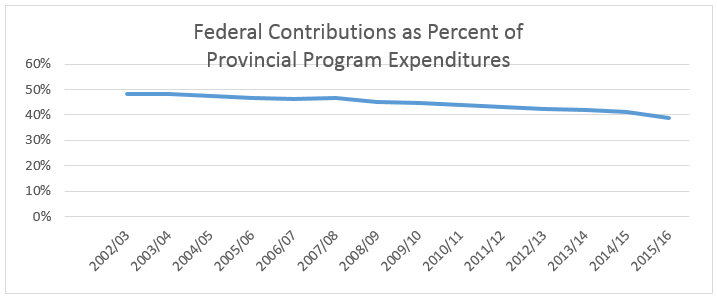
The additional funding, announced in Budget 2016, represented the first federal funding increase for the ICW Program since 2002-03.Footnote 31 While the federal government budget for the Program had not increased, many provincial governments did increase their aggregate allocations during this period. As a result, the federal government’s contribution, as a percentage of the total budget for the provincial programs, declined over time. The federal government’s contribution accounted for the 48% of the aggregate provincial program budgets in 2002-03 (i.e., there was $1.07 in provincial government funding budgeted for every budgeted dollar in federal government funding). As indicated in the chart below, the federal government allocation as a percent of the aggregate provincial program budgets declined to 46% in 2006-07 (i.e., $1.17 in provincial government funding per dollar of federal government funding), 44% in 2011-12 (i.e., $1.32 in provincial government funding), and under 40% in 2015-16 (i.e., $1.57 in provincial government funding budgeted for every dollar in federal government funding).
Chart 4: Federal ContributionsChart note ** as Percent of Provincial Program Expenditures
Text version – Chart 4: Federal Contributions as Percent of Provincial Program Expenditures
This chart tracks the federal government allocation as a percent of the aggregate provincial program budgets annually from 2002-2016. The chart demonstrates a declining trend during this period, from 48.45% in 2002-2003, to 44.95% in 2009-2010 and 38.95% in 2015-16.
Source: Performance Measures National Roll-up, Justice Canada
In 2015-16, federal government funding as a percent of the provincial budget varied widely across the regions, from a low of 32% in Saskatchewan to a high of 50% in Nova Scotia. The federal government allocation as a percent of the aggregate territorial program budgets declined from 28% in 2011-12 (i.e., $3.60 in territorial government funding for every dollar in federal government funding) to 20% in 2015-16 (i.e., $5.03 in territorial government funding budgeted for every dollar in federal government funding).
The following table summarizes performance data related to the total ICW program budget, federal government allocations, numbers of clients served and Courtworkers employed (part-time and full-time) in 2015-16.Footnote 32 As indicated, the 191 Courtworkers (177 full-time and 14 part-time) employed by the Program served 52,648 clients in 2015-16. On average, a Courtworker delivered services to nearly 300 clients with charges annually.Footnote 33 Based on the federal commitment of $5.425 million to the ten participating jurisdictions, the federal government cost of the ICW Program was equal to $103 per client with a charge and $28,403 per Courtworker.
Federal Budget and Costs |
2010-11 |
2015-16 |
|---|---|---|
Total Program Budget (both federal and provincial contributions, excluding territorial government contributions)Footnote 34 |
$11,259,041 |
$12,782,782 |
Federal contribution allocated to jurisdictionsTable note *** |
$5,425,000 |
$5,425,000 |
Percentage federal contribution |
48% |
42% |
Number of clients with a charge served |
58,788 |
52,648 |
Federal government cost per client |
$92.28 |
$103 |
Number of Courtworkers (full-time and part-time) |
183 |
191 |
Federal government cost per Courtworker |
$29,645 |
$28,403 |
ICW budget allocation |
|
|
Salary |
72% |
75% |
Other |
28% |
25% |
Source: Performance Measures National Roll-up, Justice Canada
Data from 2010-11 (at the time of the previous evaluation) is provided for comparison purposes. At that time, the cost of the ICW Program to the federal government in 2010-11 was equal to about $29,645 per Courtworker and $92.28 per client with a charge. As such, the federal government’s contribution per Courtworker decreased by about 4% from 2010-11 to 2015-16, while the average cost per client with a charge served increased by 11%. The increased cost per client is directly attributable to a change in how clients are defined, which resulted in a decrease in the number of clients reported annually (in 2012-13, the year the definition was changed, the reported number of clients with a charge declined by 15.6% even though the number of Courtworkers and presumably the workload remained virtually unchanged).
Average costs vary by jurisdiction, reflecting differences in the extent to which federal funding is leveraged with provincial/territorial funding, the balance between full-time and part-time Courtworkers, the size of the region served, demand for services and the range of services provided. Costs can also be impacted by the availability of other resources, alternative measures, and community programs which complement the ICW Program.
As indicated in Table 11, 75% of the overall Program budget was allocated to Courtworker salaries (a total of about $9.6 million in salaries). Other expenses included administration (17%), travel (7%) and training (1%). The percentage of the overall program budget allocated to Courtworker salaries has increased somewhat from 72% to 75% since the last evaluation. The Courtworker salary cost of $9.6 million is equal to an average of about $52,000 per FTE Courtworker.
The total number of people employed by the ICW Program has increased over time, in large part because of the increased expenditures made by the provincial governments. As indicated in Table 12, the number of FTE workers involved in the ICW Program at the provincial and territorial levels has increased from 212 in 2011-12 (of whom 182 FTEs were Courtworkers) to 220 in 2015-16 (of whom 184 were Courtworkers).
| Years | Courtworkers |
Others (FTEs) |
FTEs |
|||
|---|---|---|---|---|---|---|
Full-time |
Part-time |
FTEs |
Managers |
Support |
||
2011-12 |
175 |
14 |
182 |
14.5 |
15.5 |
212 |
2012-13 |
172 |
19 |
181.5 |
17.5 |
14 |
213 |
2013-14 |
177 |
12 |
183 |
26 |
11.5 |
220.5 |
2014-15 |
179 |
15 |
186.5 |
20 |
10.5 |
217 |
2015-16 |
177 |
14 |
184 |
23 |
13 |
220 |
Source: Performance Measures National Roll-up, Justice Canada
Twenty of the 35 key informants surveyed agreed that most efficient means are being used to achieve the intended ICW Program outcomes. It was noted that the Program had to be very efficient because of the budget limitations. Some of the factors identified as contributing to the efficiency of the Program include:
- Program resources are focused on the frontline staff (Courtworker salaries account for 75% of the Program budget). The success of the Program is driven by the expertise, skills and determination of the Courtworkers and the relationships they develop over time with clients, court officials, communities and other programs and resources.
- The Project Fund has improved access to training and networking opportunities for Courtworkers. Standardized training resources and programs have been developed. Online resources have been developed which can be accessed where and when needed.
- The use of a decentralized network of delivery agencies and Courtworkers, working largely independently, enables services to be tailored to the needs of the clients and the characteristics of the local operating environment.
- Federal government program overhead costs are low. Within the Department of Justice, the ICW Program is delivered with a complement of two FTEs (one full-time Manager, Program/Policy, a part-time Policy Analyst, and a part-time Financial Analyst). Salaries, benefits and operating and maintenance costs associated with administering the ICW Program (which are not paid out of the ICW Program budget) totaled $236,050 in 2016-17, which is equivalent to only 2.5% of the increased ICW Program budget (down from 3.5% at the time of the last evaluation).
According to key informants, ICW Program efficiency has also benefited from the further development of connections between Courtworkers and Crown counsel, correctional officers, court officials and judges, as well as improvements in the reporting process such as improved data collection tools and streamlined reporting documents. In addition, key informants highlighted the efforts made to demonstrate how the Program supports the mandate of the federal government and provincial governments, which have contributed to the decision to increase the budget and have increased collaboration through the TWG (discussed in Section 4.3.5) and further capacity building within SDAs. The Project Fund (discussed in Section 4.3.4) has also benefited the ICW Program by creating opportunities to develop regional initiatives or pilot projects which test innovative approaches to service delivery. The national Strategic Plan has identified some areas for the future direction of the Program.
4.3.2. Adequacy of the Program Resources
The federal contribution to the ICW Program budget was recently increased from $5.5 million to $9.5 million to address program integrity pressures identified in the 2013 evaluation. Resource constraints were impacting the ability of the ICW Program to meet the demand for existing services, respond to increasing pressures from judicial and court officials, clients and communities to expand the range or extent of services, recruit and retain staff, and provide training and other support to Courtworkers.
Fiscal year 2016-17 was the first year of the implementation of the increased federal contribution, and at the time of this evaluation there was not sufficient data available to assess the impact. There are mixed opinions amongst stakeholders as to whether the ICW Program (even after the recent budget increase) has the resources it needs to achieve its objectives.
The federal government increased its contribution for the ICW Program, resulting in a $4.0 million increase to the Program budget in 2016-17, from $5.5 million to $9.5 million. Amendments were made to the existing five-year contribution agreements (2013-2018) with the provinces to reflect the additional funding for fiscal years 2016-17 and 2017-18. Amendments were also made to the Access to Justice Agreements in the territories.
The ICW Program budget is directed towards three funding streams:
-
Funding for each of the participating provinces. After the budget increase, the maximum federal contribution to participating provinces for ICW services in a fiscal year totals approximately $7.7 million (up from $4.8 million prior to the increase).
The ICW Program currently operates in every province and territory with the exception of Prince Edward Island, New Brunswick, and Newfoundland and Labrador (which ceased participating in the ICW Program in 2012-13). The increased budget originally included a national allocation for the potential expansion of services to New Brunswick and Prince Edward Island. However, these provinces indicated that they were not ready to participate in 2016-17 and 2017-18. Prince Edward Island previously participated in the ICW Program, while New Brunswick has never participated.
The increased federal notional allocations to the other provinces reflect the needs of each jurisdiction, as well as their ability to absorb the additional allocation without exceeding the 50% maximum federal contribution provision contained in the Contribution Agreements.
-
Funding for the territorial governments. The aggregate maximum federal contribution to the three participating territories for the delivery of the ICW Program is approximately $1.5 million annually (up from $0.6 million prior to the increase).
-
Funding for the Tripartite Working Group . The base annual budget for the TWG has been maintained at $75,000. This funding is used for projects that support the mandate of the TWG. For 2016-17 and 2017-18, the notional budget for New Brunswick and Prince Edward Island (totaling $200,000) was reallocated to the Project Fund, bringing the total to $275,000. A description of use and impacts of the Project Fund is provided in Section 4.3.4.
The increase in the budget is intended to address ongoing ICW Program integrity pressures which were identified in the 2013 national evaluation. At a meeting of the FPT Working Group on the ICW Program in May 2016, an agreement was reached that “the new federal funding would be incremental and support addressing ICW Program integrity pressures including salaries, benefits, training, recruitment and retention pressures for Courtworkers and assist in meeting the demand for existing services (particularly in remote areas)”. The 2013 ICW Program evaluation found that resource constraints were impacting the ability of the ICW Program to meet the demand for existing services, respond to increasing pressures from judicial and court officials, clients and communities to expand the range or extent of services, recruit and retain staff, and provide training and other support to Courtworkers. Footnote 36
Prior to the increase, the Program Directors had characterized the ICW Program as being in a crisis, with low wages contributing to high turnover and major difficulties in attracting new staff. Furthermore, sufficient funding was not available to adequately train new Courtworkers when they were hired. It was also anticipated that the increased funding would help to address these issues as well as reduce the imbalance in funding that had developed between the federal and provincial governments. The additional funding focuses on criminal Courtwork services rather than being used to expand services beyond the criminal courts into other courts such as family.
It is anticipated that the additional budget will lead to a moderate increase in the number of Courtworkers, extend the geographic coverage of the ICW Program (as a result of increased staffing levels and funding for travel), increase the numbers of clients served, expand training, raise Courtworker wages, lead to a reduction in turnover, and enhance staff recruitment. However, there is not yet sufficient data available to assess the impact of the increase. Last year was a transition year for the ICW Program as the new funding began to work its way through the system from the federal government to the provincial governments and the SDAs. Furthermore, performance measurement and financial data are not yet available for fiscal year 2016-17 (provincial and territorial governments have until December 31 to report on ICW Program performance for the year ending March 31).
There are mixed opinions amongst the stakeholders (key informants, Courtworkers and justice officials) as to whether the ICW Program (even after the recent budget increase) has the resources it needs to achieve its objectives.
- Of the 35 key informants who were surveyed, 31% agreed (11% strongly) that the ICW Program has the resources it needs to achieve its objectives while 60% disagreed (26% strongly).
- Of the 120 justice officials who were surveyed, only 8% perceive that the ICW Program has the resources it needs to be successful, 50% indicated that the Program is under-resourced and 42% felt that they were not in a position to comment.
- Of the 114 Courtworkers who were surveyed, 44% perceive that the ICW Program has the resources it needs to be successful, 38% indicated that the Program is under-resourced, and 16% felt that they were not in a position to comment or were of a mixed opinion.
When asked to comment on the adequacy of resources, stakeholders most commonly highlighted the need to increase the number of Courtworkers to facilitate accessibility to services within the communities served, broaden the geographic coverage to include more communities, and expand the range of services provided and courts served. It was also noted that additional resources are needed to raise awareness of the ICW Program, increase access to education and training, and strengthen relationships with justice offices as well as other programs and resources. A further discussion of the opportunities for improvement is provided in Section 4.3.7.
4.3.3. Changing Role of Courtworkers
The role of Courtworkers has continued to evolve and expand, which is viewed as enhancing the effectiveness of the ICW Program. The role varies across regions and over time as Courtworkers gain experience and confidence, become increasingly recognized and valued, and develop stronger linkages with other stakeholders. Courtworkers are also becoming more involved in the courts, delivering a wider range of services in various courts, serving increasing numbers of clients, and becoming more involved in networking, community engagement and promotion of the ICW Program and Gladue reports.
The role of Courtworkers varies across regions depending on the courts served, regional priorities, their level of experience and skills, the expectations of the court, and the programming environment. For example, some Courtworkers play a more active role than others in areas such as promoting and coordinating links to Indigenous community justice programs and providing detailed information on the life circumstances of their clients. In some jurisdictions, the Courtworker role has evolved to include family law services and the provision of services to specialized courts such as domestic violence and drug treatment courts.
The flexibility of the ICW Program, particularly the ability to tailor the services to the needs of clients, the capacity of the Courtworkers and the other resources available, is a frequently identified strength of the ICW Program. Over time, the role and range of services provided have tended to expand as the Courtworkers gain experience and confidence, face pressures to provide additional services, are increasingly recognized and valued by justice officials, and develop stronger linkages with the communities and other programming. The expanded role has enhanced the services provided, improved coordination across programming, and given the ICW Program more credibility. However, it has also placed greater pressure on the Courtworkers.
Of the 114 Courtworkers who were surveyed, 74 have worked as a Courtworker for three or more years. Of these 74 Courtworkers, 54% indicated that the role of a Courtworker has changed over the past few years, 32% indicated that the role has not changed, and 14% did not express an opinion. Those who noted that the role has changed most commonly indicated that Courtworkers have become more involved in:
- The court, particularly with respect to appearing with clients, providing information to court officials, being able to speak to the sentence, and serving in more of an advocacy role.
- A wider range of services. Cited examples included greater participation in sentencing circles, more follow-up with clients throughout their probation and community programming, provision of services to victims and of wrap-around services such as helping to find housing, mental health and addiction services.
- Additional or alternative courts such as Family Court, the First Nations Court, Gladue Court and Indigenous Youth Court; and,
- Networking, community engagement, promotion of the ICW Program, training delivery, and Gladue reports.
In addition, Courtworkers noted that the demand for services has also increased. These developments were generally viewed by Courtworkers as enhancing the ICW Program. The evolving role of Courtworkers has increased access to information about the circumstances of the accused before the court and led to better decisions and more meaningful sentences. In addition, it fostered a better understanding of the history of the Indigenous peoples amongst justice officials and the communities in general, facilitated more considered and consistent application of the Gladue Principles, empowered clients, and increased utilization of the community services and diversion programs.
Justice officials and other key informants who have been involved in the ICW Program for over three years are likely to believe that the role of Courtworkers has evolved (40% of the justice officials and 37% of key informants surveyed noted a change in the role of Courtworkers over the past few years).Footnote 37 They noted that the local Courtworkers have taken a more active role in the court and the community as they have gained experience, further developed relationships, and learned more about the community and programs available. For example, some justice officials indicated that Courtworkers have become more involved in the day-to-day operations and case-by-case scenarios (particularly related to diversion) that present themselves to the court. It was noted that the Crown, defence and the court now rely much more on the Courtworker to set up resources and rehabilitative measures and to provide hands-on support through the process. The Courtworkers may, for example, be relied upon to make referrals to detox, assessments and treatment, set up appointments, reserve beds at shelters, and arrange for medical care to address health concerns. Others noted that the Courtworker has taken more responsibility for coordinating scheduling and supporting Elder training, as well as becoming involved or more involved in specialty courts. A few justice officials and key informants also noted that there has been increased involvement of Courtworkers in providing Gladue information.
According to justice officials and key informants, the increased involvement of Courtworkers has provided the court with access to information which it otherwise would not have had, enabled Gladue Principles to be applied more consistently, and led to better ICW client and court decisions. Their involvement also enhanced short-term and longer-term outcomes (such as fewer individuals being held in custody for non-appearance), improved the efficiency of the system, and contributed to greater community trust and confidence in the court.
About 10% of the justice officials surveyed also identified negative developments regarding the changing role of the Courtworkers in their community. The most common development was that, because of turnover, Courtworkers are less experienced, which impacts their involvement in the court. A few noted that, perhaps because of other commitments or simply there being too few, Courtworkers seem to be spending less time in court than in the past.
A few Courtworkers also identified negative developments mostly related to budgetary constraints. Examples included:
- A reduction in staff in their region which reduced coverage, the amount of time that can be spent with each client, and increased workloads;
- Limited access to technology such as cell phones and computers, which impacts on their ability to communicate with clients and others;
- Having to take more administrative tasks; and
- Appearing less often with clients in court, leaving most of the representation to the lawyers.
4.3.4. The Project Fund
The Project Fund has positively impacted the ICW Program. It has improved training for Courtworkers, as well as piloted and tested innovative or collaborative initiatives designed to address gaps in services and factors contributing to the overrepresentation of Indigenous people in court. The future funding and further development of initiatives that have proven to be successful are uncertain given the short term of the pilot and limited resources to expand the programming via the ICW Program.
During the term of the previous contribution agreements (2008-09 to 2012-13), the Department of Justice provided $2.25 million in project funding. The Project Fund provided contributions of up to a maximum of $40,000 per jurisdiction to a province, territory or SDA for single year projects that supported the mandate of the TWG or the ICW Program. The funding was used for a variety of purposes including training (35% funding), pilot projects (21%), research and evaluation (12%), improved reporting (5%), and various other initiatives and developments (27%).
During the term of the contribution agreements (2013-14 to 2015-16), $1.54 million was expended on various projects. Sources of funding for these projects included the base annual budget allocated to the TWG ($75,000), as well as funding reallocated from other activities (e.g., planned federal funding for the ICW Program in Newfoundland and Labrador, Prince Edward Island and New Brunswick).
The table below summarizes the Project Fund expenditures over the past three years.
Year |
Project |
||
|---|---|---|---|
AuthorityTable note **** |
Expenditures |
As % of Authority |
|
2013-14 |
$386,129 |
$386,119 |
100% |
2014-15 |
$661,537 |
$661,537 |
100% |
2015-16 |
$494,028 |
$494,028 |
100% |
Total |
$1,541,694 |
$1,541,684 |
100% |
Table 13 is the summary of all expenditures of which training-related activities accounted for a majority of the project expenditures. For example:
- In 2013-14, the majority of the funding went towards the cost of hosting a national training event (including the costs of Courtworker travel to the event).
- In 2014-15, significant funding was used to support a series of training/information sessions for Indigenous Courtworkers regarding the Protection of Communities and Exploited Persons Act.
- Funding was provided to the jurisdictions for regional training activities in 2014-15 and 2015-16, focusing on a range of issues which varied across regions. Examples of topics include performance measurement tracking and reporting, relationship to other justice programs, communications, Gladue Principles, cultural and traditional teachings, as well as FASD, trauma and grief training. Other funding related to training included support provided to enable some Courtworkers to obtain a Certificate in Indigenous Community Development.
- For three years, project funding was also provided to develop and operate the Gladue Principles website, an e-learning platform which provided easy access to a Gladue Sentencing Principles curriculum.
Apart from training, funding has also been provided to support the development of a strategic plan and an implementation plan, as well as an evaluation of the Gladue Court in Toronto.
The project funding has also been used to support jurisdictional projects. In 2015-16, Indigenous Courtworkers, IJP Community Workers and other community and justice stakeholders came together over the course of 23 engagement sessions to discuss their ideas about the causes of, and solutions to, overrepresentation of Indigenous people in the criminal justice system. Through these engagement sessions, over 4,700 ideas were shared about emerging justice issues, gaps in services and causes and solutions to overrepresentation. These ideas were collated by the Department of Justice into the Justice Experiences, Insights and Ideas Database. This database was then made available to the TWG and the FPT Working Group to report the results and provide a resource that could be used in policy and program development. Building on the database information, the call for proposals for the Project Fund included projects undertaken over a two-year period (providing contributions of up to $50,000 per year in 2016-17 and 2017-18). The funding will focus on developing (prototype) and piloting (test) projects of ideas identified by Courtworkers and others related to gaps in services and the overrepresentation of Indigenous people in the criminal justice system. It is anticipated that the results of these projects will support the federal government’s commitment to address gaps in services and reduce the overrepresentation of Indigenous Canadians. The 2016-17 and 2017-18 project funding will support ICW projects that will:
- Address gaps in services and help reduce further client involvement in the criminal justice system;
- Build communication and greater understanding between youth and court officials;
- Provide greater supervision via case-management approach to ensure clients attend all court appearances, understand and meet bail conditions, navigate the criminal court process, and access social supports and programs;
- Provide updates to the standards of practice and mechanisms in order to address provision of consistent services;
- Better structure, enhance and support Gladue services provided by Courtworkers;
- Evaluate the Justice and Solicitor General Gladue Pre-sentence Report Program in Alberta;
- Develop a more collaborative approach to service delivery, including standardized processes and procedures across SDAs; and
- Provide mentoring support to improve access to services, increase engagement with community-based services, and ultimately reduce involvement with justice services.
Of the 33 members of the TWG who were surveyed, 22 agreed (15 strongly) that the Project Fund has had a positive impact on the ICW Program, six neither agreed nor disagreed, three disagreed (one strongly) and two did not express an opinion. When asked about the impact, the members of the TWG most commonly identified the impact in terms of increasing access to training (9 members) and piloting or testing innovative projects (8 members). With respect to training, it was noted that the funding enabled the delivery of at least some training, which helps to build capacity and address integrity issues. In the absence of the Fund, many jurisdictions would not have had funding available to provide ongoing training. Other impacts of the Project Fund identified by the TWG members included improvements to reporting, such as the adoption of national data requirements, development of templates, updating of databases, development of a strategic plan and increased opportunities for networking between Courtworkers. The pilot projects reviewed during case studies (Kind Hearts Services and Indigenous Youth Engagement with Bench and Bar) demonstrate that the funding was effectively utilized to explore innovative approaches to addressing potential gaps in services or additional supports required for clients with complex needs (i.e., clients that suffer from FASD and youth). In the case of Kind Heart Services, FASD-informed services were provided via culturally relevant mentors who aided individuals with complex needs by linking them to appropriate programs and services. In addition, the project allowed for knowledge transfer to Courtworkers as well as justice and court officials about the complexities and challenges associated with recognizing and working with individuals who may suffer from FASD. The Indigenous Youth Engagement with Bench and Bar pilot is creating an open dialogue between youth and court officials by encouraging them to share their experiences and perspectives.
Some key informants interviewed during the case studies raised concerns about limited opportunities to share best practices resulting from the projects and secure sustainable funding to continue with most impactful activities.
4.3.5. The Tripartite Working Group
The TWG has provided a useful forum for ongoing monitoring and discussion of inter-jurisdictional issues related to the ICW Program. Opportunities were identified to increase the collaboration and effectiveness of the Group.
The TWG serves primarily as a forum for ongoing monitoring and discussion of inter-jurisdictional issues related to the ICW Program covering topics such as project funding, eligibility, program delivery, program evaluation, promotion and communications, training and performance measurement. Examples of some of the issues and topics that have been discussed at the TWG meeting include:
- New legislation and legislative documents such as the Safe Streets and Communities Act, the Victims Bill of Rights, and the Family Homes on Reserves and Matrimonial Interests or Rights Act;
- Sharing of information from meetings of the FPT Deputies Responsible for Justice and Public Safety, the FPT Working Group and Program Directors;
- Program evaluations, such as the evaluation framework and evaluation reports;
- Information on the roles of the programs, key issues, innovative ideas and best practices at the regional level;
- The results of research undertaken by the Department of Justice and research supported by the TWG. Examples include a communications survey and a specialized courts survey; and
- Training programs at the regional and national level.
The TWG has also advised on the Project Fund allocation and research priorities. Some specific areas where members of the TWG have been actively involved include the development of:
- The National Data Requirements. A further description of the data requirements is provided in Section 4.3.6;
- The Gladue Sentencing Principles E-learning Course;
- The ICW Strategic Plan and associated implementation plan;
- An outline for a communications framework for the ICW Program; and
- The ICW Program and IJP Collaborative Working Group, which was established to improve collaboration and communication between the coordinators/workers of the two programs. The Working Group was developed based on recommendations from the communications survey completed by Indigenous Courtworkers. The TWG also participated in co-design sessions working with the data gathered at 23 face-to-face engagement sessions.
Members of the TWG were given a series of statements and asked whether they agreed and or disagreed with each. As indicated in the table below, 66% of the members agreed the TWG has had significant input into the development of the ICW Program and associated policy, 63% agreed the TWG has had significant input into the design and development of the services delivered through the ICW Program, 57% agreed the TWG has had significant input into the development of the performance indicators, and 42% agreed the TWG works together collaboratively and effectively.
Table 14: Perceptions of the Tripartite Working Group
Question: We have developed a series of statements regarding the Indigenous Courtwork Program. We would like you to indicate whether you strongly agree, somewhat agree, neither agree nor disagree, somewhat disagree, or strongly disagree with each of the following statements.
Statement |
Strongly Agree |
Somewhat Agree |
Neither |
Somewhat Disagree |
Strongly Disagree |
N/A |
Total |
Average |
|---|---|---|---|---|---|---|---|---|
TWG Members Only (n=33) |
||||||||
The TWG has had significant input in the development of the ICW Program and associated policy |
8 |
14 |
6 |
2 |
0 |
3 |
33 |
2.1 |
The TWG has had significant input into the design and development of the services delivered through the ICW Program |
7 |
14 |
7 |
1 |
1 |
3 |
33 |
2.2 |
The TWG has had significant input into the development of the performance indicators |
9 |
10 |
7 |
4 |
0 |
3 |
33 |
2.2 |
The TWG works collaboratively and effectively |
4 |
10 |
10 |
4 |
3 |
2 |
33 |
2.7 |
Source: Key Informant Survey (2017)
As indicated, there was some disagreement as to whether the TWG works together collaboratively and effectively. While most members view the TWG as having an impact, most also commented on structural issues and changes they would like to see. The major themes were:
- The lack of decision-making authority and the ability of the TWG to provide meaningful input into decisions. For the most part, the TWG is a forum for discussion and/or information sharing. There was some frustration that the TWG does not have more authority to make decisions or, where the decisions are made by other bodies, to have meaningful input into those decisions before they are made. Members feel that they are often informed about decisions that have already been made by others and had little or no opportunity to provide input.
- Whether it is an effective use of time. While the information and discussions are generally interesting to members, some indicated that it is not necessarily the best use of their time. There was a concern as to whether the information provided leads to any actions, or whether it makes any difference in the field. It was noted that the people around the table may not be the ones in their organization who are in a position to take action or make any commitments on the information.
- Opportunity to provide input into policy. There is a sense amongst some members that government policy or documents (such as the Strategic Plan) may be developed without providing others with advance opportunities to review and have input into them. A few TWG members interviewed noted the opportunity to use the forum to share best practices and influence the program changes.
- Group dynamics. While the TWG operates by consensus, it was noted that there is little consensus building at meetings. It was suggested that collaboration and consensus building would benefit from providing more time to discuss the concerns of members, increasing openness and transparency, having more face-to-face meetings, and establishing a clear code of conduct and expectations regarding how members will interact with one another.
4.3.6. Performance Measurement
The TWG took a leadership role in improving the reporting system for the ICW Program. The new set of performance measures (shared National Data Requirements) was introduced in 2013-14. It is anticipated that the performance measures would be fully implemented as of 2016-17. Major improvements have been achieved with respect to performance measurement. A review of the data from 2015-16 (the latest data available for the evaluation) indicates that there were still a few relatively minor gaps or issues.
As part of the contribution agreements, each jurisdiction is expected to report annually on a series of performance indicators (shared national data requirements). Previous evaluations of the ICW Program (2008 and 2013) highlighted a variety of issues with the performance data related to availability, quality and comparability of the data across jurisdictions. The usefulness of the data was impacted by differences in the definition of clients and services, data collection processes, and systems and capabilities. Some of the data was very detailed and difficult to both collect and interpret; as an illustration, jurisdictions were expected to report on the name and purpose of partnerships, external committees, councils, task forces, commissions and formal networks in which the Courtworkers were involved during the reporting period. At the same time, it was recognized that the regions were not in a position to make significant investments in collecting data or improving the performance measurement system given the resources available.
The TWG took a leadership role in improving the reporting system for the ICW Program. Trilateral discussions between the federal government, provincial and territorial governments and SDAs, beginning in 2010, were effective in developing and obtaining agreement on a set of performance measures supported by a set of common definitions. The new set of performance measures (shared National Data Requirements) was introduced in 2013-14.
Type of Indicator |
Revised System |
|---|---|
Staffing |
Number of ACW Staff by Position:
|
Budget and Expenditures |
|
Number of services |
Provided “clients with a charge”:
|
Provided to “clients without a charge”:
|
|
ACW service contacts |
Provided to “clients with a charge”:
|
Source: National Data Requirements Reporting Guide (2016)
The challenge was to find an appropriate balance between the need for data (especially data on Indigenous people going through the courts) and the time required to collect and report the data. Implementation of the new requirements occurred over a two- to three-year period. A guide has been developed for the new National Data Requirements, which is updated annually.
It is anticipated that the performance measures would be fully implemented as of 2016-17. A review of the data from 2015-16 (the latest data available for the evaluation) indicates that there were still a few relatively minor gaps or issues. Some differences exist in the expenditure data across regions. For example, one jurisdiction did not have data on training expenditures; in some regions, the expenditures by category add up to the reported total expenditures; in other jurisdictions, they do not, which may indicate some differences in how the categories are defined or how the data is reported. Other inconsistencies in reporting included a lack of information reported on the breakdown of clients by youth/adult or male/female. In some cases, a number of clients have been reported instead of the number of services, and an equal number of in-court and out-of-court services have been reported in some regions, suggesting some inconsistencies in reporting.
Of the 25 members of the TWG expressing an opinion, 21 agreed (9 strongly) and 4 disagreed (2 strongly) that the performance indicators are clearly and consistently reported upon by their jurisdiction. While the collecting and reporting standardized performance measures are much improved, 15 of the TWG members indicated that there are still some challenges associated with it. These challenges include difficulties associated with compiling data from multiple SDAs within the region, and differences in the operating context, dynamics, justice system frameworks, roles and service delivery models across regions (which can impact on the relevance of the measures to particular jurisdictions), as well as differences in resources, connectivity and IT systems in place to facilitate data collection and aggregation. Data errors, a lack of training, the low priority placed on tracking by some Courtworkers, and late reporting of data from the SDAs to the provinces/territories, as well as late reporting of the aggregated data to the federal government, were also identified as challenges by some of the members.
4.3.7. Opportunities for Improvement
The opportunities for improvement in the ICW Program that were most commonly identified focused most commonly on three areas: increasing and expanding ICW services, building capacity, and providing a more integrated and collaborative approach to clients in need.
Theme |
Suggestions and Comments |
|---|---|
1. Increasing and Expanding ICW Services |
|
2. Building Capacity |
|
3. More Integrated and Collaborative Approach to Clients in Need |
|
Source: Key Informant, Justice and Court Officials and Courtworker Surveys (2017)
It was suggested by some TWG members that it is time to revise the Terms of Reference for the Working Group. Revisiting the Terms of Reference and mandate for the TWG was also one of the action items defined under the Strategic Plan prepared for the ICW Program. Other actions that were suggested by the members who were surveyed included having the TWG take a lead role in the implementation of the Strategic Plan, development of shared resources, and staging of national training events and other capacity-building initiatives.
Another suggestion from key informants is that the Department of Justice should develop a more coordinated approach towards addressing Indigenous justice issues which further integrates the activities of its various programs, including the ICW Program. Other suggestions included getting Courtworkers more involved in the Gladue report process.
- Date modified: