
Department of Justice Canada’s 2025–26 Departmental Plan
On this page:
Copyright information
Information contained in this publication or product may be reproduced, in part or in whole, and by any means, for personal or public non-commercial purposes, without charge or further permission, unless otherwise specified.
You are asked to:
- exercise due diligence in ensuring the accuracy of the materials reproduced;
- indicate both the complete title of the materials reproduced and the author organization; and
- indicate that the reproduction is a copy of an official work that is published by the Government of Canada and that the reproduction has not been produced in affiliation with or with the endorsement of the Government of Canada.
Commercial reproduction and distribution are prohibited except with written permission from the Department of Justice Canada. For more information, please contact the Department of Justice Canada at www.justice.gc.ca.
© His Majesty the King in Right of Canada, as represented by the Minister of Justice and Attorney General of Canada, 2025
ISSN 2371-6908
Cat. No. J1-18E-PDF
From the Minister
I am pleased to present the Department of Justice Canada’s 2025-26 Departmental Plan. This plan sets out our key priorities and outlines our work to ensure a fair, accessible and relevant justice system in Canada, as well as to keep everyone in Canada safe in their communities.
The Department supports a wide range of Government of Canada priorities by delivering high-quality, integrated legal advisory, litigation, legislative and other professional services, as well as providing programs and services to support the justice system.
In the coming year, Justice Canada will focus on a number of key initiatives: supporting victims and survivors of crime, keeping Canadians safe in our communities and online, addressing racism and systemic discrimination, improving access to justice, including through legal aid funding, and supporting the needs of the courts.
The Department will contribute to the development of initiatives to reduce organized crime and gang activity in Canada, support the Government’s efforts to compensate lawful owners of prohibited assault-style firearms, and address ongoing and evolving security issues in Canada and abroad. In addition, the Department will continue to support the Government of Canada’s commitment to address hate crime in Canada through legislative initiatives and programs.
On December 17, 2024, Canada reached an important milestone in improving access to justice for persons who may have been wrongly convicted: David and Joyce Milgaard’s Law received royal assent. We are advancing the process of creating an independent Miscarriage of Justice Review Commission dedicated to reviewing potential cases of wrongful convictions.
In the coming year, the Department will support the Government of Canada’s commitment to implement the United Nations Declaration on the Rights of Indigenous Peoples Act Action Plan. Based on the Final Report of the Special Interlocutor, the Government of Canada will develop a meaningful response that addresses the harmful legacy of residential schools and includes cooperation among Indigenous, federal and provincial governments, communities and religious institutions, among others. We will also turn our efforts to advancing a regional and distinctions-based approach to the Indigenous Justice Strategy.
In terms of Canada’s Black Justice Strategy, the Department will advance its implementation plan to help reduce the overrepresentation of Black people in the criminal justice system, including as victims and survivors of crime.
A key pillar of access to justice is a robust legal aid system. The Department is increasing funding for criminal legal aid in all provinces and territories and immigration and refugee legal aid in eight provinces where services are available.
Justice Canada will also continue to provide legal services to support the Government of Canada’s forward regulatory agenda, the implementation and evolution of existing legislative regimes, and the development of any new legislative initiatives.
We are living through unique and challenging times. Yet, I am confident that we can rise to this pivotal moment in our country’s history. This includes standing up for the Canadian Charter of Rights and Freedoms, the rule of law, equality and human rights; ensuring our communities are safe and secure; and building accountability and trust in our government and our justice system.
I encourage everyone to read this Departmental Plan to learn more about how we will contribute to building the best country in the world by upholding the rule of law, protecting our democratic institutions, and reinforcing the unity of Canada.
The Honourable Sean Fraser, P.C., M.P.
Minister of Justice and Attorney General of Canada

The Honourable Sean Fraser, P.C., M.P.
Minister of Justice and Attorney General of Canada
Plans to deliver on core responsibilities and internal services
Core responsibilities and internal services
Core responsibility 1: Legal Services
In this section
Description
The Minister of Justice and Attorney General of Canada provides legal services to the federal government and its departments and agencies. The Minister is responsible for seeing that the administration of public affairs is in accordance with the law. The Minister is also responsible for examining all government bills and all government regulations for inconsistency with the Canadian Charter of Rights and Freedoms. Additionally, the Attorney General is responsible for advising the heads of departments on all matters of law and for conducting all litigation for federal departments or agencies on subjects within the authority or jurisdiction of Canada.
Quality of life impacts
By providing legal services to its clients, this core responsibility contributes to the Quality of Life Framework for Canada domains and indicators related to the clients’ priorities and commitments, such as the “Good Governance” domain and the indicator “Indigenous self-determination”.
Indicators, results and targets
This section presents details on the Department’s indicators, the actual results from the three most recently reported fiscal years, and the targets and target dates approved in 2025–26 for Legal Services. Details are presented by departmental result.
Table 1: Departments and agencies receive high quality legal services
| Departmental Result Indicators | Actual Results | Target | Date to achieve target |
|---|---|---|---|
| Client satisfaction mean rating on the overall quality of legal services. | 2021–22: 8.6Footnote 1 2022–23: 8.6Footnote 2 2023–24: 8.7Footnote 3 |
8 or greater on a 10-point scale | March 2026 |
| Client satisfaction mean rating on the provision of legal services against the Service Standards. | 2021–22: 8.8Footnote 4 2022–23: 8.7Footnote 5 2023–24: 8.8Footnote 6 |
8 or greater on a 10-point scale | March 2026 |
| Percentage of litigation files resolved in a fiscal year that have a successful outcome (settled or adjudicated) from the Crown’s perspective. | 2021–22: 92% 2022–23: 90% 2023–24: 93% |
85% or greaterFootnote 7 | March 2026 |
Additional information on the detailed results and performance information for Justice Canada’s program inventory is available on GC InfoBase.
Plans to achieve results
The following section describes the planned results for Legal Services in 2025–26.
Departments and agencies receive high quality legal services
Justice Canada will provide integrated legal advisory services, litigation services, legislative drafting and regulatory drafting services to federal departments and agencies to support their priorities.
Justice Canada will continue to ensure that its legal services, including its legal advice and litigation strategies, are consistent with:
- The Canadian Charter of Rights and Freedoms.
- The Principles guiding the Attorney General of Canada in Charter litigation.
- The United Nations Declaration on the Rights of Indigenous Peoples Act (UN Declaration Act).
- The Principles Respecting the Government of Canada’s Relationship with Indigenous Peoples.
- The Attorney General of Canada’s Directive on Civil Litigation Involving Indigenous Peoples.
Indigenous rights and the path to reconciliation
Justice Canada will provide whole-of-government legal services to its clients on initiatives that contribute to the Government of Canada’s reconciliation agenda, such as those related to:
- Section 35 of the Constitution Act, 1982, which recognizes and affirms Aboriginal and treaty rights, and includes matters relating to the honour and obligations of the Crown, such as its duty to consult and its fiduciary duties.
- The implementation of the UN Declaration Act and the associated Action Plan.
- The Federal Pathway to Address Missing and Murdered Indigenous Women, Girls and 2SLGBTQQIA+ People (Federal Pathway) and the National Action Plan: Ending Violence Against Indigenous Women, Girls, and 2SLGBTQQIA+ People (MMIWG National Action Plan).
Notably, Justice Canada will provide legal services to:
- Crown-Indigenous Relations and Northern Affairs Canada and Indigenous Services Canada in support of initiatives such as:
- The implementation of Indigenous child and family services legislation, including the negotiation and conclusion of coordination agreements pursuant to An Act respecting First Nations, Inuit and Métis children, youth and families.
- The negotiation and implementation of modern treaties, self-government agreements and other constructive arrangements that reflect a recognition of rights approach and establish a new fiscal relationship with Indigenous peoples.
- Nunavut devolution, by which the Government of Canada officially transfers responsibilities over land, resource management, and rights in respect of waters to the Government of Nunavut.
- The resolution of specific claims, which are claims made by First Nations against the Government of Canada relating to the administration of land and other First Nation assets and to the fulfilment of historic treaties and other agreements.
- The co-development of reforms to improve the Specific Claims Policy and process.
- The co-development of policy options for a redesign of the federal Addition to Reserve Policy, which aims to streamline the process of creating and adding land to reserves.
- The implementation of the Truth and Reconciliation Commission’s Calls to Action, including initiatives related to missing children and unmarked graves and burial sites associated with Indian Residential Schools.
- Economic reconciliation and Indigenous business development.
- The long-term reform of Indigenous Services Canada’s First Nations Child and Family Services Program and the long-term approach to Jordan’s Principle.
- Fisheries and Oceans Canada with respect to the management of Canadian fisheries and aquaculture, including the negotiation and implementation of fisheries agreements with Indigenous communities and the enhanced involvement of Indigenous peoples in the management of aquaculture.
Safety and security
Justice Canada will provide legal services to client departments and agencies on priorities concerning public safety and security, including:
- Canadian Heritage in relation to addressing the rise of hate crime and hate speech in Canada.
- Federal government officials in the continued development of new policies and legislation to reduce organized crime and gang activity in Canada, including by addressing money laundering and creating a new Financial Crime Agency, as well as to ensure the integrity of financial institutions and the safety and security of the financial system.
- Public Safety Canada and the Royal Canadian Mounted Police to support the Government of Canada’s firearms commitments, including a program to fairly compensate lawful owners of prohibited assault-style firearms for the deactivation or destruction of these firearms.
- Public Safety Canada and the Royal Canadian Mounted Police on key policing priorities, including new approaches to federal policing in Canada and public safety issues relevant to Indigenous communities, such as policing and by-law enforcement.
- Public Safety Canada, the Royal Canadian Mounted Police, the Canadian Security Intelligence Service, Immigration, Refugees and Citizenship Canada, Canada Border Services Agency, Communication Security Establishment Canada, National Defence and the Canadian Armed Forces on ongoing and evolving security issues in Canada and abroad, including in the context of national security reviews and the Foreign Interference Commission.
- Innovation, Science and Economic Development Canada for the coming into force of the National Security Review of Investments Modernization Act to address economic-based threats to national security.
- The Office of the Superintendent of Financial Institutions Canada (OSFI) with respect to their expanded mandate and powers through the Budget Implementation Act, 2023, No. 1. These include an increase in the OSFI’s oversight in determining whether financial institutions have adequate policies and procedures to protect themselves against threats to their integrity and security, such as foreign interference.
Economic resilience
Justice Canada will provide legal services to federal client departments and agencies in support of their initiatives to build a stronger economy and to help make life more affordable for Canadians, such as:
- Canada Revenue Agency in its commitment to protect the integrity and fairness of Canada’s tax system by combatting tax evasion and avoidance, as well as in its commitment to ensure the integrity of the benefits system so that Canadians have access to the benefits and credits for which they are eligible.
- Finance Canada on matters relating to housing affordability, healthcare, dental care, tax policy, and legislative drafting services relating to federal taxation.
- Public Services and Procurement Canada to establish the Public Lands for Homes Plan, which explores opportunities to turn public lands into housing.
- Housing, Infrastructure and Communities Canada on housing and homelessness initiatives.
- Health Canada on the new long-term Canadian Dental Care Plan and its implementation.
- Finance Canada in its responsibility for the public debt, including the management of legal risks associated with the issuance of bonds and the design and implementation of new debt instruments.
- Federal officials in the preparation of legislation related to the implementation of Budget 2025 and in the preparation of Budget 2026.
Regulatory and legislative amendments
Justice Canada will provide legal services to federal client departments and agencies in support of their initiatives aiming to modernize Canada’s regulatory system and legislative framework, including:
- Federal departments and agencies on the Regulatory Reviews, which examine existing regulations and regulatory practices, identify novel regulatory approaches to support economic growth and innovation, and find ways to enable regulations to be more agile, transparent and responsive, while continuing to protect the health, safety and security of Canadians and the environment. This work will continue as the regulatory modernization agenda is updated following the consultation on the Annual Regulatory Modernization Bill: Keeping Pace with Change and the third round of Regulatory Reviews.
- Innovation, Science and Economic Development Canada in relation to the modernization of Canada’s private sector privacy law and regulations surrounding artificial intelligence systems.
- Treasury Board of Canada Secretariat as it undertakes the next statutory review of the Access to Information Act.
- Global Affairs Canada and other departments and agencies to pursue the identification, seizure, forfeiture and redistribution of assets seized under Canada’s sanctions legislation.
Equity, diversity and inclusion
To support the Government of Canada’s commitment to improve diversity, equity and inclusion in the public service, Justice Canada will:
- Provide support to the Treasury Board of Canada Secretariat, as the employer for the core public administration, in support of the promotion and implementation of the Clerk of the Privy Council’s Call to Action on Anti-Racism, Equity and Inclusion in the Federal Public Service.
- Provide support to client departments in hiring, retention, career advancement and establishment of a mental health fund for Black public servants.
- Support the restorative engagement process and actions taken to further address harassment, discrimination, violence and other barriers in the federal workplace.
- Support the Government of Canada in implementing the Pay Equity Act in the public service.
- Provide legal advice to the Public Service Commission of Canada on the renewal of Federal Internship Program for Canadians with Disabilities to make the federal public service more inclusive and representative of the diversity of the Canadian population.
Other legal services and support
Justice Canada will also provide legal services to:
- The Clerk of the Privy Council and the Privy Council Office, as well as other federal departments on questions and litigation involving Cabinet confidences.
- Federal departments and agencies in the advancement of digital government and the modernization of the delivery of government benefits and services to better serve Canadians, which includes expanding data availability and open data initiatives.
- Treasury Board of Canada Secretariat in their collaboration with Employment and Social Development Canada towards a common and secure approach to a trusted digital identity platform for Canadians.
- Treasury Board of Canada Secretariat and Canadian Heritage in the implementation of An Act for the Substantive Equality of Canada’s Official Languages.
- Public Services and Procurement Canada to ensure the ongoing delivery of defence procurements in support of Canada’s 2024 defence policy, Our North, Strong and Free: A Renewed Vision for Canada’s Defence.
- Public Services and Procurement Canada’s efforts to modernize Canada’s procurement system, including its contract modernization initiative, the Harmonized Procurement Regulations and electronic procurement system implementation.
- Federal client departments in their efforts to meet Canada’s climate and environmental objectives, such as Environment and Climate Change Canada and Fisheries and Oceans Canada’s objective to ensure that the Government of Canada meets its goals to conserve 25% of Canada’s lands and waters by 2025 and 30% by 2030.
Litigation strategies and positions
Justice Canada will continue to manage litigation and legal issues horizontally through collaboration and engagement within Justice Canada’s litigation review process and strengthen the strategic management of high-profile litigation cases and high-volume litigation cases, including by:
- Collaborating with federal departments and agencies on cross-governmental and whole-of-government litigation positions that favour, where possible: early resolution or settlement, opportunities to narrow litigation issues, resolution through government initiatives, and legislative and regulatory reform.
- Working with federal departments and agencies through senior strategic committees to support the review of litigation strategies and the consideration of policy, financial and legal implications of complex litigation involving the Government of Canada.
- Building partnerships and relationships with departments through joint learning sessions.
Key risks
Cultivating and maintaining productive relationships with client departments, partners and stakeholders enables Justice Canada to achieve its expected results. As legal practices, client priorities and demands for legal services continue to evolve, Justice Canada could face new challenges in meeting client expectations in some areas and delivering effective and fiscally sustainable services. Renewed emphasis on these relationships is necessary to navigate new situations, find ways to work better, and strive for excellent results and outcomes for those who use the Department’s services.
The Department will advance its priority of strengthening strategic partnerships with clients by continuing to enhance its business processes, provide meaningful legal risk assessments, and be a trusted and collaborative partner. Justice Canada will continue to focus on regular collaboration and joint planning with client departments and partners in central agencies to align priorities and manage demand, including by identifying trends or developments that may result in changes in legal demands. Through the ongoing implementation of the Justice Canada Legal Risk Framework, the Department will assess and communicate legal risks in a client-centric manner that supports informed decision-making. Justice Canada will also continue to capture feedback through the Legal Services Client Feedback Survey to identify any areas for improvement to ensure services are aligned with client needs.
The Department will continue to manage internally focused areas of strategic risk related to cybersecurity, employee wellness, data and information, and the workplace of the future. These risk areas, which could impact the Department’s capacity to delivery legal services, are being addressed through priorities and strategies outlined in the Internal Services section of this Departmental Plan.
Planned resources to achieve results
Table 2: Planned resources to achieve results for Legal Services
| Resource | Planned |
|---|---|
| Spending | $280,270,671 |
| Full-time equivalents | 4,051 |
The complete financial and human resources information for Justice Canada’s program inventory is available on GC InfoBase.
Related government priorities
Gender-based Analysis Plus
Supported by internal Gender-based Analysis Plus (GBA Plus) guidance, outlined in the GBA Plus Guide for Canada’s Legal Team, Justice Canada will continue to incorporate intersectional considerations in its legal work, as applicable, and in decision-making processes to ensure inclusive and equitable outcomes for all. To support this work, Justice Canada will continue to promote awareness of GBA Plus and develop targeted training and best practices to support the application of an intersectional lens in legal services.
For more information and examples, see the 2025–26 Departmental Plan GBA Plus Supplementary Information Table on the Justice Canada website.
United Nations 2030 Agenda for Sustainable Development and the UN Sustainable Development Goals
Justice Canada will continue to lead the Government of Canada’s efforts to advance Sustainable Development Goal (SDG) 16 “Peace, Justice, and Strong Institutions”, including by continuing the International Assistance Group’s efforts as Canada’s central authority for extradition and mutual legal assistance, which includes reviewing and coordinating mutual legal assistance and extradition requests made by or to Canada, as well as supporting efforts to further strengthen Canada’s Anti-Money Laundering and Anti-Terrorist Financing Regime, and participating in multilateral fora to improve international law enforcement and prosecution cooperation in relation to these and other serious transnational crimes.
Justice Canada will support other SDGs by providing legal services to client departments on their initiatives, such as those relating to housing needs, health care, and dental care (SDG 3: Good Health and Well-Being) and those that promote climate action and sustainability (SDG 13: Climate Action).
More information on Justice Canada’s contributions to Canada’s Federal Implementation Plan on the 2030 Agenda and the Federal Sustainable Development Strategy can be found in the Justice Sustainable Development Strategy.
Innovation
Justice Canada will continue innovating to ensure that high quality legal services are delivered to clients by enabling departmental digital and data capabilities and strengthening the use of data to drive decision-making. For example, Justice Canada will:
- Expand the use of new technologies and artificial intelligence to streamline administrative processes and improve search and analytical capabilities, including by developing artificial intelligence tools that will assist in legislative drafting, case law analysis, and the identification of potential bijural issues in current federal legislation.
- Support the courts in transitioning to electronic processes as a means of conducting litigation, and support modes of proceedings where counsel can appear remotely rather than in person.
- Develop tools that support litigation teams, which will enhance reporting to clients, the digitization and management of physical records, and secure document sharing.
Program inventory
Legal Services is supported by the following programs:
- Advisory Services
- Litigation Services
- Legislative Services
Additional information related to the program inventory for Legal Services is available on the Results page on GC InfoBase.
Core responsibility 2: Justice System Support
In this section
Description
The Department plays an essential role in ensuring a fair, relevant and accessible Canadian justice system. This is a shared responsibility among a broad range of players, including Parliament, the judiciary, federal departments and agencies, partners in provincial, territorial and municipal governments, a broad range of non-governmental organizations and stakeholders, and, ultimately, all Canadians.
Quality of life impacts
This core responsibility primarily contributes to the “Good Governance” domain of the Quality of Life Framework for Canada and the indicators “Access to fair and equal justice (civil and criminal)”, “Indigenous self-determination”, “Personal safety” and “Resolution of serious legal problems”.
Indicators, results and targets
This section presents details on the Department’s indicators, the actual results from the three most recently reported fiscal years, and the targets and target dates approved in 2025–26 for Justice System Support. Details are presented by departmental result.
Table 3: Justice Canada laws and policies abide by the rule of law and promote respect for rights and a fair, accessible and relevant legal framework in Canada
| Departmental Result Indicators | Actual Results | Target | Date to achieve target |
|---|---|---|---|
| Canada’s international ranking with respect to the rule of law | 2021–22: 8.6% (12th/140)Footnote 8 2022–23: 8.5% (12th/142)Footnote 9 2023–24: 8.5% (12th/142)Footnote 10 |
Top 10% | March 2026 |
| Percentage of Canadians who have confidence that the Canadian criminal justice system is fair to all people | 2021–22: 50% of Canadians have moderate to high confidence that the criminal justice system is fairFootnote 11 2022–23: 50% of Canadians have moderate to high confidence that the criminal justice system is fairFootnote 12 2023–24: Not availableFootnote 13 |
70% or greaterFootnote 14 | March 2026 |
| Percentage of Canadians who have confidence that the Canadian criminal justice system is accessible to all people | 2021–22: 58% of Canadians have moderate to high confidence that the criminal justice system is accessibleFootnote 15 2022–23: 58% of Canadians have moderate to high confidence that the criminal justice system is accessibleFootnote 16 2023–24: Not availableFootnote 17 |
70% or greaterFootnote 18 | March 2026 |
| Number of constitutional challenges in the provincial and territorial courts of appeal and the Supreme Court of Canada | 2021–22: Provincial/territorial courts of appeal: 17 Federal Court of Appeal: 1 Supreme Court of Canada: 4 2022–23: Provincial/territorial courts of appeal: 35 Federal Court of Appeal: 4 Supreme Court of Canada: 3 2023–24: Provincial/territorial courts of appeal: 35 Federal Court of Appeal: 0 Supreme Court of Canada: 5 |
Not applicableFootnote 19 | Not applicable |
Table 4: The criminal justice system supports alternative ways of responding to the causes and consequences of offending
| Departmental Result Indicators | Actual Results | Target | Date to achieve target |
|---|---|---|---|
| Number of restorative justice programs available | 2021–22: 462 2022–23: 431Footnote 20 2023–24: 394Footnote 21 |
400 or greater | March 2026 |
| Percentage of adult court cases which received a non-custodial sentence | 2021–22: 62%Footnote 22 2022–23: 61%Footnote 23 2023–24: Not availableFootnote 24 |
Between 52% and 56% | March 2026 |
| Percentage of youth court cases which received a non-custodial sentence | 2021–22: 91%Footnote 25 2022–23: 92%Footnote 26 2023–24: Not availableFootnote 27 |
85% or greater | March 2026 |
| Number of youths receiving specialized treatment through the Intensive Rehabilitative Custody and Supervision (IRCS) programFootnote 28 | 2021–22: 107Footnote 29 2022–23: 113Footnote 30 2023–24: 124 |
90 or greater | March 2026 |
Table 5: Canadians in contact with the justice system have access to appropriate services enabling a fair, timely and accessible justice system
| Departmental Result Indicators | Actual Results | Target | Date to achieve target |
|---|---|---|---|
| Percentage of federal funds accessed by provinces, territories, non-governmental organizations and other stakeholders to deliver targeted services consistent with federal priorities | 2021–22: 97% 2022–23: 99%Footnote 31 2023–24: 99% |
Between 97% and 100% | March 2026 |
| Number of Indigenous people who received services from an Indigenous courtworker | 2021–22: 70,163 2022–23: 82,054 2023–24: Not availableFootnote 32 |
80,000 or greaterFootnote 33 | March 2026 |
| Number of times duty counsel provides assistance in criminal matters | 2021–22: 836,147Footnote 34 2022–23: 1,109,380Footnote 35 2023–24: Not availableFootnote 36 |
1,000,000 or greater | March 2026 |
| Number of full-service criminal legal aid applications approved | 2021–22: 211,623Footnote 37 2022–23: 222,708Footnote 38 2023–24: Not availableFootnote 39 |
210,000 or greaterFootnote 40 | March 2026 |
| Percentage of Office of the Federal Ombudsperson for Victims of Crime client inquiries or complaints that are assessed and acted upon | 2021–22: 100% 2022–23: 100% 2023–24: 100% |
100% | March 2026 |
Additional information on the detailed results and performance information for Justice Canada’s program inventory is available on GC InfoBase.
Plans to achieve results
The following section describes the planned results for Justice System Support in 2025–26.
Justice Canada laws and policies abide by the rule of law and promote respect for rights and a fair, accessible and relevant legal framework in Canada.
Indigenous justice, laws and policies
Justice Canada will continue to contribute to a renewed relationship with Indigenous peoples, including through ongoing collaboration with federal, provincial and territorial government partners and in consultation and cooperation with First Nations, Inuit and Métis rightsholders and other Indigenous representative organizations, by:
- Continuing to work with Indigenous partners, along with lead federal departments and agencies, to prioritize and sequence the implementation of the 181 measures in the UN Declaration Act Action Plan. In addition to leading on 18 Action Plan measures, Justice Canada will:
- Play a lead role in coordinating and supporting whole-of-government implementation.
- Provide guidance to departments on assessing consistency of federal laws with the United Nations Declaration on the Rights of Indigenous Peoples.
- Support the creation and operation of a new Action Plan Advisory Committee whose membership includes Indigenous experts nominated by Indigenous partners. This committee will provide advice and guidance, upon request, on the implementation of shared priorities included in the Action Plan.
- Provide funding, through the Indigenous Partnership Fund, to support ongoing consultation and cooperation with Indigenous peoples, their capacity for sustained contributions, and their continued participation in implementing the UN Declaration Act and the Action Plan.
- Advancing the implementation of the federal Indigenous Justice Strategy, co-developed with First Nations, Inuit and Métis, to address the overrepresentation of Indigenous peoples in the criminal justice system.
- Continuing to advance innovative approaches to support the revitalization of Indigenous laws, legal systems and traditions.
Through the above priorities, among others, Justice Canada will continue accelerating progress on the implementation of the justice-related Calls to Action of the Truth and Reconciliation Commission and the Calls for Justice of the National Inquiry into Missing and Murdered Indigenous Women and Girls, as well as the broader Federal Pathway and MMIWG National Action Plan.
Criminal justice system reforms
To advance criminal law reform and strengthen the criminal justice system, Justice Canada will:
- Support the Government of Canada in its commitment to protect vulnerable groups and address hate crime in Canada, by:
- Supporting work in relation to creating a new coercive control offence in the Criminal Code.
- Supporting work to address the rise of hate crime and hate speech in Canada.
- Support the Government of Canada in its commitment to enhance and sustain an effective criminal justice system, by:
- Supporting the effective administration and operation of the bail system, which includes implementing legislative amendments relating to bail and assessing their implementation.
- Strengthening the timely access by law enforcement to digital and electronic information for criminal investigations and prosecutions.
- Continuing to address cybercrime and cyber-related crime.
- Continuing to support efforts to strengthen Canada’s anti-money laundering and anti-terrorist financing regime as a member of Canada’s Anti-Money Laundering and Anti-Terrorist Financing Regime.
- Implementing and assessing the impact of legislative amendments relating to motor vehicle theft and supporting the National Action Plan on Combatting Auto Theft.
- Assessing the implementation of recent criminal law reforms, such as An Act to amend the Criminal Code, the Sex Offender Information Registration Act and the International Transfer of Offenders Act, An Act to amend the Criminal Code and the Controlled Drugs and Substances Act, and An Act to amend the Criminal Code and the Identification of Criminals Act and to make related amendments to other Acts (COVID-19 response and other measures).
- Lead the implementation of Canada’s Black Justice Strategy, with the support of the Minister of Diversity, Inclusion and Persons with Disabilities and the Minister of Public Safety, and in consultation and cooperation with provinces, territories, and Black communities.
International collaboration on criminal justice issues
In addition to supporting Canada’s engagement within organizations such as the United Nations, Council of Europe, Group of Seven (G7), Organization for Economic Co-operation and Development (OECD), Organization of American States (OAS), and the Commonwealth, Justice Canada will support Canada’s criminal justice priorities internationally and ensure that Canadian values are considered in the development of international norms and standards on crime prevention and criminal justice by:
- Supporting efforts to ensure a strong international legal framework governing accountability for crimes against humanity, war crimes, genocide and other international crimes.
- Strengthening bilateral collaboration with key allies, such as the United States in the annual Canada–U.S. Cross-Border Crime Forum, to enhance law enforcement cooperation.
- Leading Canada’s participation in relation to the 15th United Nations Congress on Crime Prevention and Criminal Justice.
- Supporting efforts to ensure a strong international legal framework governing international cooperation in the investigation and prosecution of cybercrime and cyber-related crime, that appropriately safeguards fundamental human rights and privacy interests.
- Supporting the implementation of the United Nations General Assembly Resolution on Equal Access to Justice for All (A/RES/78/227).
- Supporting Canada’s 2025 G7 presidency and certain ministerial meetings.
- Supporting the Federal-Provincial-Territorial meetings of Ministers and Deputy Ministers Responsible for Justice and Public Safety on joint priorities.
Justice system initiatives
Justice Canada will continue to support a variety of ongoing initiatives that inform policy and program development, implementation and delivery. For example, the Department will:
- As a member of the National Action Committee on Access to Justice in Civil and Family Matters and its Steering Committee, contribute to the Action Committee’s efforts to advance an inclusive, and people-centred approach to justice across Canada and internationally.
- Support the Action Committee on Modernizing Court Operations, which is co-chaired by the Minister of Justice. The Action Committee, along with its Indigenous Advisory Group, will continue to develop non-prescriptive guidance to encourage courts to take an approach to court modernization that considers both the ways that technology can be leveraged and the need for the courts to be accessible to everyone, including marginalized populations.
- Continue to prepare a Charter Statement for every government bill in accordance with the Minister’s statutory obligation under the Department of Justice Act. Charter Statements support the Minister’s responsibility to promote respect for rights by ensuring that laws respect the rights and freedoms of Canadians. Charter Statements also contribute to an accessible justice system by helping to increase public awareness and understanding of the Charter.
- Continue to operationalize and implement the legislative and regulatory amendments to the Family Orders and Agreements Enforcement Assistance Act, as detailed in An Act to amend the Divorce Act, the Family Orders and Agreements Enforcement Assistance Act and the Garnishment, Attachment and Pension Diversion Act and to make consequential amendments to another Act. These amendments increase the efficiency of federal trace and locate services, contribute to reducing poverty for families going through separation and divorce, and help meet Canada’s obligations under the Convention of 23 November 2007 on the International Recovery of Child Support and Other Forms of Family Maintenance.
- Lead legal policy work on the anticipated amendments to the Federal Child Support Guidelines, which establish a fair standard of support for children by ensuring that child support amounts reflect the most current tax rules and are based on parents’ current capacity to pay.
- Continue to support the participation of Justice Canada employees in pro bono legal activities.
The criminal justice system supports alternative ways of responding to the causes and consequences of offending
Specialised services and programs
Justice Canada will continue to provide funding support to provinces and territories for the delivery of services and programs in areas related to the Canadian justice system, including:
- Youth justice, through the Youth Justice Services Funding Program, Intensive Rehabilitative Custody and Supervision Program, and the Youth Justice Fund.
- Crimes committed in relation to substance use disorders, through the Drug Treatment Court Funding Program, which provides court-monitored treatment and community service support as an alternative to incarceration for eligible adult offenders. The Department will continue to contribute to the Canadian Drugs and Substances Strategy led by Health Canada.
Through the Indigenous Justice Program, Justice Canada will continue to promote restorative justice and traditional Indigenous justice processes in the criminal justice system, including by:
- Providing financial support to Indigenous community-based justice programs that address the root causes of offending and reflect their community’s justice values, traditions and culture.
- Working with Indigenous partners to support the implementation of Gladue principles, particularly funding community-based justice programs to provide Gladue aftercare to assist individuals who have had a Gladue report in meeting the conditions of their sentence and implementing a recommendation from their report.
Canadians in contact with the justice system have access to appropriate services enabling a fair, timely and accessible justice system
Victims and survivors of crime
Justice Canada will continue to implement the Federal Victims Strategy to increase access to justice for victims and survivors of crime and give them a more effective voice in the criminal justice system. Specific emphasis will be placed on implementing the victims-focused priorities in government commitments, federal strategies and national action plans, such as the Federal Pathway, MMIWG National Action Plan, and Canada’s Action Plan on Combatting Hate.
Justice Canada will support initiatives that will be delivered across Canada to increase awareness about victims’ needs, rights, and available services, conduct capacity-building activities, and explore opportunities to strengthen victims’ rights. Aligned funding and policy work will include:
- Supporting projects, through the “Supporting Indigenous Victims of Crime” initiative, that improve the availability of, and increase access to, Indigenous-led, culturally safe and trauma-informed services, supports and activities that reflect community needs.
- Addressing the ongoing and emerging needs of victims and survivors of hate crimes, through financial assistance programs and compensation for victims of hate-motivated crime and by providing specialized training to Crown prosecutors and increasing the awareness of the judiciary about the unique dynamics of hate crime.
The Office of the Federal Ombudsperson for Victims of Crime (OFOVC), an institution that operates at arm’s length from the Government of Canada, works with stakeholders and clients to inform its recommendations to the federal government on intimate partner violence, sexual assault, human trafficking and femicide. Notably, the OFOVC will:
- Continue to provide information, referrals and complaint-review services directly to victims of crime, their family members or representatives, victim-serving agencies, and other stakeholders.
- Identify issues and trends that may negatively impact victims, and work to ensure that policy makers and other criminal justice personnel are aware of victims’ needs and concerns.
- Continue to increase awareness of victim issues in the criminal justice system, advise on changes to the Criminal Code and enhance victims’ and survivors’ access to their rights under the Canadian Victims Bill of Rights, which reaches its 10th anniversary in 2025.
- Release the final report from a systemic investigation on how survivors of sexual violence are treated in the Canadian criminal justice system. The report will provide actionable recommendations to integrate a trauma-informed and victim-centred approach in the criminal justice system, marking a pivotal step towards meaningful reform.
Other programs and services
Justice Canada will continue to support activities that respond to the changing conditions affecting the Canadian justice system through various funding mechanisms, including:
- The Indigenous Courtwork Program, which will continue to work with Indigenous, provincial and territorial partners to implement the ongoing funding announced in Budget 2024 to support the delivery of Family Courtwork services.
- The Legal Aid Program, which provides funding to provincial and territorial governments and legal aid service providers for the provision of criminal legal aid and immigration and refugee legal aid services to economically disadvantaged persons.
- The Justice Partnership and Innovation Program, which supports projects that improve access to justice through legal education, information and advice, particularly for racialized and Indigenous communities, victims of intimate partner violence, tenants navigating tenant legal matters. Funding will also continue to support Community Justice Centre pilots, which integrate justice services with social and health services to address the root causes of crime.
- The Legal Support and Awareness to Address Workplace Sexual Harassment initiative, through renewed funding that will support organizations that provide legal advice to people, particularly those in vulnerable groups, who have experienced workplace sexual harassment, in addition to supporting public legal education and information projects for employees and employers.
- The Canadian Family Justice Fund, which supports activities and projects that facilitate access to the family justice system for families experiencing separation and divorce. The fund also supports activities that aim to expand the ability of provinces and territories to provide supervision services for the exercise of parenting time in cases of separation and divorce, particularly in cases where there is concern about the safety of a child or another family member due to family violence.
- The Contraventions Act Fund, which supports provinces and territories in ensuring that language rights are respected in relation to the issuing and processing of contraventions tickets.
- The expanded implementation of Impact of Race and Culture Assessments (IRCA) by supporting more jurisdictions in the preparation of IRCA reports. IRCA reports help sentencing judges to better understand the effect of racism and discrimination on the offender and their life experience.
- The Access to Justice in both Official Languages Support Fund, which provides funding for projects that strengthen the bilingual capacity of the justice system and support the provision of legal information and socio-legal support services to official languages minority communities.
Key risks
The broad and diverse scope of justice issues and the multi-tiered nature of Canada’s justice system require the involvement and collaboration of many partners and stakeholders. Actively maintaining productive relationships with partners enables Justice Canada to achieve priorities and expected results. The Department will continue to take an intersectional, accessible, inclusive and people-centred approach to consultation, cooperation and engagement, and will ensure that these efforts are trauma-informed, anti-oppressive and respectful. This people-centred and evidence-based approach will enable Justice Canada to contribute to more effective decision making that will respond to today’s challenges with increasingly forward-looking and innovative laws, policies, and programs.
To help ensure successful outcomes for the Government of Canada’s reconciliation agenda, Justice Canada will continue to seek opportunities to regularly engage with national and regional Indigenous organizations, treaty nations, Indigenous governments and representative organizations, including groups representing Indigenous women and 2SLGBTQI+ individuals, as well as federal, provincial, territorial and industry partners and other stakeholders. For instance, Justice Canada will ensure that Indigenous partners and their representative organizations are fully involved in discussions around the prioritizing and sequencing of UN Declaration Act Action Plan measures. In addition, ongoing discussions with departments and Indigenous partners will continue, in order to develop key metrics to assess progress on implementation of the UN Declaration Act.
The Department will continue to support the participation of the Minister and senior officials of Justice in key international fora, including supporting Canada’s G7 presidency in 2025. The Department will also continue to collaborate with key interdepartmental partners to cultivate important international relationships, such as collaborating with Public Safety Canada on the Canada-U.S. Cross-Border Crime Forum.
In addition to maintaining productive relationships with partners and stakeholders, the Department is also managing internally focused areas of strategic risk related to cybersecurity, employee wellness, data and information, and the workplace of the future. These risk areas, which could impact the Department’s capacity to support the justice system, are being addressed through priorities and strategies outlined in the Internal Services section of this Departmental Plan.
Planned resources to achieve results
Table 6: Planned resources to achieve results for Justice System Support
| Resource | Planned |
|---|---|
| Spending | $793,916,044 |
| Full-time equivalents | 377 |
The complete financial and human resources information for Justice Canada’s program inventory is available on GC InfoBase.
Related government priorities
Gender-based Analysis Plus
Justice Canada will enhance its capacity in GBA Plus and continue to promote and apply intersectional GBA Plus considerations in the design, development, and implementation of its programs and legislative and policy initiatives. For example, the Department will:
- Ensure that its programs and legislative and policy initiatives that might have an impact on Indigenous peoples are developed through a broad and inclusive process of consultation and cooperation with organizations representing First Nations, Inuit and Métis, and reflect the diverse perspectives, experiences, and voices of Indigenous peoples, including Elders, women, men, youth, persons with disabilities, gender-diverse and 2SLGBTQI+ individuals.
- Maintain the State of the Criminal Justice System Dashboard, launched in 2019, as a key performance monitoring tool demonstrating Justice Canada’s application of GBA Plus. The Dashboard provides insights into diverse groups’ interactions with the criminal justice system, disaggregating data by factors such as age, gender, and Indigenous or racialized identity, where available. It identifies data gaps and aims to incorporate new disaggregated elements, where available, to ensure more inclusive representation of diverse experiences.
- Improve the collection and use of disaggregated data through the Justice Data Modernization Initiative as part of efforts to address the overrepresentation of Indigenous, Black and racialized people in the criminal justice system.
- Ensure a better understanding of criminal justice system stakeholders’ perceptions of criminal justice system efficiencies, both in general and considering recent legislative changes and the COVID-19 pandemic, including assessing impacts on Indigenous and racialized people and other vulnerable populations.
- Implement a data collection and intersectional analysis approach in several funding initiatives to enable these programs to quantify the identity factors of diverse populations that access these services, including location, age, gender, and ethnicity. This data aims to identify service gaps and support the future development of more equitable and inclusive programs.
For more information and examples, see the 2025–26 Departmental Plan GBA Plus Supplementary Information Table on the Justice Canada website.
United Nations 2030 Agenda for Sustainable Development and the UN Sustainable Development Goals
Justice Canada will continue to champion a people-focused approach to justice and the advancement of SDG 16 and the overall 2030 Agenda among key partners and stakeholders through:
- The implementation of the UN Declaration Act and Action Plan, as well as the work related to the Federal Pathway, the MMIWG National Action Plan, the National Inquiry into Missing and Murdered Indigenous Women and Girls’ Calls for Justice, and the Truth and Reconciliation Commission’s Calls to Action, which contribute to a renewed relationship with Indigenous peoples (SDG 10: “Reduced Inequalities”, 16).
- Ongoing discussions on the revitalization of Indigenous laws, legal systems and traditions, administration of justice arrangements with Indigenous partners, as well as collaborative work with Indigenous organizations and communities, and provinces and territories. This work provides a foundation for Indigenous groups to reclaim jurisdiction over the administration of justice within their communities and advance self-determination and develop the capacity for change that is enduring and transformational (SDG 16).
- Collaboration on domestic and international research and policy initiatives aimed at strengthening the rule of law, reinforcing public trust, and enhancing equal access to justice for all, with partners such as the Organization of Economic Cooperation and Development, the Open Government Partnership, Pathfinders for Peaceful, Just and Inclusive Societies, and the Justice Action Coalition (SDGs 5: “Gender Equality”, 10, 16, 17: “Partnerships for the Goals”).
- Cooperation and collaboration, both domestically and internationally, improving international norms on crime prevention and criminal justice (SDG 5, 10, 11: “Sustainable Cities and Communities”, 16, 17).
- The funding of programs and services that improve access to justice and foster a more inclusive and accessible justice system (SDG 5, 16).
In addition, the OFOVC’s systemic investigation on sexual assault will promote more equitable access to justice for survivors of gender-based violence and strengthen accountability for the quasi-constitutional provisions in the Canadian Victims Bill of Rights (SDG 16).
More information on Justice Canada’s contributions to Canada’s Federal Implementation Plan on the 2030 Agenda and the Federal Sustainable Development Strategy can be found in the Justice Sustainable Development Strategy.
Innovation
Justice Canada’s innovative efforts include continuing to collaborate with Statistics Canada to produce an experimental model to simulate the population flow in and out of the criminal justice system. Researchers will assess whether this model is effective for testing the potential of social interventions to reduce criminal justice system involvement, particularly the overrepresentation of Indigenous, Black and other racialized groups in the criminal justice system.
Program inventory
Justice System Support is supported by the following programs:
- Legal Policies, Laws and Governance
- Legal Representation
- Contraventions Regime
- Drug Treatment Court Funding Program
- Victims of Crime
- Youth Justice
- Family Justice
- Indigenous Justice
- Justice System Partnerships
- Ombudsperson for Victims of Crime
Additional information related to the program inventory for Justice System Support is available on the Results page on GC InfoBase.
Internal services
Description
Internal services are the services that are provided within a department so that it can meet its corporate obligations and deliver its programs. There are 10 categories of internal services:
- Management and oversight services
- Communications services
- Legal services
- Human resources management services
- Financial management services
- Information management services
- Information technology services
- Real property management services
- Materiel management services
- Acquisition management services
Plans to achieve results
This section presents details on how the Department plans to achieve results and meet targets for internal services.
Supporting a diverse and inclusive work environment
Justice Canada is committed to cultivating an equitable, diverse and inclusive work environment. To fulfill these commitments and implement those made in response to the Office of the Auditor General of Canada Audit on Inclusion in the Workplace for Racialized Employees (OAG Audit), the Department will continue to implement measurable actions to create a more representative, respectful, inclusive, accessible, and barrier-free workplace, such as by:
- Developing and publishing its second Accessibility Plan.
- Publishing a combined Anti-Racism and Anti-Discrimination Results Framework and departmental Employment Equity Plan for 2025–28.
- Implementing actions related to its Strategic Recruitment Plan to attract skilled and diverse talent to support the future needs of the Department.
- Supporting preventive and restorative efforts regarding workplace conflict, harassment and discrimination for Justice Canada employees through the work of the Ombuds and Informal Resolution Services Office. These efforts include providing confidential, independent and impartial spaces to discuss such workplace issues without fear of judgment or reprisals.
Human resources management
Justice Canada aims to build future capacity in a workplace that is safe, supportive, and healthy by supporting employees with accommodation needs through improvements to the management of accommodation solutions provided by the internal Centre for Access-Ability, Health and Wellness.
Justice Canada will continue to implement its Mental Health Action Plan by:
- Addressing risks relating to harassment and violence prevention as outlined in the departmental Workplace Assessment.
- Incorporating safe work procedures that address psychological stressors and other mental health and wellness risks in the Occupational Health and Safety Hazard Prevention Program.
- Promoting and creating mental health training, events and related resources and tools.
- Implementing measures from the Workload Improvement Initiative, such as delivering a series of learning events that cover workload management.
Through these varied activities aimed at supporting employees, Justice Canada will continue to promote a healthy work environment and foster the wellness of its people, which is an area of strategic risk management for the Department.
Enhancing digital and data capabilities
Justice Canada will continue to enable its digital and data capabilities to better inform legal, policy and program decisions, and to help manage data, information and cybersecurity strategic risks. To achieve this, the Department will promote digital information sharing and technology to improve collaboration within the organization, across government, and with external partners, while ensuring rigorous cybersecurity practices and focusing on the user experience. With improved network infrastructure and access to new software and reliable digital platforms, the Department will continue to ensure employees have the necessary tools to support their work. Notably, Justice Canada will:
- Strengthen the department’s overall security posture in support of the Government of Canada’s Enterprise Cyber Security Strategy.
- Finalize and deploy its artificial intelligence and data governance framework, which will also mitigate data-related risks and support the responsible use of artificial intelligence.
- Operationalise artificial intelligence and automation solutions from pilots into day-to-day usage, such as Otto, a centralized artificial intelligence system.
Values and ethics
In response to the Clerk of the Privy Council’s commitment to a renewed dialogue on values and ethics in the public service, Justice Canada will develop an organizational values and ethics training plan, conduct a review of the departmental Values and Ethics Code, and facilitate continued employee engagement.
Communications
Justice Canada will continue to provide clear and accurate information, in both official languages, on the legal system and on the priorities of the Government of Canada and the Minister of Justice. The Department will present materials using plain language and alternative formats that are fully accessible and respond inclusively to the public’s diverse and changing information needs.
Justice Canada will also work to improve the usability, accessibility and functionality of departmental events and communication products. Justice Canada will keep its employees informed by ensuring that its intranet site is up to date and accessible for all, including those in legal services units.
Advancing government initiatives to improve access to justice
Justice Canada will continue its work to further the implementation of the Miscarriage of Justice Review Commission Act (David and Joyce Milgaard’s Law) and the new independent Miscarriage of Justice Review Commission by supporting the preliminary work required to create the initial infrastructure (e.g., IT infrastructure, network and servers, digital platforms, financial system) to meet the essential operational requirements to allow for the appointment of a Chief Commissioner as head of the organization and for the Commission to access and manage its own appropriations.
Planned resources to achieve results
Table 7: Planned resources to achieve results for internal services
| Resource | Planned |
|---|---|
| Spending | $95,922,583 |
| Full-time equivalents | 1,258 |
The complete financial and human resources information for Justice Canada’s program inventory is available on GC InfoBase.
Planning for contracts awarded to Indigenous businesses
Government of Canada departments are to meet a target of awarding at least 5% of the total value of contracts to Indigenous businesses each year. This commitment is to be fully implemented by the end of 2024–25.
Table 8: Percentage of contracts planned and awarded to Indigenous businesses
| 5% Reporting Field | 2023–24 Actual Result | 2024–25 Forecasted Result | 2025–26 Planned Result |
|---|---|---|---|
| Total percentage of contracts with Indigenous businesses | 13.6% | 5% | 5% |
Justice Canada anticipates that it will achieve the minimum target of 5% again in the 2025–26 fiscal year.
The Procurement Strategy for Indigenous Business (PSIB) can be leveraged in all procurement activities to facilitate the awarding of contracts to Indigenous businesses. When the criteria are met, the PSIB allows for the mandatory or voluntary set-asides of contracts to Indigenous businesses. This contributes to reaching the annual 5% target.
To achieve the planned targets, Justice Canada will take a multi-faceted approach that includes:
- Increasing Indigenous procurement awareness among stakeholders involved in procurement.
- Conducting outreach activities with Indigenous suppliers’ communities through Request for Information processes and reverse tradeshows, in conjunction with other departments.
- Conducting quarterly Indigenous procurement monitoring and reporting activities to ensure that the Department is on track to meet the planned targets.
Planned spending and human resources
This section provides an overview of Justice Canada’s planned spending and human resources for the next three fiscal years and compares planned spending for 2025–26 with actual spending from previous years.
Spending
This section presents an overview of the Department’s planned expenditures from 2022–23 to 2027–28.
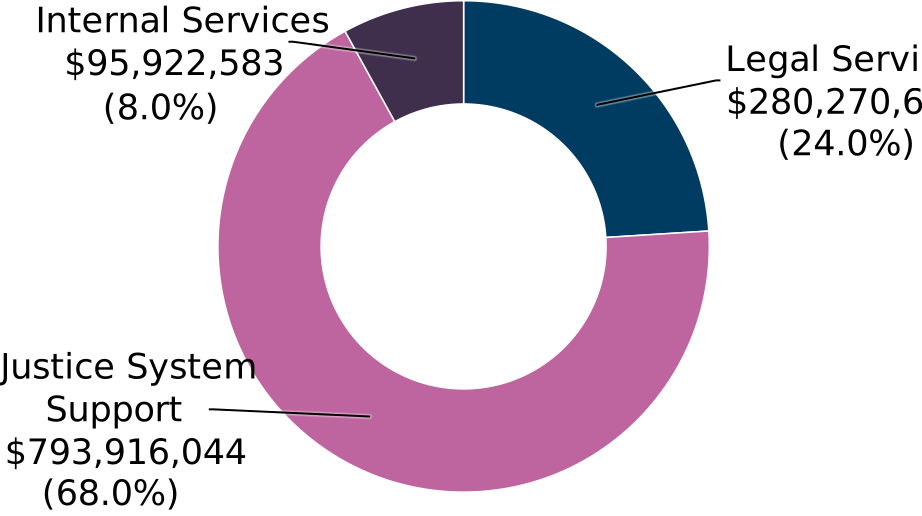
Figure 1 presents how much the Department plans to spend in 2025–26 to carry out core responsibilities and internal services.
Text description of Figure 1
Figure 1 chart shows that $793.9 million (or 67.8%) of net planned spending is allocated to the Justice System Support core responsibility, $280.3 million (or 24.0%) of net planned spending is allocated to the Legal Services core responsibility and $95.9 million (or 8.2%) of net planned spending is allocated to support internal services. This represents a total planned spending of $1,170.1 million.
Analysis of planned spending by core responsibility
The 2025–26 planned spending by core responsibility reflects the financial resources approved in the Main Estimates.
As the primary provider of legal services to federal government departments and agencies, Justice Canada has a Vote-Netted Revenue (VNR) authority to collect and spend revenue (respendable revenue) received from the provision of such services. For departmental reporting, this respendable revenue reduces total departmental authorities and operating expenditures.
The Legal Services core responsibility planned spending of $280.3 million is net of planned legal services revenues of $460.0 million (see Table 11).
The Justice System Support core responsibility planned spending of $793.9 million (see Table 11) includes both planned operating spending of $67.9 million and Grants and Contributions planned spending of $726.0 million.
Internal Services planned spending of $95.9 million is net of legal services VNR spending of $67.0 million (see Table 11).
Budgetary performance summary
Table 9: Three-year net spending summary for core responsibilities and internal services (dollars)
| Core responsibilities and internal services | 2022–23 actual expenditures | 2023–24 actual expenditures | 2024–25 forecast spending |
|---|---|---|---|
| Legal Services | 204,647,663 | 226,652,246 | 409,852,089 |
| Justice System Support | 662,843,664 | 750,690,516 | 798,069,124 |
| Subtotal | 867,491,327 | 977,342,762 | 1,207,921,213 |
| Internal services | 115,831,245 | 132,643,466 | 130,073,588 |
| Total | 983,322,572 | 1,109,986,228 | 1,337,994,801 |
Analysis of actual and forecast spending over the last three years
Justice Canada spending over the last three years shows an increasing trend from 2022–23 ($983.3 million) to 2024–25 ($1,338.0 million). This trend is mainly explained by increases in salary expenditures resulting from economic increases for various collective agreements and an increase in the workforce. This increase in the workforce is required to support increased client demand for legal services and to support policy functions. Additionally, there is an increase in grants and contributions spending under the Justice System Support core responsibility related to initiatives announced in Budgets 2021 to 2024 and the 2023 Fall Economic Statement. These increases are mainly in the following programs:
- Criminal Legal Aid Program
- Immigration and Refugee Legal Aid Program
- Victims Fund
- Indigenous Partnership Fund
The increases due to the aforementioned items impact all three years, however, the large increase in 2024–25 forecast spending in the Legal Services core responsibility is further explained by the one-time retroactive payments resulting from the Law Practitioner (LP) collective agreement and the Treasury Board approved economic increases for the Law Management (LC) group. These increases are slightly offset by the implementation of spending reductions for the Refocusing Government Spending initiative announced in Budget 2023 and the 2023 Fall Economic Statement.
More financial information from previous years is available in the Finances section of GC InfoBase.
Table 10: Three-year planned net spending on core responsibilities and internal services (dollars)
| Core responsibilities and internal services | 2025–26 planned spendingFootnote * of Table | 2026–27 planned spendingFootnote * of Table | 2027–28 planned spendingFootnote * of Table |
|---|---|---|---|
| Legal Services | 280,270,671 | 279,246,192 | 279,188,118 |
| Justice System Support | 793,916,044 | 723,580,171 | 700,930,396 |
| Subtotal | 1,074,186,715 | 1,002,826,363 | 980,118,514 |
| Internal services | 95,922,583 | 92,568,510 | 92,397,985 |
| Total | 1,170,109,298 | 1,095,394,873 | 1,072,516,499 |
Analysis of the next three years of spending
Justice Canada’s planned spending shows a decrease from $1,170.1 million in 2025–26 to $1,072.5 million in 2027–28. This $97.6 million decrease is due to changes in grants and contributions funding.
The decreases in grants and contributions planned spending are explained by funding reprofiles, reductions to funding profiles and the sunsetting of temporary funding mainly in the following programs:
- Justice Partnership and Innovation Program
- Immigration and Refugee Legal Aid
- Victims Fund
- Indigenous Justice Program
- Canadian Family Justice Fund
- Legal Advice for Complainants of Workplace Sexual Harassment
- Indigenous Partnership Fund
More detailed financial information on planned spending is available on the Finances section of GC InfoBase.
Table 11: Budgetary planned gross and net spending summary (dollars)
| Core responsibilities and internal services | 2025–26 planned gross spending | 2025–26 planned revenues netted against spending | 2025–26 planned net spending |
|---|---|---|---|
| Legal Services | 740,270,671 | 460,000,000 | 280,270,671 |
| Justice System Support | 793,916,044 | 0 | 793,916,044 |
| Subtotal | 1,534,186,715 | 460,000,000 | 1,074,186,715 |
| Internal services | 162,922,583 | 67,000,000 | 95,922,583 |
| Total | 1,697,109,298 | 527,000,000 | 1,170,109,298 |
Analysis of budgetary planned gross and net spending summary
The table above reflects Justice Canada’s planned gross spending for 2025–26, which includes the VNR authority of $527.0 million. The Department’s 2025–26 VNR authority ($527.0 million) has increased by $85.0 million compared to the 2024–25 VNR authority ($442.0 million). This increase is to better align with the expected revenue, which is higher due to new planned legal services rates that incorporates the economic increases related to the LP and LC groups and the increased demand for legal services.
The Department’s VNR authority is notionally distributed between the Legal Services core responsibility and Internal Services. The actual revenues distributed between programs could vary depending on numerous factors, such as changes to legal service rates approved periodically by Treasury Board, fluctuation in client departments’ demand for legal services, and the actual amount of revenues collected in excess of, or less than, the authority.
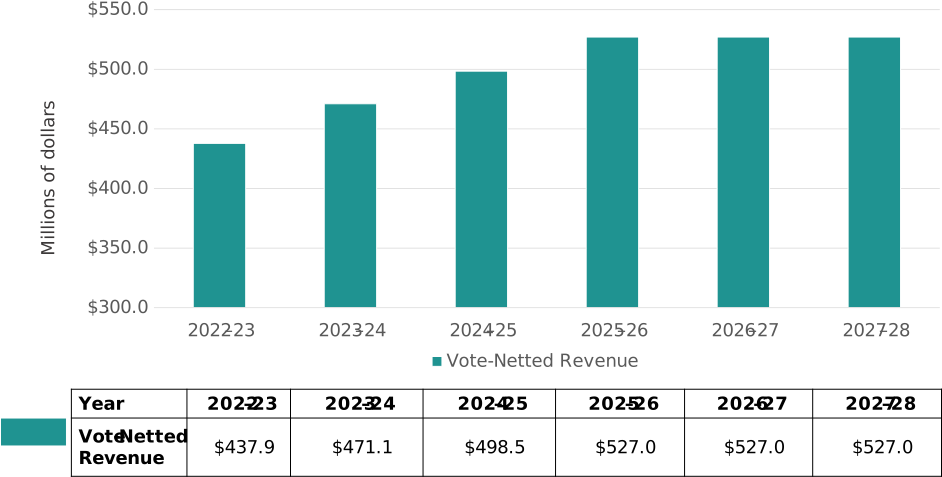
Figure 2 presents vote-netted revenue over time.
Text description of Figure 2
This vertical column graph represents departmental vote-netted revenue trends for six fiscal years for Justice Canada. The graph presents a timeline (in fiscal years) on the horizontal axis and the amount of dollars (in millions of dollars) on the vertical axis. The timeline on the horizontal axis shows six columns: one for each fiscal year from 2022–23 on the left through to 2027–28. The columns for fiscal years 2022–23 and 2023–24 show actual vote-netted revenue, while the column for fiscal year 2024-25 shows forecasted vote-netted revenue and the columns for fiscal years 2025–26 to 2027–28 show planned vote-netted revenue.
The amount in millions of dollars on the vertical axis ranges from 300.0 on the bottom to 550.0 on the top. Each column displays the amount of vote-netted revenue per fiscal year. This information is also displayed numerically below each column to indicate the precise amount of vote-netted revenue (in millions of dollars) for each of the six fiscal years presented.
The first column of the timeline, representing fiscal year 2022–23, displays $437.9 million in actual vote-netted revenue.
The second column of the timeline, representing fiscal year 2023–24, displays $471.1 million in actual vote-netted revenue.
The third column of the timeline, representing fiscal year 2024–25 displays $498.5 million in forecasted vote-netted revenue.
The fourth, fifth and sixth columns of the timeline, representing fiscal years 2025–26 to 2027–28, each display $527.0 million in planned vote-netted revenue.
Analysis of vote-netted revenue over time
Justice Canada’s forecasted VNR, as of October 31, 2024, is expected to reach $498.5 million in 2024–25. This forecast is higher than actual VNR for 2023–24 ($471.1 million) due to higher demand for legal services for a broad variety of client departments and agencies in such areas as tax, Indigenous matters, immigration and public safety.
Information on the alignment of Justice Canada’s spending with Government of Canada’s spending and activities is available on GC InfoBase.
Funding
This section provides an overview of the Department’s net voted and statutory funding for its core responsibilities and for internal services. For further information on funding authorities, consult the Government of Canada budgets and expenditures.
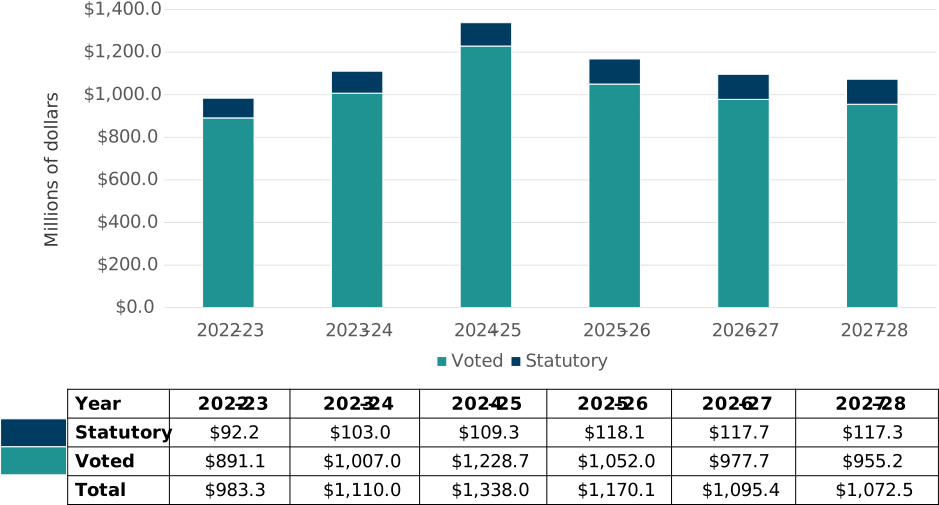
Figure 3 summarizes the Department’s approved net funding (voted and statutory) from 2022–23 to 2027–28.
Text description of figure 3
This vertical stacked column graph represents departmental spending trends for six fiscal years for Justice Canada. The graph presents a timeline (in fiscal years) on the horizontal axis and the amount of dollars (in millions of dollars) on the vertical axis. The timeline on the horizontal axis shows six columns, one for each fiscal year from 2022–23 on the left through to 2027–28. The columns for fiscal years 2022–23 and 2023–24 show actual spending, while the column for fiscal year 2024–25 shows forecast spending and the columns for fiscal years 2025–26 to 2027–28 show net planned spending.
The amount in millions of dollars on the vertical axis ranges from $0 on the bottom to $1,400.0 on the top. Each column displays an accumulated total of departmental spending for two categories of funding: statutory and voted. These two categories of funding are also displayed numerically below each column to indicate the amount of spending (in millions of dollars) for each of the six fiscal years presented.
The first column of the timeline, representing fiscal year 2022–23, displays $92.2 million in statutory spending and $891.1 million in voted spending, for a total actual spending of $983.3 million.
The second column of the timeline, representing fiscal year 2023–24, displays $103.0 million in statutory spending and $1,007.0 million in voted spending, for total actual spending of $1,110.0 million.
The third column of the timeline, representing fiscal year 2024–25, displays $109.3 million in statutory spending and $1,228.7 million in voted spending, for a total forecast spending of $1,338.0 million.
The fourth column of the timeline, representing fiscal year 2025–26, displays $118.1 million in statutory spending and $1,052.0 million in voted spending, for a total net planned spending of $1,170.1 million.
The fifth column of the timeline, representing fiscal year 2026–27, displays $117.7 million in statutory spending and $977.7 million in voted spending, for a total net planned spending of $1,095.4 million.
The sixth and final column of the timeline, representing fiscal year 2027–28, displays $117.3 million in statutory spending and $955.2 million in voted spending, for a total net planned spending of $1,072.5 million.
Analysis of voted and statutory funding over a six-year period
Variance between 2024–25 Forecast Spending and 2025–26 Net Planned Spending
Justice Canada’s planned spending for 2025–26 ($1,170.1 million) projects a net decrease of $167.9 million compared with forecast spending for 2024–25 ($1,338.0 million). The decrease is mainly under the Legal Services core responsibility related to the one-time retroactive payments included in the 2024–25 spending forecast resulting from the LP collective agreement and the Treasury Board approved economic increases for the LC group.
Additionally, there is a decrease in planned spending for internal services attributable to expenditures related to funding from Treasury Board Central Votes (such as the Operating Budget Carry Forward) included in 2024–25 forecast spending, which is not included in 2025–26 planned spending. The planned spending for 2025–26 and future years reflects only funds to be approved through the Main Estimates.
Variance from 2025–26 Net Planned Spending to 2027–28 Net Planned Spending
Justice Canada’s planned spending projects a decrease from 2025–26 ($1,170.1 million) to 2027–28 ($1,072.5 million). This $97.6 million overall reduction is mainly in the Justice System Support core responsibility and is attributable to decreases in funding and sunsetting of temporary funding announced in previous federal budgets (initiatives approved under Budgets 2021 to 2024 and the 2023 Fall Economic Statement).
For further information on Justice Canada’s departmental appropriations, consult the 2025–26 Main Estimates.
Future-oriented condensed statement of operations
The future-oriented condensed statement of operations provides an overview of Justice Canada’s operations for 2024–25 to 2025–26.
Table 12: Future-oriented condensed statement of operations for the year ending March 31, 2026 (dollars)
| Financial information | 2024–25 Forecast results | 2025–26 Planned results | Difference (Planned results minus forecasted) |
|---|---|---|---|
| Total expenses | 1,944,769,089 | 1,804,509,646 | (140,259,443) |
| Total revenues | 498,466,000 | 527,000,000 | 28,534,000 |
| Net cost of operations before government funding and transfers | 1,446,303,089 | 1,277,509,646 | (168,793,443) |
Analysis of forecasted and planned results
Total expenses are forecasted to decrease by $140.3 million, from $1,944.8 million in 2024–25 to $1,804.5 million in 2025–26. This variance is mainly explained by the following:
- One-time retroactive payments included in the 2024–25 spending forecast resulting from the LP collective agreement and the Treasury Board approved economic increases for the LC group.
- Expenditures related to funding from Treasury Board Central Votes (such as the Operating Budget Carry Forward).
The variance in revenues shows an increase of $28.5 million, from $498.5 million in 2024–25 to $527.0 million in 2025–26, which represents the difference between the legal services revenue forecast for 2024–25 and the approved Vote-Netted Revenue authority for 2025–26. Although demand for legal services is expected to remain high, only the amounts approved in the Main Estimates are presented for future years for consistency purposes.
A more detailed Future-Oriented Statement of Operations and associated notes for 2025–26, including a reconciliation of the net cost of operations with the requested authorities, is available on Justice Canada’s website.
Human resources
This section presents an overview of the Department’s actual and planned human resources from 2022–23 to 2027–28.
Table 13: Actual human resources for core responsibilities and internal services
| Core responsibilities and internal services | 2022–23 actual full-time equivalents | 2023–24 actual full-time equivalents | 2024–25 forecasted full-time equivalents |
|---|---|---|---|
| Legal Services | 3,676 | 3,897 | 4,051 |
| Justice System Support | 366 | 390 | 377 |
| Subtotal | 4,042 | 4,287 | 4,428 |
| Internal services | 1,116 | 1,156 | 1,249 |
| Total | 5,158 | 5,443 | 5,677 |
Analysis of human resources over the last three years
Overall, there is an increasing trend in FTEs over the three-year period from 2022–23 (5,158 FTEs) to 2024–25 (5,677 FTEs). The Legal Services core responsibility shows an increase of 375 FTEs; this is largely explained by an increase in the workforce to meet the increased demand for legal services.
The Justice System Support core responsibility shows an increase of 11 FTEs; this is mainly explained by an increase in the workforce to support the delivery of new initiatives for which new funding was approved in previous federal budgets.
Internal Services shows an increase of 133 FTEs; this is mainly explained by an increase in the corporate support workforce to meet Justice Canada’s needs for the delivery of new initiatives for which new funding was approved in previous federal budgets, as well as other projects and initiatives such as the second Accessibility Plan, the artificial intelligence and data governance framework, the Strategic Recruitment Plan, and the new combined Anti-Racism and Anti-Discrimination Results Framework and departmental Employment Equity Plan for 2025–28.
Table 14: Human resources planning summary for core responsibilities and internal services
| Core responsibilities and internal services | 2025–26 planned full-time equivalents | 2026–27 planned full-time equivalents | 2027–28 planned full-time equivalents |
|---|---|---|---|
| Legal Services | 4,051 | 4,051 | 4,051 |
| Justice System Support | 377 | 377 | 377 |
| Subtotal | 4,428 | 4,428 | 4,428 |
| Internal services | 1,258 | 1,249 | 1,249 |
| Total | 5,686 | 5,677 | 5,677 |
Analysis of human resources for the next three years
Justice Canada’s planned FTEs for the next three years are forecasted as of October 31, 2024. Due to the timing of forecasts and the information available, the planned FTEs do not include the impact of the following:
- Reductions related to the second phase of the Refocusing Government Spending initiative.
- Forecasted demand for legal services.
- Any new initiatives announced in Fall Economic Statement 2024 and upcoming federal Budgets.
The 2025–26 Internal Services planned FTEs includes temporary positions for the creation of an independent Miscarriage of Justice Review Commission. These FTEs are not included in the planned FTEs for future years, which accounts for the slightly lower Internal Services planned FTEs in 2026–27.
Corporate information
Departmental profile
Appropriate minister:
The Honourable Sean Fraser, P.C., M.P.
Institutional head:
Shalene Curtis-Micallef
Ministerial portfolio:
Justice
Enabling instrument:
Year of incorporation / commencement:
1868
Departmental contact information
Mailing address:
Department of Justice Canada
284 Wellington Street
Ottawa, Ontario
Canada K1A 0H8
Telephone:
613-957-4222
TTY:
613-992-4556
Email:
Website:
Supplementary information tables
The following supplementary information tables are available on Justice Canada’s website:
Information on Justice Canada’s departmental sustainable development strategy can be found on Justice Canada’s website.
Federal tax expenditures
Justice Canada’s Departmental Plan does not include information on tax expenditures.
The tax system can be used to achieve public policy objectives through the application of special measures such as low tax rates, exemptions, deductions, deferrals and credits. The Department of Finance Canada publishes cost estimates and projections for these measures each year in the Report on Federal Tax Expenditures.
This report also provides detailed background information on tax expenditures, including descriptions, objectives, historical information and references to related federal spending programs as well as evaluations and GBA Plus of tax expenditures.
Definitions
List of terms
- appropriation (crédit)
- Any authority of Parliament to pay money out of the Consolidated Revenue Fund.
- budgetary expenditures (dépenses budgétaires)
- Operating and capital expenditures; transfer payments to other levels of government, departments or individuals; and payments to Crown corporations.
- core responsibility (responsabilité essentielle)
- An enduring function or role performed by a department. The intentions of the department with respect to a core responsibility are reflected in one or more related departmental results that the department seeks to contribute to or influence.
- Departmental Plan (plan ministériel)
- A report on the plans and expected performance of an appropriated department over a 3 year period. Departmental Plans are usually tabled in Parliament each spring.
- departmental result (résultat ministériel)
- A consequence or outcome that a department seeks to achieve. A departmental result is often outside departments’ immediate control, but it should be influenced by program-level outcomes.
- departmental result indicator (indicateur de résultat ministériel)
- A quantitative measure of progress on a departmental result.
- departmental results framework (cadre ministériel des résultats)
- A framework that connects the department’s core responsibilities to its departmental results and departmental result indicators.
- Departmental Results Report (rapport sur les résultats ministériels)
- A report on a department’s actual accomplishments against the plans, priorities and expected results set out in the corresponding Departmental Plan.
- full-time equivalent (équivalent temps plein)
- A measure of the extent to which an employee represents a full person-year charge against a departmental budget. For a particular position, the full-time equivalent figure is the ratio of number of hours the person actually works divided by the standard number of hours set out in the person’s collective agreement.
- Gender-based Analysis Plus (GBA Plus) (analyse comparative entre les sexes plus [ACS Plus])
- Is an analytical tool used to support the development of responsive and inclusive policies, programs, and other initiatives. GBA Plus is a process for understanding who is impacted by the issue or opportunity being addressed by the initiative; identifying how the initiative could be tailored to meet diverse needs of the people most impacted; and anticipating and mitigating any barriers to accessing or benefitting from the initiative. GBA Plus is an intersectional analysis that goes beyond biological (sex) and socio-cultural (gender) differences to consider other factors, such as age, disability, education, ethnicity, economic status, geography (including rurality), language, race, religion, and sexual orientation. Using GBA Plus involves taking a gender- and diversity-sensitive approach to our work. Considering all intersecting identity factors as part of GBA Plus, not only sex and gender, is a Government of Canada commitment.
- government priorities (priorités gouvernementales)
- For the purpose of the 2025–26 Departmental Plan, government priorities are the high-level themes outlining the government’s agenda in the most recent Speech from the Throne.
- horizontal initiative (initiative horizontale)
- An initiative where two or more federal departments are given funding to pursue a shared outcome, often linked to a government priority.
- Indigenous business (entreprise autochtones)
- For the purpose of the Directive on the Management of Procurement Appendix E: Mandatory Procedures for Contracts Awarded to Indigenous Businesses and the Government of Canada’s commitment that a mandatory minimum target of 5% of the total value of contracts is awarded to Indigenous businesses, a department that meets the definition and requirements as defined by the Indigenous Business Directory.
- non-budgetary expenditures (dépenses non budgétaires)
- Non-budgetary authorities that comprise assets and liabilities transactions for loans, investments and advances, or specified purpose accounts, that have been established under specific statutes or under non-statutory authorities in the Estimates and elsewhere. Non-budgetary transactions are those expenditures and receipts related to the government’s financial claims on, and obligations to, outside parties. These consist of transactions in loans, investments and advances; in cash and accounts receivable; in public money received or collected for specified purposes; and in all other assets and liabilities. Other assets and liabilities, not specifically defined in G to P authority codes are to be recorded to an R authority code, which is the residual authority code for all other assets and liabilities.
- performance (rendement)
- What a department did with its resources to achieve its results, how well those results compare to what the department intended to achieve, and how well lessons learned have been identified.
- performance indicator (indicateur de rendement)
- A qualitative or quantitative means of measuring an output or outcome, with the intention of gauging the performance of a department, program, policy or initiative respecting expected results.
- plan (plan)
- The articulation of strategic choices, which provides information on how a department intends to achieve its priorities and associated results. Generally, a plan will explain the logic behind the strategies chosen and tend to focus on actions that lead to the expected result.
- planned spending (dépenses prévues)
- For Departmental Plans and Departmental Results Reports, planned spending refers to those amounts presented in Main Estimates.
A department is expected to be aware of the authorities that it has sought and received. The determination of planned spending is a departmental responsibility, and departments must be able to defend the expenditure and accrual numbers presented in their Departmental Plans and Departmental Results Reports. - program (programme)
- Individual or groups of services, activities or combinations thereof that are managed together within the department and focus on a specific set of outputs, outcomes or service levels.
- program inventory (répertoire des programmes)
- Identifies all the department’s programs and describes how resources are organized to contribute to the department’s core responsibilities and results.
- result (résultat)
- A consequence attributed, in part, to a department, policy, program or initiative. Results are not within the control of a single department, policy, program or initiative; instead, they are within the area of the department’s influence.
- statutory expenditures (dépenses législatives)
- Expenditures that Parliament has approved through legislation other than appropriation acts. The legislation sets out the purpose of the expenditures and the terms and conditions under which they may be made.
- target (cible)
- A measurable performance or success level that a department, program or initiative plans to achieve within a specified time period. Targets can be either quantitative or qualitative.
- voted expenditures (dépenses votées)
- Expenditures that Parliament approves annually through an appropriation act. The vote wording becomes the governing conditions under which these expenditures may be made.
- Date modified: