
3.0 Findings
In total, 417 lawyers and 109 judges responded to the surveys. This marks the highest response rate from judges to the National Family Law Survey since it started, up significantly from 39 in 2016 and 23 in 2018. In contrast, fewer lawyers responded to the 2022 survey when compared to the 2018 survey, which received responses from 612 lawyers.
3.1 Characteristics of respondents
Survey data show similar geographic representation among lawyers and judges. Most participants reported working in Central Canada (41% of lawyers and 39% of judges), followed by the Prairies (32% and 29%), the West Coast (14% and 15%), the Atlantic region (12% and 16%), and the Territories (1% and less than 1%).Footnote 5 More judges and lawyers reported working in urban areas (57% and 56%, respectively) than in both rural and urban areas (36% and 30%) or rural areas (7% and 13%).
When looking at their place of work, three-quarters (75%) of judges indicated they had been appointed to a provincial/territorial Superior Court or Court of Queen’s Bench. The remaining judges had been appointed to a Unified Family Court (19%), a provincial/territorial Court of Appeal (5%), or a provincial/territorial court (1%).
More lawyers reported working in private practice (85%) than in a legal aid clinic or office (10%), a government department or agency (2%), or a pro bono clinic (1%). About half (49%) of lawyers reported having taken some type of additional training, such as parenting coordination (31%), mediation (31%), collaborative family law (11%), arbitration (8%), and voice of the child reports (1%).
Just under 4 in 10 (37%) of lawyers had over 20 years of experience as a lawyer, 3 in 10 (29%) had 10 to 19 years of experience, and almost 2 in 10 had 5 to 9 years (18%) or less than 5 years of experience (17%). Most lawyers identified as a woman (69%), while 25% identified as a man and 1% identified as another gender.Footnote 6 Half (51%) of lawyers indicated that the average individual pre-tax income of most of their clients was between $50,000 and $99,999. One quarter reported that their clients’ average pre-tax income was under $50,000 (24%) or over $100,000 (25%).
Most lawyers (86%) reported that family law made up at least half of their caseload. Judges similarly reported that family law made up at least half (49%) or less than half (51%) of their caseload. Most lawyers (85%) and half of judges (50%) reported that more than 50% of their cases involved child support. A small proportion of lawyers (4%) and judges (17%) reported that less than a quarter of their cases involved child support.
3.2 Characteristics of child support cases
Child support is calculated in Canada through regulations called child support guidelines. The Federal Child Support Guidelines (Federal Guidelines) are regulations under the Divorce Act. The Federal Guidelines are a set of rules and tables used to determine the amount of child support and apply to parents who are divorcing or are divorced. In addition to the Federal Guidelines, there are provincial and territorial child support guidelines that apply when married parents separate but do not divorce, or when parents who were never married separate. The provincial and territorial guidelines are similar to the Federal Guidelines, with the exception of Quebec, which has a different child support model.
3.2.1 Almost 9 in 10 judges reported that one or both parties were unrepresented in at least half of their child support cases.
Judges were asked how frequently one or both parties were self-represented in the child support cases they heard. Two in three judges (66%) indicated that one or both parties were self-represented in about 50% of their cases, with 23% reporting that one or both parties were usually or almost always self-represented and 11% reporting that one or both parties were rarely self-represented.
3.2.2 Most lawyers and judges reported that disputes over child support occurred in at least 50% of their cases. The most common disputes involved lack of compliance with income disclosure obligations and challenges with income determination.
Lawyers and judges were asked how frequently disputes over child support occurred in their cases. More than a quarter of lawyers (28%) and two in five judges (44%) reported that these disputes usually or almost always occurred. Half of lawyers (54%) and judges (51%) reported that there were disputes over child support in about 50% of their cases. A smaller proportion of lawyers (18%) and judges (5%) indicated that there were never or rarely any disputes.Footnote 7
When asked which child support issues were the most litigious,Footnote 8 a lack of compliance with income disclosure obligations was reported by lawyers (39%) and judges (46%) as the most litigious. A similar proportion of lawyers (35%) and judges (40%) identified income determination for child support purposes as the most litigious issue. Fewer lawyers and judges reported determining child support in shared parenting time arrangements (11% and 5%, respectively) and determining amounts for special or extraordinary expenses (9% and 7%) as the most litigious issues. Other child support issues identified as being litigious included support for adult children (e.g., education and living expenses), parties seeking specific parenting time arrangements to reduce or increase the child support amount they owe or receive, and retroactive child support (e.g., calculation, cancellation, variation).
3.2.3 Two in three lawyers reported that, where available, less than a quarter of their clients sought a recalculation service.
A recalculation service is an administrative service that recalculates child support amounts without requiring parties to return to court. This administrative service determines the new child support amount by considering the applicable guidelines and any updated income information.
Just under 2 in 10 lawyers (18%) reported not having access to a recalculation service in their area. Where recalculation services were available, two in three lawyers (68%) reported that less than 25% of their clients sought this service. A small proportion of lawyers (19%) reported that more than half of their clients sought a recalculation.
3.3 Characteristics of shared parenting time cases
Shared parenting time refers to when children spend at least 40 percent of the time with each parent in a year. Under section 9 of the Federal Child Support Guidelines, determining child support in shared parenting time is discretionary, meaning that it is up to the courts to make the decision based on their judgement. However, the following factors must be considered:
- the amount in the tables that each parent would pay, based on each parent’s income (sometimes called the “set-off amount”)
- the increased costs of shared parenting time
- the condition, means, needs and other circumstances of each parent and child
3.3.1 Over half of lawyers and judges reported that less than 50% of their cases resulted in shared parenting time.
According to most judges (68%), less than 50% of the cases they heard resulted in shared parenting time. About one in three judges (31%) reported that over 50% of the cases they heard resulted in shared parenting time. For 54% of lawyers, shared parenting time was the result in less than half of their cases, and for the other 46%, shared parenting time was the result in over half of their cases. A small proportion of lawyers (6%) and judges (6%) indicated that 75% to 100% of their cases resulted in shared parenting time.
3.3.2 One in three lawyers and one in four judges reported that disputes related to the determination of child support usually or almost always occurred in shared parenting time cases.
In the cases resulting in shared parenting time, one in three lawyers (38%) and one in four judges (26%) reported that always disputes related to the determination of child support usually or almost always occurred. A smaller proportion of lawyers (21%) and one in three judges (33%) reported that disputes related to the determination of child support rarely or almost never occurred in these cases.
3.3.3 Most lawyers and judges reported that the most litigious issue in shared parenting time cases was getting parties to agree on the type of parenting time arrangements.
When disputes occurred in shared parenting time cases, most lawyers (74%) and judges (81%) reported that the most litigious issueFootnote 9 involved getting the parties to agree on the type of parenting time arrangement and decide on whether a shared parenting time arrangement was the best approach for the family. A small proportion of lawyers and judges indicated that the following issues were the most difficult to settle: calculating the child support amount (12% of lawyers and 7% of judges), calculating the 40% time threshold (6% and 6%), and one parent not exercising the agreed-upon parenting time (4% and 3%).
3.3.4 About half of lawyers indicated that they most often used a set-off amount with their shared parenting time cases without special or extraordinary expenses.
Approximately half (49%) of lawyers reported that the most common way from a given listFootnote 10 in which child support was calculated in shared parenting time cases was by using the set-off amountsFootnote 11 for both parties based on the total number of children, without special or extraordinary expenses. The next most common way that child support was calculated in these cases, as reported by 45% of lawyers, was by using all factors under section 9 of the Federal Guidelines.Footnote 12 The least common way to calculate child support in shared parenting time cases (5%) was by using the set-off of the table amounts for both parents based on the total number of children in addition to special or extraordinary expenses.
3.3.5 Lawyers used the set-off amount in most shared parenting time cases. The most common exception occurred when there was a large income disparity or different standards of living between two households.
While the set-off amount was commonly used to calculate child support in shared parenting time cases, there were some circumstances where the set-off amount was not used. The most common reason for not using the set-off amount was when there was a large income disparity or different standards of living between the two households. Other reasons included when parties’ incomes were too similar and the child support amount was too low, one party paid for most of the child-related expenses, parties agreed to another arrangement to account for unique circumstances not considered by the set-off amount,Footnote 13 and cases that involved high incomes over $150k.
3.3.6 When asked which child-related expenses were most often paid for by one parent in shared parenting time cases, lawyers reported that these were expenses related to clothes and personal care items, while judges reported that these were expenses related to school, electronics and sports.
In shared parenting time arrangements, at times, some child-related expenses may be paid for by one parent for both households. In these cases, lawyers and judges reportedFootnote 14 that these child-related expenses most commonly included clothes like winter coats and boots, electronics and school-related expenses (see Figure 1). There were also some differences in the expenses reported by lawyers and judges. Over half of lawyers selected personal care (e.g., haircuts); in contrast, judges were more likely than lawyers to select sports-related activities, sporting goods, and hobbies.
Figure 1: Child-related expenses most frequently paid for by one parent in shared parenting time cases, as reported by lawyers and judges
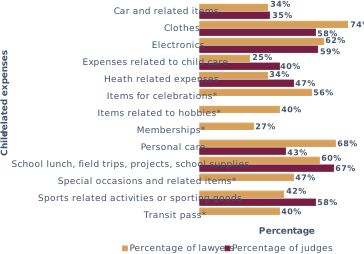
Figure 1: Child-related expenses most frequently paid for by one parent in shared parenting time cases, as reported by lawyers and judges – Text version
A horizontal bar graph with 21 rows. The x-axis indicates percentages. The y-axis indicates child-related expenses. The legend on the right side of the graph notes that yellow is for the “percentage of lawyers” and red is for the “percentage of judges.”
The first two rows are to the right of “car and related items.” The yellow bar goes up to 34% and the red bar goes up to 35%. The next two rows are to the right of “clothes,” and the yellow bar goes up to 74% and the red bar goes up to 58%. The fifth and sixth rows are to the right of “electronics,” and the yellow bar goes up to 62% and the red bar goes up to 59%. The next two rows are to the right of “expenses related to child care,” and the yellow bar goes up to 25% and the red bar goes up to 40%. The ninth and tenth rows are to the right of “health related expenses;” the yellow bar goes up to 34% and the red bar goes up to 47%. The next row is to the right of “items for celebration;” there is only one yellow bar that goes up to 56%. The twelfth row is to the right of “items related to hobbies,” and there is only one yellow bar that goes up to 40%. The thirteenth row is to the right of “memberships.” There is only one yellow bar that goes up to 27%. The next two rows are to the right of “personal care,” and the yellow bar goes up to 68% and the red bar goes up to 43%. The sixteenth and seventeenth rows are to the right of “school lunch, field trips, projects, school supplies,” and the yellow bar goes up to 60% and the red bar goes up to 67%. The next row is to the right of “special occasions and related items.” There is only one yellow row that goes up to 47%. The nineteenth and twentieth rows are to the right of “sports related activities or sporting goods,” and the yellow bar goes up to 42% and the red bar goes up to 58%. The last row is to the right of “transit pass,” and there is only one yellow bar that goes up to 40%.
The sixth expense “items for celebrations,” the seventh identified expense “items related to hobbies,” the eighth identified expense “memberships,” the eleventh identified expense “special occasions and related items,” and the last identified expense “transit pass” have a footnote with the star symbol “*.” Below the graph, the footnote reads:
*Expenses only listed in the survey of lawyers.
3.3.7 In shared parenting time cases, child-related expenses were often not added to the monthly child support amount. Instead, these expenses were most often shared by both parents as they were incurred or paid for by one parent.
Both lawyers and judges reportedFootnote 15 that child-related expenses were most commonly shared by both parents as the expenses were incurred (41% and 70%, respectively) as opposed to adding the expenses to the ongoing monthly child support amount. A similar proportion of lawyers (41%) also reported that the costs were commonly paid for by one parent and not added to the child support amount. Less common ways for dealing with these expenses included increasing the ongoing monthly child support amount to account for these costs (6% of lawyers and 11% of judges), ordering one parent to pay most costs (9% of judges), and agreeing that one parent would cover the expenses for one child and the other would cover the expenses of another child (5% of lawyers).
3.4 Special or extraordinary expenses
Section 7 of the Federal Child Support Guidelines defines special or extraordinary expenses as expenses that are necessary for the child’s best interests and reasonable given the parents’ means and the family’s spending patterns pre-separation. The Federal Guidelines identify a closed list of special or extraordinary expenses which includes childcare expenses, medical and insurance premiums, health care expenses, extraordinary expenses for primary or secondary school education or any other educational programs, post-secondary education expenses, and extraordinary expenses for extracurricular activities.
3.4.1 Most lawyers and judges reported that special or extraordinary expenses were often requested in their cases and that these were difficult to settle.
Most lawyers (81%) and over half of judges (57%) reported that an amount for special or extraordinary expenses was usually or almost always requested in their cases. A small proportion of lawyers (6%) and one in six judges (15%) indicated special or extraordinary expenses were rarely or almost never involved in the cases they heard, while 13% of lawyers and 28% of judges indicated these expenses were involved in about half of the cases they heard.
Lawyers were specifically asked about the frequency of special or extraordinary expenses that were difficult to settle.Footnote 16 Approximately half (51%) reported that these expenses were difficult to settle about 50% of the time; one-third (32%) reported that these expenses were usually or almost always difficult to settle; and 17% reported that these expenses were rarely difficult to settle.
3.4.2 According to lawyers and judges, the most frequently requested special or extraordinary expenses were extraordinary expenses for extracurricular activities and medical and insurance premiums.
When asked to rank the top three most requested special or extraordinary expenses,Footnote 17 lawyers and judges both selected extraordinary expenses for extracurricular activities (89% and 79%, respectively), and medical and insurance premiums (87% and 89%). The third most requested special or extraordinary expenses varied; lawyers selected extraordinary expenses for primary and secondary education (55%), while judges selected childcare expenses (62%). See Figure 2 for more information.
Figure 2: Top three most requested special or extraordinary expenses, as ranked by lawyers and judges
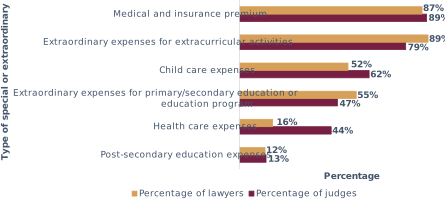
Figure 2: Top three most requested special or extraordinary expenses, as ranked by lawyers and judges – Text version
A horizontal bar graph with 12 rows. The x-axis indicates percentages. The y-axis indicates special or extraordinary expenses. The legend below the graph notes that yellow is for the “percentage of lawyers” and red is for the “percentage of judges.”
The first two rows are to the right of “medical and insurance premium.” The yellow bar goes up to 87% and the red bar goes up to 89%. The next two rows are to the right of “extraordinary expenses for extracurricular activities.” The yellow bar goes up to 89% and the red bar goes up to 79%. The fifth and sixth rows are to the right of “child care expenses,” and the yellow bar goes up to 52% and the red bar goes up to 62%. The next two rows are to the right of “extraordinary expenses for primary/secondary education or education program,” and the yellow bar goes up to 55% and the red bar goes up to 47%. The ninth and tenth rows are to the right of “health care expenses;” the yellow bar goes up to 16% and the red bar goes up to 44%. The final two rows are to the right of “post-secondary education expenses.” The yellow bar goes up to 12% and the red bar goes up to 13%.
Lawyers and judges were also asked which types of expensesFootnote 18 parents often requested as special or extraordinary expenses, regardless of whether these fall within the section 7 expenses in the Federal Guidelines. Similar to what was reported above, most lawyers (86%) and judges (92%) identified that extracurricular activities or hobbies were the most frequently requested by parents as special or extraordinary expenses (see Figure 3).Footnote 19 Lawyers were more likely to report that parents often requested costs for school-related itemsFootnote 20 (78%) and counselling or assessments (71%), while judges were more likely to report that parents often requested costs for school-related items (65%), health-related expensesFootnote 21 (85%) and childcare expenses (81%). Lawyers were also more likely than judges to report that parents requested electronics for the childrenFootnote 22 (64% compared to 48% of judges) and costs for special or seasonal clothesFootnote 23 (52% versus 24%, respectively).
Less frequently requested expenses according to lawyers included transport-related items, items related to the special needs of the children, special occasions, the children’s use of the car, memberships, unique costs associated with shared parenting time,Footnote 24 physiotherapy or massage for the children, celebrations or gifts for other children, personal care such as haircuts, and pet-related expenses.
Figure 3: Type of expenses requested by parents as special or extraordinary expenses, as reported by lawyers and judges
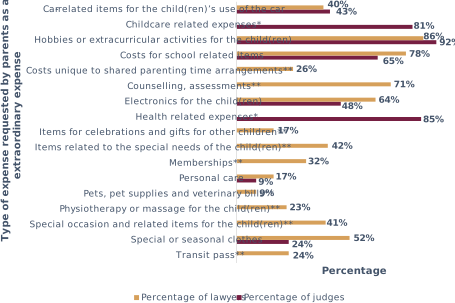
Figure 3: Type of expenses requested by parents as special or extraordinary expenses, as reported by lawyers and judges – Text version
A horizontal bar graph with 23 rows. The x-axis indicates percentages. The y-axis indicates expenses requested as special or extraordinary expenses. The legend below the graph notes that yellow is for the “percentage of lawyers” and red is for the “percentage of judges.”
The first two rows are to the right of “car related items for the child(ren)’s use of the car.” The yellow bar goes up to 40% and the red bar goes up to 43%. The next row is to the right of “childcare related expenses,” and there is only one red bar that goes up to 81%. The fourth and fifth rows are to the right of “hobbies or extracurricular activities for the child(ren),” and the yellow bar goes up to 86% and the red bar goes up to 92%. The next two rows are to the right of “costs for school related items,” and the yellow bar goes up to 78% and the red bar goes up to 65%. The eighth row is to the right of “costs unique to shared parenting time arrangements;” there is only one yellow bar that goes up to 26%. The next row is to the right of “counselling, assessments;” there is only one yellow bar that goes up to 71%. The tenth and eleventh rows are to the right of “electronics for the child(ren),” and the yellow bar goes up to 64% and the red bar goes up to 48%. The next row is to the right of “health related expenses,” and there is only one red bar that goes up to 85%. The thirteenth row is to the right of “items for celebrations and gifts for other child(ren),” and there is only one yellow bar that goes up to 17%. The fourteenth row is to the right of “items related to the special needs of the child(ren).” There is only one yellow bar that goes up to 42%. The next row is to the right of “memberships,” and there is only one yellow bar that goes up to 32%. The sixteenth and seventeenth rows are to the right of “personal care,” and the yellow bar goes up to 17% and the red bar goes up to 9%. The next row is to the right of “pets, pet supplies and veterinary bills,” and there is only one yellow bar that goes up to 9%. The nineteenth row is to the right of “physiotherapy or massage for the child(ren),” and there is only one yellow bar that goes up to 23%. The twentieth row is to the right of “special occasion and related items for the child(ren),” and there is only one yellow bar that goes up to 41%. The next two rows are to the right of “special or seasonal clothes,” and the yellow bar goes up to 52% and the red bar goes up to 24%. The last row is to the right of “transit pass,” and there is only one yellow bar that goes up to 24%.
The second identified expense “childcare related expenses” and the eighth identified expense “heath related expenses” have a footnote with the star symbol “*.” Below the graph, the footnote reads:
*Expenses only listed in the survey of judges.
The fifth identified expense “costs unique to shared parenting time arrangements,” the sixth identified expense “counselling, assessments,” the ninth identified expense “items for celebrations and gifts for other children,” the tenth identified expense “items related to the special needs of the child(ren),” the eleventh identified expense “memberships,” the thirteenth identified expense “pets, pet supplies and veterinary bills,” the fourteenth identified expense “physiotherapy or massage for the child(ren),” the fifteenth identified expense “special occasion and related items for the child(ren),” and the last identified expense “transit pass” have a footnote with two star symbols “**.” Below the graph, the footnote reads:
**Expenses only listed in the survey of lawyers.
3.4.3 According to both lawyers and judges, the types of special or extraordinary expenses that were the most difficult to settle were extraordinary expenses for extracurricular activities and post-secondary education expenses.
Along with being one of the most requested special or extraordinary expenses, extraordinary expenses for extracurricular activities were also identified by lawyers (79%) and judges (98%) as being one of the top three expensesFootnote 25 that were the most difficult to settle. One of the other top three expenses that were the most difficult to settle was post-secondary education expenses (90% of lawyers and 74% of judges); however, this type of expense was not frequently requested by parties according to lawyers (12%) and judges (13%). The last most difficult-to-settle special or extraordinary expense was health care expenses according to lawyers (51%) and extraordinary expenses for primary or secondary education according to judges (65%). See Figure 4 for more information.
Figure 4: Top three special or extraordinary expenses, as ranked by lawyers and judges
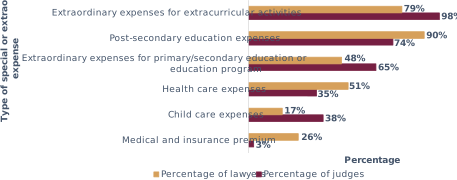
Figure 4: Top three special or extraordinary expenses, as ranked by lawyers and judges – Text version
A horizontal bar graph with 12 rows. The x-axis indicates percentages. The y-axis indicates special or extraordinary expenses. The legend below the graph notes that yellow is for the “percentage of lawyers” and red is for the “percentage of judges.”
The first two rows are to the right of “extraordinary expenses for extracurricular activities.” The yellow bar goes up to 79% and the red bar goes up to 98%. The next two rows are to the right of “post-secondary education expenses.” The yellow bar goes up to 90% and the red bar goes up to 74%. The fifth and sixth rows are to the right of “extraordinary expenses for primary/secondary education or education program,” and the yellow bar goes up to 48% and the red bar goes up to 65%. The next two rows are to the right of “health care expenses,” and the yellow bar goes up to 51% and the red bar goes up to 35%. The ninth and tenth rows are to the right of “child care expenses;” the yellow bar goes up to 17% and the red bar goes up to 38%. The final two rows are to the right of “medical and insurance premium.” The yellow bar goes up to 26% and the red bar goes up to 3%.
3.5 Income disclosure
The Federal Guidelines require initial disclosure of complete and updated income information to establish child support amounts.
3.5.1 Most lawyers and judges reported that challenges with initial income disclosure obligations arose frequently.
Similar proportions of lawyers (44%) and judges (46%) reported that there were usually or almost always challenges with initial income disclosure obligations. Over one-third of lawyers (40%) and judges (37%) indicated there were challenges with initial income disclosure obligations about half of the time. The remaining lawyers (15%) and judges (17%) reported that there were rarely or almost never any challenges with initial income disclosure obligations.
3.5.2 Many lawyers and judges reported that parties being self-employed and getting access to parties’ financial information were the two most common challenges with initial income disclosure obligations.
In the cases where there were challenges with initial income disclosure obligations, the top three most common challengesFootnote 26 involved self-employment,Footnote 27 access to income tax statements or other financial information, and parties’ failure to file income tax (see Figure 5). The least challenging issue with initial income disclosure obligations involved parties’ refusal to provide financial information.
Figure 5: Top three most challenging issues with initial income disclosure obligations, as ranked by lawyers and judges

Figure 5: Top three most challenging issues with initial income disclosure obligations, as ranked by lawyers and judges – Text version
A horizontal bar graph with 14 rows. The x-axis indicates percentages. The y-axis indicates issues with initial income disclosure obligations. The legend below the graph notes that yellow is for the “percentage of lawyers” and red is for the “percentage of judges.”
The first two rows are to the right of “self-employment.” The yellow bar goes up to 76% and the red bar goes up to 85%. The next two rows are to the right of “difficulty accessing income tax statement or other financial information.” The yellow bar goes up to 61% and the red bar goes up to 66%. The fifth and sixth rows are to the right of “failure to file income tax,” and the yellow bar goes up to 48% and the red bar goes up to 53%. The next two rows are to the right of “income sources are complicated,” and the yellow bar goes up to 41% and the red bar goes up to 42%. The ninth and tenth rows are to the right of “not understanding the legal obligations with providing income information;” the yellow bar goes up to 35% and the red bar goes up to 30%. The eleventh and twelfth rows are to the right of “incomplete or improper disclosure,” and the yellow bar goes up to 34% and the red bar goes up to 28%. The final two rows are to the right of “refusal to provide pay statement/income tax statement/other financial information.” The yellow bar goes up to 18% and the red bar goes up to 24%.
The fourth identified issue “income sources are complicated” has a footnote with the star symbol “*.” Below the graph, the footnote reads:
*Includes, for example, income from tax shelters, income from foreign sources, where the party is a shareholder, director or officer of a company or has trust income.
3.5.3 More than three-quarters of lawyers and judges reported that a party’s non-compliance with ongoing income disclosure obligations was an issue in their cases.
After an initial income disclosure is made, ongoing income disclosure is also required when requested. Over a third (37%) of lawyers indicated their clients rarely or almost never complied with ongoing income disclosure obligations, with 35% reporting their clients complied about half of the time and 28% reporting their clients usually or almost always complied with these ongoing obligations. Two in five lawyers (43%) reported that non-compliance with ongoing income disclosure became an issue about half of the time, over one in three (38%) reported that this was usually or almost always an issue, and 20% reported that it was rarely or almost never an issue. As for judges, over one in three (38%) reported that they usually or almost always heard cases about non-compliance with ongoing income disclosure obligations, while 39% heard these types of cases about half of the time and 24% rarely or almost never heard these types of cases.
3.5.4 The most common ways that parties did not comply with ongoing income disclosure obligations were by refusing to provide financial information (judges) or providing incomplete or improper disclosure (lawyers).
Lawyers and judges were asked to select the top three most common ways that parties did not comply with ongoing income disclosure obligations.Footnote 28 They had only one of the top three way in common, a party’s refusal to provide financial information, which was reported by 54% of lawyers and 87% of judges. Lawyers also selected incomplete or improper disclosure (65%) and a party with complicated income sources (54%) as the other most common way that parties did not comply. Judges reported that a party not understanding the legal obligations in providing income information (81%) and a party’s failure to file income tax (76%) were the other top ways they did not comply with ongoing income disclosure obligations (see Figure 6). Lawyers and judges shared additional ways that parties were non-compliant with ongoing income disclosure obligations; these included parties forgetting to provide information (e.g., being too busy), parties hiding increases in income to avoid having to pay more child support, and parties employed by a closely held corporation.
Figure 6: Top three most common reasons for non-compliance with ongoing income disclosure obligations, as ranked by lawyers and judges
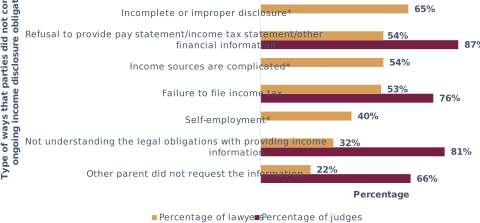
Figure 6: Top three most common reasons for non-compliance with ongoing income disclosure obligations, as ranked by lawyers and judges – Text version
A horizontal bar graph with 11 rows. The x-axis indicates percentages. The y-axis indicates reasons for non-compliance with ongoing income disclosure obligations. The legend below the graph notes that yellow is for the “percentage of lawyers” and red is for the “percentage of judges.”
The first row is to the right of “incomplete or improper disclosure.” There is only one yellow bar that goes up to 65%. The next two rows are to the right of “refusal to provide pay statement/income tax statement/other financial information.” The yellow bar goes up to 54% and the red bar goes up to 87%. The fourth row is to the right of “income sources are complicated.” There is only one yellow bar that goes up to 54%. The next two rows are to the right of “failure to file income tax,” and the yellow bar goes up to 53% and the red bar goes up to 76%. The seventh row is to the right of “self-employment;” there is only one yellow bar that goes up to 40%. The next two rows are to the right of “not understanding the legal obligations with providing income information.” The yellow bar goes up to 32% and the red bar goes up to 81%. The final two rows are to the right of “other parent did not request the information.” The yellow bar goes up to 22% and the red bar goes up to 66%.
The first identified reason “incomplete or improper disclosure,” the third identified reason “income sources are complicated,” and the fifth identified reason “self-employment” have a footnote with the star symbol “*.” Below the graph, the footnote reads:
*Reasons only listed in the survey of lawyers.
3.5.5 Most judges indicated that a disclosure order was likely to be awarded when a party did not comply with income disclosure obligations. Once the order was made, over half of lawyers indicated that the obliged party was likely to comply.
When a party did not comply with income disclosure obligations, almost all judges (91%) indicated a disclosure order was usually or almost always awarded. Lawyers were then asked how often the obliged party complied with a court-ordered application for disclosure. Over half (57%) reported that the obliged party usually or almost always complied with the order, with some lawyers reporting that the obliged party complied about half of the time (35%), rarely (6%) or never (1%).
3.5.6 Many judges reported that when a party did not comply with income disclosure obligations, their income was likely to be imputed.
If a party fails to provide income information, the court can impute their income. Income imputation refers to when a judge assigns or imposes an income on a party, regardless of whether they are actually earning that amount of money.
More than two in three judges (68%) reported that income was usually or almost always imputed when a party was non-compliant with income disclosure obligations. Almost one-quarter (23%) indicated that income was imputed about half of the time, and 8% of judges indicated that income was rarely imputed when non-compliance was found.
3.6 Income determination
For child support purposes, income is calculated using a party’s gross income. Income determination starts with line 15000 of the Income Tax Return and is adjusted with Schedule III of the Federal Child Support Guidelines.
3.6.1 Most lawyers and judges reported that disputes related to income determination occurred in at least half of their cases.
Aside from the issue of income disclosure, approximately half of lawyers (54%) and judges (49%) reported that disputes related to the determination of the amount of income for child support purposes occurred in about 50% of their cases. Around one in four lawyers (22%) and judges (27%) indicated that disputes related to income determination usually or almost always occurred. The remaining lawyers (24%) and judges (25%) indicated disputes related to income determination rarely or almost never occurred.
3.6.2 In child support cases, it was most challenging to determine income in cases where there was income from tax dividends or capital gains, irregular income patterns, and/or self-employment or cash income.
Lawyers and judges reported that the top threeFootnote 29 most challenging issues with income determination for child support purposes, aside from income non-disclosure, were cases involving income from tax dividendsFootnote 30 or capital gains that needed to be adjusted, irregular income patterns, and self-employment or cash income. The least challenging issue with income determination reported by lawyers and judges was capitalization. See Figure 7 for more information.
Figure 7: Top three challenging issues encountered when determining income for child support purposes aside from income non-disclosure, as ranked by lawyers and judges
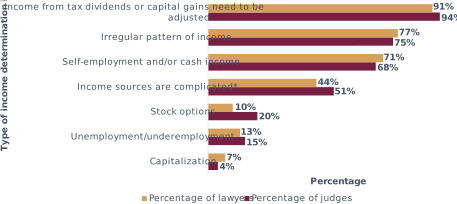
Figure 7: Top three challenging issues encountered when determining income for child support purposes aside from income non-disclosure, as ranked by lawyers and judges – Text version
A horizontal bar graph with 14 rows. The x-axis indicates percentages. The y-axis indicates income determination issues. The legend below the graph notes that yellow is for the “percentage of lawyers” and red is for the “percentage of judges.”
The first two rows are to the right of “income from tax dividends or capital gains need to be adjusted.” The yellow bar goes up to 91% and the red bar goes up to 94%. The next two rows are to the right of “irregular pattern of income.” The yellow bar goes up to 77% and the red bar goes up to 75%. The fifth and sixth rows are to the right of “self-employment and/or cash income,” and the yellow bar goes up to 71% and the red bar goes up to 68%. The next two rows are to the right of “income sources are complicated,” and the yellow bar goes up to 44% and the red bar goes up to 51%. The ninth and tenth rows are to the right of “stock options;” the yellow bar goes up to 10% and the red bar goes up to 20%. The eleventh and twelfth rows are to the right of “unemployment/underemployment,” and the yellow bar goes up to 13% and the red bar goes up to 15%. The final two rows are to the right of “capitalization.” The yellow bar goes up to 7% and the red bar goes up to 4%.
The fourth identified issue “income sources are complicated” has a footnote with the star symbol “*.” Below the graph, the footnote reads:
*Includes, for example, income from tax shelters, income from foreign sources, and party is a shareholder, director or officers of a company or has trust income.
- Date modified: