
II Children’s cognitive abilities and their impact on children’s evidence
The legal system is designed based on adults’ abilities. While children can meet expectations in some areas, in other areas their skills are still developing. Thus, it is important to understand children’s cognitive development and how it relates to their ability to perform within the legal system.
2.1 Children’s developing cognitive skills
Children’s developing cognitive skills play an important role in their ability to provide testimony. In particular, executive functioning skills, which develop throughout childhood and into early adulthood, support children, youth, and adults in providing testimony. Executive functions include components such as working memory (the ability to hold information in mind and manipulate it), and inhibition (the ability to restrain the initial impulse to respond) (Diamond, 2006). Additionally, children develop the socio-cognitive skill of theory of mind (the ability to understand that others have different thoughts, desires, feelings, or emotions). These skills are important in numerous aspects of a child’s life, but they are integral in supporting children in providing reports of their experiences.
Working memory is the ability to temporarily hold information in memory and manipulate it for subsequent recall (Baddeley, 1986). For instance, a child must hold the question being asked and the key details of an event in memory. Then the child must retrieve the details in the order they are questioned about them, and potentially re-order them based on follow-up questions. Researchers find that the accuracy of children’s eyewitness memory reports is related to their working memory (e.g., Rossi-Arnaud & Angelini, 2017; Ruffman et al., 2001), meaning children with better working memory tend to be more accurate in recounting their experiences. Working memory begins developing in the preschool years (e.g., Carlson, 2005) with working memory abilities improving with age. For example, about half of 5-year-olds can hold in memory three or fewer pieces of information and recall them (e.g., 3 numbers) and by about 9 years of age most children can hold three details in memory (Pickering & Gathercole, 2001). Working memory continues to develop with skills peaking around 30 years of age (Alloway & Alloway, 2013). This long developmental process means that children cannot be expected to perform similarly to adults. Lawyers should take this into consideration when developing questions. For example, they should ensure that they do not ask long compound questions that require children to hold multiple parts of a question in memory. And, to the extent possible, they should sequence an event in the order the event occurred, rather than jumping around from one timepoint to another.
Inhibitory control involves the ability to resist responding with an automatic response. For example, inhibitory control involves resisting answering a question before it is fully complete or not responding with the first thing that comes to mind, but instead pausing to ensure you have the correct answer before responding. Inhibitory control begins to develop during the preschool years (e.g., Carlson, 2005; Dowsett & Livesey, 2000), with 3-year-olds demonstrating a rudimentary ability to inhibit responses. By 5 years of age, children show some skills in inhibiting responses but are slow in their ability to stop an automatic response. Stopping speed increases with age across childhood and into adulthood (Williams, Ponesse, Schachar, Logan, & Tannock, 1999). While poor inhibitory control skills have been found to be related to young children’s inability to inhibit the truth, resulting in honest disclosures of their own transgressions (e.g., O’Connor, Dykstra, & Evans, 2020; Talwar, Crossman, & Wyman, 2017; Talwar & Lee, 2008; Williams, Moore, Crossman, & Talwar, 2016), it is also related to children’s tendency to respond without thinking through the question asked or their answer. For example, when asked a yes/no question (i.e., a question that can simply be answered with a yes or a no), young children (2 to 5 years old) often demonstrate a “yes” bias (Moriguchi, Osaka, & Itakura, 2008; Fritzley & Lee, 2003; Fritzley, Lindsay, & Lee, 2013), answering “yes” to a question without fully processing the question asked. Inhibitory control skills have also been found to be related to children’s ability to answer complex questions such as questions that are referentially ambiguous (see Section V; Evans, Stolzenberg, & Lyon, 2017). Children with higher inhibitory control skills are also more resistant to suggestive questions (Roberts & Powell, 2005; Melinder, Endestad, & Magnussen, 2006).
Children must also consider the perspective or intentions of the questioner to successfully answer questions. As such, the socio-cognitive skill of theory of mind is required. Theory of mind is the ability to interpret another’s mental states such as beliefs, desires, or emotions (Premack & Woodruff, 1978). Mental states are challenging for children to understand as they represent internal thoughts or feelings. People’s mental states are not always obvious to others or potentially contrast with their external behaviours. For example, we may be nice to someone we don’t really like to gain access or an advantage from them. Children’s theory-of-mind skills become more sophisticated over time (e.g., Wellman & Liu, 2004). Children start to recognize that different people can have different desires from one another. For example, young children begin to understand that an adult may have different food preferences than they do (e.g., Repacholi et al., 1997). Between 3 and 5 years of age, children develop an understanding that others may not know what they know (knowledge ignorance). This means young children may assume an adult has access to the same information as they do and thus provide less detailed responses to the adult’s questions. By around 4 or 5 years of age, children demonstrate false-belief understanding, or the awareness that someone can believe something to be true when in fact it is false. This ability supports children to resist suggestions from others about their experiences (e.g., Karpinski et al., 2009; reviewed in Bruck & Melnyk, 2004) as they understand that others may hold beliefs that are untrue or incorrect. Children’s false-belief understanding becomes more sophisticated with age. By 6 to 9 years of age they can reason about a person’s beliefs about another person’s beliefs (e.g., What Sara thinks that Michael thinks; Perner, 1988). Finally, the ability to infer someone’s real vs feigned emotional state based on contextual information (real-apparent emotion) develops around 5 to 6 years of age (Harris, Donnelly, Guz, & Pitt-Watson, 1986). For example, understanding that another child feels sad when others make jokes about them even though they are pretending they are happy. These skills may help children in interpreting interpersonal relationships.
Importantly, the development of these socio-cognitive skills (executive functions and theory of mind) has been found to be delayed or at a deficit for maltreated children. Maltreated children tend to exhibit lower scores on theory of mind and executive functioning measures compared to non-maltreated age matched peers (Beers & De Bellis, 2002; Cicchetti, Rogosch, Maughan, Toth, & Bruce, 2003; Demers et al., 2022; Lund, Toombs, Radford, Boles, & Mushquash, 2020) and this deficit remains into adolescence and adulthood (Kirke-Smith, Henry, & Messer, 2014; Mothes et al., 2015; Nikulina & Widom, 2013). Furthermore, testimonial load (e.g., increased cognitive loadFootnote 1 while testifying) amplifies these differences. Thus, the age norms discussed above are expected to be several years delayed for children who have experienced neglect or abuse.
2.2 Children’s understanding of the truth and promising
Extensive research has revealed that children begin to understand the concept of lying during the preschool years (e.g., Bussey, 1992; Lyon, Quas, & Carrick, 2013; Siegal & Peterson, 1996; Vendetti, Kamawar, & Andrews, 2019; Wandrey, Quas, & Lyon, 2012); however, it is not until around 10 or 11 years of age that children display a more comprehensive and adult-like understanding (e.g., Lavoie, Nagar, & Talwar, 2017; Strichartz & Burton, 1990; Wimmer, Gruber, & Perner, 1984). One factor that can influence children’s ability to demonstrate their conceptual understanding is how the question is asked. Some questions simply require children to recognize a truth or a lie (e.g., “If I say my shirt is blue, would that be a truth or a lie?”), while others require children to provide a definition or an explanation of the difference between the truth or a lie. Although children can successfully recognize a truth or a lie as early as 4 to 5 years of age, they are not able to provide accurate definitions until 8 years of age (Lyon & Saywitz, 1999). Furthermore, children are more accurate at differentiating between truths and lies about neutral statements (by 3.5 years of age) and good acts (around 4 to 6 years of age) than bad acts. Specifically, children have difficulty differentiating truth and lies when the speaker has committed a bad act, confusing bad acts with lies (Lyon et al., 2013; Wandrey et al., 2012). These findings suggest that children’s conceptualization of lies begins during the preschool years, but a more stable concept of truth and lies does not emerge until later childhood (approximately 10 years of age).
Beyond children’s abilities to accurately identify statements as truths and lies, researchers have examined children’s moral evaluations of whether lies are good or bad. Existing evidence suggests that children are sensitive to factors that may influence the morality of lying. For example, by 5 years of age, children are already able to consider someone’s intention (whether they were trying to deceive someone or whether they made a mistake) when evaluating the honesty of their statement as good or bad, and these evaluations reach maturity by about 10 to 11 years of age (e.g., Bussey & Grimbeek, 2000; Lyon, Ahern, Malloy, & Quas, 2010; Lyon et al., 2013). Lying to conceal a person’s wrongdoing is consistently seen as bad by children and adults in different cultures (e.g., Cheung, Siu, & Chen, 2015; Lee, Xu, Fu, Cameron, & Chen, 2001; Mojdehi, Shohoudi, & Talwar, 2020).
Importantly, research examining the relationship between children’s conceptualization and moral evaluation of lie-telling and their own honesty about negative events (i.e., wrong doings by the child or someone else) has found limited relation between the two (Talwar, Lee, Bala, & Lindsay, 2002; Talwar, Lee, Bala, & Lindsay, 2004; Talwar & Lee, 2008). Children who fail to demonstrate an understanding of truth and lies may still be honest, and children who show a sophisticated understanding may still tell lies. Given this lack of relation, children in Canadian courts (see Section VII) are not required to demonstrate an understanding of truths and lies prior to testifying in court.
How to Elicit a Promise
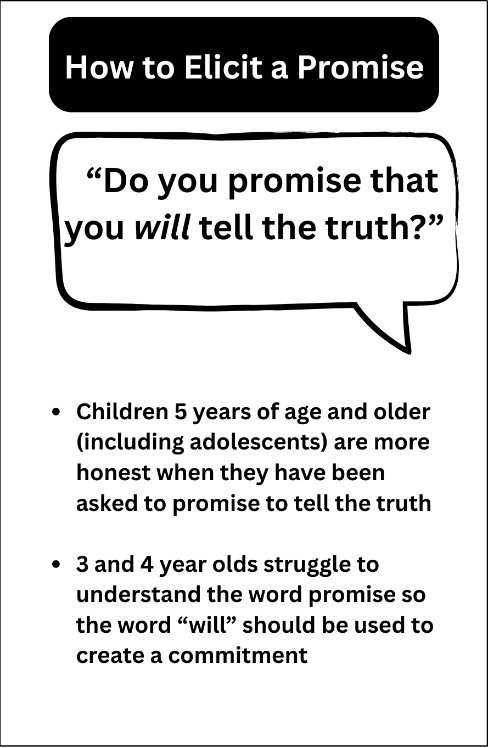
Text version
The image is in the shape of a rectangle in a vertical position. Under the title, it contains a speech bubble that says, “Do you promise that you will tell the truth?”, where the work “will” is emphasized. Below the speech bubble there are two bullet points. Next to the first bullet, it is written, “Children five (5) years of age and older (including adolescents) are more honest when they have been asked to promise to tell the truth.” The second bullet says, “Three (3) and four (4) year olds struggle to understand the word “promise” so the word “will” should be used to create a commitment.
One factor that has been found to be related to children’s honesty is promising to tell the truth. Promising has been extensively examined in the moral development literature (e.g., Astington, 1988a; 1988b; 1988c; Austin, 1962; Bussey, 2010; Lyon & Evans, 2014; Talwar, Lee, Bala, & Lindsay, 2002; 2004). Including the word “promise” in a statement has been seen as an effective technique for inducing a sense of obligation as it demonstrates one’s commitment and one’s intention (Austin, 1962; Bussey, 2010). However, young children struggle to understand the implications of the word “promise” (Astington, 1988a; 1988b). For example, Lyon and Evans (2014) found that 3- to 5-year-old children showed greater understanding of a commitment when the words “I will” are used compared to “I promise”, and that “I will” was understood at a younger age. These findings suggest that using the word promise may be less effective with younger children.
Researchers have assessed the effectiveness of promising to tell the truth on children’s honesty about negative events. Promising has consistently been found to be effective in increasing honesty with children 5 years of age through adolescence (Evans & Lee, 2010; Evans & Talwar, 2024; Lyon, Malloy, Quas, & Talwar, 2008; Lyon & Dorado, 2008; McWilliams, Stolzenberg, Williams, & Lyon, 2021; Quas, Stolzenberg, & Lyon, 2018; Talwar et al., 2002). However, asking younger children (3- to 4-year-olds) to promise to tell the truth appears to be less effective (Bender, O’Connor, & Evans, 2018). This lack of effectiveness is likely due to their lack of understanding of the word promise (as noted above). However, asking children to verbalize their promise (“I promise that I will…”) has been found to increase children’s behavioural adherence to their promises compared to simply asking them to agree to a promise. Evans and colleagues (2018) found that when they asked children to verbally state their promise not to cheat in a game (“I promise I will not peek at the toy”) including the words “I will” along with the promise significantly increased the likelihood that children would adhere to the rules and not cheat in the game. Taken together, these findings support the idea that children should be asked to promise that they will tell the truth prior to providing a report of their experiences.
2.3 Children’s abilities to estimate duration, timing, and frequency of events
When recalling a prior experience that brought them in contact with the justice system, a child may be asked to describe how long the event took, when it took place, and/or how often the event took place. These questions all inquire about seemingly reasonable, and sometimes legally necessary, details of a potentially criminal offence. In general, children do not spontaneously provide a great deal of temporal information in interviews (Peterson, 1996). However, investigators often actively seek such information from children. Asking for this information only makes sense if a child has the cognitive skills to provide such details. If they do not, then asking for this information is likely to result in guessing, changed answers, and/or non-responsiveness.
An initial key point to understand is that children’s ability to talk about time concepts precedes their ability to understand and apply these concepts, and that this comprehension is protracted (Orbach & Lamb, 2007; Tillman & Barner, 2015). For example, a child may use the word ‘yesterday’, but instead of meaning the day prior, they are describing any day before today. Similarly, just because a child is able to count to 10 does not mean that a child can accurately report the number of instances of sexual abuse they have experienced. Rote recitation of a temporal concept (e.g., listing the days of the week) and application of that concept to life experiences (i.e., on what day something happened) require different levels of understanding.
The research on children’s temporal concepts is still in relatively early phases. It is clear that children’s ability to provide temporal information increases with age, but it is difficult to pin down precisely what concepts are established at what age. There is substantial variability in these skills among children aged 7 to 12 years (Zakay, & Hancock, 1999). The literature, however, also makes clear that providing such information is a cognitively challenging task that many children involved in the justice system will struggle to do accurately (Friedman, 1991; Friedman & Lyon, 2005).
In one innovative study, Wandrey and colleagues (Wandrey, Lyon, Quas, & Friedman, 2012) asked children to describe their prior visits to dependency court (i.e., non-criminal proceedings in which child safety is at issue) and their placement changes. In their sample of 6- to 10-year- olds, they found that children were very limited in their ability to provide information about the frequency and temporal location of prior experiences. For example, only 10% of the children were able to correctly identify the month in which a past event took place. Although Wandrey and colleagues found no developmental differences, other studies have shown overall improvements in temporal understanding with age. And at least one study demonstrated that there were few differences between adolescents (14 to 16 years) and adults on several different time scales (Jack, Friedman, Reese, & Zajac, 2016).
Duration. Reporting how long an event took can have implications for both understanding the overall event and for a defendant’s ability to generate an alibi. Children appear to reach adult-like capabilities in reporting the duration of an event by about 10 to 12 years of age (Friedman et al., 2010; Friedman, Reese, & Dai, 2011; Pathman et al., 2013), which may reflect both advancements in sensitivity to duration (McCormack, 2015) and in children’s ability to use language that describes varying durations (Block et al., 1999).
Timing. Some criminal charges may depend on identifying when an event took place or how old the child was at the time (see Woiwod & Connolly, 2017). Placing an event in the temporal past appears to be challenging for children, and the difficulty increases with greater temporal distances between recall and the event in question (e.g., Hudson & Mayhew, 2011). Most of the recent research indicates that children’s ability to recall how long ago an event took place begins to reach adult levels between the ages of about 8 to 10 years old (Deker & Pathman, 2021; Pathman, Deker, Coughlin, & Ghetti, 2022).
In a study of children’s memory for visits to the hospital emergency room for a traumatic injury, Peterson (1996) found that 2- to 9-year-olds were very poor at reporting the time of day of the injury and the time at which they arrived at the hospital when directly asked. When not prompted for temporal details, only 9-year-olds spontaneously provided such information. In Wandrey and colleagues’ (2012) study of the timing of prior dependency court visits and placements, children who attempted to date their first of several court visits were off by about six months and they were off by 9 to 12 months for placement timing. These findings highlight the difficulty in providing precise timing information.
Frequency. Although children appear to do well in discriminating whether an event was experienced once or more than once (Sharman, Powell, & Roberts, 2011; Roberts et al., 2015), when an event has been experienced repeatedly, accuracy of frequency estimates is quite low. Wandrey et al. (2012) found that although children had a general sense of the number of times they had been to court and the number of placements they had experienced, their precision was extremely poor. Unfortunately, children seemed relatively unaware of their difficulties (or unwilling to signal this) in providing this information because few children responded with “I don’t know” to questions about event frequency. In Section IV, we address some of the reasons for children’s difficulty in reporting event frequency.
In sum, children appear to struggle to provide temporal information. General estimates and time frames may seem reasonable to request, but attempting to elicit precise temporal information about past events is unlikely to provide highly accurate information (of course, there will be exceptions). Temporal information, perhaps more than most other concepts, demonstrates the tension between what children are capable of reporting and what the justice system often demands from witnesses (e.g., Price, Connolly, & Gordon, 2016). Critically, children’s ability to recall temporal information is unrelated to their recall of accurate event details (Friedman & Lyon, 2005), and thus conclusions about a child’s overall accuracy or honesty should not be drawn from any observed challenges in recalling temporal detail.
2.4 Children’s concepts of court
A final consideration in children’s cognitive abilities as they relate to their involvement in the legal system is children’s understanding of court processes. Of course, most adults would expect that young children would have limited understanding of the intricacies involved in key roles like a judge, lawyer, jury, or evidence, and that children would generally lack an understanding of courtroom procedures. The little research available on the topic clearly demonstrates these expectations to be accurate: children, particularly younger children, lack knowledge of court concepts, and this uncertainty contributes to anxiety about their participation in the justice system.
Several studies have been conducted that have demonstrated children’s limited knowledge of concepts and processes related to court, as well as legal terminology. In the first major study to demonstrate this challenge, Flin and colleagues (Flin, Stevenson, & Davies, 1989) showed that children younger than 10 years of age knew little about the legal system, including both processes and terminology. For instance, many 6- to 8-year-olds believed that lying on the stand could result in their imprisonment (Flin, Stevenson, & Davies, 1989). A clear conclusion that can be drawn from the literature on children’s knowledge of court concepts is that such knowledge generally improves with age (Block, Oran, Oran, Baumrind, & Goodman, 2010; Flin, Stevenson, & Davies, 1989; Melton, Limber, Jacobs, Oberlander, Berliner, & Yamamoto, 1992; Sas, Austin, Wolfe, & Hurley, 1991; Saywitz, Jaenicke, & Camparo, 1990). However, despite evidence that some legal professionals assume that children aged 10 to 12 years old will have more adult-like understanding of legal concepts (Eltringham & Aldridge, 2000; Henderson, 2002), even children as old as 15 years demonstrate limited legal knowledge both before and after court experiences (Crawford & Bull, 2006; Quas, Wallin, Horwitz, Davis, & Lyon, 2009).
Some of children’s difficulty lies in unfamiliarity with behavioural expectations and courtroom procedures (e.g., where key players will sit in the room), whereas other challenges are found in understanding the specific terms used in the justice system. In one of the earliest demonstrations, Saywitz and colleagues (1993) noted two primary error types when children were asked about court terminology. First, children demonstrated auditory discrimination errors, such as mistaking “jury” for “jewelry”. Second, children made homonym errors, by confusing words with more than one meaning (a court is a place to play basketball). Professionals who interact with children in the justice system must clearly describe all components of the court experience to reduce children’s confusion and the potential for misunderstanding. This is particularly essential because there is evidence that limited legal knowledge increases children’s anxiety about testifying (Goodman et al., 1998; Saywitz & Nathanson, 1993). We return to efforts to prepare children for court in Section VII.
- Date modified: