
Perceptions of accountability in youth and young adults
Holding youth accountable through the YCJS
The YCJA is based on the principle that youth are presumed to be less morally blameworthy than adults; it acknowledges that youth should be held accountable differently than adults given their lack of maturity and their greater level of dependency (s. 3(1)b)ii)).
Respondents were asked whether youth should be held accountable in a different way than adults for crimes they have committed because they are less emotionally and cognitively mature. Responses were measured on a five-point scale, from one (1) meaning “Strongly disagree” to five (5) meaning “Strongly agree.” Overall, 60% of respondents agreed that youth should be held accountable in a different way than adults for crimes they have committed because they are less emotionally and cognitively mature. Younger respondents aged 18 to 24 (80%) and 25 to 34 (71%) were more likely to agree with this statement, compared with older respondents aged 35 to 44 (58%), 45 to 54 (57%), 55 to 64 (48%), and 65 and older (58%). Women (64%) were more likely than men (56%) to agree that youth should be held accountable differently than adults (see Chart 3). Respondents with a higher level of education, such as a bachelor’s degree (65%) and a post-graduate degree (72%), were more likely to agree with this statement, compared with respondents with a lower level of education (i.e., a high school diploma or equivalent (56%), a registered apprenticeship or other trades certificate or diploma (53%), a college, CEGEP or other non-university certificate or diploma (58%), and a university certificate or diploma below a bachelor’s level (55%).
Chart 3. Percentage (%) of respondents who agree that youth (aged 12 to 17) and young adults (aged 18 to 21 and 22 to 24) should be held accountable in a different way than older adults for crimes, by gender, Canada, 2022
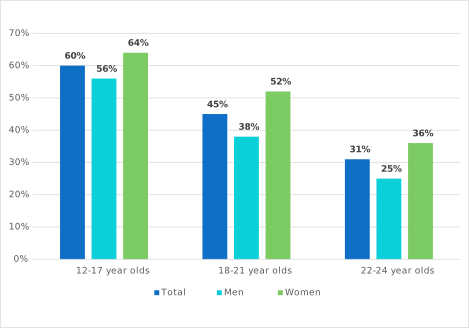
Chart 3. Percentage (%) of respondents who agree that youth (aged 12 to 17) and young adults (aged 18 to 21 and 22 to 24) should be held accountable in a different way than older adults for crimes, by gender, Canada, 2022 – Text version
There is a vertical bar graph with three groups of four bars. The x-axis lists the three groups of bars from left to right “12-17 year olds”, “18-21 year olds”, and “22-24 year olds”. The y-axis lists percentages from 0% to 70%, increasing in increments of 10%.
There is a legend below the graph that notes that blue is ‘Total”, light blue is “Men”, and green is “Women”.
The first group of vertical bars are identified as “12-17 year olds” with the blue bar at 60%, the light blue bar at 56%, and green at 64%.
The second group of vertical bars are identified as “18-21 year olds” with the blue bar at 45%, light blue at 38%, and green at 52%.
The last group of vertical bars are identified as “22-24 year olds” with the blue bar at 31%, light blue at 25%, and green at 36%.
Below the legend are notes that say:
Holding young adults accountable through the adult CJS
Compared with the youth justice system, the adult criminal justice system has limited ability to deal with issues outside the formal criminal justice system, and relies more on custodial sentences to hold adults accountable. Previous research suggests that some people may not reach brain maturity until about the age of 25 (Giedd & al., 1999; Steinberg, 2015). This may result in young adults (aged 18-24) being less emotionally and cognitively mature, less capable of anticipating the consequences of their actions and in greater need of social supports, than older adults.
The NJS asked respondents whether young adults aged 18-21 years old and 22-24 years old should also be held accountable differently than older adults, for instance by receiving services and supports that are tailored to their level of maturity. Overall, 45% of respondents agreed with this statement when applied to young adults aged 18 to 21 years old. Indigenous (49%) and racialized people (50%)–specifically Middle Eastern and North African (57%), Black (56%), and South Asian people (54%)–were more likely to agree that young adults aged 18-21 years old should also be held accountable differently than older adults, compared with White people (44%). Younger respondents aged 18 to 24 (61%) and 25 to 34 (50%) were more likely than respondents aged 35 to 44 (38%) and 45 to 54 (42%) to agree with this statement. Significant differences were also observed based on the gender of respondents. Women (52%) were more likely than men (38%), to agree that young adults aged 18-21 years old should be held accountable differently than older adults (see Chart 3 above).
A smaller percentage of respondents (31%) agreed that young adults aged 22 to 24 years old should be held accountable differently than older adults. Agreement with this statement was more pronounced among Indigenous people (39%)–notably First Nations (43%) and Métis people (36%)–and racialized people (35%)–specifically Black (43%), Middle Eastern and North African (42%) and South Asian people (39%)–compared with White people (29%). Women (36%) were more likely to agree with this statement, relative to men (25%). People born outside of Canada (35%) were more likely than those born in Canada (30%) to agree that young adults aged 22 to 24 years old should be held accountable differently than older adults.
Holding young adults accountable through the YCJS
The survey further asked if young adults aged 18-21 years old and 22-24 years old who have been professionally assessed as not having the required level of maturity should be held accountable using the YCJS rather than the adult criminal justice system. Overall, 42% of respondents agreed with this statement when applied to young adults aged 18-21 years, but a smaller percentage (29%) agreed with this statement when applied to young adults aged 22-24 years old. Over one-quarter of respondents (28%) agreed that all young adults aged 18 to 21 (regardless of having an assessment) should be held accountable using the YCJS instead of the adult criminal justice system. Again, a smaller percentage of respondents (18%) agreed with this statement when applied to young adults aged 22 to 24.
- Date modified: