
Perceptions of judge’s consideration of Indigenous identity during sentencing
The YCJA states that particular attention must be given to the circumstances of Indigenous youth during sentencing (s. 38(2)d)). Respondents were asked if they agree that judges should consider the circumstances of Indigenous youth during sentencing when a youth is found guilty of 1) a minor offenceFootnote 10 and 2) a serious offence.Footnote 11 Responses were measured on a five-point scale, from one (1) meaning “Strongly disagree” to five (5) meaning “Strongly agree.”
Most respondents (64%) agreed with this statement in the case of minor offences (see Chart 4a). Indigenous people (71%)–specifically First Nations people (76%)–were more likely than White people (63%) to agree. Black people (73%) were also more likely than White people to agree that judges should consider the circumstances of Indigenous youth during sentencing when a youth is found guilty of a minor offence. Additionally, respondents aged 18 to 24 (75%) and 65 or older (71%) were more likely to agree with this statement than those aged 25 to 34 (64%), 35 to 44 (56%), 45 to 54 (62%), and 55 to 64 (60%). Woman (70%) were more likely than men (56%) to agree that judges should consider the circumstances of Indigenous youth during sentencing when a youth is convicted of a minor offence. Education was also related to perceptions of whether the circumstances of Indigenous youth should be considered at sentencing. Respondents with some post-secondary education (not completed) (68%), a bachelor’s degree (73%), and a post graduate degree above bachelor’s level (75%) were more likely to agree with this statement, relative to respondents with some high school (52%), a high school diploma or equivalent (59%) and a registered apprenticeship or other trades certificate or diploma (51%).
A smaller percentage of respondents overall (29%) agreed with this statement in the case of serious offences (see Chart 4a). Indigenous people (38%)–specifically First Nations (43%)–and racialized people (40%)–specifically Black people (45%) and Southeast Asian people (49%)–were more likely than White people (25%) to agree that judges should consider the circumstances of Indigenous youth during sentencing in the case of serious offences. Women (32%) were more likely than men (25%) to agree with this statement. People born outside of Canada (36%) were more likely than those born in Canada (27%) to agree with this statement.
Chart 4a. Percentage (%) of respondents who agree that judges should consider the circumstances of Indigenous youth during sentencing, by Indigenous identity, racialized identity and offence type, Canada, 2022
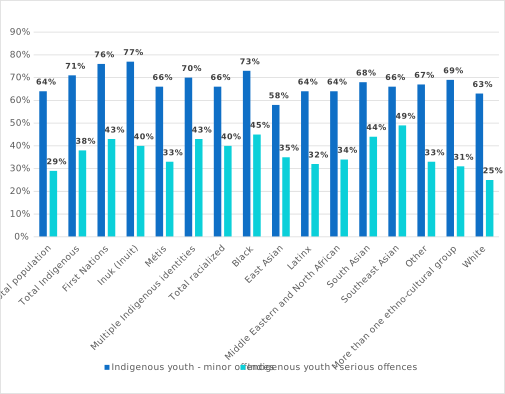
Chart 4a. Percentage (%) of respondents who agree that judges should consider the circumstances of Indigenous youth during sentencing, by Indigenous identity, racialized identity and offence type, Canada, 2022 – Text version
There is a vertical bar graph with 16 pairs of vertical bars from left to right: “Total population”, “Total Indigenous”, “First Nations”, “Inuk (Inuit)”, “Métis”, “Multiple Indigenous identities”, “Total racialized”, “Black”, “East Asian”, “Latinx”, “Middle Eastern and North African”, “South Asian”, “Southeast Asian”, “More than one ethno-cultural group”, and “White.”
There is a legend below that graph that notes that blue is “Indigenous youth – minor offences” and light blue indicates “Indigenous youth – serious offences.”
The first pair of vertical bars are identified as “Total population” with the blue bar at 64% and the light blue at 29%.
The next pair of vertical bars are identified as “Total Indigenous” with the blue at 71% and the light blue at 38%.
The following pair of vertical bars are identified as “First Nations” with the blue bar at 76% and the light blue at 43%.
The following pair of vertical bars are identified as “Inuk (Inuit)” with the blue bar at 77% and the light blue at 40%.
The next pair of vertical bars are identified as “Métis” with the blue bar at 60% and the light blue at 33%.
The next pair of vertical bars are identified as “Multiple Indigenous identities” with the blue bar at 70% and the light blue at 43%.
The next pair of vertical bars are identified as “Total racialized” with the blue bar at 66% and the light blue at 40%.
The following pair of vertical bars are identified as “Black” with the blue bar at 73% and the light blue at 45%.
The next pair of vertical bars are identified as “East Asian” with the blue bar at 58% and the light blue at 35%.
The next pair of vertical bars are identified as “Latinx” with the blue bar at 64% and the light blue bar at 32%.
The following pair of vertical bars are identified as “Middle Eastern and North African” with the blue bar at 64% and the light blue at 34%.
The next pair of vertical bars are identified as “South Asian” with the blue bar at 68% and the light blue at 44%.
The next pair of vertical bars are identified as “Southeast Asian” with the blue bar at 66% and the light blue at 49%.
The next pair of vertical bars are identified as “Other” with the blue bar at 67% and the light blue at 33%.
The next pair of vertical bars are identified as “More than one ethno-cultural group” with the blue bar at 69% and the light blue at 31%.
The last pair of vertical bars are identified as “White” with the blue bar at 63% and the light blue at 25%.
Below the legend are notes that say:
Perceptions of judge’s consideration of racialized identity during sentencing
The YCJA states that, within the limits of fair and proportionate accountability, the measures taken against youth who commit offences should respect ethnic, cultural and linguistic differences (s. 3(1)c)). Respondents were asked whether judges should impose sentences that take into consideration the circumstances of racialized youth by first considering options other than custody for 1) minor offences and 2) serious offences.Footnote 12 Responses were measured on a five-point scale, from one (1) meaning “Strongly disagree” to five (5) meaning “Strongly agree.”
The majority of respondents (61%) agreed with this statement in the case of minor offences (see Chart 4b). A higher percentage of respondents who agreed with this statement was observed among Indigenous people (68%)–specifically First Nations people (73%)–and Black people (72%), relative to White people (60%). Respondents aged 18 to 24 (69%) and those aged 65 and older (68%) were also more likely to agree that judges should impose sentences that take into consideration the circumstances of racialized youth by first considering options other than custody for minor offences, compared with respondents aged 35 to 44 (55%), 45 to 54 (59%), and 55 to 64 (57%). Women (67%) were more likely than men (53%) to agree with this statement.
A smaller percentage of respondents (26%) agreed with this statement in the case of serious offences (see Chart 4b). Indigenous people (34%)–specifically First Nations people (42%)–as well as racialized people (38%)–notably Southeast Asian (44%) and Black people (41%)–were all more likely than White people (22%) to agree that judges should consider the circumstances of racialized youth during sentencing in the case of serious offences. Women (28%) were more likely than men (23%) to agree with this statement. Respondents born outside of Canada (32%) were more likely to agree compared with those who were born in Canada (24%).
Chart 4b. Percentage (%) of respondents who agree that judges should consider the circumstances of racialized youth during sentencing, by Indigenous identity, racialized identity and offence type, Canada, 2022
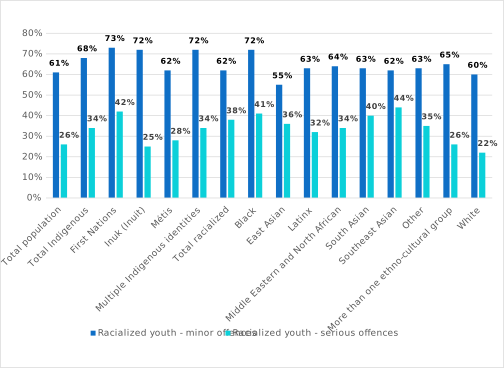
Chart 4b. Percentage (%) of respondents who agree that judges should consider the circumstances of racialized youth during sentencing, by Indigenous identity, racialized identity and offence type, Canada, 2022 – Text version
There is a vertical bar graph with 16 pairs of vertical bars from left to right: “Total population”, “Total Indigenous”, “First Nations”, “Inuk (Inuit)”, “Métis”, “Multiple Indigenous identities”, “Total racialized”, ‘Black”, “East Asian”, “Latinx”, “Middle Eastern and North African”, “South Asian”, “Southeast Asian”, “More than one ethno-cultural group”, and “White.”
There is a legend below that graph that notes that light blue is “Racialized youth – minor offences” and grey indicates “Racialized youth – serious offences.”
The first pair of vertical bars are identified as “Total population” with the blue bar at 61% and the light blue at 26%.
The next pair of vertical bars are identified as “Total Indigenous” with the blue at 68% and the light blue at 34%.
The following pair of vertical bars are identified as “First Nations” with the blue bar at 73% and the light blue at 42%.
The following pair of vertical bars are identified as “Inuk (Inuit)” with the blue bar at 72% and the light blue at 25%.
The next pair of vertical bars are identified as “Métis” with the blue bar at 62% and the light blue at 28%.
The next pair of vertical bars are identified as “Multiple Indigenous identities” with the blue bar at 72% and the light blue at 34%.
The next pair of vertical bars are identified as “Total racialized” with the blue bar at 62% and the light blue at 38%.
The following pair of vertical bars are identified as “Black” with the blue bar at 72% and the light blue at 41%.
The next pair of vertical bars are identified as “East Asian” with the blue bar at 55% and the light blue at 36%.
The next pair of vertical bars are identified as “Latinx” with the blue bar at 63% and the light blue bar at 32%.
The following pair of vertical bars are identified as “Middle Eastern and North African” with the blue bar at 64% and the light blue at 34%.
The next pair of vertical bars are identified as “South Asian” with the blue bar at 63% and the light blue at 40%.
The next pair of vertical bars are identified as “Southeast Asian” with the blue bar at 62% and the light blue at 44%.
The next pair of vertical bars are identified as “Other” with the blue bar at 63% and the light blue at 35%.
The next pair of vertical bars are identified as “More than one ethno-cultural group” with the blue bar at 65% and the light blue at 26%.
The last pair of vertical bars are identified as “White” with the blue bar at 60% and the light blue at 22%.
Below the legend are notes that say:
- Date modified: