
House of Commons Standing Committee on Justice and Human Rights – Bill C-7, An Act to amend the Criminal Code (medical assistance in dying)
Technical Briefing Deck
An Act to Amend the Criminal Code (medical assistance in dying)
Technical Briefing October 2020
Minister of Justice and Attorney General of Canada
Minister of Employment, Workforce Development and Disability Inclusion
Minister of Health
Background
June 2016
Former Bill C-14 decriminalized medical assistance in dying (MAID) for adults with decision-making capacity who are intolerably suffering and whose natural deaths are reasonably foreseeable, following the Supreme Court of Canada’s decision in Carter v Canada.
December 2018
Reports of the Council of Canadian Academies on MAID for mature minors, advance requests and requests where mental disorder is the sole underlying condition are tabled.
September 2019
Superior Court of Québec declares unconstitutional the eligibility criterion of “reasonable foreseeability of natural death.” The ruling, which applies only in Quebec, was not appealed. The Court suspends the declaration of invalidity for six months (until March 11, 2020, extended to December 18, 2020).
February 2020
Introduction of this bill, in response to Superior Court of Québec Truchon decision.
Not yet known
Former Bill C-14 required a Parliamentary Review of the MAID regime and the state of palliative care to begin 5 years after coming into force. Delayed due to COVID-19 impacts on Parliamentary activity.
Overview of main changes to MAID regime
- The Bill proposes amendments to the Criminal Code MAID provisions in relation to the following issues:
- Eligibility criteria;
- Safeguards;
- Waiver of final consent;
- Monitoring regime.
| Current Eligibility Criteria | Proposed Eligibility Criteria |
|---|---|
| 18+ years of age, has decision-making capacity and eligible for publicly funded health care services | 18+ years of age, has decision-making capacity and eligible for publicly funded health care services |
| Voluntary request for MAID | Voluntary request for MAID |
| Informed consent to receive MAID given after patient informed of means available to relieve suffering | Informed consent to receive MAID given after patient informed of means available to relieve suffering |
Person has “grievous and irremediable medical condition”, meaning all of the following criteria:
|
Person has “grievous and irremediable medical condition”, meaning all of the following criteria:
|
| For purposes of MAID eligibility, a mental illness is not a “serious and incurable illness, disease or disability” (new). |
| Current safeguards | Proposed changes to safeguards |
|---|---|
| Patient must make a written request that must be witnessed and signed by two independent witnesses. | Patient must make a written request that must be witnessed and signed by one independent witness (eased safeguard). |
| A paid personal or health care worker can be an independent witness (eased safeguard). | |
| Two independent practitioners must confirm all eligibility criteria. | Two independent practitioners must confirm all eligibility criteria. |
| Person must be informed that they can withdraw request at any time, by any means. | Person must be informed that they can withdraw request at any time, by any means. |
| Mandatory 10-day reflection period after written request is signed, unless death or loss of capacity imminent. | (10-day reflection period safeguard removed) |
| Immediately before MAID is provided, person must be given opportunity to withdraw consent, and must confirm consent to receive MAID. | Immediately before MAID is provided, person must be given opportunity to withdraw consent, and must confirm consent to receive MAID, except if waived (consent is given in advance). |
MAID safeguards: Natural death is not reasonably foreseeable
- The Bill proposes a different set of safeguards where natural death is not reasonably foreseeable:
- Patient must make a written request that is witnessed and signed by one independent witness (eased safeguard);
- A paid personal or health care worker can be an independent witness (eased safeguard);
- Two independent practitioners must confirm all eligibility criteria are met;
- One of the two practitioners assessing eligibility must have expertise in the condition that causes the person’s suffering (new safeguard);
- Person must be informed that they can withdraw request at any time, by any means;
- Minimum period of 90 days for assessment of request, which can be shortened if loss of capacity is imminent and assessments are complete (new safeguard);
- Person must be informed of counselling, mental health supports, disability supports, community services and palliative care, and be offered consultation with relevant professionals, as available and applicable (clarification of informed consent);
- Practitioners agree with the person that they have discussed and appropriately considered reasonable means of alleviating their suffering (clarification of informed consent);
- Immediately before MAID is provided, person must be given opportunity to withdraw consent, and must confirm consent to receive MAID.
- Patient must make a written request that is witnessed and signed by one independent witness (eased safeguard);
Waiver of final consent where natural death is reasonably foreseeable
- The Bill would permit the provision of MAID to persons who are no longer able to consent to it at the time it is to be provided:
- Person’s natural death must be reasonably foreseeable;
- Person must be assessed as eligible for MAID and MAID procedure must be scheduled;
- Person must be informed that they are at risk of losing decision-making capacity before the scheduled date;
- Practitioner must agree to provide MAID on the scheduled day if patient has lost capacity
(or earlier, after loss of capacity, if agreed); - Person gives consent in writing to receive MAID on the scheduled day if they are no longer able to consent on that day (this waives the requirement that consent be expressed immediately before MAID is provided).
- If, on the day of MAID procedure, the person has capacity to consent to MAID, the practitioner must give the person the opportunity to withdraw their request and ensure that the person gives express consent to receive MAID (existing safeguard requiring final consent).
- If, on the day of MAID procedure, the person has lost capacity to consent to MAID, the practitioner can provide MAID on the basis of the consent given earlier:
- Consent given in advance is invalidated if the person demonstrates, by words or gestures, refusal or resistance to the administration of MAID at the time of the procedure.
Changes to the Federal MAID Monitoring Regime
- The Bill would also amend the Criminal Code to expand data collection through the federal monitoring regime.
- Currently, only practitioners who receive written requests for MAID and pharmacists who dispense MAID substances are required to provide the information prescribed in the Regulations.
- Amendments would require all practitioners who assess MAID eligibility (prior to receiving a written request), and any person who undertakes preliminary assessments of whether a person meets eligibility criteria, to provide the information required by the federal Regulations for the Monitoring of Medical Assistance in Dying.
- Amendments would also clarify that pharmacy technicians are required to provide information if they dispense a substance for MAID.
Non-Legislative Measures
- Minister of Health to work with provinces and territories, health system partners and health practice regulatory bodies to develop, implement, monitor and report on MAID practice guidelines, training and retrospective review processes and results.
- Minister of Employment, Workforce Development and Disability Inclusion to work with provincial and territorial partners to enhance disability supports.
Annex: Profile of MAID in Canada (First Annual Report on MAID in Canada, 2019)
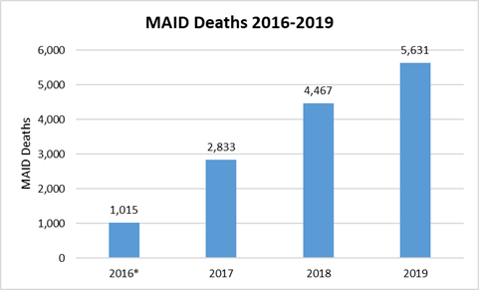
- Since legislation enacted, there have been 13,946 reported MAID deaths.
- Average age when receiving MAID is 75.2 years.
- Nearly equal proportion of males (50.9%) and females (49.1%) receiving MAID.
- Most common underlying medical condition is cancer (67.2%), followed by respiratory (10.8%) and neurological (10.4%) conditions.
- In 2019, there were 5,631 cases of MAID, representing 2% of all deaths in Canada in that year. In other permissive regimes, assisted deaths account for 0.3% to 4.6% of all deaths.
- There has been a consistent and gradual increase in MAID deaths over the last 3 years.
Text version
- Date modified: