
What We Heard from Women
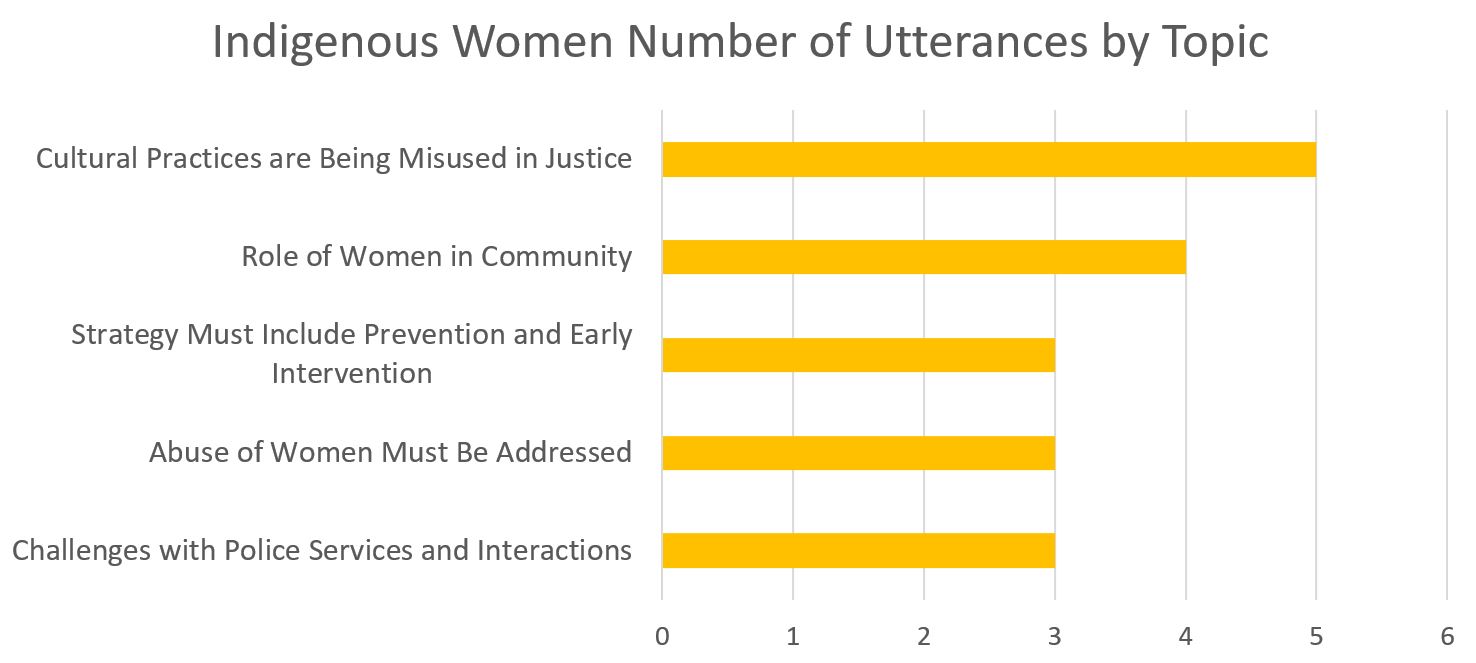
The following chart shows the most commonly coded themes from the Women’s Session. Some themes that were identified as key themes overall have been removed.
Text version
Bar chart representing the number of times 5 common themes were raised during the engagement session with women:
- Cultural practices are being misused in justice: 5 times
- Role of women in community: 4 times
- Strategy must include prevention and early intervention: 3 times
- Abuse of women must be addressed: 3 times
- Challenges with police services and interactions: 3 times
It is important to note that we hosted only one dialogue session specifically addressing the unique challenges and issues faced by Indigenous women in the Canadian justice system. During that session, we heard from provincial and territorial governments, women’s political and justice agencies, tribal governments and Indigenous councils, community-based restorative justice groups, women working in prevention and education, women's correctional facility staff, women’s healing organizations, as well as women Elders, knowledge holders and ceremonialists. Although the conversation explored many topics and ideas, it was indicated by participants that further discussions are required and would be welcomed.
Many participants commented that women come into contact with the criminal justice system due to issues associated with poverty and lack of resources. Many social determinants of justice, including addictions, partner abuse, mental health challenges, and unemployment were highlighted as areas where better programming and support would prevent women from entering the criminal justice system. In turn, this would help keep families together and help heal generational trauma that continues to split up Indigenous mothers from their children.
“It's a lot to do with addiction, mental health, trauma, relationships with the wrong character, all of those things. Even in terms of poverty we've noticed for a lot of the women that crimes of poverty or survival are kind of what they're being incarcerated for. So that whole spin has to change in terms of this restorative approach is that we have to look at ways to kind of avoid penalizing people for those things and have more community-based programming that's preventative and intervention programs from that court level so that individuals aren't actually being incarcerated.
“There's typically children involved so there's family that has to be considered and so when women end up in prison, they lose their source of income, they lose their children, they lose their housing and then trying to get back into the community, and to regain that all is really challenging.”
When women do enter the criminal justice system, the participants noted the harm that arises from taking mothers away from their children. Programs that allow mothers to care for their babies while incarcerated and work to keep families connected were cited as being extremely helpful in lowering recidivism and strengthening cultural and community ties after release.
“We've dealt with different scenarios where we did have one young girl, I think she was 13, 12 maybe, was traumatized by the fact that her mother came to jail because she envisioned the facility as what you saw on TV. She was absolutely traumatized by the fact that her mother was in jail and going through this horrific experience according to what you saw on TV. We brought the girl in to spend the weekend with her mother. So the mother got to cook with her daughter in the kitchen. She got to socialize with the daughter and just so that the daughter could go home and feel okay because she was (sic) very concerned about the mother.”
Women in the dialogue session were outspoken about the ways in which the justice system tries to incorporate “Indigenous” cultural practices into their systems and programs. For instance, there were concerns around improper vetting of the Elders that are associated with the system. We heard that Elders need to be recommended by communities and nations rather than selected by Justice Canada, and that training needs to be made available to Elders working in the system to ensure that re-traumatization doesn’t occur due to insensitive or old-fashioned perspectives.
“Get better training, get better training for yourself, for your elders, for the administration. Because I found out over the years that administration is the most passive aggressive, completely detrimental and aggressive and do not want to listen to anything else but themselves and their own peers.
“I think that the people who are the cultural team and the older generation need to have better training on how to be more warm and inviting and encouraging to younger generation as well because they are very skeptical and they're very negative. I find they're very aggressive and stern because of the trauma they endured. And it's so normalized… a strict grandmother or they're a strict auntie or strict uncle, but they're not strict, they're actually abusive and detrimental for mental health.”
Throughout the session, we heard about the role of women in modern Indigenous society, and the cultural understandings and misunderstandings that lead to the mistreatment of women by both perpetrators of crime and the criminal justice system. Women expressed that they do not feel valued, whether by those in positions of power or those who patrol and police their communities. Women in the session noted that they often feel objectified, sexualized, and tokenized, and that the result of those perceptions is that they are not respected at any point in the system.
“I get tokenized, I get utilized for my cultural relevance and my knowledge, but I'm not even being honoured or acknowledged and I'm tired of just being hired because I'm Indigenous.
“So women in all levels and all economic barriers are seen as a commodity for sexual gratification. That normalization has to stop.”
The women we heard from believe that a concerted effort must be made to re-model the system of security risk classification. Not simply to better reflect the whole individual, but to ensure that women’s access to services and programs are not limited due to their designation. Further, women who spoke to this issue described the long-term effects of security risk designation when aiming to reunite with their children post-incarceration and how difficult it is to navigate past these labels. Women want a justice system that truly supports Indigenous families.
- Date modified: