
Section 5: consistency of laws
Section 5 of the UN Declaration Act calls on the Government of Canada, in consultation and cooperation with Indigenous peoples, to take all measures necessary to ensure federal laws are consistent with the UN Declaration. This is an obligation relevant when either developing new legislation or amending existing federal laws that could affect the rights and interests of Indigenous peoples.
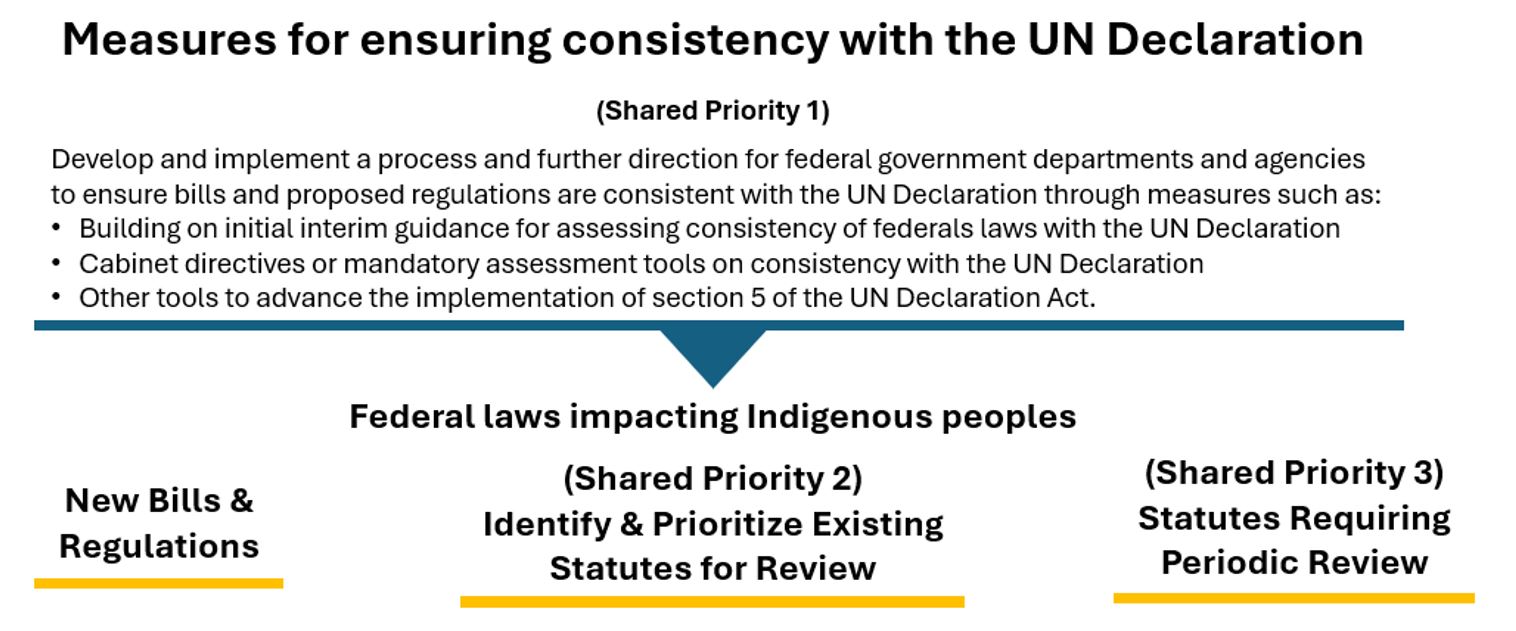
Text version
A graphic titled “Measures for ensuring consistency with the UN Declaration”. Under the title there is an area of text titled “Shared Priority 1”: Develop and implement a process and further direction for federal government departments and agencies to ensure bills and proposed regulations are consistent with the UN Declaration through measures such as:
- Building on initial interim guidance for assessing consistency of federals laws with the UN Declaration
- Cabinet directives or mandatory assessment tools on consistency with the UN Declaration
- Other tools to advance the implementation of section 5 of the UN Declaration Act”
Under that area of text, an arrow points downwards to another section of text titled “Federal laws impacting Indigenous peoples”, which is then divided into three sub-sections: “New bills and regulations”, “(Shared Priority 2) Identify and prioritize existing statutes for review”, and “(Shared Priority 3) Statutes requiring periodic review.”
In support of implementing Section 5, Shared Priorities (SP) Measures 1, 2 and 3, seek to advance implementation generally. Other APMs commit to reviewing and revising specific regulatory and legislative frameworks, and any progress on these commitments can be found in Annex B: Status of Action Plan Measures.
Continued and expanded efforts to fulfilling section 5 obligations is a priority of many Indigenous partners.
“We have seen a significant amount of outreach by the federal government to change practice policy and laws for the better. The feedback that we provided to the federal government on various policies programs and legislation has been accepted and in our view given consideration, in support for First Nations. However, there are still challenges because the feedback and constructive comments has to fit into existing bureaucratic framework things outside of that don't easily get considered by the bureaucracy.”
Anishinabek Nation of Union of Ontario Indians (UOI)
Legislative initiatives: key highlights
Over the past year, legislative initiatives engaging section 5 that required more intensive consultation and cooperation given the impacts on Indigenous rights advanced through Parliament. While Indigenous peoples and federal officials have identified a need to continue working toward developing a shared understanding of what working in consultation and cooperation means, these initiatives serve to highlight collaborative work being advanced as that shared understanding gets refined:
- An Act to amend the Interpretation Act and to make related amendments to other Acts, which changed the federal Interpretation Act by adding a section 35 non-derogation clause, received Royal Assent in November 2024. This clause ensures that all federal laws, statutes, and regulations are interpreted in a way that upholds, and does not diminish, Aboriginal and treaty rights recognized and affirmed in section 35 of the Constitution Act, 1982. Passage of this Act followed consultation with Indigenous partners conducted between 2020-2023.
- The Haida Nation Recognition Act, which affirms the Government of Canada’s recognition of the Haida Nation’s inherent right to govern themselves and make decisions according to their own governance, also received Royal Assent in November 2024. Required by the Nang K̲’uula • Nang K̲’úulaas Recognition Agreement concluded in 2023, the Act was drafted in consultation and cooperation with the Haida Nation.
- The Canadian Sustainable Jobs Act, which is intended to facilitate and promote economic growth, the creation of sustainable jobs and support for workers and communities in the shift to a net-zero economy, included the creation of a framework to allow for ongoing dialogue with Indigenous peoples as part of Canada’s approach to sustainable jobs. It received Royal Assent in June 2024.
- Introduction of Bill C-38, An Act to amend the Indian Act (New Registration Entitlements). The bill did not receive Royal Assent prior to prorogation. The intent of this bill was to addres several remaining inequities in registration and First Nation membership under the Indian Act, which supports First Nations (FN) priority 7 of the Action Plan.
- Introduction of Bill C-61, An Act respecting water, source water, drinking water, wastewater and related infrastructure on First Nation lands. The bill did not receive Royal Assent prior to prorogation. The intent of this bill was to support First Nations Priorities (FN) Measures 16 and 17 of the Action Plan relating to First Nations drinking water and wastewater.
- Introduction of Bill C-77, An Act respecting the Commissioner for Modern Treaty Implementation was introduced to Parliament in October 2024. The bill did not receive Royal Assent prior to prorogation. The intent of this bill was to establish a Commissioner for Modern Treaty Implementation as an independent Agent of Parliament, which would hold the federal government accountable for fulfilling its Modern Treaty commitments and obligations, identify areas for improvement, and strengthen the Crown’s Treaty relationships. This legislation supported Modern Treaty Partner Priorities (MT) measure 9.
Disclaimer: Since the end of the reporting period, the government has reintroduced C-38 and has publicly committed to reintroduce Bill C-61 and Bill-C77.
Working in consultation and cooperation to ensure consistency with the UN Declaration
Consultation and cooperation with Indigenous peoples on several legislative and regulatory initiatives in 2024-2025 contributed to ensuring consistency with the UN Declaration.
Supporting Indigenous harvesting rights
Based on consultation and cooperation undertaken, Transport Canada proposed amendments to the Regulations Amending the Small Vessel Regulations (Pleasure Craft Licensing) to exempt Indigenous persons from the pleasure craft license service fee if they use their pleasure craft to exercise their section 35 rights.
Protecting sea ice and the arctic ecosystem
During consultation and cooperation on potential amendments to the National Marine Conservation Areas General Regulations, feedback about the importance of protecting sea ice in accordance with Inuit worldviews and recognizing its critical role in ensuring cultural continuity and protecting Arctic ecosystems resulted in new content being added to the regulatory proposal.
Establishing a Canada Water Agency
The Canada Water Agency Act came into force on October 15, 2024, creating a standalone Canada Water Agency (Shared Priorities Measure 49). First Nations, Inuit and Métis partners were engaged on the creation of the Canada Water Agency since 2020, and meetings with partners were held in 2024 to discuss how their input was reflected in the legislation to create the standalone agency and its mandate and priorities.
Early involvement
“Canada should ensure that when laws and policies are going to be reviewed, that consultation with affected Indigenous groups is built into the process, at the appropriate time. In practice, consultation has been identified as a required step very far into the process, with the consequence that Indigenous people, including Indigenous women’s organizations, perceive the invitation to not be meaningful...”
Esquao, Institute for the Advancement of Aboriginal Women
The following initiatives saw Indigenous peoples involved early, in the initial planning or early development stage:
Addressing border crossing challenges
To alleviate some of the complex border crossing and migration challenges Indigenous peoples face, in October 2024, the Minister of Immigration, Refugees and Citizenship Canada announced Temporary Measures to reunite families across the Canada–United States (US) border. This announcement built on the roundtables and discussions that Immigration, Refugees and Citizenship Canada and the Canada Border Services Agency held with Indigenous communities, governments and organizations from October 2023 to February 2024. Discussions with Indigenous partners are expected to continue and would focus on developing proposed options for potential legislative changes as a long-term solution in support of Shared Priorities Measure 52.
Indigenous governing bodies and the Canada Energy Regulator Act
Consistent with the commitment in Shared Priorities Measure 34, Natural Resources Canada and the Canada Energy Regulator are working in consultation and cooperation with Indigenous partners to inform the development of proposed regulations that, if enacted, would shape the parameters of Indigenous Ministerial Arrangements. These arrangements would enable Indigenous governments to exercise certain powers, duties and functions of the Canada Energy Regulator.
Reinforcing Haida decision-making in Gwaii Haanas
In keeping with the Chiix̲uujin / Chaaw K̲aawgaa “Big Tide (Low Water)” Haida Title Lands Agreement, Parks Canada is working in consultation and cooperation with the Haida Nation to support the application of Haida laws in Gwaii Haanas.
Implementing the Impact Assessment Act
The Impact Assessment Agency of Canada is working in consultation and cooperation with Indigenous partners to plan and develop Indigenous Impact Assessment Co-Administration Agreement Regulations and on potential amendments to the Physical Activities Regulations (often referred to as the Project List).
Action Plan Measures supporting the implementation of section 5
Shared Priorities Measure 1
Justice Canada, Privy Council Office and Treasury Board Secretariat have started working in consultation and cooperation with Indigenous partners to develop and implement a process and further direction for federal government departments and agencies to ensure bills and proposed regulations are consistent with the UN Declaration through measures such as building on initial interim guidance for assessing consistency of federal laws with the UN Declaration. Initial bilateral meetings with key partners to provide information to help understand current processes and concepts, and to gain their perspectives to inform plans for a broader consultation and cooperation process were held during the reporting period.
The federal government distributed the Interim Guide for Officials on How to Assess Consistency with the United Nations Declaration on the Rights of Indigenous Peoples (the Interim Guide) to federal departments and agencies in June 2024. Reflecting its commitment to transparency, Justice Canada published the Interim Guide publicly in March 2025. Justice Canada strongly encourages federal officials to use the Interim Guide and supports them with training. This guidance remains evergreen and Indigenous partners' feedback will inform future versions of this guide.
Transport Canada has a mandatory assessment template to examine new or amended legislative and regulatory initiatives for potential intersections with the UN Declaration. This tool complements other significant efforts to ensure that all employees understand their obligations under the UN Declaration Act. In 2024-2025, Transport Canada officials completed 25 assessments.
Shared Priorities Measure 2
Consistent with the commitment in Shared Priorities Measure 2, An Act to amend the Interpretation Act and to make related amendments to other Acts amended the federal Interpretation Act to include a non-derogation clause that directs anyone interpreting federal laws to do so in a way that upholds, and does not diminish, Aboriginal and Treaty rights affirmed in section 35 of the Constitution Act, 1982. Information about consultation and cooperation on this legislation can be found here.
Shared Priorities Measure 3
Shared Priorities Measure 3 commits federal departments to review laws requiring periodic review in a manner that ensures consistency with the UN Declaration.
Early consultation and cooperation efforts undertaken in 2024-2025 by the Treasury Board of Canada Secretariat (TBS) shaped the approach to the mandatory review of the Access to Information Act planned for 2025. Key priorities identified by Indigenous partners included improving Indigenous access to information and enhancing protection of Indigenous data from disclosure.
The Canada Water Agency sought Indigenous partners views on how they want to be involved during the anticipated review of the Canada Water Act. Feedback received will inform the development of engagement plans reflecting their needs, preferences and priorities.
Department of Justice Canada
- Date modified: