
Audit of the Health and Wellness Program
Date: November 1st, 2022
Internal Audit Branch
Internal Audit and Evaluation Sector
Table of contents
- 1 Executive summary
- 2 Background
- 3 Audit objective
- 4 Audit scope
- 5 Audit approach
- 6 Findings, recommendations and management response and action plan
- 7 Audit opinion
- Appendix A: Audit criteria
- Appendix B: list of acronyms
1 Executive summary
1.1 Introduction
In the recent years, mental and psychological health has been gaining increasing attention and momentum in the federal public service. In 2015, the Clerk of the Privy Council, the Treasury Board Secretariat (TBS) and the Public Service Alliance of Canada (PSAC) identified addressing mental health in the workplace as a key priority, and commitments were established for deputy ministers to implement mental health strategies within their departments.
Since 2016, JUS has implemented initiatives and created the Mental Health Strategy (MHS) to advance employee health and wellness in the workplace. This Strategy was developed and aligned with both the Mental Health Commission of Canada’s (MHCC): National Standard on Psychological Health and Safety and the Mental Health Joint Task Force’s Report issued by Treasury Board Secretariat. In the fall of 2020, the Department updated its Mental Health Action Plan (MHAP) for a new 2020-2023 iteration, to continue the momentum on supporting employee health and wellness in the workplace.
JUS also committed to a hazard prevention program, the implementation of the Mental Health Strategic Advisory Group (MHSAG), and the creation of a network of Mental Health Ambassadors to support and promote mental health initiatives at a branch and sector level.
1.2 Strengths
The Department of Justice has taken a clear position in recognizing the importance of supporting and promoting mental and psychological health in the workplace. It has taken steps to advance the health and wellness of employees with the development of the MHS to “build a workplace culture in which everyone is empowered to work collaboratively to foster a psychologically healthy and safe workplace”Footnote 1. Employees have access to training, workshops, guides and toolkits, and information is distributed on a regular basis. Measures are in place to recognize individuals who put forward efforts to contribute to a positive and psychologically healthy workplace. A Mental Health Champion was appointed to “support and encourage stakeholders to engage with employees at all levels and to make collective and individual contributions towards a psychologically healthy workplace”. Furthermore, a network of Mental Health Ambassadors was put in place to help managers lead activities in support of workplace mental health, and to distribute information on training, events, tools and services available.
The Department complies with the new dispositions of the Canada Labour Code Part II to integrate mental health as a key component of occupational health and safety in the workplace. As mandated by the Treasury Board Secretariat, Justice Canada implemented a Psychological Health and Safety Management System (PHSMS), completed an assessment of workplace psychological hazards, and identified the factors that are of highest risk to employees’ mental health, such as workload management. The Department has undertaken a process to further assess workload issues and impacts.
The MHS is supported by a governance framework that provides roles and responsibilities for the support and promotion of mental health across working and management levels. It encompasses an action plan that sets out the outcomes Justice is looking to achieve, as well as an advisory group that provides advice and monitors the achievement of outcomes.
1.3 Areas for Improvement
Training is offered to managers and employees on a voluntary basis, however employee participation is limited. There is a risk of inconsistent knowledge, skills and abilities to support employees’ mental health and well-being among teams. Despite the Department’s efforts to engage employees and encourage dialogue on mental health matters, their participation in consultation processes is also limited.
The Department needs to define the healthy practices and healthy behaviours employees and executives need to adopt from a preventive perspective, to promote mental health and support the culture change.
Employees consider that the workload and the organizational culture are the two main factors impacting their mental health.
There are governance and oversight mechanisms in place to support the MHS. However, information sharing between stakeholders could be improved to deepen senior management’s knowledge of the Department’s health and wellness status, and to better support decision making.
1.4 Management Response
Management is in agreement with the audit findings, has accepted the recommendations included in this report, and has developed a management action plan to address them. The management action plan has been integrated in this report.
Submitted by:
_____________________________
Pamela Rudiger-Prybylski
Interim Chief Audit and Evaluation Executive
Department of Justice Canada
_____________________________
Date
2 Background
The World Health Organization defines psychological health as “a state of well-being in which the individual realizes [their] own abilities, can cope with the normal stresses of life, can work productively and fruitfully, and is able to make a contribution to his or her community”. Mental illness is the number one and fastest-growing cause of short-term and long-term disability in Canada. It accounts for nearly half of the disability claims among Canada’s federal public servants.
In recent years, mental and psychological health has been gaining increasing attention and momentum in the federal public service. In 2015, the Clerk of the Privy Council, the Treasury Board Secretariat (TBS) and the Public Service Alliance of Canada (PSAC) identified addressing mental health in the workplace as a key priority. The Clerk of the Privy Council and Secretary to the Cabinet stated:
“We must create the space for open and stigma-free dialogue that allows for honesty and compassion as well as a focus on preventing psychological harm, promoting health and resilience, and addressing incidents or concerns”
Further to this, commitments were established for deputy ministers to implement mental health strategies within their departments.
Justice Canada’s Framework for Mental Health
Along with the launch of the Federal Public Service Workplace Mental Health Strategy, the Department of Justice (Justice or JUS) implemented its Mental Health Strategy (MHS) in 2016. This Strategy was developed and aligned with both the Mental Health Commission of Canada’s (MHCC): National Standard on Psychological Health and Safety in the Workplace (the Standard) and the Mental Health Joint Task Force’s Report issued by Treasury Board Secretariat (TBS): Building Success: A Guide to Establishing and Maintaining a Psychological Health and Safety Management System in the Federal Public Service. Both the MHCC Standards and Task Force’s reports act as a voluntary, best practice framework for creating a psychologically healthy and safe workplace.
Justice’s MHS is administered along with the Psychological Health and Safety Management System (PHSMS), for the identification and mitigation of hazards that can affect the psychological health and safety of employees in the workplace. Three goals are defined under the MHS, which are aligned with those of the Federal Public Service:
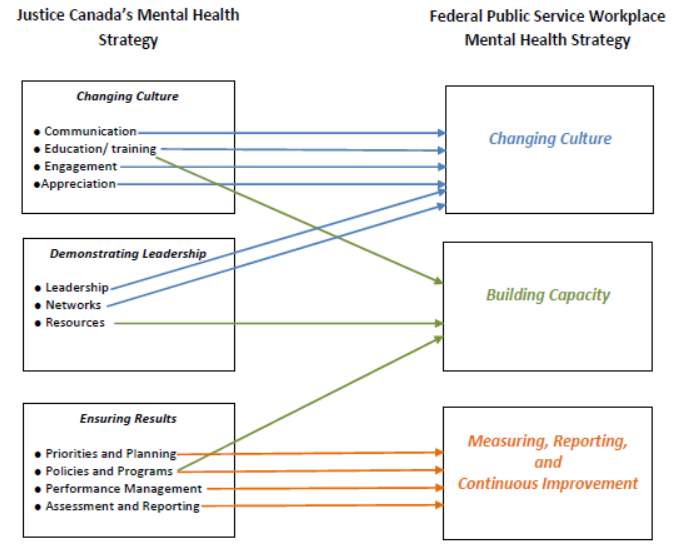
Justice and Federal Public Service Mental Health Strategies – Text version
This graph illustrates how the goals of the Justice Canada’s Mental Health Strategy align with those of the Federal Public Service Workplace Mental Health Strategy.
Justice Canada’s Mental Health Strategy’s Pillar 1, Changing Culture (Communication, Education/Training, Engagement, and Appreciation), and Pillar 2, Demonstrating Leadership (Leadership, Networks), are linked to the Federal Service Workplace Mental Health Strategy’s Changing Culture goal.
Justice Canada’s Mental Health Strategy’s Pillar 1, Changing Culture (Education/Training), Pillar 2, Demonstrating Leadership (Resources), and Pillar 3 (Policies and Programs) are linked to the Federal Service Workplace Mental Health Strategy’s Building Capacity goal.
Justice Canada’s Mental Health Strategy’s Pillar 3, Changing Culture (Priorities and Planning, Performance Management, and Assessment and Reporting), is linked to the Federal Service Workplace Mental Health Strategy’s Measuring, Reporting and Continuous Improvement goal.
Senior management’s commitment to address mental and psychological health, including changing culture and de-stigmatizing mental health issues, is reflected in the JUS Mental Health Framework through the MHS. This includes:
- A Mental Health Action Plan (MHAP), which sets out the outcomes Justice is looking to achieve to support its mission and vision for mental health and wellbeing. The MHAP also incorporates a mental health perspective to JUS’ mandate, roles and policies, with key considerations from various groups such as employment equity, diversity and inclusion steering committee and its sub-committees.
- A hazard prevention program revised every five years that describes what preventive measures are required to ensure physical and psychological needs in the workplace.
- An advisory group that provides oversight and guidance in support of the MHS.
- A network of Mental Health Ambassadors across the Department that help support the Wellness Team in promoting mental health.
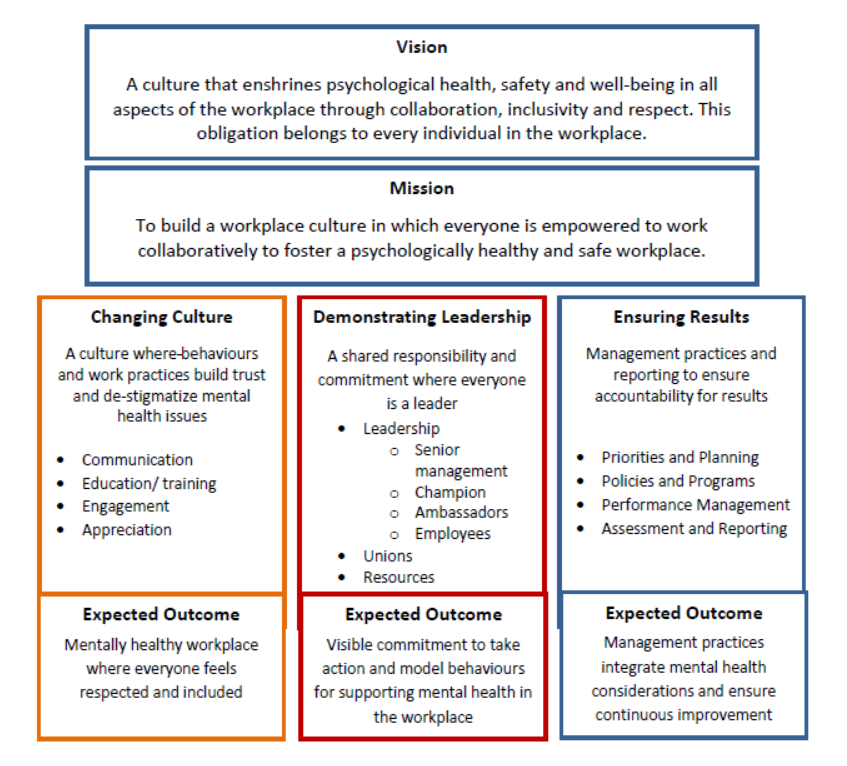
Mental Health Framework Overview – Text version
Vision: A culture that enshrines psychological health, safety and well-being in all aspects of the workplace through collaboration, inclusivity and respect. This obligation belongs to every individual in the workplace.
Mission: To build a workplace culture in which everyone is empowered to work collaboratively to foster a psychologically healthy and safe workplace.
Pillar 1 – Changing Culture: A culture where behaviours and work practices build trust and de-stigmatize mental health issues.
- Communication
- Education/ training
- Engagement
- Appreciation
Expected Outcome: Mentally healthy workplace where everyone feels respected and included.
Pillar 2 – Demonstrating Leadership: A shared responsibility and commitment where everyone is a leader.
- Leadership
- Senior management
- Champion
- Ambassadors
- Employees
- Unions
- Resources
Expected Outcome: Visible commitment to take action and model behaviours for supporting mental health in the workplace
Pillar 3 – Ensuring Results: Management practices and reporting to ensure accountability for results.
- Priorities and Planning
- Policies and Programs
- Performance Management
- Assessment and Reporting
Expected Outcome: Management practices integrate mental health considerations and ensure continuous improvement.
The MHAP was renewed in 2020 for the 2020-2023 period. It was developed by taking into consideration the context of the Covid-19 pandemic and its impacts on individuals and the workplace.
3 Audit objective
The objective of this Audit was to assess the adequacy and effectiveness of the processes, procedures, and practices in place to support the health and wellness of employees.
4 Audit scope
The scope for this Audit included all of the new or existing relevant processes, plans and procedures implemented by the Department to maintain a healthy and high-performing workforce. The Audit focused on policies, procedures, processes in place during the fiscal years 2019-2020 to 2021-2022.
5 Audit approach
This audit was conducted in accordance with Treasury Board Policy on Internal Audit and Directive on Internal Audit, the Institute of Internal Auditors’ International Standards for the Professional Practice of Internal Auditing, the Mental Health Commission of Canada’s National Standard of Canada for Psychological Health and Safety in the Workplace and the International Organization for Standardization’s International Standard for Auditing Management Systems.
These standards require that the audit be planned and performed in such a way as to obtain reasonable assurance that the objectives of the audit are achieved.
6 Findings, recommendations and management response and action plan
This section provides the findings and recommendations resulting from the Audit work carried out. The Audit was conducted based on the lines of enquiry and Audit criteria identified in the planning phase which are presented in Appendix A.
6.1 Advancing Mental Health and Mitigating Stigma
The MHS’s vision and mission is to promote a workplace that is psychologically healthy and safe. The first of three strategic goals, Changing Culture, aims to promote “a culture where behaviours and work practices build trust and de-stigmatize mental health issues”.
The Department is actively supporting and promoting mental health in the workplace but there is room for improvement to further advance the culture shift.
JUS has taken a clear position in recognizing the importance of supporting and promoting mental and psychological health in the workplace, and in implementing a strategy that meets employees’ needs. It launched its MHS in 2016, along with the Federal Public Service Workplace Mental Health Strategy. The first objective of the Strategy on culture change encompasses training, communication, engagement and appreciation.
Education
JUS employees have access to a broad range of mental health training, workshops, podcasts, guides and toolkits through the Canada School of Public Service (CSPS) and other providers such as the Wellness Team, and the Canadian Innovation Centre for Mental Health in the Workplace (CIMHW). Between 2015 and 2018, all delegated managers were required to complete The Working Mind (TWM) mandatory training to gain the necessary knowledge and skills to assist employees with their mental health concerns. This training objective was to “address and promote mental health and reduce the stigma of mental illness in a workplace setting, while increasing resiliency”Footnote 2. However, after all managers completed their mandatory training, subsequent training became optional in 2018. In light of the optional training, managers who were appointed after 2018 are more likely to have a gap in mental health knowledge and skills. Officials from the Management Sector explained that the decision to remove the mandatory factor was supported by the fact that all delegated managers at that time were trained, and that optional training would continue to be offered to new and future delegated managers. However, results reported through the annual MHAP Accomplishments reports (2017-2020) revealed that participation in these courses is limited, and that there are barriers to training. In 2017-18, 82 employees completed TWM training activities, and 28 employees participated in MHFA. Several training sessions had to be cancelled due to insufficient numbers of participants, including the Mental Health in the Workplace (MHW) workshop from the Joint Learning Program. In 2018-19, these numbers increased, and the safeTALK training was added to the curriculum. In 2019-20, only one MHFA session was delivered due to in-house resources, and 15 employees participated in the safeTALK training.
These observations are consistent with responses obtained from employees during the Pulse survey administered in 2020 to gauge employees’ needs and sentiments in relation to workplace restrictions. Forty-seven percent (47%) (N=816 of 1750) of employees answered that they did not participate in any training or use any tool offered by the Department to support their mental health and well-being. During interviews, some employees reported facing barriers to participation in training, such as high workloads, or a lack of support from supervisors to attend mental health training sessions or workshops. Education and training are key to increase awareness and build competencies around psychologically healthy behaviors. In the absence of mental health training, or other educational mechanisms such as coaching, there is a risk of imbalance in knowledge, skills and abilities to support employees’ mental health and well-being among teams. In that respect, some managers mentioned during interviews that they did not feel adequately prepared to meet expectations related to managing mental health related matters with employees or certain situations, such as dealing with employees who have experienced trauma.
Communication and Dialogue
The Department is using different communication channels to share knowledge and information about mental health issues and initiatives, best practices and resources. Regular communications on training offered, events from the Canadian Innovation Centre for Mental Health in the Workplace and LifeSpeak tools are sent to employees through the Wellness Teams’ emails and shared on the JUS Intranet site.
According to the Standard, active, meaningful, and effective participation of stakeholders is a key factor in psychological health. Moreover, organizations shall engage workers in policy development, data gathering, and the planning process to better understand their needs with respect to psychological health. During the first year of the pandemic, the Department conducted two pulse surveys with an objective to gauge employees’ needs and sentiments throughout the various phases of workplace restrictions which also includes questions relating to psychological health and safety. The Department also held consultations with employees in 2020 to ask them what they would like to see addressed for mental health in the workplace. Results from these consultations and others, such as the 2019 Public Service Employee Survey (PSES), were used to revise and update the MHAP for the 2020-2023 cycle. More recently, a second PHSMS survey was conducted in order to audit and update the hazard prevention program.
Despite the Department’s efforts to engage employees and encourage dialogue on mental health matters, response rates to some consultation processes are declining. For instance, participation in the PHSMS survey declined from 33% to 20% between 2019 and 2022. Furthermore, the gap in dialogue with employees was reflected in the results from the PHSMS survey, where the psychological factor “Involvement and Influence” dropped down from the 8th to the 11th rank between 2019 and 2022. This suggests that many employees don’t feel involved or that they have any influence in the decisions that affect them. In light of the impact that input and feedback can have on employee engagement, continued consultations can help further refine existing mental health related policies, processes and practices that better reflect employees’ needs.
Appreciation
JUS acknowledges that promoting mental health and supporting a culture change involves a recognition and appreciation of efforts made towards a positive and psychologically healthy workplace, and has taken steps to put this into practice. Executives have a performance objective in their performance agreement that allows them to be recognized for Supporting Physical and Psychological Health and Safety. For non-executive employees, the criteria “Actively contributing to workplace well-being and a safe, healthy and respectful workplace” is integrated under the Integrity and Respect performance objective. More recently, Mental Health Ambassadors received a DM Coin in recognition for their contributions in supporting the mental health of all employees. Recognizing employees’ adoption or encouragement of psychologically healthy behaviours is key to demonstrate the Department’s full support and care for employees’ mental health, and to demonstrate their commitment to make it a priority.
There are several other initiatives in place that demonstrate the Department’s commitment to promote and support mental health. A Mental Health Champion was appointed in 2015, whose role is to support and encourage management and stakeholders, such as the unions, Mental Health Ambassadors and Employment Equity and Diversity groups, to engage with employees and to make collective contributions towards a psychologically healthy workplace. The Champion brings forward the results obtained from quarterly discussions with the Mental Health Strategic Advisory Group (MHSAG) to the Executive Committee, to ensure that wellness is taken into consideration when decisions are made. In 2019, the Executive Committee held a half-day retreat to discuss known issues impacting employees’ mental health, such as workload management. Efforts put forward by the Department to promote and support mental health are recognized by employees. In the last PSES, 84% of respondents answered that the Department does a good job in raising awareness of mental health in the workplace. This is important, since the positive impacts of a psychologically healthy and safe workplace include a reduction of several workplace issues, such as the risk of conflict, turnover, absenteeism and performance, or morale issues.
Advancing the culture shift
Despite the efforts brought forward by the Department to move towards a culture of building trust and de-stigmatizing mental health issues, mental health remains a difficult subject to approach in the workplace. Results from the 2020 PSES demonstrate that 1 in 4 JUS employees do not feel comfortable to discuss their mental health with their supervisor: Twenty-five percent (25%) of respondents disagreed to the question I would feel comfortable sharing concerns with my immediate supervisor about my mental health (compared to 20% for the rest of the public service). Results from the 2022 PHSMS survey also ranked the Organizational Culture category as the second highest factor impacting employees’ mental health, with a score decrease between 2019 (3.17) and 2022 (2.9).
Shifting an organizational culture to address mental health stigma in the workplace can take several years and, as communicated in the MHS Framework, will require a change in practices and behaviours. A Management’s guide on mental health in the workplace has been developed to provide information and guidance on roles and good practices to deal with employees living with a mental health illness. A Mental Health Passport was also implemented to convey information and tools on positive mental health habits. While the aforementioned tools are useful, Management and employees would also benefit from information on healthy practices and behaviours that shed light on the prevention of adverse mental health events and on the practices that can hinder psychological health and wellness in the workplace. Since this information has yet to be defined and shared in the Department, the absence of expected practices and behaviours may create barriers to implement change.
Recommendation #1
It is recommended that the Chief Financial Officer and Assistant Deputy Minister, Management Sector:
- Define the skills, behaviours and practices that are expected from executives and employees to foster a culture that further addresses mental health stigma in the workplace.
- Communicate the required skills, expected behaviours and practices through formal training and other support mechanisms (e.g. Coaching and guidance from the wellness program, EAP advisory services, APEX advisory services, etc.).
Management Response and Action Plan
Agreed.
The Wellness program will continue to offer training and awareness to support both employees and managers. Support mechanisms available to all employees are promoted via various communications and are also marketed on our JUSnet site and the Wellness DW site.
Action 1:
Create a comprehensive placemat of existing tools, resources and learning activities that will enhance the behavioural skills and competencies of employees and promote a psychologically safe workplace.
Offices of Primary Interest
Assistant Deputy Minister Management Sector and Chief Financial Officer
Organizational Health Programs
(Office of Secondary Interest: Centre of Expertise for Learning and Professional Development)
Measure: Placemat is posted on Wellness DW and is communicated via committees, internal communications from MH Champion and will be promoted through Corporate Learning calendar
Attainability: Attainable with current resources
Action 2:
Further define expected behaviours associated with the core competency of Integrity and Respect in support of a psychologically safe work environment.
As stated in the report, “executives have a performance objective in their performance agreement that allows them to be recognized for Supporting Physical and Psychological Health and Safety”.
Offices of Primary Interest
Assistant Deputy Minister Management Sector and Chief Financial Officer
Corporate HR Programs and Planning
Measure:
Information is shared via the tools available for performance management.
Attainability: Attainable
Target Completion Date: Q4 – FY 2022-2023 (March 2023)
6.2 Implementing the Mental Health Strategy
The MHS is carried out through an action plan that outlines the outcomes Justice is looking to achieve. It also encompasses a hazard prevention program that describes what preventive measures are required to ensure that physical and psychological needs in the workplace are met.
The Department has identified its most critical psychological hazards, however further work is needed to find and implement mitigating measures.
Identifying workplace psychological hazards
In 2018, the new legislative requirements based on the Canada Labour Code Part II mandated the integration of mental health as a key component of occupational health and safety in the workplace. In response to this requirement, the Treasury Board Secretariat issued the report: Building Success: A Guide to Establishing and Maintaining a Psychological Health and Safety Management System in the Federal Public Service. Other federal government organizations were invited to take action in accordance with the report to ensure a psychologically safe workplace. JUS responded by preparing a three-year plan for a Psychological Health and Safety Management System, and launched its first phase in March 2019.
The National Standard of Canada for Psychological Health and Safety in the Workplace (the Standard) specifies requirements for a documented and systematic approach to develop and sustain a psychologically healthy and safe workplace. It provides a list of suggested risk factors to assess workplace psychological hazards. In 2019 and in 2022, JUS undertook surveys to identify potential psychological hazards in the Justice workplace. Thirteen (13) psychological factors taken from the Standard were assessed.
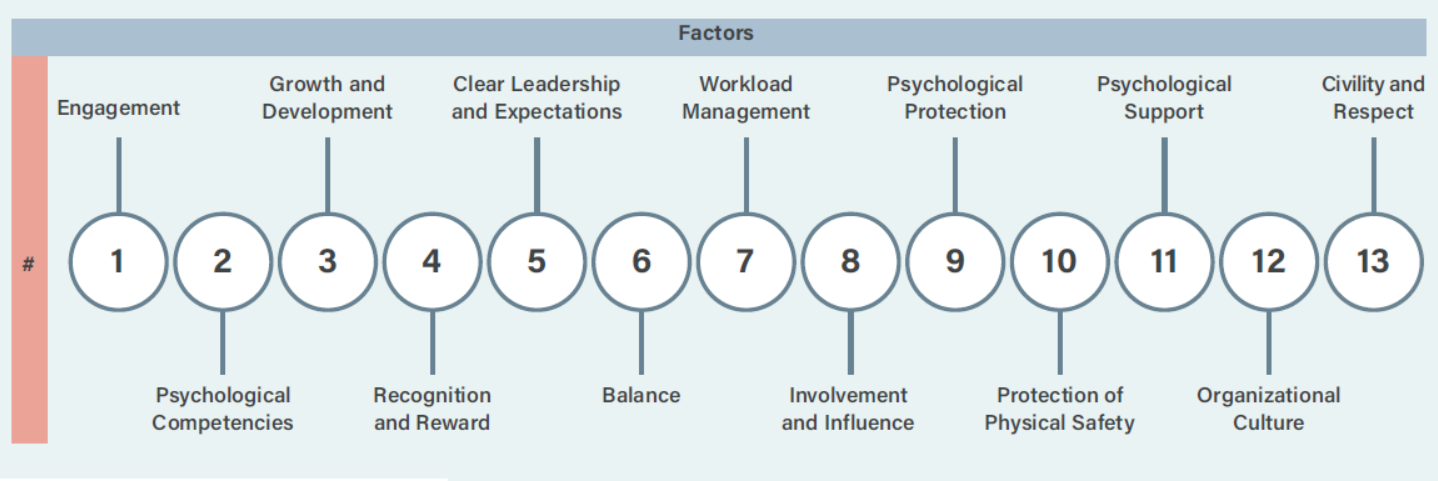
13 Psychological Factors – Text version
- Engagement
- Psychological Competencies
- Growth and Development
- Recognition and Reward
- Clear Leadership and Expectations
- Balance
- Workload Management
- Involvement and Influence
- Psychological Protection
- Protection of Physical Safety
- Psychological Support
- Organizational Culture
- Civility and Respect
In the last consultation, participant identified workload management and the organizational culture as being the two highest risk factors. These results are consistent with those of the PSES, where 55% of employees responded that they were able to complete their assigned workload during their regular working hours (compared to 70% for the rest of the public service), and where 24% responded negatively (compared to 13% for the rest of the public service). During interviews, some managers mentioned using mechanisms to alleviate workload surges by negotiating with clients to extend deadlines, or by redistributing work. Other managers, however, said they were unable to find solutions to ease workloads. Some employees interviewed were concerned that workload issues had led to high turnovers, resource shortage and increased work surges for those remaining employees.
Addressing workplace psychological hazards - Workload management
Workload management is defined in the Standard as a work environment where assigned tasks and responsibilities can be accomplished successfully within the time available. As per the Standard, workload management is the risk factor that many workers describe as being the biggest workplace stressor, which means that JUS’ PHSMS results are not unique.
The Department acknowledges that workload management is a priority, and that there is a need for a drill down to assess the root cause of workload issues and find solutions. On April 1st, 2018 the Department released the Resource Tool for Managers: Best Practices for Managing Workload Pressures and Stressors to help managers address the issue of excessive stress as a result of workload pressures. In May 2022, an external consultant was hired to conduct a department-wide workload assessment. During the development of this report, consultations with various stakeholders across the Department, such as management teams from different sectors, the MHSAG, and the Employment Equity Diversity and Inclusion Steering Committee (EEDISC) were taking place. Other consultations with employees, through surveys and interviews, in the context of the Workplace Assessment and Hazard Identification and Risk Assessment were also completed. An action plan for workload management was scheduled to be presented for approval at the Executive Committee in the fall of 2022. Although these consultations captured information on workload levels and on the impacts of ongoing high workloads, it would be beneficial to explore workload reduction strategies.
Recommendation #2:
It is recommended that the Chief Financial Officer and Assistant Deputy Minister continue consultations on workloads with employees and executive groups, and explore workload reduction strategies.
Management Response and Action Plan
Agreed.
Activities and information sessions (i.e. workshop on managing workload pressures and stressors) will continue to be offered by the Wellness Program as well as other activities identified in the Mental Health Action Plan.
Action:
Develop a departmental Workload Management Strategy to address workload pressures. In addition to the report from the consultation that took place in spring of 2022, the Workplace Assessment as well as other sources of data such as the PSES and the EAP reports will also be used in the creation of the Workload Management Strategy.
Offices of Primary Interest:
Assistant Deputy Minister Management Sector and Chief Financial Officer
Organizational Health Programs
Measure: Draft strategy will be shared with various stakeholders for feedback and approval. The strategy and plan will be presented to the Executive Committee for endorsement.
Attainability: Attainable
Target Completion Date: Approved Strategy: Q4 – FY 2022-2023 (January 2023)
The implementation is to be rolled out over the course of 5 years. Yearly updates will be provided to DAC on progress of strategy.
6.3 Governance and Oversight
The MHS is supported by various governance mechanisms. The MHAP sets out the outcomes Justice is looking to achieve, and progress against actions is reported through the annual MHAP Accomplishments reports. Roles and responsibilities among various groups in the organization are defined in the Strategy itself, and practices are in place to take employees’ mental health into consideration when decisions are made at the executive level.
A governance and oversight system is in place to support the Mental Health Strategy. However, information sharing and integration to support decision making could be improved.
The MHAP sets out the outcomes Justice is looking to achieve and the specific actions that need to be taken to achieve them. Progress against actions is reported through the annual MHAP Accomplishments reports, and the achievement of expected outcomes is monitored by the MHSAG. Even though the Management Sector has yet to publish its update since 2019-2020, the 2020-2022 version was under preparation at the time of writing this report.
Roles and responsibilities
The MHS states that mental health is “a shared responsibility and commitment where everyone has a role to play, and provides the following specific descriptions of what is expected from key players and stakeholders:
| Executive Committee |
|
|---|---|
| Mental Health Strategic Advisory Group |
|
| The Wellness Team |
|
| Other key stakeholders: Mental Health Ambassadors, Occupational Health and Safety, Employment Equity, Labour relations, etc. |
|
The Resource Guide for Managers also provides guidance on roles at different levels of the organization (i.e. Department, manager and employee) to deal with employees living with a mental health illness. However, several employees reported during interviews that they were unaware of their role, their managers’ role or the Department’s role with respect to psychological health and safety. According to the Standard, both individuals and the workplace have responsibilities in improving and maintaining well-being in the workplace. In order to ensure that employees and managers fulfill their roles and responsibilities, the Department must make sure that these are known and well understood.
The Mental Health Ambassadors’ network is a key stakeholder in helping the Department promote the importance of mental health, and share information on training, events, tools and services available to employees. During interviews, some ambassadors stated that their role varied depending on their supervisors and colleagues. While some are involved in various wellness committees or are encouraged to speak about mental health during all-staff meetings, others indicated that they did not have time to have dialogue with employees in their unit because of their regular workload. Some also indicated that they did not have opportunities to share information within the network itself. Better information sharing among ambassadors could help make their work more efficient and more consistent across the Department.
Mental Health Information for Decision-Making
The Department has mechanisms in place to take employees’ health and wellness into consideration when making key organizational decisions. The MHSAG is a central advisory body, which is responsible for providing advice and direction on the Department of Justice Mental Health Strategy and for monitoring the achievement of the expected outcomes. It meets on a quarterly basis and reports to the EC periodically. As part of its role, the group provides advice and recommendations in the development of the Department’s mental health governance initiatives and related priorities. It reports information regarding the state of mental health in the Department to executive discussion tables. This group therefore allows the Department to gather input and feedback from various stakeholders:
Composition of the Mental Health Strategic Advisory Group
- Chair: Mental Health Champion
- Standing Members:
- Director, Corporate HR Programs, Planning and Systems, HRB
- Manager, Organizational Health Programs
- Team Lead, Wellness Program
- DG, Human Resources Branch
- Representative of the Anti-Discrimination and Anti-Racism Secretariat
- Director, Safety, Security & Emergency Management Division, Corporate Services Branch
- Employer Co-Chair or representative, National Policy Health & Safety Committee
- Representative from the Informal Conflict Management Services
- Representative from Change Management and Business Transformation
- Two representatives from the mental health ambassador networks (rotational basis)
- Champion, Employment Equity, Diversity & Inclusion Steering Committee
The MHSAG is able to gather information on the Department’s health and wellness through the participating stakeholders. It does not, however, collect and integrate information gathered from other groups, such as the Ombuds and Informal Resolution Services Office (OIRSO), Labour Relations, Occupational Health and Safety, the Harassment and Violence Prevention Program Reports on Informal Resolution, Labor Relations cases and Conflict Management services used. These sources contain information and indicators of the state of mental health in the Department, which could be informative to the MHSAG and senior management. During interviews, stakeholders and members of the MHSAG expressed their wish for a better integration of mental health information, data and indicators. Better information sharing among stakeholders and service providers could help depict a more accurate and more comprehensive status of the mental health and wellness situation within the Department. It could help to better identify needs, risks and priorities, and better support well-informed decision making.
Recommendation #3:
It is recommended that the Chief Financial Officer and Assistant Deputy Minister (Management Sector) further the integration of information and data gathered from various sources to define and monitor organizational health indicators for better decision making.
Management Response and Action Plan
Agreed.
Action 1: Develop a departmental health dashboard.
This dashboard will include information from various sources such as but not limited to the PSES, Harassment and Violence Incidents and Workplace Assessment, Disability Management and Duty to Accommodate.
Office of Primary Interest:
Corporate HR Programs and Planning
(Office of Secondary Interest: Labour Relations, Ombuds and ICMS office, HR Reporting team)
Measure: Dashboard is shared with appropriate stakeholders for decision-making.
Attainability: Attainable
Target Completion Date: Q3 FY 2023-2024 (December 2023)
7 Audit opinion
The Department has policies, procedures, processes, and systems in place to support the implementation of the Department’s MHS. The Department promotes and supports mental health by communicating its importance and its value in the workplace. It offers training, tools and services to employees, and adopts practices to recognize efforts made towards a psychologically healthy environment. It also created key positions and networks to promote and support mental health. The Department meets its responsibilities with respect to assessing workplace psychological hazards, and is taking steps to address these hazards. Further efforts are however needed to support increased participation in training and in consultation processes. The Department needs to define the healthy practices and healthy behaviours employees and executives need to adopt to promote mental health and support the culture change it is aiming for. The Department should also incorporate mechanisms to better integrate wellness information and input gathered by various stakeholders, and to deepen senior management’s knowledge of the Department’s health status.
Appendix A: Audit criteria
Line of enquiry 1: promoting wellness and identifying needs
- The Department promotes and supports employee health and wellness and engages employees to identify their needs when developing related strategies, plans, and resources.
- 1.1 The Department engages employees in active, regular dialogue to understand their needs and factors influencing their mental health, to support participation in health and wellness activities and initiatives, and to share knowledge and tools.
- 1.2 Management is supportive and promotes a psychologically healthy and safe workplace through decisions and actions that support employees’ mental health.
- 1.3 A strategy and plan are in place to address mental health stigma in the workplace, and to recognize the value of efforts towards a psychologically healthy workplace.
Line of enquiry 2: development and implementation of health and wellness programs
- The Department’s strategies and plans are in development to address the identified needs, and staff are equipped with resources to enable a psychologically healthy and safe workplace.
- 2.1 A workload management strategy and plan are in development to address workload concerns, enabling employees to work in a psychologically healthy and safe manner.
- 2.2 The Department provides training, resources, tools, and shares best practices to support employees’ wellness and work-life balance during the pandemic and related work transitions.
- 2.3 Management is trained and has access to tools and resources to identify and support employees requiring assistance for mental health or trauma issues.
Line of enquiry 3: management and oversight
- Effective implementation of governance are in place within the Department to support the Mental Health Strategy and various health and wellness programs.
- 3.1 Roles, responsibilities, and accountabilities for a psychological healthy and safe environment are defined and understood at both management and employee levels.
- 3.2 Mechanisms are in place to consider health and wellness factors during departmental decision-making processes.
- 3.3 Performance measures and mechanisms have been identified and are in place to monitor progress and assess the impact of its program on the overall health and wellness of the Department.
Appendix B: list of acronyms
- ADM
- Assistant Deputy Minister
- APEX
- Association of Professional Executives of the Public Service of Canada
- CFO
- Chief Financial Officer
- CIMHW
- Canadian Innovation Centre for Mental Health in the Workplace
- Department
- Department of Justice
- EAP
- Employee Assistance Program
- EEDISC
- Employment Equity Diversity and Inclusion Steering Committee
- EC
- Executive Committee
- HR
- Human Resources
- HRB
- Human Resources Branch
- ICMS
- Informal Conflict Management System
- JUS
- Department of Justice
- MHCC
- Mental Health Commission of Canada
- MHS
- Mental Health Strategy
- MHAP
- Mental Health Action Plan
- MHSAG
- Mental Health Strategic Advisory Group
- MHA
- Mental Health Ambassadors
- OIRSO
- Ombuds and Informal Resolution Services Office
- PSAC
- Public Service Alliance of Canada
- PSES
- Public Service Employee Survey
- PHSMS
- Psychological Health and Safety Management System
- Pulse
- Justice Take-The-Pulse (Fall 2020)
- Standard
- National Standard of Canada for Psychological Health and Safety in the Workplace
- TBS
- Treasury Board Secretariat
- Date modified: