
2014–15 Departmental Performance Report
Section I: Organizational Expenditure Overview
Organizational Profile
Minister: Jody Wilson-Raybould
Responsible Minister 2014-15: Peter MacKay
Deputy Head: William F. Pentney
Ministerial Portfolio: Justice
Main legislative authority: Department of Justice Act
Year established: 1868
Organizational Overview
Raison d’être
The Department of Justice has the mandate to support the dual roles of the Minister of Justice and the Attorney General of Canada.
Under Canada’s federal system, the administration of justice is an area of shared jurisdiction between the federal government and the provinces and territories. The Department supports the Minister of Justice who is responsible for 52 statutes and areas of federal law by ensuring a bilingual and bijural national legal framework, principally within the following domains: criminal justice (including justice for victims of crime and youth criminal justice), family justice, access to justice, Aboriginal justice, public law, and private international law.
The Department also supports the Attorney General as the chief law officer of the Crown, both in terms of the ongoing operations of government and of the development of new policies, programs, and services for Canadians. The Department provides legal advice to the Government and federal government departments and agencies, represents the Crown in civil litigation and before administrative tribunals, and drafts legislation.
Responsibilities
The Department of Justice was officially established in 1868, when the Department of Justice Act was passed in Parliament. The Act sets out the roles and responsibilities of the Department as well as those of the Minister of Justice and Attorney General of Canada.
The Department of Justice fulfills three distinctive roles within the Government of Canada. It acts as:
- a policy department with broad responsibilities for overseeing all matters relating to the administration of justice that fall within the federal domain - in this capacity, it strives to ensurea fair, relevant, and accessible Canadian justice system for all Canadians;
- a provider of a range of legal advisory, litigation and legislative services to government departments and agencies; and
- a central agency responsible for supporting the Minister in advising Cabinet on all legal matters.
The Department of Justice has approximately 4,400 dedicated, full-time equivalent employees. Fifty-eight percent of Justice employees are located in the National Capital Region. The other 42 percent provide a strong national presence through a network of regional offices and sub-offices across the country.
Just over half of departmental employees are lawyers. The other half comprises a broad range of professionals, including paralegals, social scientists, program managers, communications specialists, administrative services personnel, and financial officers.
Strategic Outcomes and Program Alignment Architecture
- 1. Strategic Outcome: A Fair, Relevant and Accessible Canadian Justice System
- 1.1 Program: Stewardship of the Canadian Legal Framework
- 1.1.1 Sub-program: Legal Policies and Laws
- 1.1.2 Sub-program: Justice System Support
- 1.1.2.1 Sub-sub-program: Criminal Justice and Legal Representation
- 1.1.2.2 Sub-sub-program: Victims of Crime
- 1.1.2.3 Sub-sub-program: Youth Justice
- 1.1.2.4 Sub-sub-program: Family Justice
- 1.1.2.5 Sub-sub-program: Aboriginal and Northern Justice
- 1.1.2.6 Sub-sub-program: Justice in Official Languages
- 1.2 Program: Office of the Federal Ombudsman for Victims of Crime
- 1.1 Program: Stewardship of the Canadian Legal Framework
- 2. Strategic Outcome: A Federal Government that is Supported by High-Quality Legal Services
- 2.1 Program: Legal Services to Government Program
- Internal Services
Organizational Priorities
| Priority | TypeFootnote 1 | Strategic Outcome and Program |
|---|---|---|
| To ensure that the justice system continues to enhance the personal safety and security of citizens through criminal laws, policies, and programs | Ongoing | SO 1 – A Fair, Relevant and Accessible Canadian Justice System Program 1.1 – Stewardship of the Canadian Legal Framework |
| Summary of Progress | ||
In 2014-15, in support of Speech from the Throne commitments, the Department worked to ensure that the justice system continues to enhance the personal safety and security of Canadians. Accordingly, it supported the introduction, re-introduction or parliamentary enactment of:
The Department also supported Criminal Code amendments for:
Furthermore, the Department led the Government’s response to 15 private members’ bills that proposed criminal law reforms to address public safety issues, including human trafficking, rape, and parole ineligibility. The Department also continued to lead the National Anti-Drug Strategy, working with 11 federal departments. The Strategy had been expanded in the 2013 Speech from the Throne to include prescription-drug abuse. The 2014 federal budget allocated $44.9 million over five years to the Strategy to address prescription-drug abuse. Working with provinces, territories and non-governmental organizations, the Department supported programs and initiatives designed to enhance the Canadian criminal justice system. This included reviewing new issues, supporting reforms that were enacted by Bill C-13, the Protecting Canadians from Online Crime Act, and supporting the effective implementation of Bill C-36, the Protection of Communities and Exploited Persons Act in response to the Supreme Court of Canada’s decision in Bedford. The Department also supported the Government's international priorities related to justice system reforms by participating in multilateral forums (e.g. on corruption, drugs, cybercrime) and by providing technical assistance and capacity-building initiatives to foreign countries, which contributed to the promotion of democracy, respect for human rights, effective governance, and international security. |
||
| Priority | Type | Strategic Outcome and Program |
|---|---|---|
| To support victims of crime | Ongoing | SO 1 – A Fair, Relevant and Accessible Canadian Justice System Program 1.1 – Stewardship of the Canadian Legal Framework |
| Summary of Progress | ||
The Department continued to lead the Federal Victims Strategy, which advances policy, legislation, and public awareness activities and programming to give victims a more effective voice in the criminal justice system. Through the Victims Fund grants and contributions program, funding was provided to provincial and territorial governments and non-governmental organizations to encourage initiatives that promote access to justice for victims of crime. Furthermore, in 2014-15, new funding was secured to enhance community-based programs to assist sellers of sexual services in exiting prostitution. The Department hosted the Federal Symposium for National Victims of Crime Awareness Week in Ottawa to launch the 2014 Victims Week. This symposium brought together more than 200 victims, non-governmental organizations and policy makers to raise awareness of victim issues and services for victims. Funding of $1.2 million was made available through the Victims Fund and enabled 180 victims’ organizations across the country to host events. The Department led the federal effort to develop the Canadian Victims Bill of Rights, which came into force on July 23, 2015, and supported parliamentary consideration of Bill C-32, the Victims Bill of Rights Act, tabled in April 2014. The Department also continued to provide a “victims lens” and engage with key stakeholders, including the Federal-Provincial-Territorial (FPT) Working Group on Victims of Crime and the FPT sub-committee on the effective implementation of Bill C-32, the Victims Bill of Rights Act. The Department worked together with Status of Women Canada, Aboriginal Affairs and Northern Development Canada and Public Safety Canada to develop the Action Plan to Address Family Violence and Violent Crimes Against Aboriginal Women and Girls (2015-20). The Plan includes Justice-led policy and program initiatives in support of Aboriginal victims and families of missing or murdered Aboriginal women. Furthermore, the Department continued to increase support for child victims through policy and program initiatives to develop and enhance Child Advocacy Centres across Canada. |
||
| Priority | Type | Strategic Outcome and Program |
|---|---|---|
| To support the Government of Canada’s priorities through the delivery of high-quality legal services | Ongoing | SO 2 – A Federal Government that is Supported by High-Quality Legal Services Program 2.1 – Legal Services to Government Program |
| Summary of Progress | ||
In 2014-15, on behalf of the Government of Canada and federal departments and agencies, the Department of Justice continued to provide high-quality legal services in support of economic, social, governmental and international policy and programming priorities. With respect to economic affairs, the Department continued to provide legal services on initiatives aimed at advancing the Government’s priorities. For example, the Department provided legal services for legislative initiatives in support of the Action Plan to Improve Northern Regulatory Regimes and in support of the negotiation and preparation of a draft Nunavut Devolution Agreement-in-Principle. It also provided legal services in support of consultations on major resource development projects, such as the Northern Gateway Pipeline, the Shell Jackpine Oilsands Expansion, and the Site C Clean Energy Project. Furthermore, the Department provided legal services in support of the Government’s trade-liberalization agenda, the Federal Framework for Aboriginal Economic Development, the restructuring of Atomic Energy of Canada Limited, the commercialization of the Canadian Wheat Board, major procurements, and loan guarantees for the Lower Churchill hydroelectric projects. The Department also supported the development and implementation of telecommunications policies and various consumer and competition-oriented initiatives. In the area of social affairs, the Department drafted legislation to protect Canadians from online crime, child predators and terrorism, including measures governing the sentencing, release, and transfer of offenders. It also provided expert legal services respecting the development of Bill C-51, the Anti-terrorism Act, 2015, the Canadian Victims Bill of Rights, new prostitution legislation, changes to sentencing provisions, the Citizenship Act reform, as well as challenges to criminal law reforms and the firearms registry. Moreover, the Department continued its legal advisory, legal policy and litigation roles supporting the Government’s Action Plan on Specific Claims “Justice at Last", including representing the Government before the Specific Claims Tribunal, and the implementation of the Indian Residential Schools Settlement Agreement. Through comprehensive and coordinated legal services, the Department also supported the Government’s response to the Ebola outbreak. The Department supported the Government in international affairs through the provision of legal services for initiatives in areas of national security, foreign relations, and trade. For example, it assisted in the development of Canada’s emergency management responses, provided legal support to facilitate border flow, helped negotiate a Canada-US treaty on preclearance, and provided legal support to Canada’s military, including land holdings litigation. In addition, the Department assisted with the negotiation, legal review and implementation of the Canada-Korea Free Trade Agreement, the Canada-European Union Comprehensive Economic and Trade Agreement, and the Canada-European Union Strategic Partnership Agreement, as well as other trade and investment agreements. It provided litigation services on disputes under the World Trade Organization Agreement (e.g. with the US over country of origin labelling and with the EU over seals) and over $6 billion in claims brought under the North American Free Trade Agreement (e.g. Eli Lilly, Mesa Power, and the Detroit International Bridge Company). The Department provided advice and support on high-profile, sensitive and complex files regarding counter-terrorism, immigration and refugee law changes, and it continued to provide support for the prosecution of persons for crimes against humanity and revocation of citizenship for war crimes. In regard to governmental affairs, the Department provided legal services in support of new legislative measures and tax changes that were announced in the 2014 Federal Budget. It also helped enforce new monetary penalties and criminal offences under the Income Tax Act and the Excise Tax Act. The Department defended the Government’s position in over 15,000 tax litigation files, which included complex and high-risk collections files. It provided legal services in support of amendments to private and public pension legislation and regulations, as well as litigation support in response to challenges to labour and employment legislation. It also defended the constitutionality of Canadian legislation with respect to healthcare (e.g. physician-assisted suicide, issuance of heroin under the Special Access Programme and Canada’s medical marijuana regime). Furthermore, the Department provided legal advisory and real property services related to several large-asset dispositions, as well as some acquisitions, that resulted from the policy, program and service changes of departmental clients. |
||
| Priority | Type | Strategic Outcome and Program |
|---|---|---|
| To continue to manage organizational transformation in the context of cost containment | Ongoing | SO 1 – A Fair, Relevant and Accessible Canadian Justice System SO 2 – A Federal Government that is Supported by High-Quality Legal Services |
| Summary of Progress | ||
In its effort to complete the implementation of the Modernization Strategy (2012-15), the Department further streamlined processes to become more effective and efficient in delivering its services. In the area of policy and programs, progress included renewed program funding strategies to better address the needs of the target population, improved alignment with departmental policy needs, and modernized funding-delivery mechanisms. For example, the Justice Partnership and Innovation Program funding mechanism was modified to allow more flexibility and to reduce the cost and time of its administration. In support of obligations under the Legal Services Review commitments to contain the cost of legal services across government, the Department achieved savings in 2014-15 and is committed to achieving savings in 2015-16 and 2016-17. In addition, the Department continued to deliver on its mandate while managing under an operating budget freeze and in a cost-containment environment. The Department also supported the implementation of Blueprint 2020 through various initiatives, such as the creation of an Innovation Council, which helped to achieve efficiencies, streamline business processes, and manage expenditures. With a view to foster innovation and engagement, the Department collaborated with Public Safety Canada to host a Policy Bazaar where participants from over 25 federal departments and agencies exchanged ideas on innovative policy tools and approaches and on the role of technology in policy modernization. Building on the success of Blueprint 2020, the Department has formulated a vision for the future. This vision, entitled Canada’s Legal Team, is based on three pillars: a whole-of-Justice approach; legal and business excellence; and new ways of working. It is meant to guide the changes the Department needs to make in how it delivers its mandate to ensure that it continues to contribute to Canada’s success. The vision will drive innovation and the use of technology to improve service delivery and streamline processes, as well as build strong foundations for analytics that will enable evidence-based decision-making. It also includes renewing the Department’s relationship with its partner departments and mobilizing its talent to serve the country's evolving needs. In 2014-15, the Department undertook preparation activities, such as providing training and limiting e-mail storage, to ensure readiness for the implementation of the E-mail Transformation Initiative by Shared Services Canada. The Department also fully implemented the Common Human Resources Business Process, resulting in the development of new tools and processes to yield efficiencies. Under the implementation of the Transformation of Pay Administration Initiative, the Department began the transfer of pay accounts to the Public Service Pay Centre in Miramichi. The remaining pay services are expected to be transferred to the Pay Centre in December 2015. |
||
Risk Analysis
| Risk | Risk Response Strategy | Link to Program Alignment Architecture |
|---|---|---|
| Responding to new and emerging policy priorities – The broad scope and complexity of the justice system pose ongoing challenges for timely policy and program responses. | As identified in the 2014-15 Report on Plans and Priorities, the Department:
|
|
| Maintaining partnerships necessary for policy/program development and delivery – Relationships with essential justice system partners and stakeholders could weaken if not actively maintained. | As identified in the 2014-15 Report on Plans and Priorities, the Department:
|
|
| Meeting evolving demands for legal services – Unanticipated changes in the volume or nature of legal service requests, as well as changes in law practice management, could impact the Department’s ability to deliver effective and fiscally sustainable services. | As identified in the 2014-15 Report on Plans and Priorities, the Department:
|
|
The effective management and monitoring of key corporate risks supported the implementation of the Department’s priorities in 2014-15.
Given that the administration of justice in Canada is an area of shared jurisdiction, the Department’s stewardship of the Canadian legal framework requires close collaboration with the provinces and territories. The Department must also work with a broad range of stakeholders, which includes other federal departments, non-governmental organizations and international institutions. At times, relationships with these essential partners may be affected by the need to balance expectations and interests. An additional complexity, in the current era of electronic information and connectedness, is heightened expectations for rapid responses to emerging issues.
To manage these risks, the Department has continued to monitor emerging trends to inform its forward planning and maintain policy responsiveness. An ongoing dialogue has been maintained with key partners and stakeholders and the Department has worked to ensure the appropriate engagement of funding recipients. The Department also continues succession planning and knowledge-management activities to maintain the proper knowledge, skills, and expertise required to navigate within this complex operating environment.
In its role as a provider of legal advisory, litigation, and legislative services to other federal departments and agencies, the Department must maintain the appropriate delivery capacity to meet legal needs. This capacity is largely contingent on the recovery of costs from clients. As clients adjust priorities, uncertainties may arise concerning the Department’s ability to deliver effective and fiscally sustainable services, particularly if there are unanticipated changes in the volume or nature of legal service requests. The Department's ability to meet service demands may also be affected by changes in law-practice management. Legal work is increasingly complex and cross-cutting. Moreover, the volume of electronically stored information that is crucial to legal files continues to grow rapidly.
To appropriately manage evolving service demands, a number of actions have been taken. For instance, the Department has improved its financial forecasting processes and has continued joint planning with clients. This collaboration includes sharing information on the effective management of legal risks, the triggers and costs of litigation, and the appropriate role of legal counsel. The Department has also actively supported ongoing professional development for its legal staff, as well as developed and enhanced supporting tools, technologies and processes. All of these activities have been undertaken within the context of the horizontal review of legal services (LSR), which was initiated in 2013-14 with a view to effectively managing the demand for legal services and ensuring the fiscal sustainability of those services in the long term. Based on the findings of this review, the Department is working to refine its service-delivery model over a three-year period.
Actual Expenditures
| 2014–15 Main Estimates | 2014–15 Planned Spending | 2014–15 Total Authorities Available for Use | 2014–15 Actual Spending (authorities used) | Difference (actual minus planned) |
|---|---|---|---|---|
| 630,587,874 | 662,042,809 | 730,554,309 | 708,851,618 | 46,808,809 |
Note: The 2014-15 budgetary financial information provided in this document excludes the Department's Vote-Netted Revenue Authority which allows the Department to recover from other government departments and agencies some of the costs incurred to deliver legal services. For 2014-15, the Department recovered $297.2 million.
| 2014-15 Planned | 2014-15 Actual | 2014-15 Difference (Actual minus Planned) |
|---|---|---|
| 4,588 | 4,399 | -189 |
Note: The 2014-15 Human Resources information provided in this document includes the FTEs related to the recovery of costs incurred to deliver legal services.
| Strategic Outcomes, Programs and Internal Services | 2014-15 Main Estimates | 2014-15 Planned Spending | 2015-16 Planned Spending | 2016-17 Planned spending | 2014-15 Total Authorities Available for UseFootnote * | 2014-15 Actual Spending (Authorities Used) | 2013-14 Actual Spending (Authorities Used) | 2012-13 Actual Spending (Authorities Used) |
|---|---|---|---|---|---|---|---|---|
| Strategic Outcome 1: A Fair, Relevant and Accessible Canadian Justice System | ||||||||
| Program 1.1: Stewardship of the Canadian Legal Framework | 348,317,035 | 348,317,035 | 394,638,847 | 388,913,386 | 395,616,601 | 383,759,270 | 382,305,605 | 424,204,889 |
| Program 1.2: Office of the Federal Ombudsman for Victims of Crime | 1,318,570 | 1,318,570 | 1,320,994 | 1,320,994 | 1,318,823 | 1,080,165 | 1,195,444 | 1,178,162 |
| Subtotal | 349,635,605 | 349,635,605 | 395,959,841 | 390,234,380 | 396,935,424 | 384,839,435 | 383,501,049 | 425,383,051 |
| Strategic Outcome 2: A Federal Government that is Supported by High-Quality Legal Services | ||||||||
| Program 2.1: Legal Services to Government Program | 194,550,000 | 201,897,664 | 198,250,530 | 186,770,969 | 206,826,028 | 208,762,405 | 191,292,725 | 191,992,179 |
| Subtotal | 194,550,000 | 201,897,664 | 198,250,530 | 186,770,969 | 206,826,028 | 208,762,405 | 191,292,725 | 191,992,179 |
| Internal Services Subtotal | 86,402,269 | 110,509,540 | 117,522,777 | 97,067,259 | 126,792,857 | 115,249,778 | 162,247,090 | 116,607,619 |
| TotalFootnote ** | 630,587,874 | 662,042,809 | 711,733,148 | 674,072,608 | 730,554,309 | 708,851,618 | 737,040,864 | 733,982,849 |
- Table note *
-
Differences may arise due to rounding.
- Table note **
-
Differences may arise due to rounding.
Alignment of Spending With the Whole-of-Government Framework
| Strategic Outcome | Program | Spending Area | Government of Canada Outcome | 2014-15 Actual Spending |
|---|---|---|---|---|
| SO 1: A Fair, Relevant and Accessible Canadian Justice System | Program 1.1: Stewardship of the Canadian Legal Framework | Social Affairs | A safe and secure Canada | 383,759,270 |
| Program 1.2: Office of the Federal Ombudsman for Victims of Crime | Social Affairs | A safe and secure Canada | 1,080,165 | |
| SO 2: A Federal Government that is Supported by High-Quality Legal Services | Program 2.1: Legal Services to Government Program | Government Affairs | Well-managed and efficient government operations | 208,762,405 |
| Spending Area | Total Planned Spending | Total Actual Spending |
|---|---|---|
| Economic affairs | 0 | 0 |
| Social affairs | 349,635,605 | 384,839,435 |
| International affairs | 0 | 0 |
| Government affairs | 201,897,664 | 208,762,405 |
Departmental Spending Trend
As shown in the Budgetary Financial Resources table, the Department's 2014-15 Main Estimates totaled $630.6 million and its Total Authorities amounted to $730.6 million. The Total Authorities include funding received through the 2014-15 Supplementary Estimates processes and Treasury Board Secretariat Central Votes in the amount of $48.2 million.
Departmental Spending Trend Graph
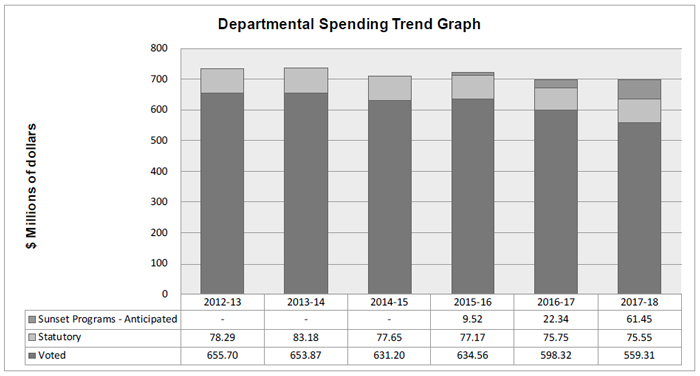
Description
This stacked vertical bar graph represents departmental spending trends for six fiscal years for the Department of Justice Canada. The graph presents a timeline (in fiscal years) on the horizontal axis and amount of dollars (in millions of dollars) on the vertical axis. The timeline on the horizontal axis shows six vertical bars; one for each fiscal year from 2012-13 on the left through to 2017-18. The amount of thousands of dollars on the vertical axis ranges from 0 to 800,000. Each vertical bar displays an accumulated total of departmental spending for three categories of funding: sunset programs – anticipated, statutory, and voted. These three categories of funding are also displayed numerically below each bar to indicate the precise dollar amount of funding for each of the six fiscal years presented.
The first vertical bar of the timeline, representing fiscal year 2012-13, displays a total of $0 for sunset programs – anticipated, $78.29 million statutory, and $655.7 million voted. The second bar of the timeline, representing fiscal year 2013-14, displays a total of $0 for sunset programs – anticipated, $83.18 million statutory, and $653.87 million voted. The third bar of the timeline, representing fiscal year 2014-15, displays a total of $0 for sunset programs – anticipated, $77.65 million statutory, and $631.2 million voted. The fourth bar of the timeline, representing fiscal year 2015-16, displays a total of $9.52 million for sunset programs – anticipated, $77.17 million statutory, and $634.56 million voted. The fifth bar of the timeline, representing fiscal year 2016-17, displays a total of $22.34 million for sunset programs – anticipated, $75.75 million statutory, and $598.32 million voted. The sixth and final bar of the timeline, representing fiscal year 2017-18, displays a total of $61.45 million for sunset programs – anticipated, $75.55 million statutory, and $559.31 million voted.
While spending (including statutory expenditures) has increased from $734.0 million in 2012-13 to $737.0 million in 2013-14, spending decreased in 2014-15 to $708.9 million (3.8 percent from the previous year). The variance between 2013-14 and 2014-15 is primarily due to the severance pay cash out which incurred onetime expenses in 2013-14.
The decrease in planned spending can be explained by the sunsetting programs that account for $9.52 million in 2015-16, $22.34 million in 2016-17, and $61.45 million in 2017-18. Also, the decrease from 2015-16 to 2016-17 represents a ramp-up of the reductions due to the implementation of the legal services review and other minor technical adjustments.
Furthermore, as the Department deals with fluctuating demand for legal services, the profile of its Total Authorities continues to change from year to year. As the graph below demonstrates, the trend shows a decrease of 5.0 percent in A-base as a result of the implementation of Budget 2012 savings measures as well as a relatively small variance in the Vote-Netted Revenue (VNR) over the three-year period.
A-Base and Vote-Netted Revenue Trend
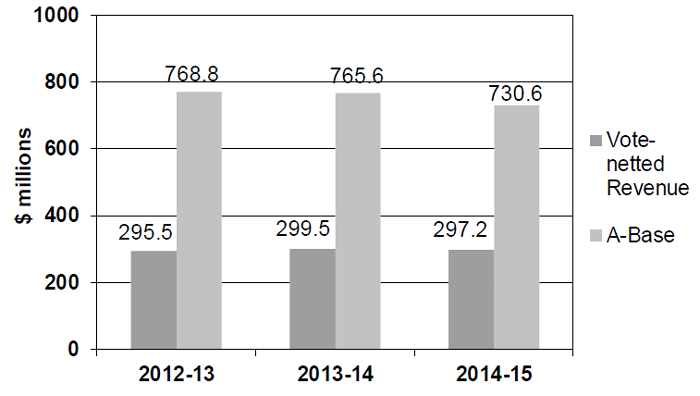
Description
The Department of Justice Base and Net Voting Authority Trend bar graph shows on the x-axis, from left to right, fiscal years 2012-13, 2013-14 and 2014-15. The y-axis displays amounts in millions of dollars from 0 to 1000. The graph consists of a group of two vertical bars per fiscal year, which represent the Vote-netted Revenue and A-Base Voting Authority for that year in millions of dollars. The graph shows that there has been a decrease in Net Voting Authority from $768.8 million in 2012-13, to $765.6 million in 2013-14, to $730.6 million in 2014-15. In addition, the graph shows an increase from $295.5 million in 2012-13 to $299.5 million in 2013-14, followed by a decrease to $297.2 million in 2014-15.
In 2014-15, $297.2 million in VNR was collected. This VNR decrease is primarily due to a yearly fluctuation in legal service demand. The A-Base authority in 2013-14 includes a onetime increase for the cash-out of severance pay. Without that increase, the authorities for 2013-14 and 2014-15 would be comparable.
Estimates by Votes
For information on the Department of Justice’s organizational voted and statutory expenditures, consult the Public Accounts of Canada 2015, which is available on the Public Works and Government Services Canada website.
- Date modified: