
Litigation Branch Evaluation Final Report
Appendix A: Logic Model
A logic model is a systematic and visual way to illustrate the relationship between the planned activities of a program and its expected results. In other words, a logic model is a depiction of how a program works and what it is trying to achieve. A basic logic model has the following key elements:
- Activities: The processes, tools, events, and actions that are part of the implementation of the program. The activities should lead to the intended results.
- Outputs: The direct product of the identified activities.
- Outcomes: The impacts of the program. These are results/changes/benefits/ consequences. They are usually presented in stages, as change is incremental over time; immediate should support and lead to the intermediate outcomes, and intermediate to long-term outcomes.
This section provides a logic model for the Litigation Branch, including a visual diagram followed by text descriptions of the key elements.
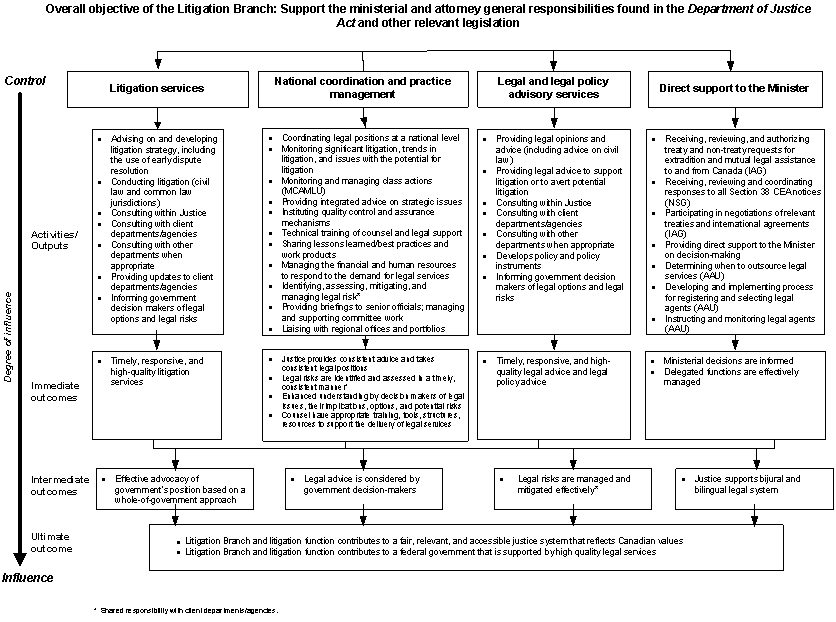
Overall objective of the Litigation Branch: Support the ministerial and attorney general responsibilities found in the Department of Justice Act and other relevant legislation - Text equivalent
Overall objective of the Litigation Branch: Support the ministerial and attorney general responsibilities found in the Department of Justice Act and other relevant legislation
The activities for Litigation Branch are:
- Litigation Services
- National Coordination and Practice Management
- Legal and Legal Policy Advisory Services
- Direct Support to the Minister
The outputs for Litigation Services are:
- Advising on and developing litigation strategy, including the use of early dispute resolution
- Conducting litigation (civil law and common law jurisdictions)
- Consulting within Justice
- Consulting with client departments/agencies
- Consulting with other departments when appropriate
- Providing updates to client departments/agencies
- Informing government decision makers of legal options and legal risks
The immediate outcomes for Litigation Services are:
- Timely, responsive, and high-quality litigation services
The outputs for National Coordination and Practice Management are:
- Coordinating legal positions at a national level
- Monitoring significant litigation, trends in litigation, and issues with the potential for litigation
- Monitoring and managing class actions (MCAMLU)
- Providing integrated advice on strategic issues
- Instituting quality control and assurance mechanisms
- Technical training of counsel and legal support
- Sharing lessons learned/best practices and work products
- Managing the financial and human resources to respond to the demand for legal services
- Identifying, assessing, mitigating and managing legal riskImage note *
- Providing briefings to senior officials, managing and supporting committee work
- Liaising with regional offices and portfolios
The immediate outcomes for National Coordination and Practice Management are:
- Justice provides consistent advice and takes consistent legal positions
- Legal risks are identified and assessed in a timely, consistent mannerImage note *
- Enhanced understanding by decision makers of legal issues, their implications, options and potential risks
- Counsel have appropriate training, tools, structures, resources to support the delivery of legal services
The outputs for Legal and Legal Policy Advisory Services are:
- Providing legal opinions and advice (including advice on civil law)
- Providing legal advice to support litigation or to avert potential litigation
- Consulting within Justice
- Consulting with client departments/agencies
- Consulting with other departments when appropriate
- Developing policy and policy instruments
- Informing government decision makers of legal options and legal risks
The immediate outcomes for Legal and Legal Policy Advisory Services are:
- Timely, responsive and high-quality legal advice and legal policy advice
The outputs for Direct Support to the Minister are:
- Receiving, reviewing and authorizing treaty and non-treaty requests for extradition and mutual legal assistance to and from Canada (IAG)
- Receiving, reviewing and coordinating responses to all Section 38 CEA notices (NSG)
- Participating in negotiations of relevant treaties and international agreements (IAG)
- Providing direct support to the Minister on decision making
- Determining when to outsource legal services (AAU)
- Developing and implementing process for registering and selecting legal agents (AAU)
- Instructing and monitoring legal agents (AAU)
The immediate outcomes for Direct Support to the Minister are:
- Ministerial decisions are informed
- Delegated functions are effectively managed
Collectively, the immediate outcomes lead to the following intermediate outcomes:
- Effective advocacy of government’s position based on a whole-of-government approach
- Legal advice is considered by government decision-makers
- Legal risks are managed and mitigated effectivelyImage note *
- Justice supports bijural and bilingual legal system
Collectively, these intermediate outcomes support the following ultimate outcomes:
- Litigation Branch and litigation function contributes to a fair, relevant and accessible justice system that reflects Canadian values
- Litigation Branch and litigation function contributes to a federal government that is supported by high quality legal services
The Logic Model depicts that the degree of influence diminishes from Control at the Activity Level to one of Influence at the Ultimate Outcome level.
- Image note 1
-
Shared responsibility with client departments/agencies
Activities and outputs
The Litigation Branch coordinates numerous activities that can be grouped into four main areas:
- litigation services, which involve legal representation in matters before the courts that involve the Federal Crown
- national coordination and practice management, which provide functional guidance to ensure consistency of approach across the country and across government
- legal and legal policy advisory services to federal departments and agencies
- direct support to the Minister of Justice in his capacity as Minister rather than as the Attorney General of Canada
Each of these areas of activity is described below.
Litigation services
The litigation work of the Branch involves the provision of legal representation to federal departments and agencies involved in matters either before the courts or potentially leading to court proceedings. Litigation Branch counsel provide specialized litigation services and expertise to defend or make claims on behalf of the Federal Crown before various provincial and federal courts as well as administrative tribunals. These litigation services include providing advice on litigation strategy and identification of opportunities for early resolution and settlement of litigious matters. In preparing and advising on litigation matters, counsel consult as appropriate with specialized experts within Justice, with DLSU counsel and with other departments or agencies as appropriate. Litigation counsel also inform government officials of the legal risks on their litigation matters and provide options to reduce those risks through litigation strategies.
National coordination and practice management
The Litigation Branch and the ADAG Litigation are centrally involved in the coordination of the Department’s litigation activities. Although all units of the Branch and the Department as a whole participate in law practice management and coordination activities, three key units have specific roles in the national coordination and management of litigation services:
- the National Litigation Committee
- MCAMLU
- LPMC
National coordination and practice management includes: monitoring and analyzing litigation trends and how these court decisions or legal issues could impact the government’s overall liability and legal risk; developing and providing strategic and integrated legal advice to manage, plan for, and possibly avoid potential litigation; actively participating in ongoing litigation in order to provide strategic advice and ensure that nationally consistent positions are adopted by regional litigators; and briefing and supporting senior departmental officials in managing their legal risks. It also includes the development and training of counsel and paralegals, sharing lessons learned and best practices, and managing resources to meet the demand for legal services.
Legal and legal policy advisory services
Legal advisory services include the provision of legal advice to federal government officials on a variety of matters with respect to legal issues affecting the government, including advice on existing litigation and potentially litigious situations, and proposed policy or legislative instruments. In preparing this advice, Litigation Branch counsel consult with officials within the appropriate client departments or agencies and/or DLSUs. In addition, consultations are held, as appropriate, with specialized sections within Justice, portfolios, and regional offices. Counsel include identification and assessment of legal risks in their legal advice to government departments, as well as possible options to prevent or reduce legal risks.
Direct support to the Minister
The Litigation Branch provides direct support to the Minister in his ministerial role, ensuring that he meets his responsibilities under various statutes and areas of federal law. Direct support is provided in the areas of national security, international assistance, and the outsourcing of legal work and appointment of private sector law firms and law practitioners to provide legal services to the government. The NSG and IAG provide legal opinions and advice to the Minister of Justice on relevant legislation, its operation, and issues related to the possible disclosure of sensitive or potentially injurious information. In addition, these groups provide briefing materials to the Minister and the Deputy Minister of Justice on national S&I issues, and extradition and mutual legal assistance requests. Both NSG and IAG also provide legal policy advice within their areas of expertise, as well as exercise decision-making powers that have been delegated under relevant legislation.
The LPMC establishes the framework in support of the outsourcing of legal work to the private sector and provides functional direction over the outsourcing decision-making process. It also oversees the selection and legal agent appointment process and establishes the framework for managing and monitoring the activities of legal agents and associated costs.
Immediate outcomes
Litigation services
Timely, responsive, and high-quality litigation services
This outcome includes efficiently responding to client requests for litigation services; meeting mutually agreed-upon or court-imposed deadlines; providing regular progress reports; and providing clear and practical guidance, including for the prevention, containment, or early resolution of contentious issues. The resulting litigation strategy responds to the client department/agency’s priorities and objectives, while ensuring that the strategy is guided by the rule of law and the Department’s responsibilities under the Department of Justice Act. The litigation services are also commensurate with the available resources and are assigned to counsel with the appropriate level of experience given the complexity of the file.
National coordination and practice management
Justice provides consistent advice and takes consistent legal positions
The Litigation Branch adheres to the “whole-of-government” approach in providing consistent legal advice and taking consistent legal positions on litigation matters. Various structures and processes have been established to ensure that positions taken by Justice counsel on litigation matters and in the legal advice provided are consistent across Justice and across the government. Consultation and communication support this outcome. The work of the National Litigation Committee is central to enhancing this coordination function for litigation within the Department.
Legal risks are identified and assessed in a timely and consistent manner
Counsel consider legal risks in the course of providing forward-looking legal advice and assisting client departments/agencies to respond proactively and prevent, mitigate, or manage their legal risks. Counsel apply the Justice legal risk grids to ensure that legal risks are consistently assessed following the same criteria across Justice, and they utilize Justice legal risk management processes as required, for example, the preparation of contingency plans on high-risk files. The Justice processes for assessing the level and impact of legal risk ensure that the level of risk is accurately determined and communicated in a consistent and timely manner.
Enhanced understanding by decision-makers of legal issues, their implications, options, and potential risks
The legal advice provided by counsel is communicated in a matter to provide government decision-makers with the necessary understanding of their legal risk, what options are available to avoid or minimize those risks and to provide decision-makers with the information they require to make informed, timely, and strategic decisions related to their programs, policies, and operations.
Counsel have training, tools, structures, and resources to support the delivery of legal service
As part of law practice management and coordination, the Litigation Branch ensures that litigation and advisory counsel have access to the training, tools, structures, and resources needed to provide high-quality legal services and to develop their legal skills. This includes information sharing on best practices, practice directives, training opportunities, and mechanisms to alert counsel to important developments in the law.
Legal and legal policy advisory services
Timely, responsive, and high-quality legal and legal policy advice
The Litigation Branch counsel provide timely, responsive, and high-quality legal and legal policy advice that foresee problems, present options, and offer solutions. Legal opinions are clear and serve their intended purpose, including the provision of advice at early stages of significant files. While the client department/agency’s priorities are considered, the legal and legal policy advice are developed so that they are guided by the rule of law, the Department of Justice Act,and the Statutory Instruments Act. Legal and legal policy advice are provided in a timely manner, so that client department/agency officials can adequately consider the advice during their decision-making process.
Direct support to the Minister
Ministerial decisions are informed
The Litigation Branch provides legal advice and legal policy advice to the Minister in support of his ministerial functions. By providing the Minister with high-quality and timely legal advice that considers legal risks and options, including their implications, the Litigation Branch supports the ability of the Minister to make informed legal and legal policy decisions. For example, the National Litigation Committee makes recommendations to the Minister concerning matters such as interventions and submissions on important cases, the IAG provides advice with respect to matters under the Extradition Act which must be decided personally by the Minister, and the LPMC makes recommendations to the Minister for the appointment of legal agents, based on sound outsourcing decisions and agent selection processes.
Delegated functions are effectively managed
Some ministerial decision-making is delegated to units within the Litigation Branch. The Branch effectively manages these delegated functions by ensuring that processes are followed and handled in a manner that ensures that the functions assigned to the Minister of Justice by legislation are fulfilled. For example, LPMC provides functional direction over the outsourcing decision-making process, agent selection, and appointment and management of agent activities and costs. Similarly, IAG carries out functions assigned to the Minister of Justice as the central authority for Canada under the Extradition Act and the Mutual Legal Assistance in Criminal Matters Act. The NSG makes recommendations to the ADAG Litigation on whether to authorize disclosure of information for which notice has been received under section 38 of the CEA, and on what conditions, if any.
Intermediate outcomes
The intermediate outcomes are not specific to the activity area, as all of the activity areas support these outcomes.
Effective advocacy of the government’s position based on a whole-of-government approach
The Litigation Branch must act to ensure that the interests of the Crown in the proper administration of justice are protected through its conduct of litigation, its use of settlement where appropriate, and the legal advice given. As with all areas of Justice, the Litigation Branch is responsible for taking an integrated, “whole-of-government” approach where its legal advice and litigation positions consider the overall impact on the government and not just particular client interests. This is accomplished by consulting within Justice and, where appropriate, with other federal departments/agencies. Central Agencies are briefed and consulted as appropriate to ensure that Justice takes legal positions that consider and respond to the potential risks to the federal government as a whole.
Legal advice is considered by government decision-makers
By providing timely, responsive, consistent, and useful legal advice to departments and agencies, government officials are able to consider the legal risks and the legal implications of certain proposed decisions in addition to other relevant factors (e.g., operational, political, financial) in their decision-making process. Legal advice provides government officials with options to reach their objectives while considering the legal implications associated with their decisions.
Legal risks are managed and mitigated effectively
The Litigation Branch ensures that client departments/agencies are provided with legal advice that includes an assessment of their legal risks and options that can be considered by those departments to either prevent or reduce those risks. Counsel consult and communicate with client officials to make them aware of the legal risks and to discuss the impact of the identified risks. Counsel also provide options and strategies that departments or agencies can consider to manage or reduce those legal risks as part of their overall business and integrated risk considerations. The ultimate decision on how to proceed rests with the client departments/agencies, subject to the Department of Justice Act. However, the Litigation Branch’s advice supports the ability of the client departments/agencies to make informed choices on how to manage their legal risks.
Justice supports Canada’s bijural and bilingual legal system
The Litigation Branch ensures that legal services are offered in both official languages and under both judicial traditions: the common law and civil law. The Litigation Branch and the QRO have the expertise and capacity to support Canada’s bijural and bilingual legal system. They are able to manage litigation files in situations where other regional offices may not have the necessary bilingual capacity. Furthermore, the QRO handles all civil law litigation services for the federal government in consultation with the Litigation Branch where appropriate.
Ultimate outcomes
Through the achievement of the immediate and intermediate outcomes, the Litigation Branch supports the Department’s two strategic objectives:
- a fair, relevant, and accessible Canadian justice system
- a federal government that is supported by high-quality legal services.
- Date modified: