
Litigation Branch Evaluation Final Report
4. Findings
4.1. Relevance
The evaluation considered the relevance of the Litigation Branch with respect to the continued need for its services given the demand for the legal services, the responsiveness of the Litigation Branch to federal government priorities, roles and responsibilities, as well as the Branch's support of Justice Canada's strategic outcomes.
4.1.1. Continued Need for the Litigation Branch
The Litigation Branch addresses needs of the government, both in terms of the structure it provides to coordinate litigation services and the type of legal expertise it offers.
Through the ADAG Litigation, the Branch serves a coordination role for all litigation involving the federal government. This coordination role is particularly important given the matrix structure of the Department of Justice, where litigation services are provided primarily by litigators in the Litigation Branch and the regional offices, and litigation support services are provided by counsel in the DLSUs and specialized sections within the Litigation Branch. Footnote 13 The coordination role of the ADAG Litigation includes keeping the government apprised of ongoing litigation by providing regular briefings. According to stakeholders, federal interest and involvement in the litigation process are strong and the ADAG Litigation's role is a critical one.
Beyond the coordination role, the Branch has units that provide centralized support functions to lawyers in the Department.
- The LPMC oversees the procurement of legal services and appointment of legal agents. Agents are required when the Department does not have the necessary expertise or capacity to handle a matter, or when, for various reasons such as geographic distance between regional offices and the relevant court, it is cost effective to hire a local agent. The LPMC is responsible for the contracting and policy framework for outsourcing legal work and supports counsel across the Department with a transparent and objective process.
- The National eDiscovery and Litigation Support Services provide a centre of expertise in handling files with a large volume of documents, which key informants report is becoming commonplace and requires a substantial level of effort to manage. The Group directly assists with discovery and disclosure on some very complex files that have hundreds of thousands of documents. In addition, it provides advice to counsel on issues such as using document management software, assists clients with the identification of relevant documents, and helps determine an efficient document review strategy. Through the National eDiscovery and Litigation Support Services, the Litigation Branch provides support to the Department on pressing litigation management issues.
The Branch's units that provide litigation and litigation-related advisory services serve a unique role within the Department. While CLS operates much like a regional office with a geographic area that it covers, it also handles cases of national significance where central management is necessary. MCAMLU is a specialist unit that handles some of the more complex, inter-provincial/territorial class actions and also serves as a resource to regional offices that are handling class actions. The NSG and the IAG serve very specific functions related to national security litigation, and extradition and mutual legal assistance requests, respectively. Footnote 14 The location of these groups within Justice Canada headquarters strengthens the Department's ability to coordinate its response in their legal areas.
Demand for Litigation Branch services
The increasing demand for Litigation Branch services provides further evidence of the ongoing need for the Branch. The evaluation evidence (document review and stakeholder interviews) pointed to a variety of legal practice trends influencing the demand for Litigation Branch services. These sources highlighted a number of trends as factors that, in the past five years, have increased demand for Litigation Branch services (see Table 5).
| Unit | Trends |
|---|---|
| CLS |
|
| IAG |
|
| NSG |
|
| MCAMLU |
|
The rise in demand for Litigation Branch services is confirmed by the Department's administrative data in iCase. These data show that the number of files actively managed Footnote 16 by the Branch increased by 11% between 2008/09 and 2013/14. The increase was fairly steady, except for a 4% decline in 2012/13. Not surprisingly, the increase is driven by litigation files, which rose from 1,077 in 2008/09 to 1,351 in 2013/14, a 25% increase. Footnote 17 Although not all units within the Litigation Branch experienced an increase in files to the same extent, Footnote 18 the percentage of actively managed files did increase over the evaluation period for each of the four largest units within the Branch. MCAMLU experienced the greatest increase (26%), followed by CLS (19%), NSG (16%), and IAG (4%) (see Table 6). Footnote 19
| Unit | 2008/09 | 2009/10 | 2010/11 | 2011/12 | 2012/13 | 2013/14 | Total | |||||||
|---|---|---|---|---|---|---|---|---|---|---|---|---|---|---|
| # of files | % change | # of files | % change | # of files | % change | # of files | % change | # of files | % change | # of files | % change | # of files | % change | |
| IAG | 1,890 | -- | 1,755 | (6)Table note * | 1,819 | 3 | 1,930 | 6 | 1,772 | (8) | 1,957 | 10 | 5,980 | 4 |
| NSG | 128 | -- | 159 | 24 | 156 | (2) | 196 | 25 | 145 | (26) | 149 | 3 | 349 | 16 |
| CLS | 1,125 | -- | 1,191 | 6 | 1,272 | 7 | 1,275 | 0 | 1,320 | 4 | 1,343 | 2 | 4,710 | 19 |
| MCAMLU | 34 | -- | 34 | 0 | 27 | (21) | 29 | 7 | 37 | 28 | 43 | 16 | 72 | 26 |
| Total | 3,177 | -- | 3,139 | (1) | 3,274 | 4 | 3,430 | 6 | 3,274 | (4) | 3,492 | 7 | 11,111 | 11 |
- Table note 1
-
Source: iCase
Bracketed values indicate negative changes.
In addition to an increase in the number of files, iCase data show a concomitant increase of 21% in the hours expended by the Litigation Branch on actively managed files over the evaluation period. Trends regarding the hours spent on files varied among units within the Litigation Branch. Footnote 20 Of the four largest units within the Litigation Branch, IAG experienced the largest increase in level of effort (58%) from 2008/09 to 2013/14, followed by NSG (29%) and MCAMLU (28%). IAG's increase primarily occurred in 2013/14. By contrast, CLS (which was responsible for about 50% of the total hours for actively managed Litigation Branch files despite seeing an increase in the volume of actively managed files) had a 13% decrease in hours, from 82,258 hours in 2008/09 to 71,675 hours in 2013/14 (see Figure 2). Footnote 21
Figure 2: Total Number of Hours for Actively Managed Files by Unit - 2008/09 to 2013/14
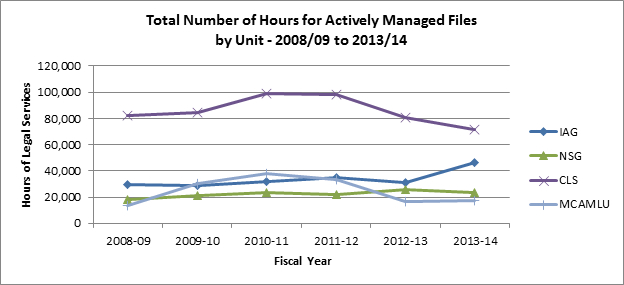
Figure 2: Total Number of Hours for Actively Managed Files by Unit - 2008/09 to 2013/14 - Text equivalent
Line graph showing the total number of hours for actively managed files by unit and by year
For IAG:
- In 2008-09, 29,400 hours
- In 2009-10, approximately the same (29,161 hours)
- In 2010-11, a slight increase to 31,963 hours
- In 2011-12, a slight increase to 34,783 hours
- In 2012-13, a slight decrease to 31,298 hours
- In 2013-14, an increase to 46,495 hours
For NSG:
- In 2008-09, 17,996 hours
- In 2009-10, a slight increase to 21,227 hours
- In 2010-11, a slight increase to 23,214 hours
- In 2011-12, a slight decrease to 21,975 hours
- In 2012-13, a slight increase to 25,675 hours
- In 2013-14, a slight decrease to 23,185 hours
For CLS:
- In 2008-09, 82,258 hours
- In 2009-10, a slight increase to 84,576 hours
- In 2010-11, an increase to 98,563 hours
- In 2011-12, approximately the same (97,859 hours)
- In 2012-13, a decrease to 80,589 hours
- In 2013-14, a decrease to 71,675 hours
For MCAMLU:
- In 2008-09, 13,813 hours
- In 2009-10, an increase to 30,129 hours
- In 2010-11, an increase to 37,619 hours
- In 2011-12, a slight decrease to 33,169 hours
- In 2012-13, a decrease to 16,740 hours
- In 2013-14, a slight increase to 17,631 hours
Source: iCase
Legal Risk and Complexity
Although the general increase in the number of hours spent on Litigation Branch files is likely partly attributable to the increase in file volume, it is clear that the increase in the number of files actively managed by the Litigation Branch is not entirely responsible for the overall increase in workload. Other factors, such as risk and complexity of files, also affect workload, but do not affect all units uniformly. The administrative data confirm key informant opinion that legal risk ratings have not changed substantially in the last five years. The only exception was CLS, where legal risk has declined Footnote 22 MCAMLU files with a risk rating remained generally high risk and most of the files of IAG and NSG are low risk. Footnote 23
The complexity of files, however, did change for most units of the Litigation Branch. Footnote 24 For CLS, high or mega-complexity litigation files declined from about 15% in 2008/09 to 10% in 2012/13, and low-complexity litigation files increased substantially from 38% in 2008/09 to 46% in 2012/13. Footnote 25 In contrast, NSG and IAG experienced increases in complexity. Over the evaluation period, NSG experienced a more than doubling of the proportion of high-complexity litigation files (from 12% to 36%). Footnote 26 IAG's actively managed advisory files (which make up most of IAG's work) saw a reduction in the percentage of files with low-complexity ratings (from 53% in 2008/09 to 38% in 2012/13), and an increase in the percentage with medium-complexity ratings over the same period (from 37% to 57%). Footnote 27 Key informants also perceived an increase in the complexity of IAG files, noting changes in the nature of extradition files which have rendered them more complex, and an increased tendency for defence counsel to raise abuse of proceedings allegations against the Crown in extradition cases, which are difficult to defend. In general, key informants attributed the rise in complexity to the increasing number of files with high volumes of documents and other evidence, which places increased pressures on counsel.
4.1.2. Alignment with Federal Priorities and Roles and Responsibilities
The Litigation Branch has an ongoing role to play in supporting and upholding government priorities. Evidence indicates close alignment between the work of the Litigation Branch and documented federal priorities and commitments — and shows that Justice plans and priorities in relation to litigation work shift in order to maintain this close alignment. Speeches from the Throne and budget reports highlight a number of federal priority areas that signal a role for Litigation Branch services. For example, speeches and budget reports released during the time period covered by the evaluation highlight goals and commitments such as the federal government's emphasis and investments related to crime prevention, extradition reform and public safety (including changes to sentencing laws, the Extradition Act, and other public safety-related legislation); proposed changes to legislation in the area of Aboriginal law; initiatives involving Aboriginal populations (such as addressing specific claims and exploring opportunities for economic development on reserve land); and commitments to pursuing foreign policy that will advance Canadian interests.Branch litigators (particularly from CLS, NSG and IAG) have expertise in these priority areas. Moreover, in highlighting the work of the Litigation Branch in areas such as public safety, criminal law reform, Aboriginal law, and foreign treaty relationships, internal documents and DPRs show good alignment between the work of the Litigation Branch and documented federal priorities.
Evaluation findings also provide evidence that the work of the Litigation Branch supports the Minister of Justice and Attorney General of Canada in fulfilling responsibilities under federal legislation. The following points describe the ways in which the work of the Branch corresponds with federal statutes:
- Under the Department of Justice Act, Justice Canada has a mandate to support the roles of the Minister of Justice and Attorney General of Canada. The Department of Justice Act specifies that the AGC is to advise federal department heads on all matters of law connected to their departments (s. 5[b]). The Act also gives the AGC authority over the “regulation and conduct of all litigation for or against the Crown or any department, in respect of any subject within the authority or jurisdiction of Canada” (s. 5[d]). By conducting litigation on behalf of the Crown and coordinating litigation-related services across the government, the Litigation Branch as a whole clearly supports the AGC in fulfilling these mandates of the Department of Justice Act.
- The IAG supports the Minister in carrying out responsibilities under the Extradition Act and the MLACMA. Evidence from documents and stakeholder interviews indicates that the Group adapts its services to maintain alignment with these pieces of legislation and also assists in efforts to change and improve the legislation. In addition, documents and stakeholders indicate that the IAG further supports the priorities of the Government of Canada by prioritizing its requests over those made to Canada by other countries.
- The NSG plays a role in advising the ADAG Litigation on legal matters related to a number of acts, including the CEA, the Canadian Security Intelligence Service Act, the Security of Information Act, andthe Security Offences Act. In addition, the NSG carries out duties in relation to the Anti-terrorism Act. Of these statutes, the CEAimplies the greatest role for the NSG; under the CEA, the AGC is responsible for making appropriate objections when disclosure of national security information is sought in administrative, civil or criminal proceedings.
By supporting the Minister of Justice and Attorney General of Canada in carrying out responsibilities under the above-mentioned statutes, the Litigation Branch also assists the Minister in ensuring that “the administration of public affairs is in accordance with the law” (thus fulfilling requirements outlined in section 4 of the Department of Justice Act).
4.1.3. Alignment with Departmental Strategic Priorities
Evaluation results indicate that the Litigation Branch supports the Department of Justice in meeting both of its strategic outcomes. Footnote 28 Regarding the first strategic outcome (a fair, relevant and accessible Canadian justice system), the Litigation Branch's lawyers are bound by the provisions of the Department of Justice Act to ensure that the government acts in accordance with the law. Unlike private counsel, whose focus is on their client's interests, Justice counsel have a primary duty to protect fundamental fairness and the rule of law. An example of this is the Litigation Branch's work related to access to justice. Litigation Branch counsel (along with representatives from other branches, portfolios and sectors across the Department of Justice) take part in the Access to Justice Working Group. This group meets monthly and its mandate is to support the Department of Justice in efforts to improve access to Justice in federal programs, activities and initiatives.
Evidence also indicates that the Litigation Branch contributes to the Department's fulfillment of its second strategic outcome (a federal government that is supported by high-quality legal services). Stakeholders indicate that Litigation Branch services are both high quality and responsive to clients' needs (see Section 4.2.1). In addition, they noted that Branch services are provided to essentially any government department or agency, citing this as further evidence of the Branch's responsive support of the federal government.
4.2. Performance - Achievement of Expected Outcomes (Effectiveness)
According to the 2009 Treasury Board Policy on Evaluation, evaluating performance involves assessing effectiveness, efficiency and economy. The subsections below discuss the effectiveness of the Litigation Branch — in other words, the extent to which the Litigation Branch is achieving its expected outcomes.
4.2.1. Timely, Responsive, High-Quality Litigation Services and Legal Advice
Like all legal services within the Department of Justice, the work of the Litigation Branch is guided by departmental service standards. These standards demonstrate the Department's commitment to delivering high-quality (i.e., timely, responsive and useful) services to government departments and agencies. The evaluation found a high level of satisfaction with the overall quality, as well as the responsiveness and timeliness of Litigation Branch services — indicating that the Branch is upholding this multifaceted departmental commitment to high-quality service provision. Specific findings with regard to the quality, timeliness and responsiveness of Litigation Branch services are discussed in greater detail below.
Quality of Litigation Branch Services
Satisfaction with the quality of Litigation Branch services is confirmed by multiple lines of evidence. Moreover, evaluation results indicate that Litigation Branch representatives, as well as clients and other stakeholders, are in agreement about the quality of Branch services. In the 2012 Client Feedback Survey, the Litigation Branch received a score of 8.4 out of 10 (surpassing the departmental target of 8.0 out of 10) for the overall quality of litigation services provided — up from a score of 8.0 in 2009. Litigation Branch representatives as well as client departments and other areas of the Department of Justice support these findings. The majority of key informants and case study interviewees (representing the Litigation Branch, client departments and DLSU counsel) as well as Litigation Branch survey respondents agreed that the Branch provides high-quality services, or identified that their experience in working with the Litigation Branch was above average or excellent.
Evaluation results also indicate that service quality is relatively consistent among units within the Litigation Branch. Almost all key informants and case study participants (representing both clients and the Branch) agreed that the Litigation Branch provides high-quality services, regardless of their affiliation or experience in working with particular units of the Branch. Survey results support this observation, as the majority of Branch survey respondents who could comment reported above average or excellent working experiences with the NSG (79%), the IAG (65%), the Office of the ADAG (67%), the CLS (63%), National eDiscovery and Litigation Support Services (58%), and MCAMLU (57%). Just under half of survey respondents who could comment reported average or excellent working experiences with the LPMC (48%). For all units of the Litigation Branch, very few respondents reported below average or poor working experiences. Footnote 29
Successful outcomes in litigation files can be viewed as an indicator of effective legal service provision; Justice Canada has used this measure for its departmental performance reporting. Footnote 30 Successful outcomes can be achieved through settlement or adjudication. Results are recorded as successful (a complete win for the government's position), unsuccessful (a complete loss), or partially successful. Footnote 31 For most of the last six years, the proportion of successful CLS litigation files had been relatively stable at about two-thirds. In 2013/14, the percentage of successful files rose to 74%, which exceeds the Department target of 70% and matches the most recently reported departmental average of 74.9% (Department of Justice, 2013) (see Table 7 ).
| 2008/09 (n=447) |
2009/10 (n=751) |
2010/11 (n=460) |
2011/12 (n=701) |
2012/13 (n=632) |
2013/14 (n=551) |
|
|---|---|---|---|---|---|---|
| Successful | 64% | 53% | 68% | 66% | 69% | 74% |
| Partially Successful | 15% | 9% | 17% | 12% | 15% | 14% |
| Unsuccessful | 21% | 12% | 15% | 21% | 16% | 12% |
| (Not Indicated) | 1% | 27% | <1% | - | <1% | -- |
| Total | 101% | 101% | 100% | 99% | 100% | 100% |
Note: Totals may not sum to 100% due to rounding.
Source: iCase data (Closed litigation files)
Responsiveness of Litigation Branch Services
All data collection methods provide evidence that Litigation Branch services are responsive to the needs of clients.
Results from Client Feedback Surveys indicate that clients are satisfied with the responsiveness of Branch services; in 2012, the Litigation Branch scored well above the departmental target for providing courteous and responsive legal services (9.1 out of 10) and for identifying the correct service provider to meet clients' needs (8.6 out of 10). In addition, the high ratings given for electronic (8.5), in-person (8.6), and telephone (8.7) communications show that clients are generally satisfied with various modes of communication used by the Branch. Key informant interviews and case study results support these findings, as clients who participated in these lines of evidence reported that the Litigation Branch has been responsive to their requests for assistance, and has kept them informed of developments. According to Litigation Branch survey respondents, clients are kept informed; nearly all respondents reported that they, or a member of their legal team, frequently or regularly provided the client department with progress reports and updates on files (94%), consulted with the client department to understand the nature of the legal problem on a given file (89%), and involved the client department in the development of legal strategies, positions and/or options (84%).
These observations indicate a generally high degree of communication with clients on files; however, the evaluation found variation in both the kinds of issues about which the Litigation Branch consults with clients, and the extent to which files involve direct interaction between the Litigation Branch and clients.
- Although some files and case studies document that Branch counsel consulted the client on a variety of legal issues (including identifying and assessing risk, options to manage risk, developing legal strategies and positions, the impact of legal risk, and possible settlement), others indicate that the client was only consulted on one or two issues (such as background information, case law, or developing legal strategies or positions).
- The Litigation Branch survey and the key informant interviews provide evidence that the Branch interacts to a greater degree with DLSU counsel than directly with client departments; over 8 in 10 survey respondents (82%) reported that they interact frequently or regularly with the client departments' DLSU, while less than half (47%) reported having frequent or regular interactions with client departments directly.
- Similarly, key informant interviews and Litigation Branch survey results indicate that the Branch consults with client departments concerning legal issues more so than policy or program issues; although a very high percentage of survey respondents reported consultation regarding legal issues, far fewer (40%) indicated that they, or a member of their legal team, frequently or regularly discussed policy and/or program objectives with client departments.
Evaluation results point to many reasons for these variations. Case studies, key informant interviews, and survey results indicate that the amount and type of client consultations can depend on the type of case, as well as the client department, with some cases and some clients calling for more consultations on a broader array of issues than others. As key informants pointed out, not all clients have experience in litigation, and not all wish to be extensively involved in the litigation process; in many cases, it is entirely appropriate for the Litigation Branch to interact with DLSU counsel in lieu of interacting directly with client departments, particularly when issues are strictly legal in nature. Regarding the extent to which the Branch engages with clients concerning policy or program issues, key informants and survey respondents identify that policy work is not central to the work of all Litigation Branch units, and that, in many cases, Branch counsel are called on primarily to provide legal rather than policy advice. Footnote 32
Considering these reasons and the generally high level of client satisfaction with Branch responsiveness (described above), it is reasonable to conclude that the above-mentioned variations in communications with client departments are appropriate and, for the most part, do not negatively impact the responsiveness of the Litigation Branch to clients' needs. However, one observation is worth mentioning. In Client Feedback Surveys, the Litigation Branch scored slightly below the departmental target in both 2009 and 2012 with regard to the regular provision of informative progress reports or ongoing feedback on the status of service requests to clients. Footnote 33 Highlighting this observation is not meant to suggest that the Branch alone is responsible for any communication issues with clients, particularly given the DLSU's role. However, this observation may indicate that, on a case-by-case basis, there may be room for improvement or greater effort in verifying clients' expectations regarding the nature and extensiveness of consultations and progress reporting at the outset of files, and in clarifying the respective roles of Litigation Branch and DLSU counsel on the file, including relaying information to clients.
Provision of Timely Litigation Services
The evaluation found strong evidence that the Litigation Branch provides timely services. The ability to meet deadlines is one indicator of timely service provision, and all lines of evidence for this evaluation show that the Branch is successful in meeting court-imposed, as well as client and other internal deadlines. Footnote 34 Another indicator of timely service provision is the timeliness with which the Litigation Branch responds to requests for legal services. Again, evaluation results provide evidence of success. Positive results from both the 2012 Client Feedback Survey and Litigation Branch survey show that clients and Branch staff agree that the Litigation Branch responds to client requests in a timely manner. Footnote 35 Similarly, interview participants (both case study and key informant interviewees) generally agreed that the Branch's responses are timely.
Time Pressures
Although all sources of evidence show that the Litigation Branch is able to complete work and respond to clients in a timely manner, evaluation results provide some evidence of time pressures on the work of Branch employees. Results from the PSES were not entirely positive regarding the timeliness of decision making within the Department of Justice. In 2008, only 43% of Litigation Branch respondents agreed that senior management in the Department makes timely and effective decisions; however, this rose to 59% by 2011 (Statistics Canada, 2008; 2011). If direction or approvals at the managerial level are delayed, this could affect the ability to meet deadlines. Many key informants representing the Branch noted that deadlines are often tight and that they do not always have the time they would like to work on files. The majority of Litigation Branch respondents to the 2011 PSES (58%) reported that they can often or almost always complete their work within regular working hours, but the percentage was less than for the Department (63%) or the public service overall (67%). Many key informants mentioned that they currently must work longer hours in order to manage their workload during peak times.
Given the positive results concerning quality, responsiveness and timeliness described above, these pressures currently do not appear to be affecting the ability of Branch employees to produce high-quality, responsive legal services. However, they may point to pressures within the Litigation Branch that could, in the future, affect service delivery.
4.2.2. Consistency of Legal Advice and Positions
The evaluation considered the Litigation Branch's contributions to consistency both across the Department of Justice (i.e., the degree to which the Department “speaks with one voice”) and within the Government of Canada as a whole (i.e., the degree to which a “whole-of-government” perspective is achieved on legal issues). In general, the evaluation found evidence of appropriate and effective coordination and consultation, which contribute to consistency at both levels.
Overarching Coordination: the Role of the ADAG Litigation and Central Committees
The ADAG Litigation
The ADAG Litigation has functional responsibility not only for each of the five units within the Litigation Branch, but also for coordinating the conduct of litigation department-wide. The national coordination role of the ADAG Litigation is central to ensuring that the Department “speaks with one voice” and that it adopts a “whole-of-government” approach to litigation. In its coordination role, the Office of the ADAG Litigation acts as a central point of contact regarding litigation matters. It provides information to DM and ADM offices, central agencies, portfolios, and regional offices through consultations and reports; plays a direct role in reporting/briefing on litigation issues; and participates in central committees dealing with high-profile litigation issues — namely, the NLC and the National Security Intelligence Committee. The Office of the ADAG Litigation approaches its coordination role with the recognition that the Department has many structures in place (e.g., portfolios, team leaders, regional litigation committees) across the country to manage litigation. The ADAG Litigation does not direct those processes but can become involved should issues arise that require central support.
Evidence indicates that the ADAG Litigation is effectively carrying out his coordination function. Key informants mentioned that the ADAG Litigation communicates regularly with ADM and DM offices as well as with regional offices. The Office of the ADAG Litigation is also a central point of contact with the PCO and other central agencies on litigation matters, providing frequent, regular updates. As part of Deficit Reduction Action Plan (DRAP) measures, the ADAG Litigation has assumed a more direct reporting role in recent years, taking over from the Management Sector in terms of tracking and reporting on steps in significant litigation. Key informants described weekly reports and tools, such as the “litigation placemat” Footnote 36 and the “litigation calendar” Footnote 37 (which are prepared by the Office of the ADAG Litigation), as useful and effective in making senior management aware of high-profile litigation.
A few key informants identified a gap within the Department related to the development of civil litigation policy (e.g., amending civil procedures). While criminal law policy is handled by the Criminal Law Policy Section, there is not a comparable group for civil litigation policy. Footnote 38 According to a few key informants, this is a gap that could be filled by the Litigation Branch and the Office of the ADAG Litigation.
Central Committees
As mentioned above, participation in central committees is another way in which the ADAG Litigation carries out the position's coordination responsibility. The ADAG Litigation chairs the NLC — a departmental committee Footnote 39 that provides a forum for senior-level representatives to deliberate on significant litigation Footnote 40— and is a member of the NSIC. Footnote 41 Each of these committees has its own mandate and role to play in ensuring a consistent approach to litigation issues, and the evaluation found evidence of their effectiveness in this area.
Evidence (primarily from key informant interviews and the Litigation Branch survey) indicates that the NLC is a useful structure for ensuring both national coordination and consistency as well as a consistent departmental approach. Although certain matters (such as seeking leave to appeal to the Supreme Court of Canada [SCC], SCC factum review, and interventions on matters of national importance) are required to go before the NLC, the Committee also functions as a “last step” in a chain-like conflict resolution process. Footnote 42 Most key informants agreed that, when the NLC is used in a conflict resolution role, it works well and is an effective mechanism for resolving disputes and ensuring consistency in litigation, particularly with regard to high risk and high-profile litigation matters. Survey results were similarly positive, as the majority of respondents who could provide an opinion said that the Committee is useful to their work. Footnote 43
In reaching “whole-of-government” decisions, the NLC is aided by its relationship with regional litigation committees and its connections to other government departments. Even though regional litigation committees serve purposes distinct from that of the NLC, they typically review and approve materials and documents that regional counsel plan to submit to the Committee. NLC membership includes regional Litigation Committee chairs (who serve as regular NLC members), as well as senior management representing client interests and counsel who have handled cases for various client departments and areas of the law. Many key informants mentioned that the NLC's broad representation and, in particular, the regular connection between the NLC and regional litigation committees help the NLC to settle disagreements effectively between counsel and clients, and guide regions dealing with similar cases to a consistent approach — thus promoting national consistency. Key informants expressed the opinion that the working relationship between the NLC and regional litigation committees is effective, and that the regions are actively engaged in the Committee.
Despite an overall positive perception of the NLC, key informants observed the following limitations to the NLC's functioning:
- Some key informants noted that, at times, NLC members (mostly ADMs) send substitutes to meetings, which can reduce the number of people actively participating in committee meetings.
- A few key informants commented that the NLC tends to focus on particular cases rather than its other possible roles related to developing practice directives or guidelines for litigation.
The NLC generally seems to be fulfilling its coordination function well, but these observations indicate potential areas for improvement.
Regarding the NSIC, evaluation stakeholders (mainly key informants) highlighted the importance of this committee in facilitating information sharing and ensuring national consistency on files with national security implications. In particular, key informants described the NSIC as “effective and necessary” — especially considering that information sharing on national security issues is made more difficult by the need to protect sensitive information (i.e., the need for secrecy can hinder information sharing). By providing a secure environment for discussion, the NSIC facilitates a coordinated approach to policy, litigation and legal advice, as well as practical issues related to national security and intelligence work.
In addition to the broad role of the ADAG Litigation and central committees in achieving a “whole-of-government” approach to litigation issues, Litigation Branch counsel have a role to play in ensuring national consistency in the way that they work across the Department and with other affected departments on litigation files. How the Litigation Branch contributes to consistency in these ways is discussed below.
Working across the Department
Evidence indicates that the Litigation Branch advice and legal positions are both internally consistent and in line with the departmental approach to litigation issues. Litigation Branch staff and clients believe that the Branch provides consistent legal advice to clients. Many key informants identified that regular interactions and communications help to ensure a consistent approach to litigation issues, and two-thirds of survey respondents (69%) strongly agree or agree that the Branch has structures in place to ensure that Justice provides consistent legal advice. In addition, the Branch scored 8.3 out of 10 regarding consistency of the legal advice provided to clients in the 2012 Client Feedback Survey, a result that is above the departmental target (Office of Strategic Planning and Performance Measurement, 2013).
The ability to provide consistent legal advice is supported by several structures and practices to ensure consultations within the various Litigation Branch units as well as between them. Documents and key informant interviews provide evidence that the four units within the Litigation Branch directly involved in litigation (CLS, MCAMLU, IAG and NSG) have practices in place to ensure regular communication among Branch staff, including regular staff meetings, conference calls, practice groups or working groups. The CLS has a Litigation Committee that reviews high-profile files, which the majority of survey respondents who were able to comment found to be useful to their work. These practices are designed to keep Branch employees up-to-date on files, trends and developments in relevant areas of law. In turn, this information sharing helps to ensure that those working within Branch units take a consistent approach in dealing with files and addressing legal issues.
Other information-sharing processes contribute to consistency in the Litigation Branch. Documents and key informant interviews provide evidence of regular communication among Litigation Branch unit heads and managers related to files, risks and practice issues. The Litigation Branch Managers' Meeting, chaired by the ADAG Litigation, provides an informal forum for exchange of information across Branch units.
In addition to effective information sharing within the Litigation Branch, ensuring that the Department of Justice “speaks with one voice” regarding litigation-related matters requires effective coordination among those working on litigation issues across the Department, including DLSU counsel, regional offices, and other specialized areas of Justice.
As noted in Section 4.2.1, Litigation Branch counsel interact more often with DLSUs than directly with client departments. Consequently, communications between DLSUs and the Branch are important to the Department speaking with one voice. The evaluation evidence shows that consultations with DLSU counsel are regular. A large majority of survey respondents (80%) indicated that the client department's DLSU was frequently or regularly consulted on their files, and that the Litigation Branch does an excellent or above average job at consulting or involving DLSUs. The file review supports the extensiveness of Branch consultations with DLSUs, as it provided evidence that multiple units within the Litigation Branch consulted DLSUs on several occasions about a wide variety of legal issues.
Evaluation results, however, are somewhat mixed with regard to the working relationship between the Branch and DLSU counsel on litigation files. Many key informants representing both Litigation Branch and DLSU counsel commented that relationships between Litigation Branch and DLSU counsel are positive and that both informal and formal communication and information-sharing practices (e.g., status reports, the monthly national conference call on litigation trends) are effective at promoting consistency. Although Litigation Branch and DLSU counsel do not always agree on issues, key informants identified that differences of opinion are worked out effectively through discussion at the counsel level. Given the respectful relationships between Litigation Branch and DLSU counsel, more formal mechanisms for resolving differences of opinion, such as the NLC, are rarely needed to ensure consistency in the work of DLSU and Litigation Branch counsel. Survey responses, however, are not as positive. Less than half of respondents (40%) considered their experience working with the DLSUs to be excellent or above average Footnote 44 — a less positive result than for other areas of the Department, such as regional offices. In written feedback, survey respondents indicated that, at times, a greater role for (and greater assistance from) DLSU counsel on files would be appropriate and appreciated. Indeed, one in five survey respondents from CLS cited issues working with DLSU counsel as a factor constraining the Branch's ability to provide high-quality legal services. A few key informants also supported a greater role for DLSUs on Litigation Branch files, including portfolio-level representatives who indicated that some DLSUs do not feel that they are being involved enough in the document production process. It should be noted that both key informants and survey respondents identified that the working relationship does vary from one DLSU to another. Litigation Branch representatives also pointed out that the Branch does not work as consistently with the same client departments/DLSUs as counsel in portfolios do, which limits their opportunity to build a close working rapport with DLSU counsel. These results indicate that the working relationship between the Litigation Branch and at least some DLSUs could be improved.
Consultations with regional offices and specialized sections within Justice Canada occur less on Litigation Branch files than do consultations with DLSUs and other affected departments and agencies. Footnote 45 However, evidence indicates that the Litigation Branch consults with these areas when appropriate and that, for the most part, these consultations help to ensure a consistent departmental approach. Key informants identified regular communication and good coordination between Branch headquarters and regional offices — particularly on major cases — and described consultations with subject matter experts in other areas of the Department as a common occurrence. Similarly, the majority of survey respondents who could provide an opinion reported that the Litigation Branch's work involving or consulting with these areas of the Department was excellent or above average. The case studies and file review results provide further evidence that consultations with regional offices and specialized sections have taken place on files as needed. Furthermore, the majority of respondents who could provide an opinion reported excellent or above average working relationships or experiences with both regional litigators and specialized sectors.
Although the evaluation results are very positive regarding the extent to which appropriate consultations take place to ensure that the Department speaks with one voice, key informant interviews provided some suggestions worth mentioning for achieving greater regional coordination on class actions files. Some key informants indicated some room for improvement in communications between the MCAMLU and regional litigators involved in class actions files, noting the importance of ensuring that provincial class action rules and legal cultures are adequately considered when the MCAMLU has the lead on class actions cases. Others also pointed to a need for clearer criteria regarding whether the MCAMLU or the regions will have responsibility for litigating in class actions cases.
Involving Other Affected Departments
Together, all lines of evidence help to confirm that the Litigation Branch engages in consultations with other government departments and agencies when necessary, and that these consultations contribute to a whole-of-government approach to litigation-related issues.
The file review and case studies provided evidence of interaction and consultation with multiple departments and agencies on several files. Footnote 46 Survey results support these findings, as the majority (55%) of respondents reported frequent or regular consultations with other potentially affected departments and agencies on their files.
While consultations with potentially affected departments and agencies do not occur on all Litigation Branch files, the evaluation did not find evidence to suggest that departments and agencies are not being consulted when they should be. Key informants identified the practice of forming steering committees or working groups for litigation files or issues involving multiple departments and portfolios (e.g., the long-gun registry) as an effective strategy for ensuring good coordination and managing the need for instructions and approvals. Survey results also indicate an above average working relationship between the Litigation Branch and government departments and agencies affected by litigation, with clearly delineated roles and responsibilities. Footnote 47
4.2.3. Legal Risk Management (LRM)
LRM is “the process of making and carrying out decisions that reduce the frequency and severity of legal problems that prejudice the government's ability to meet its objectives successfully” (Department of Justice, 2007b). As such, LRM involves a number of different stages and activities, including:
- identification and assessment of potential legal risks;
- communication of potential risks to stakeholders, as necessary;
- mitigation of legal risks to the extent possible by addressing policy and legal issues (such as through changes to practices or policies, or by proposing amendments to legislation and/or regulations); and
- management of legal risks that have materialized and reduction of their potential costs (monetary and otherwise) (Department of Justice, 2007b).
The LRM process also involves reassessment of legal risks, as necessary, as issues develop over time.
Evaluation results indicate that the role of the Litigation Branch in the LRM process varies among files. In part, this variation is due to the responsive nature of the Litigation Branch's services; its role in identifying, assessing, managing or mitigating risks depends to some extent on client (or DLSU) requests for Branch services in these areas. Despite its varied role, however, the evaluation found that the Litigation Branch makes important contributions to LRM on most files, Footnote 48 and that these contributions are valued.
Multiple lines of evidence indicate that the Litigation Branch makes contributions to risk assessment on most files. Data from iCase show that the vast majority of Branch files opened between 2008/09 and 2012/13 were assessed for legal risk and assigned a risk level, Footnote 49 and, for the most part, it appears that the timing of risk assessments is appropriate. Data from iCase show that a large proportion of files are assigned a risk assessment early on in the file (within 30 days), and the majority of stakeholders — including survey respondents and key informants — agreed that the Litigation Branch assesses and reassesses risks in a timely manner. Footnote 50 In addition, case studies and the file review provide evidence that the Branch engages in risk assessments and reassessments at appropriate times in files. Initial risk assessments typically take place post-pleadings, and legal risk is generally reviewed at critical junctures later on in the file, such as after exchanging pleadings, examinations for discovery, motions, etc. Key informants indicated that Branch counsel conform to requirements for the regular review and update of risk assessments, and that these assessments are regularly reviewed (even if they are not revised), particularly with regard to high-complexity files. Although iCase does not provide a record of all reassessments of risk (and, therefore, cannot confirm whether requirements for risk reassessment are being met), Footnote 51 data from iCase show multiple risk assessments on the majority of advisory files for CLS, IAG, NSG and MCAMLU.
Results from the case studies and key informant interviews indicate that the Litigation Branch also plays a role in assisting clients with risk management and mitigation — particularly in high-risk cases. The file review provided evidence of written contingency plans on only a few files. However, stakeholders (key informant and case study interviewees) identified that the Litigation Branch's contributions to risk mitigation and management include providing ongoing risk analyses and advice, answering questions about the effects of certain actions on legal proceedings, and helping clients to determine whether efforts should be made to settle. Key informants also mentioned that the coordinating role that the Litigation Branch plays in monitoring cases across Canada (such as through the class actions database, which includes a comprehensive list of active, non-active and closed files) allows the Branch to assess the effectiveness of strategies and more accurately advise clients about how litigation will proceed.
The evaluation found a high level of satisfaction with the contribution of the Litigation Branch to LRM. Results from the Client Feedback Surveys provide evidence that clients are satisfied with the extent to which the Branch works with them to identify legal risks, and communicates with them about legal risks, legal options to mitigate identified legal risks, and the development of legal strategy and positions (Office of Strategic Planning and Performance, 2013). Footnote 52 The key informant interviews, case studies and file review support the Client Feedback Survey results. Key informant and case study interviewees representing clients and DLSU counsel generally agreed that the Litigation Branch and DLSUs work well together to assist clients in managing their legal risks, and that Branch strategies to mitigate or manage legal risk are generally clearly communicated and effective. In the files selected for case studies and file review, clients generally considered the legal advice provided by the Litigation Branch in determining how to handle the legal risks involved.
Compliance with Risk Assessment Protocol and Risk Assessment Limitations
Although evaluation results concerning the Litigation Branch's work related to LRM are very positive, the results point to some potential limitations to the risk assessment protocol and tools used by the Litigation Branch to guide the assessment and communication of risks.
Litigation Branch counsel are required to enter risk assessment information into iCase and to review and revise (if necessary) this information every 90 days. With this in mind, a few observations based on data from iCase on risk assessments entered between 2008/09 and 2012/13 are worth mentioning.
- First, for MCAMLU, a relatively high proportion of litigation files each fiscal year did not receive a risk assessment. This is likely due to the fact that class actions involve several separate files, and MCAMLU assesses a risk on the file that is currently proceeding to court. As a comparison, CLS litigation files listed as “unable to assess” were in single digits.
- Second, a relatively high proportion of CLS and MCAMLU advisory files had a risk status of “unable to assess”, in comparison to the other Branch units' advisory files. Footnote 53
- Third, it appears that the timeliness of risk assessments on CLS files has declined over the evaluation period. The percentage of advisory files receiving a risk rating within 30 days of file opening dropped from 90% in 2008/09 to 31% in 2012/13. Similarly, the percentage of litigation files assessed within 30 days dropped from 95% in 2008/09 to 48% in 2012/13.
These observations are worth pointing out because they may be indicative of some difficulties in complying with iCase risk reporting requirements. Counsel are expected to enter a risk assessment into iCase quickly upon receipt of a file; however, key informants identified difficulties in making accurate risk assessments this early on. Key informants mentioned that, in some cases, counsel can feel pressured to enter risk levels into iCase before they have had sufficient time to gather (via document review, interviews, and/or discussions with clients and witnesses) the information they need to make an accurate risk assessment. Key informants also identified difficulties in identifying risk at an early stage in certain files — class actions files in particular — given the need to evaluate both the merits of individual files as well as their suitability to go forward as a class action (a difficult task to perform at an early stage). Often, individual files that are part of class action can be considered low risk, but when multiplied in a class action, the risk level can become very high.
Evaluation results also point to some potential issues with implementation of the new LRM framework. As mentioned in Section 3.6, use of the new LRM framework became mandatory for litigation files on April 14, 2013, and for advisory and legislative files, on September 13, 2013. The expectation was that advisory and legislative files opened on or before September 2013 with timekeeping entered in the previous 12 months were to have their legal risk assessed using the new framework and entered into iCase by May 1, 2014. However, based on the iCase data provided to the evaluation in June 2014, this target was not being met as most actively managed advisory files in 2013/14 were still listed as “not yet evaluated”.
Reactions to the LRM toolkit and grid (both the previous and revised LRM framework) were mixed. According to some key informants, by establishing standard risk terminology and guidelines, the LRM tool kit and grid have increased the consistency with which risk is assessed and communicated. However, other key informants (representing the Litigation Branch, DLSU counsel, and other government departments and agencies) identified some issues with the standardized approach, and, in particular, with the LRM grid. These key informants noted the following:
- The LRM grid involves assigning a numerical value to risk, but as risk can be difficult to quantify with “mathematical precision”, a numerical value may lead clients to develop fixed views about the risk level, which may not be entirely appropriate. Detailed written risk analyses are more helpful than using the LRM grid or assigning numerical risk levels.
- Due to the large dollar value of class actions cases, using the LRM grid for risk analysis on class actions files always results in a high-risk rating.
- The scope of the “moderate” or medium risk category is very broad, and captures a large proportion of files with varying risk levels. A few key informants said that this leads to the perception that the Department of Justice is overly averse to risk.
- The grid itself does not provide clients with a sufficient level of detail. As legal risks are nuanced, a more detailed explanation is necessary to provide clients with enough information on the range of possibilities.
- The use of standardized language hinders the ability of counsel to tailor communication to the client, and communicate risk in a way that makes the most sense to the client.
The survey results also show some ambiguity about risk assessment structures in general. Respondents were fairly divided on whether the Litigation Branch has structures in place to ensure that risks are assessed in a consistent manner across portfolios and regions. About 4 in 10 survey respondents (41%) strongly agree or agree that such structures exist, with just over a third indicating they are neutral (24%) or disagree (11%). About a quarter (24%) reported that they either did not know enough to respond or this issue was not applicable to their work.
4.2.4. Contribution to Informed Decision Making
The Litigation Branch contributes to informed decision making by making senior government officials aware of legal risks, legal issues and legal options. Even though clients ultimately decide whether to accept legal risks and what strategies to adopt, the advice of the Branch should, if it is useful and of high quality, at least be considered by client departments/agencies.
The Litigation Branch engages in several activities that are intended to enhance the understanding of decision-makers of legal issues involved in files. Primary among these activities are consultations with clients and other affected departments/agencies. As discussed in Section 4.2.2, the Branch engages in regular consultations. Not only do these consultations support a “whole-of-government” approach to legal issues, but they ensure that the Litigation Branch understands the client's context and provides the Branch with the opportunity to inform the client of the legal issues involved. Client Feedback Survey results indicate that clients are satisfied with the extent to which Litigation Branch counsel fully understand the nature of their legal issues (the Branch received a score of 8.2 out of 10 in both 2009 and 2012 for this indicator) and advise them of issues or developments that may impact their work (the Branch scored 8.0 in 2009 and 8.3 in 2012).
Many key informants (representing the Litigation Branch, DLSU counsel and clients) also reported that the Litigation Branch adequately involves clients in the development of legal strategy and positions. It was reported that the Branch involves clients by asking for instructions throughout the process and providing clients with options. However, some key informants pointed out that the extent to which clients are involved varies among clients; some clients are more experienced with, and interested in, litigation than others. A few representatives of client departments expressed dissatisfaction with the extent to which they were involved in the development of legal strategy. For example, these clients noted that:
- at times, they have been told that legal strategy is the role of counsel, not clients;
- they were not provided with options, and did not understand why their situation meant that they were “out of options”; and
- on particular files, they have encountered difficulties in getting Litigation Branch counsel to meet with them (although this was identified as a rare occurrence).
Although counsel provide clients with legal advice, the determination on the course of action is, of course, the client's decision. Footnote 54 Clients must weigh Litigation Branch advice against other considerations (such as policy, business, or operational objectives, or financial considerations). Evaluation evidence (key informant interviews, case studies) showed that the advice provided by the Branch is considered by clients in developing legal strategies and making decisions most of the time, and many said that Litigation Branch advice is followed in the majority of cases. A few key informants identified the expertise of Branch counsel in specific areas of the law and the litigation process, and clients' desires to minimize potential risk of future cases, as main factors contributing to the high degree of consideration given to Litigation Branch advice. Clients attested to the quality of the advice provided in the 2012 Client Feedback Survey; they gave the Litigation Branch a score of 8.3 out of 10 for providing clear and practical guidance to resolve legal issues (up from 7.9 in 2009).
Supporting Ministerial Decision Making
The Litigation Branch supports informed decision making by government officials through the direct support it provides the Minister of Justice through the regular briefing process and specific ministerial functions that are delegated to certain units of the Litigation Branch.
As described in Section 2.1, the Litigation Branch is involved in directly supporting the Minister in the exercise of his ministerial functions. Its work keeping the Minister informed of litigation involving the Crown is discussed above. This section considers several discrete areas where the Litigation Branch has a role that goes beyond briefing. Two of the areas involve “delegated authority”, where counsel are responsible for certain statutory duties assigned to the Minister of Justice. These include highly specialized areas of the law (such as extradition, mutual legal assistance, and section 38 CEA requests), where the Minister is very reliant on IAG and NSG advice to make decisions, particularly when these must be made within statutory deadlines. IAG and NSG counsel are involved in drafting decisions for the Minister and may meet directly with the Minister to discuss the details of cases.
The IAG supports the Minister of Justice in meeting his responsibilities under the Extradition Act and the MLACMA. Based on the information from key informants and survey respondents, the IAG is meeting its responsibilities under these pieces of legislation. Key informants mentioned that the IAG is acting on all ministerial responsibilities delegated to the Group, noting that the IAG briefs the Minister extensively on these issues. Briefings to the Minister are comprehensive, and include a ministerial summary, all submissions made by the person sought for extradition or their counsel, any additional information provided by counsel or foreign countries, a comprehensive legal analysis, and a draft decision for the Minister's approval. Most IAG and Office of the ADAG survey respondents strongly agreed or agreed that the IAG contributes to making informed ministerial decisions (83%), and that it effectively manages its delegated functions (94%). Footnote 55 File review results support key informant and survey findings, as the five IAG files reviewed showed general compliance with the statutory requirements in terms of receiving appropriate authorities and approvals, obtaining reviews of key documents by unit leaders, providing briefing materials to support the Minister's decision, and updating the foreign states that made the extradition and mutual legal assistance request.
Evaluation evidence indicates that the NSG effectively carries out its role as the central coordinating office within the Department of Justice regarding section 38 of the CEA, thereby helping to protect sensitive government information that might be injurious to national security, defence or international relations. The NSG has established procedures and best practices (documented in protocols, guidelines, Deskbooks and other outreach materials), and delivers training on section 38 CEAmatters to raise awareness of section 38 requirements and to ensure that its delegated ministerial functions are properly exercised. Key informants indicated that the NSG makes efforts to be proactive on section 38 CEA matters by being involved in cases prior to litigation and identifying when section 38 might come into play. In addition, most of the Office of the ADAG and NSG respondents strongly agreed or agreed that the NSG contributes to informed ministerial decision making (66%), and that the NSG effectively managed its delegated functions (89%). Footnote 56
The file review results support these findings, as all five NSG files included memoranda of legal advice prepared by the NSG. In preparing these documents, NSG consulted with the client, specialized sections within Justice (e.g., Public Law Sector), litigators in the underlying prosecution, and the Public Prosecution Service of Canada, as appropriate. In most files, all of the memoranda were also reviewed by the Director of the NSG.
The LPMC provides support for the outsourcing to legal agents and makes recommendations to the Minister regarding the appointment of legal agents based on the selection process. The Centre has put in place a number of directives and guidelines to ensure that it fulfills the Department of Justice's Policy on Contracting for Legal Services and Legal Agent Appointments through the AAP. These directives and guidelines, which took effect on April 10, 2013, aim to result in “a systematic and consistent approach” to all aspects of dealing with legal agents, including decisions to outsource legal work; sourcing, selecting, appointing and remunerating agents; instructing, monitoring and evaluating legal agents; and taxing legal agents.
Key informants generally consider that the process for appointing legal agents works effectively and that outsourcing is necessary to manage the litigation caseload. The file review confirmed that the steps for outsourcing found in the Directive on Outsourcing Legal Services were followed. The six LPMC files reviewed included documentation required by the Directive, including a detailed explanation that outlined the rationale for outsourcing. The reasons were the unavailability of resources within Justice Canada, expertise/experience, urgency (as delay would be injurious to the public interest or the Crown's position), geographical considerations, and conflict of interest.
The process for appointing agents varied among the six LPMC files and appeared justified based on the considerations involved in each file: one was a sole source (this was a high-profile, complex file that had an urgent need for the appointment and conflict of interest issues); two were informal processes of appointment for relatively low cost files ($14,000 to $24,000 estimated costs) where the outsourcing was necessary because of unavailability of Justice Canada resources and geographic considerations (e.g., court appearance in remote community); and three were high cost files (estimated costs ranged from $450,000 to $1,500,000) that used the more formal process of a detailed Expression of Interest. Footnote 57
The evaluation also reviewed three CLS files that had legal agent involvement. These files were less likely to document the process for appointing the agent, but they included correspondence and instructions from Justice counsel to the legal agent. The files demonstrated active monitoring of the agent: two files included evidence of monitoring costs and two files indicated that remedial actions were taken when there were issues with the performance of the agent (e.g., the agent redrafted a factum to respond to Justice Canada's concerns with the quality of the original draft).
In response to recommendations from the 2011 audit of the Legal Account Verification Process, LPMC has also taken steps to improve the AAP. First, LPMC improved the ability to monitor costs and report on legal agent disbursements and fees by developing national standards for iCase and mandatory iCase data capture, and reporting requirements for files involving legal agents (Internal Audit Branch, 2011). Second, the LPMC revised the hourly rate as the audit concluded that the rates were well below current market rates, which was affecting the retention of legal agents and the priority that legal agents were giving files.
Although not a delegated function, the Litigation Branch also supports ministerial decision making related to intervening in court, filing an appeal, and approving positions to be taken and facta to be filed with the Supreme Court of Canada. The Litigation Branch has a structured process in place for providing advice to the Minister that is documented in Branch policies and the Civil Litigation Deskbook. Footnote 58
- The NLC makes recommendations to the Minister about whether the AGC should intervene in court.
- Key informants pointed to the importance of the NLC in flagging for the Minister the interests of the AGC in whether or not to file a leave to appeal, particularly in cases where clients may have a strong preference that may not align with the AGC's interests.
- Memoranda supporting the recommendations are sent first to the ADAG level, then the Associate DM level, then to the ministerial level.
4.2.5. Litigation Branch contribution to Justice Canada's Support of a Bijural and Bilingual Legal System
The evaluation found evidence of ways in which the Litigation Branch supports its employees in working within a bilingual legal context. The document review and key informant interviews provided evidence that internal training sessions and materials, policies and tools (such as a practice directive on language rights in litigation and official languages litigation rules outlined in the Civil Litigation Deskbook) are available to support counsel in dealing appropriately and effectively with language issues that arise during proceedings. Results from the PSES indicate a high level of satisfaction with the ways in which the Litigation Branch supports its employees in working in the official language of their choice. Footnote 59
It stands to reason that, by facilitating work in either official language, the Litigation Branch supports its employees in responding to clients' official language needs. Indeed, evidence indicates agreement among Branch employees and clients that the Litigation Branch is meeting official language needs; results from Client Feedback Surveys indicate a very high level of satisfaction with the accessibility of Litigation Branch services in both official languages, Footnote 60 and almost all key informants representing the Litigation Branch and many representing DLSU counsel indicated that the Litigation Branch is able to meet the demand for services in both official languages (in particular, by representing clients and providing materials to clients in either official language as needed). Key informants noted various practices in place to facilitate the Branch's response to bilingual demands, including employment of bilingual litigators and bilingual managers capable of working in either official language, as well as deliberate assignment of counsel on files to ensure the right mix of staff to meet file-specific language requirements. Although evaluation results regarding the Branch's bilingual capacity are positive overall, key informants mentioned that this capacity could be improved by expanding opportunities for counsel to participate in second language training. Footnote 61
Information on the extent to which the Litigation Branch's functions as a centre of expertise in both the common and civil law systems was somewhat limited; however, available evidence (mostly from key informant interviews) indicates that the Branch does support Justice Canada's ability to work effectively within a bijural legal context. Training records indicate that Litigation Branch lawyers have taken part in training sessions dealing with Canada's bijural legal system. In addition, the few key informants who discussed bijural issues agreed that the Litigation Branch has the capacity to work effectively in both legal contexts and represents a centre of expertise in this area. Key informants noted that practices such as the employment of bijural counsel and use of structures (such as the MCAMLU's monthly national call) to facilitate discussion about bijural issues support the Branch in addressing both common and civil law matters.
4.2.6. Supports (Training, Tools, Structures and Resources) for the Work of the Litigation Branch
Training
Internal planning documents indicate that training is a priority for the Litigation Branch. In line with this commitment, the Litigation Branch offers various training opportunities for its counsel as well as for Justice litigation counsel more generally. For its own counsel, the Litigation Branch hosts annual Learning Days that cover a range of topics, such as litigation skills, practice management, ethics and substantive law. Training records show that in 2011/12, a total of 158 individual Litigation Branch employees took part in 159 distinct training events. In 2012/13, 168 individual Branch employees took part in 207 distinct training events and activities. (Employees took part in multiple events both years, hence the greater number of training events than employees taking part.) Since the Litigation Branch had approximately 200 FTEs in each of these years (including administrative staff), most employees had attended at least one training session in those years.
The Litigation Branch also hosts a variety of training opportunities for Justice litigation counsel, such as its National Litigation Symposiums, which are two-day events held every other year. Footnote 62 These symposiums provided all Justice litigators with the opportunity to learn about emerging issues relevant to their work, including use of new technologies and social media in court, the increasing number of multi-jurisdictional class actions, the impact of economic crisis on litigators, ethics, national security, developments in substantive law, and litigation skill development. Certain groups within the Litigation Branch — IAG and NSG — also offer annual training sessions on their specialized legal areas (e.g., extradition, mutual legal assistance, national security law). More generally, the Litigation Branch also offers “in house” training opportunities on legal subjects to Justice employees. Footnote 63
Feedback from participants indicates that the Litigation Branch should consider how to improve its training offerings, particularly for its own staff. Participants in the 7th and 8th National Litigation Symposia were generally positive on the subject of symposia events, but comments suggest that the Branch could improve symposia services in both official languages. Other external training does not appear to have mechanisms for obtaining participant feedback.
The evaluation found that the Litigation Branch employees are less enthusiastic about their training opportunities. While the majority of Branch employees who responded to the PSES generally believe they receive the training needed to do their job, the percentage agreeing with this statement has declined over time from 84% in 2005, to 71% in 2008, and to 67% in 2011. The survey of counsel and paralegals confirmed that a large minority (43%) consider the amount of training and its relevancy to their work to be fair or poor. These results, combined with the priority placed on training by the Litigation Branch, highlight training as an area for improvement.
Key informants and survey respondents provided some specific suggestions for improvements:
- more training in practical skills that counsel (junior counsel, in particular) require (e.g., cross-examination skills, trial experience, trial techniques, expert evidence, litigation strategy, the writing and use of risk assessments, and advocacy — trial, court and appellate);
- a greater focus on training relevant to criminal litigators (as currently the Department of Justice focuses more on providing training relevant to civil litigators); and
- more training in specific and specialized areas.
Tools and Structures
The Litigation Branch makes use of and/or participates in various quality management or quality control tools, structures or processes. Departmental practice groups, which are informal voluntary communities of Justice counsel interested in a particular legal specialty, are one mechanism for improving the quality of legal services. Members of the Litigation Branch take part in a number of practice groups that deal with issues relevant to the work of the Branch, including dispute resolution, access to information and privacy, eDiscovery, international law, and national security law.
In addition to practice groups, tools such as practice directives, best practice documents, reference manuals, and work tools are intended to foster high-quality legal services. The Litigation Branch has an extensive set of practice directives that provide litigation counsel and litigation managers with instructions regarding specific issues related to civil litigation work. Footnote 64 Evidence from the document review and key informant interviews indicates that practice directives are issued on an ongoing basis as new issues arise. Work tools, best practice documents, and reference materials and manuals vary among units within the Branch; however, each of the four largest Branch units (CLS, NSG, MCAMLU and IAG) makes use of a wide variety of quick-reference tools covering a broad array of information relevant to the work of Litigation Branch counsel. Key informants also identified more informal practices in place to support the Litigation Branch's work, such as having senior counsel review communications before they go out, and returning emails and phone calls from clients and DLSU counsel within 24 hours.
As seen in Section 4.2.2, the majority of Litigation Branch survey respondents indicated that they consider practice groups and directives to be very useful or useful. Similarly, key informants representing the Litigation Branch indicated that the above-mentioned practice directives and tools are effective at compiling relevant information for litigators, as well as assisting litigators in proceeding with cases and providing high-quality advice. In addition, key informants pointed out that when practice groups involve a mix of junior and senior counsel, they support the provision of high-quality legal services, in part by supporting mentoring practices.
Other tools or processes that are considered very useful or useful by the majority of survey respondents who have enough experience using them to provide an opinion include the CLS Litigation Committee, the NLC, internal mentoring practices, and eDiscovery software. Tools or processes considered less useful by survey respondents include departmental policies, file assignment process, Early Warning Notes, the LRM assessment grid/matrix, and Justipedia. Key informants were particularly critical of the LRM assessment process (see Section 4.2.3) and Justipedia, which was criticized for not being user-friendly and for having materials of variable quality and relevance. Many key informants commented that they do not use Justipedia.
| Very useful | Useful | Neutral | Not very useful | Not at all useful | DK | N/A | NR | |
|---|---|---|---|---|---|---|---|---|
| Legal risk management assessment grid/matrix | 7% | 11% | 29% | 20% | 9% | 8% | 16% | - |
| File assignment process | 9% | 21% | 31% | 4% | 11% | 12% | 12% | - |
| Practice directives | 16% | 41% | 21% | 4% | 4% | 11% | 3% | - |
| Early Warning Notes | 5% | 17% | 24% | 13% | 7% | 12% | 21% | - |
| eDiscovery Software | 8% | 19% | 16% | 3% | 5% | 24% | 24% | 1% |
| Justipedia | 5% | 17% | 21% | 19% | 20% | 9% | 7% | 1% |
| Internal mentoring practices | 19% | 24% | 15% | 13% | 5% | 12% | 12% | - |
| Practice groups | 20% | 37% | 12% | 8% | 3% | 9% | 11% | - |
| Civil Litigation Section Litigation Committee | 16% | 15% | 16% | 4% | 1% | 23% | 25% | - |
| National Litigation Committee | 11% | 17% | 16% | 4% | - | 31% | 21% | - |
| Departmental policies | 5% | 32% | 33% | 11% | 5% | 9% | 4% | - |
Note: Summation of percent values may not equal 100% due to rounding.
As will be discussed in Section 4.3, a major workload and capacity issue for the Litigation Branch is the increasing number of files that involve high volumes of documents and evidence. The evaluation considered how well the available tools, processes and structures assist the Branch in handling high volumes of documents and evidence and, in particular, classified documents.
Handling High Volumes of Documents and Evidence
Documents and interviews have identified the need for a more efficient electronic document system to manage the large quantities of documentary evidence required for commissions of inquiry and other large cases. Ringtail is the litigation support software application used by the Department of Justice. Based on audits in 2007 and 2008, Ringtail's functionality met the needs of most users; however, concerns were raised over the capacity of the database server and the workload of technical specialists to meet future demand for Ringtail, and an anticipated increase in the use of Ringtail for large, complex litigation cases. The audit recommended database server upgrades and preparation of resource plans to meet future demands and to resolve system bottlenecks (Internal Audit Branch, 2008).
Some issues anticipated by the audit appear to have materialized. Many key informants noted problems with the speed of the system and difficulties with remote access (it cannot be accessed via Wi-Fi due to security issues); they expressed the opinion that the Litigation Branch is behind the private sector in terms of up-to-date technologies related to document review and eDiscovery software, although they recognized that the Branch is making progress in these areas.
A key component of that progress is the formation of the National eDiscovery and Litigation Support Services, which was established to respond to increasing electronic discovery (i.e., eDiscovery) needs. The Group aims to better align litigation support services and evidence management through capacity building related to eDiscovery and litigation support tools and processes. Many key informants representing the Litigation Branch noted that the creation of the Evidence Management Team and its operation over the past few years have helped the Branch to deal with increasing document review requirements on litigation files. Some pointed out that the Team has made efforts to ensure that the Branch has access to up-to-date eDiscovery tools, which have increased the speed with which documents can be reviewed. A few also pointed out that this team could play an important role in national security files, given that it has tools and resources to work in a top secret environment.
While managers and senior counsel who participated in interviews were well aware of the National eDiscovery and Litigation Support Services, the survey results indicate that many litigation counsel are not aware of the potential for the Group to assist them. A large proportion of CLS respondents could not provide an opinion on the usefulness of the eDiscovery software (35%), either answering that they did not know or that it was not applicable to their work. In addition, when asked to assess the extent to which they are adequately utilized, three-quarters of eDiscovery and Litigation Support Services respondents consider themselves to be under-utilized.
Tools and Processes for Handling Classified Information
Several Litigation Branch units handle classified information as part of their work (NSG, IAG and CLS, in particular). The evaluation findings indicate that the Litigation Branch has the tools and processes necessary to appropriately handle classified information. The Branch follows government standards in the storage and access of classified materials. In addition, units that work the most with classified materials (e.g. NSG) have ‘ensuring awareness of security procedures' as a management/human resources priority and train staff extensively on handling sensitive information.
Key informants identified some challenges related to security requirements:
- Locked computers prohibit counsel from adding programs that would assist them in their day-to-day responsibilities, such as software needed to view certain types of client materials, without approval.
- The connections that provide secure Internet access to counsel are unreliable, which limits the extent to which counsel can work remotely.
- Ringtail has limitations for work involving highly sensitive documents, including the lack of capacity to track redactions when they are removed.
- There are significant limitations to receiving classified materials from colleagues outside of their building (since secure fax is unreliable).
- A better information security system is needed for managing and working with files containing protected and classified information. Shared Services Canada's Government of Canada Secret Infrastructure could assist in this area, but it is years away from implementation. The Department is looking at interim solutions (e.g. C5) but access for everyone will continue to be a challenge.
Other Technology Needs
In addition to the technology issues related to eDiscovery and classified information, a few other technological and information management systems issues identified included the need for the following:
- more expertise and resources for electronic court procedures and hearings — in part, to ensure that the Litigation Branch can assume a leadership role in efforts to streamline and modernize hearings;
- improved information technology systems that are more coordinated across the Department of Justice;
- improvements in the “shared services approach”, which has resulted in frequent changes to technological tools (to which it can prove difficult to adjust), and a reduced email capacity (which reduces the ability of counsel to use email to gain quick access to relevant communications and information, and requires them to spend a lot of time cleaning out their inbox); and
- improvements to iCase and GCDOCS, as they do not facilitate file searching as effectively or easily as iRims did.
The concerns cited above may explain the decline in satisfaction with materials and equipment over time; the percentage of PSES respondents who agreed that they have the materials and equipment to do their job dropped from 94% in 2005, to 88% in 2008, and to 83% in 2011 (Statistics Canada, 2005; 2008; 2011).
Resources
The Litigation Branch employees believe that the Branch has made appropriate hires and they have confidence in senior management. Footnote 65 Key informants, however, identified concerns related to staff retention and the capacity to meet demand for Branch services. In terms of staff retention, two potentially related concerns were identified: the lack of ability to promote senior counsel, and the fact that some senior counsel tend to leave litigation work to work in other areas within the Department of Justice. In fact, 2011 PSES results revealed that 19% of Litigation Branch respondents planned to leave their current position within two years, while a further 27% indicated that they were not sure. A few key informants mentioned difficulties in replacing counsel, due to the long time needed to gain skills/experience/expertise in the complex issues with which the Litigation Branch works.
Key informants also identified several resource challenges that affect the Litigation Branch's capacity to provide legal services.
- Many key informants (including representatives of multiple sectors within the Litigation Branch, and a few representatives of other areas of Justice) identified a need for more paralegals and counsel within the Branch.
- Travel restrictions and the difficulties in gaining approval for travel are hindering the work of some Branch litigators. Internal documents listed the cap on travel as a key risk (assigned a risk level of 8 out of 9) to the effective operation of the Litigation Branch, and as a factor limiting training opportunities for Litigation Branch counsel.
- An insufficient number of counsel may have the security clearances required for working on national security files as capacity issues have arisen in some cases. This was mainly raised by CLS respondents.
- Some IAG representatives mentioned that when big cases arise, they do not always have enough qualified lawyers — particularly those with criminal law experience — to draw from within the Department of Justice.
- Some key informants identified a need for stronger administrative support. The Litigation Branch is inhibited to some degree by the resources available for, and government restrictions on, contracting. Given short timeframes for hiring experts to support the litigation process, the Branch could use better support related to contracting.
Information on financial resources will be discussed in more detail in Section 4.3. Key informants did not express their opinions on the adequacy of financial resources, but they implied a link between the current availability of financial resources and issues related to staffing, such as retention.
4.3. Performance - Demonstration of Efficiency and Economy
The Treasury Board Secretariat's 2009 Policy on Evaluation defines efficiency as production of “a greater level of output ...with the same level of input or, a lower level of input … the same level of output”, and that economy “is achieved when the cost of resources used approximates the minimum amount of resources needed to achieve expected outcomes” (Treasury Board of Canada Secretariat, 2009). Applying these definitions to the Litigation Branch, an analysis of its efficiency and economy considers the ability of the Branch to manage the cost and demand for legal services and the degree to which the legal services provided are cost efficient.
4.3.1. Trends in Expenditures, Resources and Resource Use
As noted in Section 2.2, during the six-year period covered by the evaluation, the expenditures of the Litigation Branch have increased 31%. Table 9 below shows that this increase is due to salaries (up by 42%), as expenditures for operations and maintenance have declined (down by 42%). Expenditures related to salaries rose, in part, because the number of FTEs increased by about 25% between 2008/09 and 2013/14; however, FTEs have been decreasing since 2011/12 (see Table 10). The remaining increase occurred primarily between 2008/09 and 2009/10 when a new collective agreement took effect.
| 2008/09 | 2009/10 | 2010/11 | 2011/12 | 2012/13 | 2013/14 | |
|---|---|---|---|---|---|---|
| Salary before EBP | 13,998,434 | 16,908,137 | 18,761,303 | 18,872,798 | 18,878,161 | 19,940,591 |
| EBP @ 20% | 2,799,687 | 3,381,627 | 3,752,261 | 3,774,560 | 3,775,632 | 3,988,118 |
| Subtotal: salary expenditures | 16,798,121 | 20,289,764 | 22,513,564 | 22,647,358 | 22,653,793 | 23,928,709 |
| Operating and Maintenance | 2,555,710 | 2,495,744 | 2,764,000 | 2,772,435 | 1,614,688 | 1,486,064 |
| Total annual expenditures | 19,353,831 | 22,785,508 | 25,277,564 | 25,419,792 | 24,268,481 | 25,414,773 |
Source: Data provided by Litigation Branch
Hiring clearly focused on legal staff, as the number of administrative FTEs rose by 3% compared to 31% for legal counsel and 59% for paralegals. Every unit of the Litigation Branch saw an increase in the number of legal counsel — with some of the smaller units experiencing the greatest proportionate increase in staff (the Office of the ADAG went from 2.41 to 7.87 FTEs and LMPC went from 1.00 to 3.00 FTEs). The percentage staff increases for the other units of the Branch are NSG (37%), MCAMLU (16%), and IAG and CLS (both 11%). Footnote 66 In addition, almost all units of the Branch (LPMC is the exception) experienced an increase in paralegals (see Table 10).
As reflected in the number of hours spent on actively managed files each year, resource use increased by 20%, which is slightly below the increase in level of staffing. The increase in staffing cannot be directly mapped onto resource usage for a number of reasons. First, some units (IAG in particular) have made an effort to increase compliance with iCase reporting requirements, so its substantial increase in level of effort (58%), which was the largest increase among the Litigation Branch units, is not reflected in increased staffing, which is likely appropriate. Second, other units such as LPMC do not record hours in iCase. Given that NSG and MCAMLU both had substantial increases in level of effort (26% and 28%, respectively), the increase in staffing appears to align with this increased workload. CLS has a more modest staffing increase (14%), but this has occurred during a time when its level of effort on client files has declined by the same percentage. The issue of resource sufficiency and CLS is dealt with in more detail in Section 4.3.3.
Table 10: Litigation Branch Human Resources (FTEs)
| 2008/09 | 2009/10 | 2010/11 | 2011/12 | 2012/13 | 2013/14 | |
|---|---|---|---|---|---|---|
| ADAG Office | 2.41 | 6.58 | 6.7 | 8.75 | 7.97 | 7.87 |
| CLS | 35.18 | 40.63 | 47.54 | 44.29 | 40.86 | 38.94 |
| LPMC | 1.00 | 1.53 | 2.00 | 2.78 | 3.00 | 3.00 |
| MCAMLU | 4.94 | 10.13 | 11.29 | 10.72 | 5.90 | 5.75 |
| eDiscovery | -- | -- | -- | -- | 5.75 | 6.64 |
| IAG | 18.02 | 15.24 | 16.37 | 18.33 | 17.78 | 19.95 |
| NSG | 8.80 | 9.71 | 12.69 | 12.29 | 12.28 | 12.02 |
| Other Footnote 67 | 1.80 | -- | -- | -- | -- | -- |
| 2008/09 | 2009/10 | 2010/11 | 2011/12 | 2012/13 | 2013/14 | |
|---|---|---|---|---|---|---|
| ADAG Office | -- | -- | -- | 0.92 | 0.56 | 1.13 |
| CLS | 13.86 | 15.14 | 18.11 | 18.14 | 17.46 | 16.79 |
| LPMC | 1.79 | 2.00 | 2.67 | 1.62 | 1.00 | 1.00 |
| MCAMLU | 2.95 | 8.29 | 9.67 | 11.21 | 2.23 | 3.96 |
| eDiscovery | -- | -- | -- | -- | 5.65 | 5.88 |
| IAG | 5.77 | 7.18 | 7.78 | 9.02 | 9.08 | 9.11 |
| NSG | 4.77 | 4.77 | 4.70 | 6.61 | 7.94 | 9.33 |
| 2008/09 | 2009/10 | 2010/11 | 2011/12 | 2012/13 | 2013/14 | |
|---|---|---|---|---|---|---|
| Counsel | 72.16 | 83.82 | 96.58 | 97.15 | 93.55 | 94.17 |
| Paralegals | 29.14 | 37.38 | 42.94 | 47.51 | 43.93 | 47.20 |
| Administration | 58.12 | 58.60 | 67.45 | 67.48 | 64.60 | 58.83 |
| Total FTEs | 159.42 | 179.80 | 206.97 | 212.14 | 202.08 | 200.20 |
4.3.2. Costs Recovered
Litigation Branch expenditures are covered by cost recovery from client departments/agencies and A-base funding. Footnote 68 The cost-recovery mechanism is complex and as cost-recovery guidelines were considered lacking, Justice Canada began a Cost Recovery Process Improvement (CRPI) Project in the fall of 2010. Footnote 69 As a result, the revenue from cost recovery is not considered comparable pre- and post-CRPI. Table 11 presents the cost of legal services collected from clients over the last two fiscal years (post-CRPI). During this period, the Branch recovered more than half of its expenditures through cost recovery. Footnote 70
| 2012/13 | 2013/14 | |
|---|---|---|
| Total annual expenditures | 24,268,481 | 25,414,773 |
| Cost Recovery | ||
| Legal services | 11,728,699 | 10,521,617 |
| Disbursements | 998,671 | 1,065,944 |
| Total collected | 12,727,370 | 11,587,561 |
| Cost recovery as a percentage of total expenditures | 52% | 46% |
Source: Data provided by Litigation Branch
4.3.3. Managing Demand, Reducing Cost, and Improving Efficiency
Sufficiency of Resources
To a large degree, demand management is affected by the sufficiency of resources available. As discussed in Section 4.2.6, the evaluation found that, in general, the materials and equipment available to Litigation Branch staff are sufficient, with some noted areas for improvement. In addition, overall, the Branch is able to provide timely, responsive, high-quality work with current resources (see Section 4.2.1).
Although resources for the Branch appear to be sufficient, the evaluation results raised some potential area-specific concerns. The available data, however, limit the ability to draw firm conclusions. Considering the 2013/14 fiscal year, the average number of hours recorded to actively managed files by legal staff in MCAMLU and IAG (see Table 12) are substantially higher than the other two units (CLS and NSG) that conduct litigation and carry advisory files. This result raises the question of whether the lower increase in legal counsel staffing for IAG and MCAMLU adequately covers resource needs so that capacity issues do not arise. However, the completeness and accuracy of the time recorded in iCase makes it difficult to offer a definitive answer. For example, IAG representatives noted that they have made recent efforts to ensure more accurate timekeeping by IAG staff, which resulted in a large increase in hours in 2013/14, so hours for earlier years are presumably less accurate. Using IAG as an example, it is likely that the diligence of entering hours into iCase may vary by unit within the Litigation Branch.
A complete understanding of the work of the Branch depends on accurate entry and allocation of hours. For example, CLS has a reduction in hours spent on actively managed files during the period covered by the evaluation (see Section 4.1.1); however, CLS also has recorded a substantial portion of hours to corporate files, which are files opened to record time spent on activities related to a matter that benefits the Department of Justice as a corporate entity (i.e., non-legal owrk). Footnote 71 Time recorded to corporate files by CLS rose from 9% of counsel and paralegal time recorded in iCase in 2008/09 to 28% in 2013/14. Footnote 72 If corporate files are included in the level of effort for CLS during the evaluation period, instead of a 13% decrease, CLS has experienced an approximate 30% increase. However, the rise in corporate files raises questions about the nature of the demand for CLS services and potentially the accuracy with which legal staff are recording their time in iCase. Footnote 73 If time recorded to corporate files is included, the Litigation Branch units in Table 12 are more similar in hours per staff member.
| Total number of staff (counsel and paralegals) | Total hours | Hours per staff member (counsel and paralegals) |
|
|---|---|---|---|
| MCAMLU | 9.71 | 17,631 | 1815.76 |
| IAG | 29.06 | 46,495 | 1599.97 |
| CLS | 55.73 | 71,675 | 1286.11 |
| NSG | 20.35 | 23,185 | 1139.31 |
Source: iCase.
Note: Because of the limitations noted in Section 3.6, not all Litigation Branch units are included in the table.
Staffing and Managing Workload on Files
Project management, with its focus on reducing cost, improving efficiency and performance measurement, as well as its emphasis on measurable results, is increasingly becoming part of practice management for lawyers (Barrett, 2010; Hodgart, 2010). The Department of Justice recognized this, when, as part of its 2012 Process Optimization measures, it announced that it would apply project management principles and provide project management training to litigation managers, and that it would use benchmarks for certain file types and set as a goal to reduce the average number of hours spent on files by 4.5%.
While it is still too early to measure results for Process Optimization, the evaluation did consider other aspects of project management that have been more long term and ongoing in the Department and the Branch. The Department instituted the Law Practice Model (LPM), where low-risk, low-complexity work is to be assigned to more junior counsel as a method to achieve cost savings. The model follows law practice management literature, which discusses assigning work based on its “value” (Hodgart, 2010). High value files in the Litigation Branch are those with high risk and/or high complexity, as those files have been assessed as being higher profile, having a larger potential impact on the client, and presenting more challenges to manage. Using project management principles, these files should have more resources directed to them (e.g., greater level of effort, larger teams) and more senior counsel attention. In addition, the law practice management literature emphasizes that the most efficient use of resources involves appropriate delegation of “low value” work (i.e., low risk/complexity files or more routine tasks on higher risk/complexity files) to more junior counsel and paralegals. This section will consider both the allocation of resources based on risk and complexity and the use of paralegals on files.
Alignment of Resources to Level of Risk and Complexity
Many key informants (representing the Litigation Branch as well as client departments and DLSUs) and Litigation Branch survey respondents believe that files are assigned appropriately to counsel at the right level, given the risk and complexity level of the files. Tasks are considered to be appropriately delegated to junior counsel and paralegals to keep costs down for clients. Most Branch survey respondents also consider junior counsel to be well supported by senior counsel, which ensures high-quality services (see Table 13 for survey results).
Although managers within the Litigation Branch do initial risk assessments on files to guide the assignment of files to counsel, some key informants said that, at times, a shortage of available counsel at the appropriate level makes file assignment more challenging. A few key informants mentioned that, even though the Litigation Branch makes substantive attempts to allocate files appropriately, at times, the availability of counsel is what drives file assignment. According to these key informants, given that more Branch counsel are working at capacity, sometimes files are assigned to whoever has some capacity to do the work.
| Frequently (80%-100%) |
Regularly (50%-79%) |
Occasionally (25%-49%) |
Rarely (1%-24%) |
Never (0%) |
DK | N/A | |
|---|---|---|---|---|---|---|---|
| Were files assigned to the appropriate level of counsel given the legal risk/complexity of the file? | 42% | 37% | 8% | 5% | 3% | 5% | - |
| Were tasks allocated appropriately (level and experience) within the team assigned to manage the file? | 42% | 40% | 8% | 11% | - | - | - |
| Were appropriate levels of mentoring and/or supervision provided to support the management of your files? | 34% | 34% | 18% | 5% | 5% | 3% | - |
Note: Summation of percent values may not equal 100% due to rounding.
Source: Litigation Branch survey (CLS and MCAMLU respondents only)
An analysis of iCase data confirms the opinion of key informants and survey respondents that, in general, the Litigation Branch is targeting its legal resources based on the risk and complexity of the file, demonstrating that the Branch is using practice management techniques intended to minimize cost and increase efficiency. The indicators analyzed for the evaluation are the hours devoted to files and the assignment of legal staff by the files' risk and complexity levels.
Table 14 shows the average number of hours spent on files based on their level of risk and complexity. As would be expected, but with a few exceptions, there is a corresponding increase in the level of effort spent on files as risk and complexity rise. Exceptions involve:
- legal areas where the unit of the Branch has a relatively small number of actively managed files (e.g., IAG and litigation files), so the results in one or two files can greatly affect the average level of effort;
- legal areas where the unit of the Branch is involved in monitoring/supporting, but another area in the Department is leading the file (e.g., NSG's litigation or advisory work); and
- related files that are all highly complex, but the level of effort is expended on the file that is proceeding to court (e.g, MCAMLU class action litigation).
Table 14: Average Number of Hours per File Risk Level - 2008/09 to 2012/13
| Risk Level | ||
|---|---|---|
| Advisory | Litigation | |
| Low | 13.7 | 111.3 |
| Medium | 22.0 | 241.8 |
| High | 70.7 | 3.5 |
| Not yet evaluated | 20.4 | 59.0 |
| Unable to assess | 18.7 | 0.3 |
| Total | 15.8 | 112.1 |
| Complexity Level | ||
|---|---|---|
| Advisory | Litigation | |
| Low | 10.8 | 30.8 |
| Medium | 19.0 | 101.2 |
| High | 28.7 | 303.9 |
| Mega | 42.1 | - |
| Not applicable | 66.8 | 43.9 |
| (Not indicated) | 7.5 | - |
| Total | 15.8 | 114.9 |
| Risk Level | ||
|---|---|---|
| Advisory | Litigation | |
| Low | 62.9 | 266.4 |
| Medium | 73.4 | 516.8 |
| High | - | 57.8 |
| Not yet evaluated | 103.2 | 213.9 |
| Unable to assess | 1.0 | - |
| Total | 64.2 | 327.7 |
| Complexity Level | ||
|---|---|---|
| Advisory | Litigation | |
| Low | 233.0 | 115.2 |
| Medium | 61.8 | 364.1 |
| High | 29.8 | 730.5 |
| Mega | - | - |
| Not applicable | 35.6 | - |
| (Not indicated) | - | - |
| Total | 64.2 | 335.9 |
| Risk Level | ||
|---|---|---|
| Advisory | Litigation | |
| Low | 11.1 | 33.6 |
| Medium | 25.1 | 108.7 |
| High | 87.0 | 249.4 |
| Not yet evaluated | 25.6 | 60.3 |
| Unable to assess | 59.0 | 43.4 |
| Total | 42.0 | 72.9 |
| Complexity Level | ||
|---|---|---|
| Advisory | Litigation | |
| Low | 29.9 | 18.7 |
| Medium | 45.2 | 79.8 |
| High | 82.6 | 246.0 |
| Mega | - | 300.9 |
| Not applicable | 25.3 | 19.0 |
| (Not indicated) | 30.0 | 9.0 |
| Total | 42.0 | 72.9 |
| Risk Level | ||
|---|---|---|
| Advisory | Litigation | |
| Low | 16.4 | 14.0 |
| Medium | - | 79.7 |
| High | 20.4 | 489.1 |
| Not yet evaluated | 265.8 | 66.8 |
| Unable to assess | 2,313.4 | 886.1 |
| Total | 1,416.3 | 447.0 |
| Complexity Level | ||
|---|---|---|
| Advisory | Litigation | |
| Low | 16.4 | 56.1 |
| Medium | 68.2 | 880.7 |
| High | 62.4 | 58.7 |
| Mega | 2,323.4 | 635.3 |
| Not applicable | 2,720.0 | - |
| (Not indicated) | 621.1 | 1.5 |
| Total | 1,416.3 | 447.2 |
Figures 3 to 10 show the alignment of staffing with legal risk and complexity for each of the four units of the Litigation Branch that manage litigation and advisory files. As demonstrated by these figures, the general trend is for the level of effort of senior counsel (LA-2B and LA-3A, 3B, and 3C) to increase with legal risk and complexity levels. That being said, each unit within the Branch has its own pattern that reflects its type of work.
For IAG (Figures 3 and 4), high risk litigation and advisory files receive more senior counsel time. Advisory files, which constitute the vast majority of IAG's work, show a balance of various levels of staff across risk and complexity levels but with a higher proportion of level of effort provided by senior counsel compared to junior counsel and paralegals.
Figure 3: IAG: Proportion of Legal Service Hours per File by Risk Level (2008/09 to 2012/13)
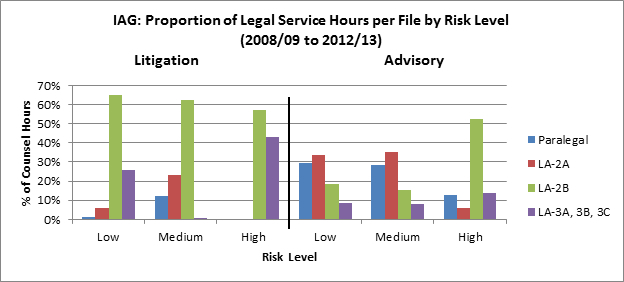
Source: iCase Footnote 74
Figure 3: IAG: Proportion of Legal Service Hours per File by Risk Level (2008/09 to 2012/13) - Text equivalent
Bar graph showing the proportion of legal service hours per file by risk level and by file type
| Low | Medium | High | |
|---|---|---|---|
| Paralegal | 1% | 12% | 0% |
| LA-2A | 6% | 23% | 0% |
| LA-2B | 65% | 62% | 57% |
| LA-3A, 3B, 3C | 26% | 1% | 43% |
| Low | Medium | High | |
|---|---|---|---|
| Paralegal | 29% | 28% | 13% |
| LA-2A | 34% | 35% | 6% |
| LA-2B | 18% | 15% | 53% |
| LA-3A, 3B, 3C | 8% | 8% | 14% |
Figure 4: IAG: Proportion of Legal Service Hours per File by Complexity Level (2008/09 to 2012/13)
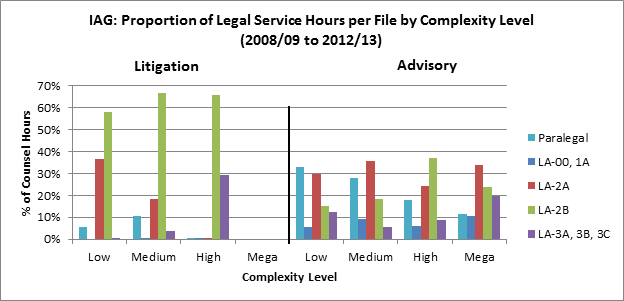
Source: iCase Footnote 75
Figure 4: IAG: Proportion of Legal Service Hours per File by Complexity Level (2008/09 to 2012/13) - Text equivalent
Bar graph showing the proportion of legal service hours per file by risk level and by file type
| Low | Medium | High | Mega | |
|---|---|---|---|---|
| Paralegal | 6% | 11% | 0% | 0% |
| LA-00, 1A | 0% | 0% | 0% | 0% |
| LA-2A | 37% | 18% | 0% | 0% |
| LA-2B | 58% | 66% | 66% | 0% |
| LA-3A, 3B, 3C | 0% | 4% | 29% | 0% |
| Low | Medium | High | Mega | |
|---|---|---|---|---|
| Paralegal | 33% | 28% | 18% | 12% |
| LA-00, 1A | 5% | 9% | 6% | 10% |
| LA-2A | 30% | 36% | 24% | 34% |
| LA-2B | 15% | 18% | 37% | 24% |
| LA-3A, 3B, 3C | 12% | 6% | 9% | 20% |
NSG also shows increased senior counsel time spent in higher risk and complexity files. The trend is somewhat less clear than for IAG due to the substantial amount of time spent by counsel at the LA-2A level, who constituted most of the NSG counsel between 2008/09 and 2012/13.
Figure 5: IAG: Proportion of Legal Service Hours per File by Complexity Level (2008/09 to 2012/13)
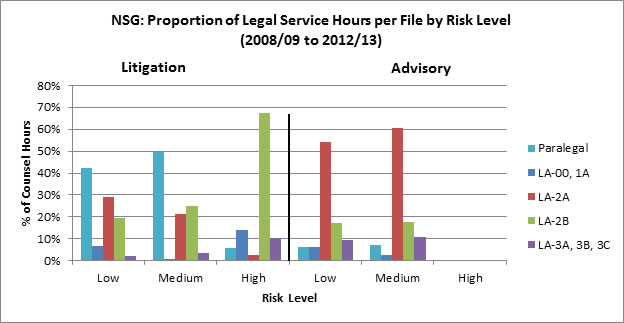
Source: iCase Footnote 76
Figure 5: IAG: Proportion of Legal Service Hours per File by Complexity Level (2008/09 to 2012/13) - Text equivalent
Bar graph showing the proportion of legal service hours per file by risk level and by file type
| Low | Medium | High | |
|---|---|---|---|
| Paralegal | 42% | 50% | 6% |
| LA-00, 1A | 7% | 1% | 14% |
| LA-2A | 29% | 21% | 3% |
| LA-2B | 20% | 25% | 67% |
| LA-3A, 3B, 3C | 2% | 3% | 10% |
| Low | Medium | High | |
|---|---|---|---|
| Paralegal | 6% | 7% | 0% |
| LA-00, 1A | 6% | 2% | 0% |
| LA-2A | 54% | 60% | 0% |
| LA-2B | 17% | 18% | 0% |
| LA-3A, 3B, 3C | 10% | 11% | 0% |
Figure 6: NSG: Proportion of Legal Service Hours per File by Complexity Level (2008/09 to 2012/13)
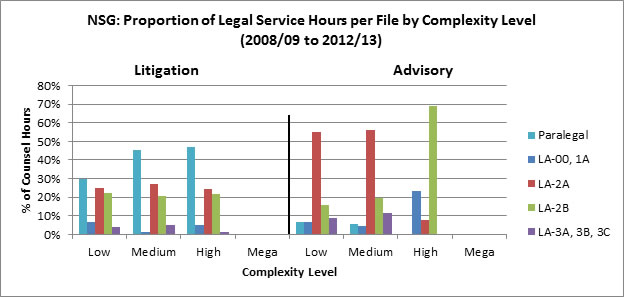
Source: iCase Footnote 77
Figure 6: IAG: Proportion of Legal Service Hours per File by Complexity Level (2008/09 to 2012/13) - Text equivalent
Bar graph showing the proportion of legal service hours per file by risk level and by file type
| Low | Medium | High | Mega | |
|---|---|---|---|---|
| Paralegal | 30% | 45% | 47% | 0% |
| LA-00, 1A | 7% | 1% | 5% | 0% |
| LA-2A | 25% | 27% | 24% | 0% |
| LA-2B | 22% | 21% | 22% | 0% |
| LA-3A, 3B, 3C | 4% | 5% | 2% | 0% |
| Low | Medium | High | Mega | |
|---|---|---|---|---|
| Paralegal | 7% | 6% | 0% | 12% |
| LA-00, 1A | 7% | 5% | 24% | 10% |
| LA-2A | 55% | 56% | 8% | 34% |
| LA-2B | 16% | 20% | 69% | 24% |
| LA-3A, 3B, 3C | 9% | 11% | 9% | 20% |
For CLS, Figures 7 and 8 reflect a balanced approach to litigation teams with all levels of counsel involved regardless of legal risk and complexity levels. However, as would be expected, higher legal risk and complexity litigation files do show more senior than junior counsel time. These files also have a substantial level of effort from paralegals, which reflects the comments made by many key informants that these litigation files create extensive document production demands. Both the increasing amount of senior counsel involvement and the increased use of paralegals for higher legal risk and more complex files match what would be expected from the literature on practice management — more senior counsel involvement in “high value” (i.e., high impact, high importance) work, and delegating “low value” (i.e., less strategic, more routine) tasks, such as document production, to less costly staff.
For advisory files, the pattern is as would be expected with the proportion of senior time increasing in correspondence with the legal risk level. That trend is less marked when considering complexity, but that may be due to the nature of the issues in even lower complexity advisory files.
Figure 7: CLS: Proportion of Legal Service Hours per File by Risk Level (2008/09 to 2012/13)
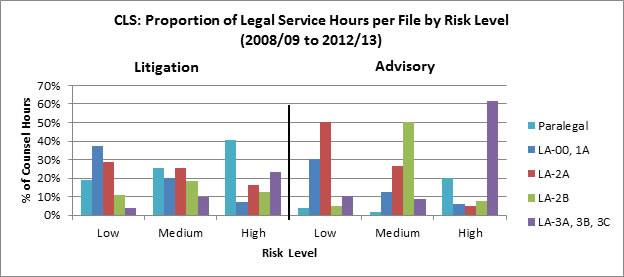
Source: iCase Footnote 78
Figure 7: CLS: Proportion of Legal Service Hours per File by Risk Level (2008/09 to 2012/13) - Text equivalent
Bar graph showing the proportion of legal service hours per file by risk level and by file type
| Low | Medium | High | |
|---|---|---|---|
| Paralegal | 19% | 25% | 41% |
| LA-00, 1A | 37% | 20% | 7% |
| LA-2A | 29% | 26% | 16% |
| LA-2B | 11% | 19% | 13% |
| LA-3A, 3B, 3C | 4% | 10% | 23% |
| Low | Medium | High | |
|---|---|---|---|
| Paralegal | 4% | 2% | 20% |
| LA-00, 1A | 30% | 12% | 6% |
| LA-2A | 50% | 26% | 5% |
| LA-2B | 5% | 50% | 8% |
| LA-3A, 3B, 3C | 10% | 9% | 61% |
Figure 8: CLS: Proportion of Legal Service Hours per File by Risk Level (2008/09 to 2012/13)
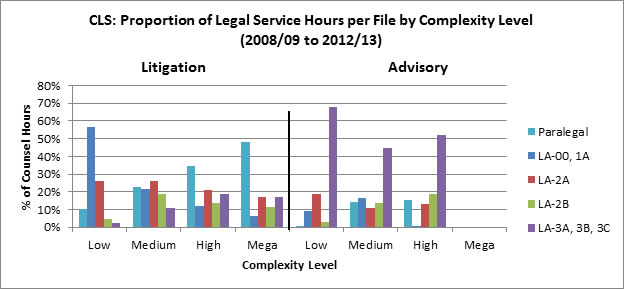
Source: iCase Footnote 79
Figure 8: CLS: Proportion of Legal Service Hours per File by Risk Level (2008/09 to 2012/13) - Text equivalent
Bar graph showing the proportion of legal service hours per file by risk level and by file type
| Low | Medium | High | Mega | |
|---|---|---|---|---|
| Paralegal | 10% | 23% | 35% | 48% |
| LA-00, 1A | 57% | 22% | 12% | 6% |
| LA-2A | 26% | 26% | 21% | 17% |
| LA-2B | 4% | 19% | 14% | 11% |
| LA-3A, 3B, 3C | 2% | 11% | 19% | 17% |
| Low | Medium | High | Mega | |
|---|---|---|---|---|
| Paralegal | 1% | 14% | 15% | 0% |
| LA-00, 1A | 9% | 16% | 1% | 0% |
| LA-2A | 19% | 11% | 13% | 0% |
| LA-2B | 3% | 14% | 19% | 0% |
| LA-3A, 3B, 3C | 68% | 45% | 52% | 0% |
For MCAMLU, the patterns are harder to determine because this unit has both few files and few lawyers, most of whom were at the LA-2A level between 2008/09 and 2012/13. In addition, some files at high legal risk or high-complexity levels, as noted above, may be monitored or supported while most effort is put toward the related class action file that is proceeding to court.
Figure 9: MCAMLU: Proportion of Legal Service Hours per File by Risk Level (2008/09 to 2012/13)
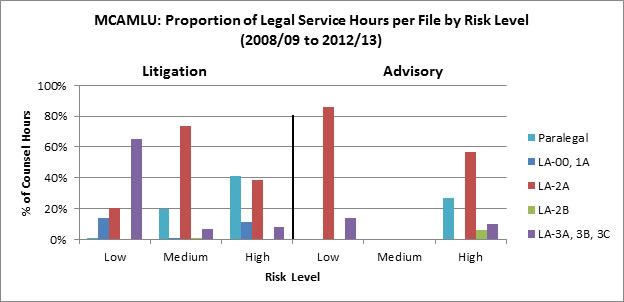
Source: iCase Footnote 80
Figure 9: MCAMLU: Proportion of Legal Service Hours per File by Risk Level (2008/09 to 2012/13) - Text equivalent
Bar graph showing the proportion of legal service hours per file by risk level and by file type
| Low | Medium | High | |
|---|---|---|---|
| Paralegal | 0% | 20% | 41% |
| LA-00, 1A | 14% | 0% | 11% |
| LA-2A | 21% | 73% | 38% |
| LA-2B | 0% | 0% | 0% |
| LA-3A, 3B, 3C | 65% | 6% | 8% |
| Low | Medium | High | |
|---|---|---|---|
| Paralegal | 0% | 0% | 27% |
| LA-00, 1A | 0% | 0% | 0% |
| LA-2A | 86% | 0% | 57% |
| LA-2B | 0% | 0% | 6% |
| LA-3A, 3B, 3C | 14% | 0% | 10% |
Figure 10: MCAMLU: Proportion of Legal Service Hours per File by Risk Level (2008/09 to 2012/13)
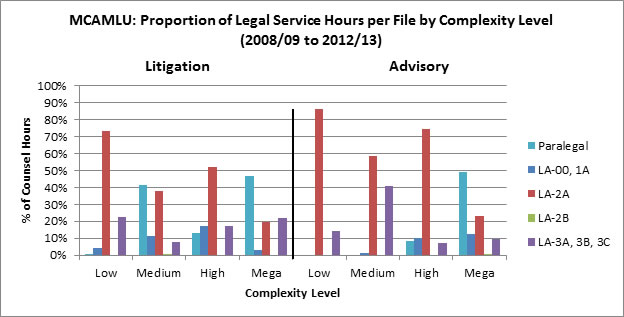
Source: iCase Footnote 81
Figure 10: MCAMLU: Proportion of Legal Service Hours per File by Risk Level (2008/09 to 2012/13) - Text equivalent
Bar graph showing the proportion of legal service hours per file by risk level and by file type
| Low | Medium | High | Mega | |
|---|---|---|---|---|
| Paralegal | 0% | 41% | 13% | 47% |
| LA-00, 1A | 4% | 11% | 17% | 3% |
| LA-2A | 73% | 38% | 52% | 19% |
| LA-2B | 0% | 0% | 0% | 0% |
| LA-3A, 3B, 3C | 23% | 8% | 18% | 22% |
| Low | Medium | High | Mega | |
|---|---|---|---|---|
| Paralegal | 0% | 0% | 9% | 49% |
| LA-00, 1A | 0% | 4% | 10% | 12% |
| LA-2A | 86% | 58% | 74% | 23% |
| LA-2B | 0% | 0% | 0% | 0% |
| LA-3A, 3B, 3C | 14% | 41% | 7% | 9% |
Use of Paralegals
As mentioned earlier, the law practice literature identifies the delegation of suitable tasks to non-lawyers as an effective approach to reducing legal costs for clients and/or freeing counsel to focus on work that requires their skills (Hodgart, 2010). The Department of Justice effectively endorsed this approach when it included increased reliance on paralegals as one of its Process Optimization measures announced in 2012. Certainly, the 59% increase in paralegal FTEs in the Litigation Branch between 2008/09 and 2013/14 indicates support for the use of paralegals that pre-dates the Process Optimization measures.
Across the Litigation Branch, there was positive feedback on the role of paralegals, but the findings also indicate a potential lack of sufficient paralegal resources, as well as a somewhat restricted use of paralegals. Comments on paralegals focused primarily, although not exclusively, on their role in document review and production, which is not surprising given the increasing volume of documents involved in many litigation files. Key informants noted that the Branch benefits from high-quality paralegal support — which includes paralegals with legal as well as IT backgrounds — capable of dealing with complex electronic document production requirements. Given the demanding nature of document production, the need for more paralegals was identified by both key informants (including representatives of multiple sectors within the Litigation Branch, and a few representatives of other areas of Justice) and Litigation Branch survey respondents. The focus of paralegal work on document review and production aligns with counsel and paralegal survey respondents on how paralegals are most often used (see Table 15 and Table 16). The other main tasks in which paralegals are engaged involve work done by IAG (i.e., review of extradition/ Mutual Legal Assistance Treaty (MLAT) requests).
The concentrated use of paralegals on document production may be overlooking other areas where they could be of assistance to counsel. Over half of paralegals surveyed believe that they have, at least occasionally, worked on files where counsel spent time on tasks that paralegals could have done (43% of paralegal respondents reported that this frequently or regularly occurs; in contrast, 28% reported that it rarely or never occurs).
| Frequently (80%-100%) |
Regularly (50%-79%) |
Occasionally (25%-49%) |
Rarely (1%-24%) |
Never (0%) |
DK | N/A | NR | |
|---|---|---|---|---|---|---|---|---|
| Document production | 69% | 10% | 8% | 4% | - | - | 10% | - |
| Redaction of documents for privileges (national security and solicitor-client privilege) | 33% | 24% | 12% | 6% | 8% | - | 18% | - |
| Review of public interest immunity claims and redactions | 24% | 6% | 8% | 4% | 12% | 2% | 45% | - |
| Preparation of responses to undertakings given at discovery | 12% | 22% | 8% | 14% | 2% | - | 43% | - |
| Preparation of documents for submission to PCO for certification of Cabinet confidences | 12% | 14% | 2% | 2% | 12% | 6% | 53% | - |
| Preparation of affidavits | 10% | 14% | 18% | 26% | 8% | - | 24% | 2% |
| Review of extradition/MLAT requests | 10% | 8% | - | - | 8% | 2% | 73% | - |
| Legal research | 8% | 10% | 28% | 33% | 14% | 2% | 6% | - |
| Initial drafts of pleadings | 6% | 6% | 8% | 22% | 20% | - | 39% | - |
| Interviewing potential witnesses | 2% | 10% | 12% | 10% | 26% | - | 41% | - |
| Initial draft of written submissions | - | - | 16% | 24% | 26% | - | 35% | - |
| Initial draft of questions for discovery | - | 2% | 10% | 14% | 22% | - | 53% | - |
Note: Summation of percent values may not equal 100% due to rounding.
Source: Litigation Branch survey (National eDiscovery and Litigation Support Services and the ADAG Office counsel were not included)
| Frequently (80%-100%) |
Regularly (50%-79%) |
Occasionally (25%-49%) |
Rarely (1%-24%) |
Never (0%) |
DK | N/A | NR | |
|---|---|---|---|---|---|---|---|---|
| Document production | 76% | - | - | - | - | - | 14% | 10% |
| Redaction of documents for privileges (national security and solicitor-client privilege) | 38% | 29% | 10% | - | 5% | - | 14% | 5% |
| Review of extradition/MLAT requests | 24% | - | - | - | 29% | - | 43% | 5% |
| Legal research | 14% | 19% | 33% | 24% | - | - | 5% | 5% |
| Preparation of affidavits | 14% | 10% | 10% | 38% | 5% | - | 19% | 5% |
| Preparation of responses to undertakings given at discovery | 14% | 10% | 5% | 10% | 14% | - | 38% | 10% |
| Interviewing potential witnesses | 14% | 10% | 19% | - | 10% | - | 43% | 5% |
| Review of public interest immunity claims and redactions | 14% | 10% | 5% | 5% | 10% | - | 52% | 5% |
| Initial drafts of pleadings | 10% | 14% | 14% | 19% | 14% | - | 24% | 5% |
| Initial draft of written submissions | 10% | 5% | 5% | 19% | 19% | - | 38% | 5% |
| Initial draft of questions for discovery | 5% | 5% | 19% | 5% | 19% | - | 43% | 5% |
| Preparation of documents for submission to PCO for certification of Cabinet confidences | - | - | 14% | 24% | 14% | - | 43% | 5% |
Note: Summation of percent values may not equal 100% due to rounding.
Source: Litigation Branch survey (National eDiscovery and Litigation Support Services and the ADAG Office paralegals were not included)
Table 17 shows that, generally, paralegal hours are increasing over time. The importance of paralegals to the teams across the Litigation Branch is evident in that for most types of work, paralegals constitute one-quarter to almost one-half of the total legal service effort. Although there are some fluctuations across the years, the proportion of paralegals’ level of effort has remained fairly unchanged.
Table 17: Distribution of Paralegal and Counsel Hours (2008/09 to 2013/14)
| Litigation Files | |||
|---|---|---|---|
| Paralegal hours | Total legal service hours | % hours by paralegals | |
| 2008/09 | 19,040 | 76,353 | 25% |
| 2009/10 | 20,247 | 77,456 | 26% |
| 2010/11 | 25,098 | 92,17a6 | 27% |
| 2011/12 | 27,003 | 89,750 | 30% |
| 2012/13 | 21,519 | 75,517a | 28% |
| 2013/14 | 18,607 | 67,305 | 28% |
| Total | 131,514 | 478,557 | 27% |
| Advisory Files | |||
|---|---|---|---|
| Paralegal hours | Total legal service hours | % hours by paralegals | |
| 2008/09 | 185 | 2,119 | 9% |
| 2009/10 | 299 | 2,768 | 11% |
| 2010/11 | 553 | 2,292 | 24% |
| 2011/12 | 40 | 2,860 | 1% |
| 2012/13 | 59 | 1,810 | 3% |
| 2013/14 | 59 | 1,722 | 3% |
| Total | 1,195 | 13,571 | 9% |
| Litigation Files | |||
|---|---|---|---|
| Paralegal hours | Total legal service hours | % hours by paralegals | |
| 2008/09 | 1,739 | 4,780 | 36% |
| 2009/10 | 2,700 | 7,276 | 37% |
| 2010/11 | 3,570 | 6,995 | 51% |
| 2011/12 | 4,591 | 9,114 | 50% |
| 2012/13 | 1,926 | 5,371 | 36% |
| 2013/14 | 3,333 | 9,198 | 36% |
| Total | 17,859 | 42,734 | 42% |
| Advisory Files | |||
|---|---|---|---|
| Paralegal hours | Total legal service hours | % hours by paralegals | |
| 2008/09 | 2,120 | 5,045 | 42% |
| 2009/10 | 10,807 | 20,146 | 54% |
| 2010/11 | 13,327 | 28,573 | 47% |
| 2011/12 | 10,001 | 20,953 | 48% |
| 2012/13 | 4,309 | 10,267 | 42% |
| 2013/14 | 2,998 | 5,803 | 52% |
| Total | 43,562 | 90,787 | 48% |
| Litigation Files | |||
|---|---|---|---|
| Paralegal hours | Total legal service hours | % hours by paralegals | |
| 2008/09 | 5,057 | 11,014 | 46% |
| 2009/10 | 6,596 | 13,991 | 47% |
| 2010/11 | 5,758 | 15,304 | 38% |
| 2011/12 | 6,153 | 14,514 | 42% |
| 2012/13 | 9,415 | 19,058 | 49% |
| 2013/14 | 7,576 | 16,618 | 46% |
| Total | 40,555 | 90,499 | 45% |
| Advisory Files | |||
|---|---|---|---|
| Paralegal hours | Total legal service hours | % hours by paralegals | |
| 2008/09 | 615 | 6,820 | 9% |
| 2009/10 | 55 | 6,955 | 1% |
| 2010/11 | 543 | 7,078 | 8% |
| 2011/12 | 725 | 6,472 | 11% |
| 2012/13 | 129 | 5,117 | 3% |
| 2013/14 | 174 | 4,983 | 3% |
| Total | 2,240 | 37,425 | 6% |
| Litigation Files | |||
|---|---|---|---|
| Paralegal hours | Total legal service hours | % hours by paralegals | |
| 2008/09 | 20 | 373 | 5% |
| 2009/10 | 16 | 1,161 | 1% |
| 2010/11 | 34 | 2,420 | 1% |
| 2011/12 | 36 | 363 | 10% |
| 2012/13 | 164 | 1,428 | 11% |
| 2013/14 | 2 | 996 | 0% |
| Total | 272 | 6,741 | 4% |
| Advisory Files | |||
|---|---|---|---|
| Paralegal hours | Total legal service hours | % hours by paralegals | |
| 2008/09 | 7,730 | 26,527 | 29% |
| 2009/10 | 6,569 | 25,521 | 26% |
| 2010/11 | 7,941 | 26,760 | 30% |
| 2011/12 | 8,536 | 30,685 | 28% |
| 2012/13 | 8,984 | 27,229 | 33% |
| 2013/14 | 12,197 | 41,688 | 29% |
| Total | 51,957 | 178,410 | 29% |
Source: iCase
Use of National eDiscovery and Litigation Support Services
The document review and stakeholder interviews highlighted the substantial impact that expanded discovery obligations and the rise in eDiscovery are having on Litigation Branch workload. Document disclosure during the course of litigation requires substantial technological and paralegal support, and is a large part of the work of the Litigation Branch. In recent years, disclosure requirements have become larger and more complex for a number of reasons. In part, additional document requirements are due to the increased use of email as a primary means of communication within client departments; the volume of potentially relevant material has expanded and the review requires more time. In addition, documents and stakeholders identify an increase in demand for disclosure of sensitive information as well as an increase in the complexity of disclosure exemptions and redaction requirements.
National eDiscovery and Litigation Support Services is a relatively new addition to the Litigation Branch that provides a single point of access to Justice Canada for discovery, eDiscovery and disclosure resources and services; substantive legal, practical and procedural advice to counsel in litigation offices and legal service units; advice to senior government officials and Ministers on eDiscovery issues and strategy; and training and learning activities related to discovery, eDiscovery and disclosure. The Group includes lawyers and paralegals who work exclusively on helping litigation teams review and analyze documents for relevance, privilege and other issues. They use software and specialized techniques to review large volumes of documents quickly, efficiently and accurately. The evidence management team is available to support all Justice litigators, and is intended to support litigation teams (rather than taking work away from them) and to reduce the need for outsourcing information processing work.
These improvements to document review and evidence processing are expected to increase efficiency in a number of ways, including:
- reducing the need for outsourcing tasks related to document review and evidence processing (although internal documents indicated that certain tasks, such as scanning and coding, will continue to be outsourced);
- ensuring a consistent approach to working with electronic evidence in litigation files; and
- providing a source of expertise in how evidence is organized and structured.
The Group is still too new to demonstrate its cost savings to the Department, but projections are a cost avoidance “soft savings” of $9.5 million by 2016/17. The savings are not projected to result in reduced FTEs or outsourcing costs because of the projected increase in demand for handling eDiscovery. Instead, they are expected to reduce the increase in costs through their efficiency gains. Currently, the goal of the Group is to handle 25% of the total document workload (focusing on the largest files), with 25% to be outsourced, and 50% to be handled by counsel (smaller files). Estimates are that the Group is currently handling closer to 12% of the total document workload. Litigation Branch survey results indicated low awareness of the Group, with 37% of counsel who primarily handle litigation files reporting they either had no experience with the Group or considered it not applicable to their work. Experience with the Group was generally positive as just over one-third (35%) of respondents assessed their experience as excellent or above average, 24% of respondents considered their experience to be average, and 2% considered it to be poor.
Resolving Matters Efficiently and Effectively
Dispute Resolution
Another area targeted by 2012 Process Optimization involves negotiating service expectations and seeking settlement mandates from clients early in litigation files as a method of ensuring that clients' desired outcomes are achieved in an affordable manner. The Process Optimization measure aligns with a long-standing Justice Canada commitment to pursuing early resolution strategies that has included policy development, a commitment to training on effective dispute resolution processes, and tools to assist counsel (e.g., templates, toolkits, checklists). The CLS has also developed its own resources related to dispute resolution, including checklists, competencies and guidance materials.
Not all files are appropriate for dispute resolution, so attempts to negotiate settlement or use other dispute resolution processes, such as arbitration or mediation, may not be desired. Early dispute resolution may not suit cases involving constitutional or public law issues, significant questions of government policy, rights or principles that require court affirmation, or issues requiring consistency in application of the law. In these cases, litigation may be preferred. Therefore, even if early dispute resolution is encouraged, it should not be pursued in every case.
Based on multiple lines of evidence (key informant interviews, client and Litigation Branch surveys, case studies), the Litigation Branch appears generally to be pursuing dispute resolution processes, when appropriate. Over three-quarters of counsel survey respondents (77%) frequently or regularly consider using dispute resolution options on their files. In addition, nearly three-quarters (73%) of survey respondents considered that dispute resolution processes are adequately utilized. Footnote 82 Results from Client Feedback Surveys confirm that the Litigation Branch assists clients in early resolution; in 2012, the Branch received a score of 8.0 out of 10 (up from 7.7 in 2009) for identifying means to prevent or resolve legal disputes at the earliest opportunity.
The evaluation evidence points to a potential area of improvement in the types of dispute resolution options considered, although a more in-depth study would be required to provide a definitive finding. According to Litigation Branch survey respondents, the dispute resolution option most frequently used to try to settle a file is negotiation, followed by court-mandated mediation. Very few respondents reported working on files that attempted to use other options such as voluntary mediation or neutral evaluation (or non-binding arbitration) to settle the dispute. This result is similar to the conclusions from internal reviews, which found that, while negotiation was used substantially in litigation files, the use of other forms of dispute resolution (voluntary mediation, case management conferences for settlement purposes, and settlement conferences) was low. The more limited use of types of dispute resolution processes might account for the Branch scoring 7.9 out of 10 in the 2012 Client Feedback Survey (0.3 less than its 2009 score, and below the departmental target of 8.0) for identifying opportunities to use dispute resolution practices, where appropriate. However, this score had a high margin of error, so results must be interpreted with caution.
Whether to use dispute resolution is a decision that typically rests with the client, so its use (or not) points to issues beyond the Litigation Branch's direct control. Key informants from the Branch noted that clients do not typically engage in early dispute resolution prior to Litigation Branch involvement. In addition, many key informants (representing the Litigation Branch and DLSUs) said that the Branch keeps alternative dispute resolution in mind and makes good use of dispute resolution practices (including mediation, case conferences, counsel-to-counsel discussion, and settlement) when they are appropriate. However, a few key informants identified that, since some clients are averse to settling, the Litigation Branch has fewer opportunities for engaging in alternative dispute resolution than it may like. Client hesitance to engage in settlements is not universal: key informants representing client departments who discussed the use of early dispute resolution mentioned that they consider these forms of alternative dispute resolution, and that they consider the court a last resort. Similarly, a few DLSU representatives mentioned that their clients are open to early dispute resolution.
The available iCase data indicate that CLS settles litigation cases at a comparable rate to the rest of Justice Canada. Footnote 83 In the most recent Departmental Performance Report (2011/12) for which the rate of settlement is available, 23% of litigation files were settled (Department of Justice Canada, 2012a). The method of settlement most often indicated in iCase by CLS is negotiation. Footnote 84 Other methods of dispute resolution combined (e.g., mandatory mediation, voluntary mediation, and other judicial processes) are used about 30% of the time in settlements, compared to 70% for negotiation.
| 2008/09 (n=534) |
2009/10 (n=926) |
2010/11 (n=566) |
2011/12 (n=835) |
2012/13 (n=768) |
2013/14 (n=391) |
|
|---|---|---|---|---|---|---|
| Adjudicated | 51% | 37% | 50% | 62% | 59% | 62% |
| Settled | 32% | 22% | 31% | 22% | 24% | 28% |
| Closed administratively/ transferred | 16% | 19% | 19% | 16% | 18% | 10% |
| Not indicated | 1% | 22% | <1% | - | <1% | - |
| Total | 100% | 100% | 100% | 100% | 100% | 100% |
Note: Totals may not sum to 100% due to rounding.
Source: iCase data (closed CLS litigation files)
Gaining a better understanding of dispute resolution, including whether there are opportunities for expanding the types of dispute resolution processes attempted in files and whether these processes could be used earlier (even before the Litigation Branch is involved), is part of Process Optimization and goes beyond the scope of this evaluation. However, the evaluation findings indicate that the Branch is currently using dispute resolution and successfully settling matters at about the same rate as the Department as a whole.
- Date modified: