
Public Safety, Defence, and Immigration Portfolio Evaluation
4. Evaluation Findings
This section of the report describes the evaluation findings related to the PSDI Portfolio. The information is based on findings collected from all lines of evidence.
4.1. Relevance
Simply put, federal departments and agencies cannot operate without the support of Department of Justice legal services. The Office of the PSDI ADAG, DLSUs and regional offices together provide critical support to their client departments and agencies as they carry out their mandate, implement new initiatives and respond to issues having a legal dimension. These services and support have been particularly relevant in a context where national security has been among the federal government’s list of top priorities. Moreover, activities of the Portfolio align directly with the roles and responsibilities attributed to the federal government. The following subsections further elaborate on these findings.
4.1.1. Addressing the needs of the federal government
Overview of the need
In 2013/14, legal counsel from the PSDI Portfolio spent approximately 475,000 hours managing litigation files for their client departments and agencies. They provided more than 200,000 hours of advisory work, in addition to investing more than 28,000 hours in legislative files. The Department of Citizenship and Immigration Canada alone faced more than 10,000 litigation cases. These numbers, among many others that are further explored in this report, serve to illustrate the extent to which legal support and services are integrated in the ongoing operations of PSDI client departments and agencies. Whether they relate to transactional or contractual activities, the assessment of legal risk associated with a new policy or legislative initiative, or the management of litigation files that range from low risk and low complexity to highly complex and sensitive, evaluation findings confirm that legal services provided by the PSDI Portfolio are essential to the ongoing operations of its client departments and agencies.
Trends affecting the demand
A number of trends affect the need for services provided by the Portfolio. As noted by legal counsel who were interviewed as part of this evaluation, the complexity of some of the files they manage has steadily increased over the period covered by the evaluation. This opinion was also echoed by those legal counsel who participated in the survey. As illustrated in Figure 3, just over 70% of respondents agreed or strongly agreed with the view that the complexity of files they have been involved in has significantly increased over the past three to five years. This trend was slightly more pronounced among legal counsel working in DLSUs, as opposed to those working in regional offices, which reflects the fact that the majority of litigation files assigned to the Portfolio are of low and medium complexity levels. Footnote 15 The ADAG Office manages and closely monitors only a small minority of the total number of PSDI files, namely those of high complexity.
Evaluation findings point to a number of factors that have contributed to this increased complexity in files being managed by the Portfolio. For instance, a number of departments and agencies are facing policy or operational challenges where there are few, if any, precedents in law that could serve to assess the associated legal risks. Another dynamic identified during the interviews and case studies is the increasingly integrated approach adopted to tackle some policy or operational challenges, particularly in the area of national security. Finally, on the litigation front, a number of high profile cases involving PSDI client departments and agencies have raised complex constitutional issues that had to be addressed by appellate courts. Footnote 16
Figure 3: Complexity of files
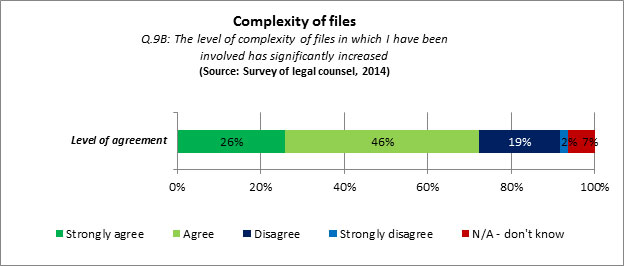
Figure 3 - Text equivalent
Cumulative Bar Graph showing the results of Q.9B from PSDI Legal Counsel Survey (2014): The level of complexity of files in which I have been involved has significantly increased.
| Strongly agree: | 26% |
| Agree: | 46% |
| Disagree | 19% |
| Strongly disagree | 2% |
| N/A – don’t know | 7% |
Another trend that has had an impact on the demand for PSDI legal services is the level of legislative activities that occurred in Parliament during the period covered by the evaluation. The significant amendments made to the Immigration and Refugee Protection Act, the integration of the Passport Office within CIC, the Canadian Victims Bill of Rights initiative, and more recently, the tabling of Bill C-51, the Anti-Terrorism Act, 2015 Footnote 17 , were some of the examples provided.
It was also noted during interviews conducted as part of this evaluation that the level of advisory activities has been triggered by the tabling in Parliament of Private Members’ Bills. Over the period covered by this evaluation, their numbers have been increasing significantly. Footnote 18 The fact that these bills are not led by a department or agency (but may still have a direct impact on the department or agency’s operations) has required a considerable level of effort on the part of some PSDI legal counsel.
Finally, a number of commissions of inquiry, such as the Commission of Inquiry into the Investigation of the Bombing of Air India Flight 182, the Arar Inquiry, and the Iacobucci Inquiry, have had a significant impact on the need for legal support during both their proceedings and the required follow-up.
The need for coordination and monitoring
Overall rationale for ongoing coordination and monitoring
There is a strong rationale for the coordination and monitoring of legal activities undertaken by legal counsel affiliated with the Department of Justice Canada, regardless of where they work. Some legal files involve multiple departments and agencies that may have varying or even competing interests or circumstances that have to be taken into consideration and resolved. In addition, legal opinions provided by legal counsel must be consistent and in accordance with the role attributed to the Minister of Justice to act as the official legal advisor of the Government of Canada as a whole. Footnote 19
The same principle applies when various files raise similar legal issues and yet are managed by legal counsel located in different DLSUs or regional offices. Again, active monitoring and coordination activities Footnote 20 are required to ensure that legal positions put forward will be consistent among these different files and promote the best solution for the government as a whole. This reflects the ongoing commitment of the Department of Justice Canada to “speak with one voice.” To achieve this may occasionally require choosing one position over another. Such decisions are taken by senior Justice officials, with the appropriate coordination support.
Many positions within the Department of Justice are expected to support active coordination and monitoring efforts. As already noted in the description of the Portfolio, functional responsibilities for the advisory, litigation and policy work related to national security have been respectively assigned to the ADAG (PSDI), ADAG (Litigation), and the Senior Assistant Deputy Minister (Policy Sector). Also noted in the description of the Portfolio, the ADAG Office includes two teams (the NLCT and the NSLT) that are expected to support the coordination and monitoring of services offered to the Portfolio’s client departments and agencies.
4.1.2. Alignment with Federal Roles and Responsibilities
During the period covered by the evaluation, activities of the federal government were driven by a number of broad policy priorities including, predominantly, economic recovery and security (the latter component engaging the PSDI Portfolio directly). In the June 2011 Speech from Throne, the Governor General stated that “our government will move quickly to reintroduce comprehensive law and order legislation to combat crime and terrorism”. Footnote 21 Legal counsel and representatives from client departments and agencies who were interviewed as part of this evaluation have repeatedly emphasized how much this law and order agenda has mobilized resources. Numerous legislative initiatives have been associated with this policy priority, including tougher sentences for certain types of crimes and the Victim’s Bill of Rights.
The title of the government’s 2013 Speech from Throne, “Prosperity and opportunity in an uncertain world”, reflected the continued priority given to law and order, and the national security agenda. Footnote 22 In it, the government restated its commitment to fundamental changes to the Criminal Code to punish crime and better protect victims of crimes. It also committed the government to renew the Canada First Defence Strategy, to pursue fundamental reforms to the immigration system to eliminate backlogs, to better protect refugees, and to reform the Citizenship Act — all policy goals that involve PSDI client departments and agencies.
4.1.3. Alignment with federal roles and responsibilities
Parliament has specifically assigned to the Minister of Justice the role of official legal advisor to all federal departments and agencies. Footnote 23 More specifically, the Department of Justice Canada must support the Minister in his capacity as Attorney General of Canada, by conducting litigation for and against the Crown and by advising “the heads of the several departments of the Government on all matters of law connected with such departments.” Footnote 24
There is a strong rationale for centralizing legal services within the Department of Justice Canada, as opposed to allowing each department to contract its own legal counsel. In the early 1960s, the Royal Commission on Government Organization (commonly referred to as the Glassco Commission) found that the vast majority of the federal government’s lawyers, including legal counsel in the other departments and outside agents, did not come under the responsibility of the Department of Justice Canada. The Commission examined this issue, and proposed that all legal services (with a few exceptions) be grouped together under the direction of the Department, in order to eliminate the many disadvantages of a decentralized practice. Footnote 25
The centralized model whereby the Department of Justice, with few exceptions, provides legal services to government departments and agencies ensures there is a consistency of approach and that the Department speaks with one voice. This model has been integrated in the Treasury Board of Canada’s Common Services Policy, which identifies Justice Canada as the mandatory provider of legal services for federal departments and agencies. The Policy states that certain services are designated as mandatory “when a government-wide interest or consideration prevails over, or coincides with, the interest of individual departments and agencies.” Footnote 26 In the specific case of the Department of Justice Canada, the Policy notes that in the discharging of duties, “the Minister of Justice weighs considerations of both law and government policy,” and that legal services provided by the Department “are centrally controlled in order to assure overall consistency and integrity of approach.” Footnote 27
In supporting the ongoing management of DLSUs included within its scope, assuming functional responsibility for the work performed in regional offices for its client departments and agencies, and managing the law related to public safety, defence, and immigration, the PSDI Portfolio supports the Department in discharging its responsibilities in accordance with the Department of Justice Act and the Common Services Policy.
4.2. Design of the Portfolio
The mandate of the PSDI Portfolio is fairly well defined and understood. Its composition has evolved over time and currently involves departments and agencies that share some common institutional goals, while pursuing their own specific mandate. To support its ongoing operations, the Portfolio has established governance structures and processes that have contributed to an efficient communication flow among managers. This subsection provides further details on these findings.
4.2.1. Mandate and objectives of the Portfolio
The role of the PSDI Portfolio covers two fundamental dimensions. First, it is responsible for the operational management of the DLSUs and, to some extent, regional offices, insofar as the latter group provides legal services to PSDI client departments and agencies. This includes, among other things, the yearly budget and resource allocation process, as well as the implementation of any Portfolio or departmental-wide initiatives. Secondly, the Portfolio assumes some responsibilities related to the management of the law. This is done through a number of structures and processes including, but not limited to, the work of the NLCT and the NSLT.
One line of inquiry for this evaluation was to assess the extent to which PSDI legal counsel understand the mandate and objectives of the Portfolio. This is particularly relevant to ensure that, beyond immediate considerations related to their daily work within a DLSU or a regional office, legal counsel understand their affiliation to a broader entity that entails an overarching goal of consistency in the work performed by the Portfolio. On that front, evaluation findings indicate that there is, in fact, a fairly good understanding of the mandate and objectives of the Portfolio among PSDI legal counsel. First, as illustrated in Figure 4, 8 out of 10 survey respondents indicated that they had a very good or good understanding of the mandate of the Portfolio.
Figure 4: Mandate of the Portfolio
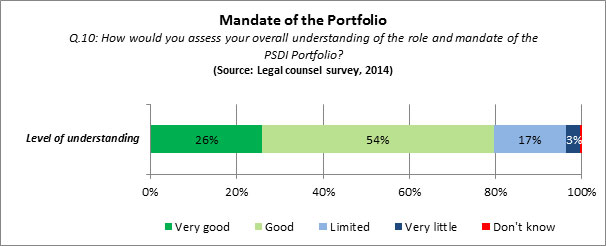
Figure 4 - Text equivalent
Cumulative bar graph showing the results of Q.10 from the PSDI Legal Counsel Survey (2014). How would you assess your overall understanding of the role and mandate of the PSDI Portfolio?
| Very Good | 26% |
| Good | 54% |
| Limited | 17% |
| Very Little | 3% |
| Don’t Know | 0% |
Interviews conducted specifically with managers operating in DLSUs and regional offices confirm that they have a particularly good understanding of the role of the Portfolio. As further described in subsection 4.2.3, the governance structures and processes in place contribute directly to this outcome. The leadership team within the ADAG Office, heads of DLSUs and regional directors general communicate weekly on Portfolio matters, which helps to ensure a broadly held common understanding of the mandate and role of the Portfolio.
4.2.2. Portfolio composition
As noted in the Section 2.0 of the report, which describes the organization of PSDI, the Portfolio has evolved over time, moving from a single-client portfolio focussing on immigration matters, to a collection of DLSUs and regional offices serving nine departments and agencies. The evaluation assessed the extent to which there is a shared purpose that could logically link the work of PSDI legal counsel and allow the Portfolio to serve its fundamental mandate, both in terms of operational management and the management of the law.
Shared areas of responsibility
As it currently stands, the Portfolio serves client departments and agencies that share a joint responsibility for national security. For instance, all departments and agencies currently served by the Portfolio have been engaged to some extent in law and order initiatives that the federal government has implemented during the period covered by the evaluation. Many of these initiatives have, in fact, required the direct collaboration of a number of these departments and agencies. This was reflected in the findings from the survey of PSDI legal counsel, where more than half of respondents (55%) indicated that an increasing proportion of their files involve more than one department and agency. Evaluation findings indicate that by providing a platform where they can communicate, exchange ideas, and coordinate their activities, the Portfolio does support the ongoing work of legal counsel operating both in its DLSUs and regional offices.
However, in some cases the work performed by legal counsel, particularly those in DLSUs, can be highly specialized and relevant only to the particular department they serve. For example, in cases such as traffic accident claims involving government-owned vehicles, the legal work may be performed largely in isolation of other PSDI departments and agencies. Evaluation findings indicate that for those involved in this kind of work, the design of the Portfolio has limited impact and, by extension, limited benefits.
Collaborating beyond the Portfolio
The fact that legal counsel are assigned to a portfolio does not preclude them from collaborating with legal counsel affiliated with other portfolios. Findings from interviews and case studies provided many examples where such collaboration has been occurring, particularly in files involving Transport Canada and the Department of Foreign Affairs, Trade, and Development. Along the same line, a third (33%) of the respondents to the legal counsel survey indicated that an increasing proportion of their files involve departments and agencies that are located outside of the Portfolio. This collaboration has been occurring successfully, and evaluation findings did not identify any systemic barriers that would limit the ability of such collaboration to occur as a result of the current Portfolio configuration.
4.2.3. Governance structure and processes
The Portfolio has implemented a number of governance structures and processes that, according to evaluation findings, have facilitated the exchange of information and the collaboration among DLSUs and regional offices:
- Weekly management calls: The ADAG Office, the heads of the DLSUs, and the PSDI Regional Directors hold a weekly conference call to discuss management related issues. Participants in these calls who were interviewed as part of this evaluation systematically praised this communication tool. They indicated that these calls contribute to building a shared understanding of the overall activities of the Portfolio, in addition to providing strategic information on department-wide initiatives affecting the Portfolio. These calls also facilitate the ongoing collaboration among Portfolio managers, including more particularly the collaboration between DLSUs and regional offices.
- In-person management meetings: Three times a year, these same individuals meet in person to address management priorities and issues in more depth. Evaluation findings indicate that these meetings have been particularly helpful in supporting the implementation of the Process Optimization initiative, which is further discussed in subsection 5.3.2 of this report.
- Weekly calls on national security matters: To support the management of law, the ADAG Office also holds a weekly conference call dealing specifically with national security matters. DLSU managers involved in these files attend this meeting. In addition to discussing ongoing files, managers receive briefings on the work of the National Security and Intelligence Committee (NSIC). Established by the Deputy Minister and chaired by the ADAG PSDI, the NSIC supports the department-wide coordination of legal policy, advisory, and litigation issues relating to national security and intelligence. Footnote 28 Managers interviewed as part of this evaluation found these meetings to be relevant, particularly in the current policy context where national security remains a government priority.
- Scratch Legal Issues Committee (SLIC): Also related to the management of law — in this case immigration law — the ADAG Office holds weekly conference calls with members of the SLIC. Integrated within the NLCT, the SLIC involves designated members from CIC and CBSA DLSUs, as well as litigators from the regional offices in Quebec, Ontario, the Prairie Provinces, and British Columbia. Evaluation findings indicate that the work of the SLIC has greatly contributed to ensuring consistency in the positions and opinions provided by the Portfolio on immigration matters. Among other things, the SLIC reviews and approves appellate level facta, develops model paragraphs to be included in facta when relevant, develops position papers on significant legal issues, and provides overall insights into immigration law policy matters.
- Immigration Managers Committee (IMC) –This committee is coordinated by the NLCT. It is a monthly call with immigration lawyers who manage legal counsel working in PSDI on immigration matters. They are responsible for management issues related to the practice of immigration law, including: the relations with the courts; immigration ethical practice issues; the impact of important legislation and decisions on the operations; and participation and representation at various immigration conferences. IMC is made up of immigration managers from the key immigration regions, Crimes Against Humanity and War Crimes, CIC and CBSA DLSUs, the PSDI Deputy ADAG, and the NLCT Director.
In addition, to support the ongoing monitoring of resource allocation within the Portfolio, the Office of Business Management provides ongoing reporting, largely based on iCase Footnote 29 and financial data, addressing a number of indicators, such as the number of files managed by the Portfolio (active, opened, and closed), the distribution of hours dedicated to the types of files (advisory, litigation, legislative), the distribution of files by complexity and risk levels, the distribution of work between components of the Portfolio, or the distribution of hours billed to a file by seniority levels among legal counsel.
Evaluation findings indicate that this data provides important support to the ongoing management of the Portfolio, including the implementation of department-wide initiatives such as those undertaken as part of Process Optimization. This information has also played a critical role in the context of this evaluation by providing key performance data.
4.3. Performance – Achievement of Expected Outcomes
This subsection explores several dimensions of the actual work performed by the Portfolio over the period covered by this evaluation. It includes an analysis of the work done specifically on litigation, advisory, and legislative files, and the extent to which it has met the needs of the PSDI client departments and agencies. This subsection also assesses the impact of the coordinating and monitoring support provided by the ADAG Office, and the extent to which legal counsel have access to the tools they require to effectively deliver their services.
4.3.1. Overview of the support provided by the Portfolio
Approximately 95% of the work performed by PSDI legal counsel is associated with litigation or advisory files. The remaining 5% is essentially split equally between legislative files and non-legal files. The latter category includes activities that are not associated with a specific client and may include, for instance, professional development activities.
As illustrated in Figure 5, the volume of work performed on the three main categories of PSDI files has substantially increased over the period covered by the evaluation. In particular, the number of hours billed on litigation files has increased by 72%, whereas the number of hours billed on advisory files has increased by 53% between 2008/09 and 2013/14. This trend has been triggered in part by the addition of two DLSUs to the Portfolio in 2009/10 (DND/CAF and CSE). Since 2010/11, the rate of growth in litigation hours has been a more modest 8% and in advisory hours, 3%. Although it represents a relatively minor proportion of all legal services provided by PSDI, by comparison, the growth in hours of legislative services has been substantial (47%) since 2010/11. The level of effort has dropped for all categories of files since 2012/13.
Figure 5: Number of hours per types of files – PSDI Portfolio
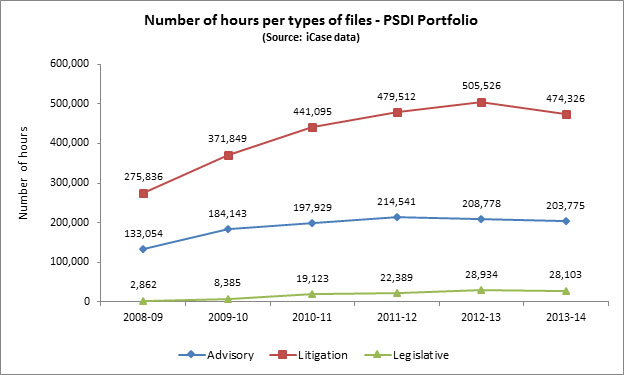
Figure 5 - Text equivalent
Line graph showing the number of hours per types of files by fiscal year. Source: iCase data
| Fiscal Year | 2008-09 | 2009-10 | 2010-11 | 2011-12 | 2012-13 | 2013-14 |
|---|---|---|---|---|---|---|
| Litigation | 275,836 | 371,849 | 441,095 | 479,512 | 505,526 | 474,326 |
| Advisory | 133,054 | 184,143 | 197,929 | 214,541 | 208,778 | 203,775 |
| Legislation | 2,862 | 8,385 | 19,123 | 22,389 | 28,934 | 28,103 |
Findings from the survey of legal counsel largely reflect these trends. As illustrated in Figure 6, the majority of survey respondents were of the opinion that the number of files in which they have been involved over the past three to five years has significantly increased, particularly so among respondents that belong to DLSUs.
Figure 6: Volume of work
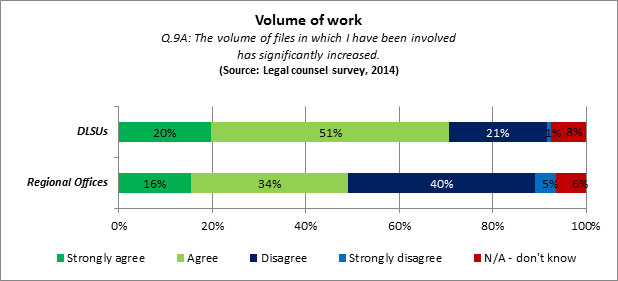
Figure 6 - Text equivalent
Cumulative bar graph showing the results of Q.9A from the PSDI Legal Counsel Survey (2014).
The volume of files in which I have been involved has significantly increased.
DLSUs response:
| Strongly agree | 20% |
| Agree | 51% |
| Disagree | 21% |
| Strongly disagree | 1% |
| N/A – don’t know | 8% |
Regional Offices response:
| Strongly agree | 16% |
| Agree | 34% |
| Disagree | 40% |
| Strongly disagree | 5% |
| N/A – don’t know | 6% |
As already noted in subsection 4.1 of this report, which addresses the relevance of services provided by the Portfolio, a number of factors have contributed to the greater demand for legal services, including the increased complexity of files and the implementation of several new initiatives related to national security and immigration matters.
4.3.2. Litigation services
The Portfolio has been managing an increasing number of files during the period covered by the evaluation (Table 5). Only in 2013/14 has there been a drop in the number of actively managed files from the previous year.
| 2008/09 | 2009/10 | 2010/11 | 2011/12 | 2012/13 | 2013/14 | |
|---|---|---|---|---|---|---|
| # of files | 11,133 | 13,263 | 15,744 | 17,911 | 19,493 | 18,284 |
Source: iCase data
Data indicates that CIC is, by far, the department that mobilizes the greatest level of litigation resources. As indicated in Figure 7, over 162,000 hours of litigation work have been assigned to CIC files in 2013/14, which involved more than 10,000 active files. The CBSA, the RCMP, and CSC were also among the most active agencies on litigation matters during that same year.
Figure 7: Distribution of litigation hours per client (2013/14)
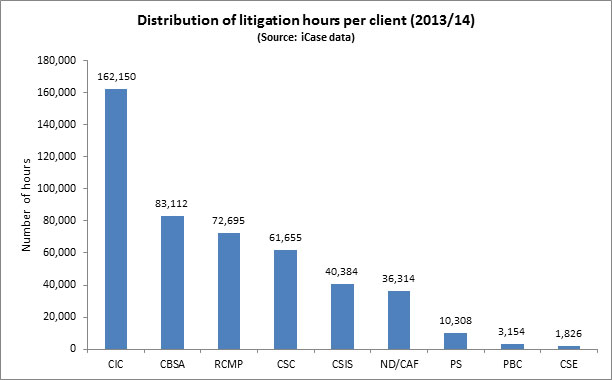
Figure 7 - Text equivalent
Bar graph showing the number of litigation hours for each DLSU in 2013-14. Source: iCase data
| CIC | 162,150 |
| CBSA | 83,112 |
| RCMP | 72,695 |
| CSC | 61,655 |
| CSIS | 40,384 |
| ND/CAF | 36,314 |
| PS | 10,308 |
| PBC | 3,154 |
| CSEC | 1,826 |
Looking at trends among the top three departments and agencies requiring litigation services during the period covered by the evaluation, the data points to a steady increase in the number of litigation hours dedicated to CIC files, whereas hours assigned to RCMP and CBSA files have experienced more fluctuations (Figure 8). The fact that CIC had to deal with significant backlogs as a result of legislative changes made to the immigration and refugee processes explains both the sharp increase between 2009 and 2011, and the slight decrease that has followed thereafter.
Figure 8: Number of hours on litigation files
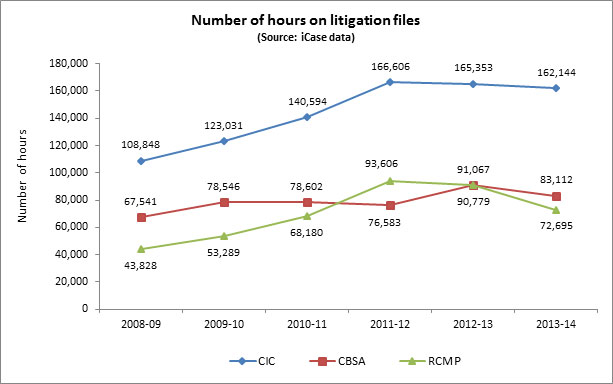
Figure 8 - Text equivalent
Line graph showing the number of litigation hours by selected client department and by year.
Source: iCase data
| Fiscal year | 2008-09 | 2009-10 | 2010-11 | 2011-12 | 2012-13 | 2013-14 |
|---|---|---|---|---|---|---|
| CIC | 108,848 | 123,031 | 140,594 | 166,606 | 165,353 | 162,144 |
| CBSA | 67,541 | 78,546 | 78,602 | 93,606 | 91,067 | 83,112 |
| RCMP | 43,828 | 53,289 | 68,180 | 76,583 | 90,779 | 72,695 |
Figure 9 illustrates the regional distribution of litigation work among the six regional offices and the National Capital Region (NCR) in 2013/14. The fact that Ontario, Quebec, and British Columbia manage the vast majority of files related to immigration matters explains, in part, that they are responsible for a greater portion of the Portfolio’s litigation work than the other three regions.
Figure 9: Regional distribution of hours recorded - Litigation (2013/14)
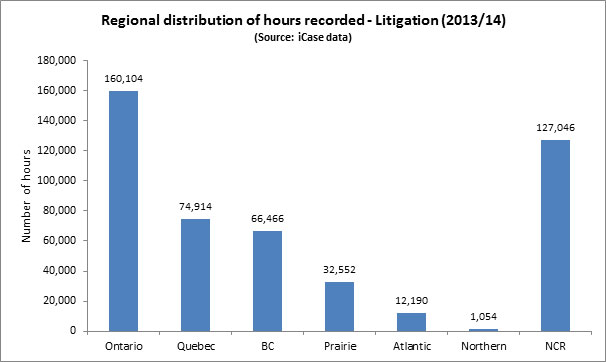
Figure 9 - Text equivalent
Bar graph showing number of litigation hours by region. (Source: iCase data)
| Ontario | 160,104 |
| Quebec | 74,914 |
| BC | 66,466 |
| Prairie | 32,552 |
| Atlantic | 12,190 |
| Northern | 1,054 |
| NCR | 127,046 |
The hours allocated to the NCR include a range of activities, such as the litigation support provided by DLSUs, the NLCT, and the Public Law Sector, as well as the litigation work undertaken by the Litigation Branch (Civil Litigation Section). Figure 10 provides the breakdown of the 127,046 hours of litigation attributed to the NCR region in Figure 9.
Figure 10: Distribution of litigation hours in the NCR (2013/14)
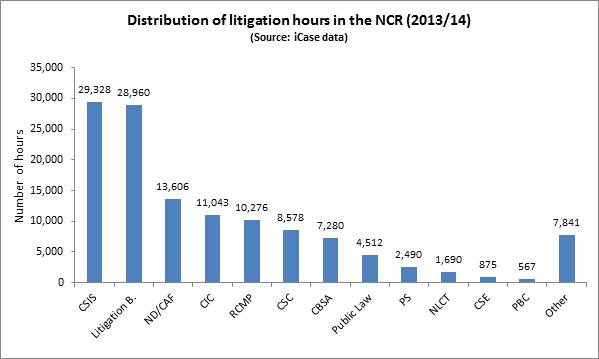
Figure 10 - Text equivalent
Bar graph showing number of litigation hours in the NCR. (Source: iCase data)
| CSIS | 29,328 |
| Litigation Branch | 28,960 |
| ND/CAF | 13,606 |
| CIC | 11,043 |
| RCMP | 10,276 |
| CSC | 8,578 |
| CBSA | 7,280 |
| Public Law | 4,512 |
| PS | 2,490 |
| NLCT | 1,690 |
| CSEC | 875 |
| PBC | 567 |
| Other | 7,841 |
In terms of complexity, the majority of litigation files managed by the Portfolio are of low or medium complexity levels. As illustrated in Figure 11, between 1% and 3% of litigation files managed by the Portfolio during the period covered by the evaluation were considered as being highly complex.
Along the same lines, the level of risk associated with the vast majority of files managed by the Portfolio has been standing at a low or medium level. Figure 12 indicates that approximately 1% of litigation files are typically assessed as high risk. Footnote 30
Figure 11: Distribution of the level of complexity - Litigation files closed
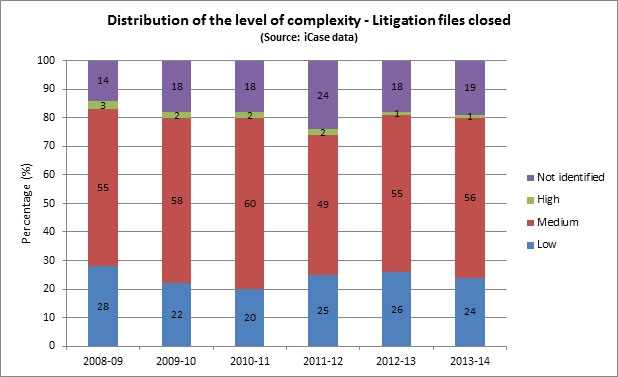
Figure 11 - Text equivalent
Cumulative bar graph showing the level of complexity of closed litigation files (Source: iCase)
| Fiscal year | 2008-09 | 2009-10 | 2010-11 | 2011-12 | 2012-13 | 2013-14 |
|---|---|---|---|---|---|---|
| Complexity: Low | 28% | 22% | 20% | 25% | 26% | 24% |
| Complexity: Medium | 55% | 58% | 60% | 49% | 55% | 56% |
| Complexity: High | 3% | 2% | 2% | 2% | 1% | 1% |
| Complexity: Not Identified | 14% | 18% | 18% | 24% | 18% | 19% |
Figure 12: Distribution of risk levels - Litigation files closed
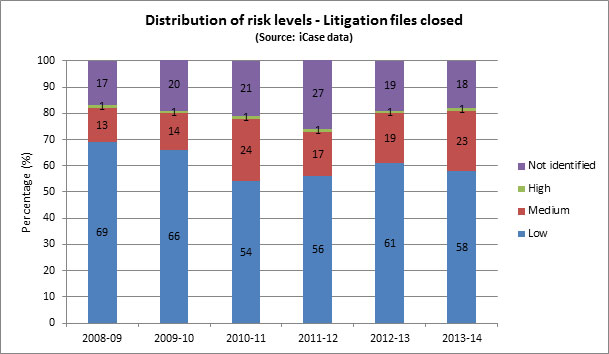
Figure 12 - Text equivalent
Cumulative bar graph showing the level of risk of closed litigation files (Source: iCase)
| Fiscal year | 2008-09 | 2009-10 | 2010-11 | 2011-12 | 2012-13 | 2013-14 |
|---|---|---|---|---|---|---|
| Complexity: Low | 69% | 66% | 54% | 56% | 61% | 58% |
| Complexity: Medium | 13% | 14% | 24% | 17% | 19% | 23% |
| Complexity: High | 1% | 1% | 1% | 1% | 1% | 1% |
| Complexity: Not Identified | 17% | 20% | 21% | 27% | 19% | 18% |
The mix of legal counsel assigned to litigation files has evolved over the period covered by the evaluation, particularly as it relates to the mix of LA-01 and LA-02 legal counsel. Footnote 31 As illustrated in Figure 13, there has been a shift from LA-02 to LA-01 in the proportion of hours assigned to litigation work, particularly between 2009 and 2012. This was largely the result of the implementation of the Law Practice Model, which was adopted in 2009 and was expected to be fully implemented by 2012. Footnote 32 The purpose of this initiative was to reduce costs by assigning legal work to the appropriate level of counsel and through the increased recruitment of junior legal counsel as more senior counsel retired.
Figure 13: Distribution of hours per classifications - Litigation files
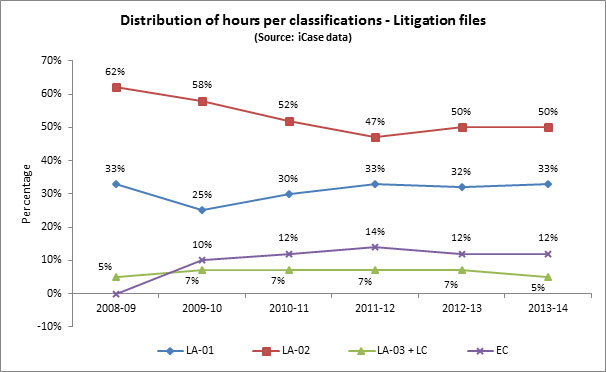
Figure 13 - Text equivalent
Line graph showing the proportion of litigation hours by level of counsel and by year (Source: iCase)
| Fiscal year | 2008-09 | 2009-10 | 2010-11 | 2011-12 | 2012-13 | 2013-14 |
|---|---|---|---|---|---|---|
| Level of Counsel: LA-01 | 33% | 25% | 30% | 33% | 32% | 33% |
| Level of Counsel: LA-02 | 62% | 58% | 52% | 47% | 50% | 50% |
| Level of Counsel: LA-03 + LC | 5% | 7% | 7% | 7% | 7% | 5% |
| Level of Counsel: EC | 0% | 10% | 12% | 14% | 12% | 12% |
The use of paralegals and legal assistants has remained fairly stable during the period, standing at approximately 12% of hours assigned to litigation work.
4.3.3. Advisory services
This subsection is now turning to the advisory work performed by the Portfolio. In doing so, some data limitations must first be noted. As already indicated in subsection 4.2.3, there is not a consistent approach among DLSUs on the formal opening of advisory files for data recording purposes. Consequently, it is more indicative to use the level of hours billed (as opposed to the number of actively managed files) in assessing the trends in advisory work over time. Also, as a result of changes made to the iCase system, it was not possible (at the time of the evaluation) to access data on the level of risks and complexity of advisory files. Footnote 33
There has been a sustained increase in the demand for advisory services over the period covered by the evaluation. As previously noted, the number of hours billed to advisory work has increased by 53% during the period covered by the evaluation, and more than 70% of survey respondents from DLSUs (where the bulk of the advisory work is done) have indicated that the number of files in which they have been involved has significantly increased over the past three to five years.
Data on the fiscal year 2013/14 indicates that the RCMP and the Department of National Defence are the two clients that have required the highest level of advisory support (Figure 14). When combined, these two clients have received 45% of all advisory work performed by the Portfolio.
Figure 14: Distribution of advisory hours per client (2013/14)
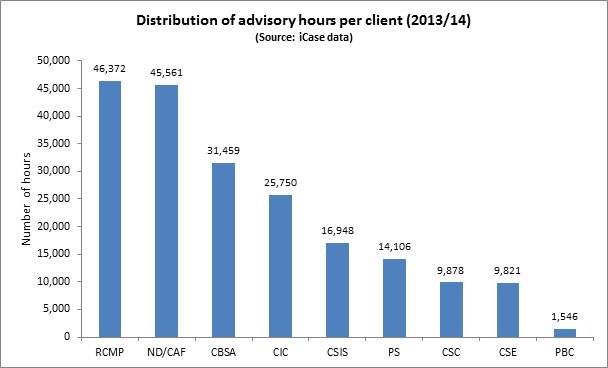
Figure 14 - Text equivalent
Bar graph showing the number of advisory hours by client department in 2013-14 (Source: iCase data).
| RCMP | 46,372 |
| ND/CAF | 45,561 |
| CBSA | 31,459 |
| CIC | 25,750 |
| CSIS | 16,948 |
| PS | 14,106 |
| CSC | 9,878 |
| CSE | 9,821 |
| PBC | 1,546 |
Historical trends over the period covered by the evaluation indicate that the CBSA, CIC, and CSIS are the client departments and agencies that have experienced the most significant fluctuations in their demand for advisory services. As illustrated in Figure 15, CBSA and CSIS have experienced a sustained increase in the level of advisory work received, whereas CIC has experienced a decrease over the same period. In this latter case, it is worth noting that this decrease in advisory work has been matched by an increase in the litigation work being performed for CIC by the Portfolio (see Figure 8). As noted during interviews conducted as part of this evaluation, CIC implemented broad legislative and policy reforms to the immigration and refugee system during the early part of the period covered by the evaluation, which triggered an increase in advisory work. These changes have led to an increase in litigation activities, which occurred later in the period covered by the evaluation and which explains the trend observed in litigation hours.
Figure 15: Number of hours on advisory files (selected clients)
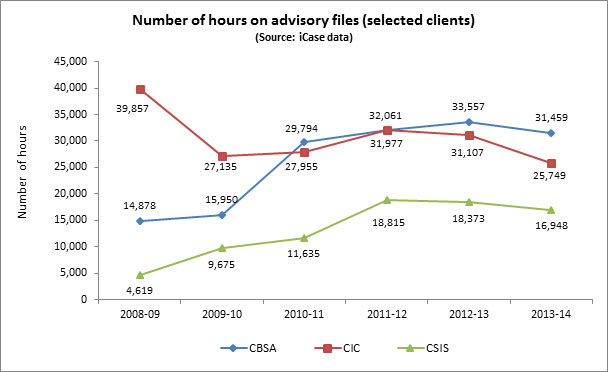
Figure 15 - Text equivalent
Line graph showing the number of hours on advisory files for CBSA, CIC and CSIS between 2008-09 and 2013-14. (Source: iCase data)
| Fiscal year | 2008-09 | 2009-10 | 2010-11 | 2011-12 | 2012-13 | 2013-14 |
|---|---|---|---|---|---|---|
| Client Department: CBSA | 14,878 | 15,950 | 29,794 | 32,061 | 33,557 | 331,459 |
| Client Department: CIC | 39,857 | 27,135 | 27,955 | 31,977 | 31,107 | 25,749 |
| Client Department: CSIS | 4,619 | 9,675 | 11,635 | 18,815 | 18,373 | 16,948 |
As could be expected, the bulk of the advisory work is performed by DLSUs assigned to their respective client department or agency. Figure 16 shows the distribution of PSDI-related advisory hours assigned in the National Capital Region (NCR). It is worth noting, however, that the NLCT and the Litigation Branch, both of which focus predominantly on litigation activities, also provide advisory services. Moreover, legal counsel in regional offices, whose focus is predominantly on litigation work, also offer advisory legal services. As illustrated in Figure 17, they have provided over 19,000 hours of advisory services in 2013/14, predominantly from the regional offices in British Columbia, Ontario, and the Prairie provinces.
Figure 16: Distribution of PSDI-related advisory hours in the NCR (2013/14)
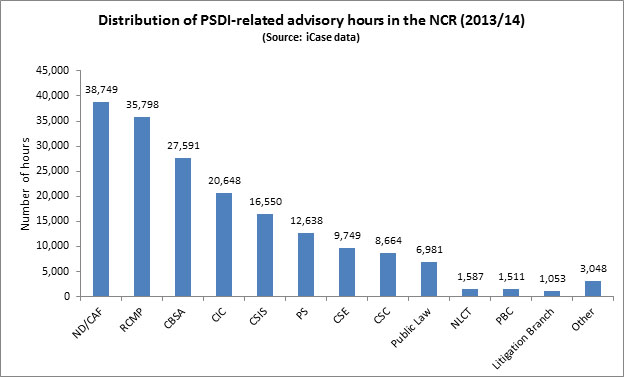
Figure 16 - Text equivalent
Bar graph showing the number of hours on PSDI-related advisory files in the NCR in 2013-14. (Source: iCase)
| ND/CAF | 38,749 |
| RCMP | 35,798 |
| CBSA | 27,591 |
| CIC | 20,648 |
| CSIS | 16,550 |
| PS | 12,638 |
| CSE | 9,749 |
| CSC | 8,664 |
| Public Law | 6,981 |
| NLCT | 1,587 |
| PBC | 1,511 |
| Litigation Branch | 1,053 |
| Other | 3,048 |
Figure 17: Regional distribution of hours recorded - Advisory (2013/14)
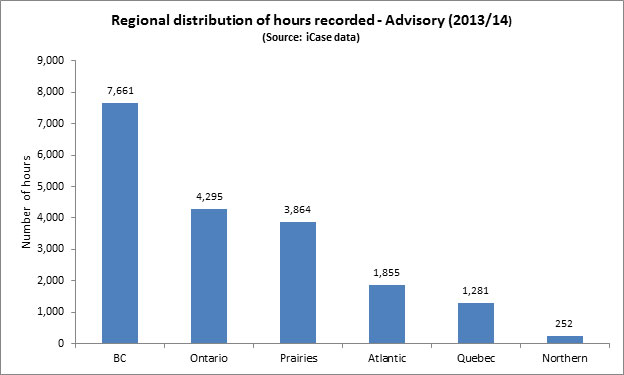
Figure 17 - Text equivalent
Bar graph showing the number of hours of PSDI-related advisory work in each region in 2013-14. (Source: iCase data)
| BC | 7,661 |
| Ontario | 4,295 |
| Prairies | 3,864 |
| Atlantic | 1,855 |
| Quebec | 1,281 |
| Northern | 252 |
As for the distribution of work among legal counsel, the trend observed in litigation files also applies to advisory files. As a result of the implementation of the Law Practice Model, there has been a shift from LA-02 to LA-01 during the first four years of the period covered by the evaluation (Figure 18). And while the use of paralegals and legal assistants has remained largely stable, there has been an increase in the proportion of work done by LA 03, reflecting the increasing complexity and risks associated with some of these files.
Figure 18: Distribution of hours per classifications - Advisory files
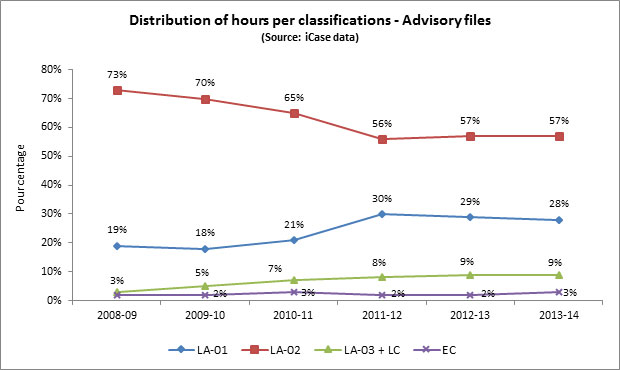
Figure 18 - Text equivalent
Line graph showing the proportion of hours working on advisory files by level of counsel and by year (Source: iCase data)
| Fiscal year | 2008-09 | 2009-10 | 2010-11 | 2011-12 | 2012-13 | 2013-14 |
|---|---|---|---|---|---|---|
| Level of Counsel: LA-01 | 19% | 18% | 21% | 30% | 29% | 28% |
| Level of Counsel: LA-02 | 73% | 70% | 65% | 56% | 57% | 57% |
| Level of Counsel: LA-03 + LC | 3% | 5% | 7% | 8% | 9% | 9% |
| Level of Counsel: EC | 0% | 2% | 3% | 2% | 2% | 3% |
4.3.4. Legislative work
The legislative agenda of the federal government directly shapes the level of legislative work that the PSDI Portfolio must provide to its client departments and agencies. While all clients served by the Portfolio have been provided with some legislative assistance from PSDI legal counsel over the period covered by the evaluation, those directly engaged in the legislative reforms related to immigration and refugee processes, as well as those engaged in legislative initiatives related to the law and order priorities of the federal government, have required the most sustained level of legislative assistance. More specifically, CIC, PS, CBSA, and RCMP account a significant proportion of the legislative work done during the period covered by the evaluation.
Two factors constrained the analysis of PSDI legislative work. Data for time spent on legislative services started to be collected in a comprehensive manner in 2010/11. Moreover, during the reporting phase of this report, an error was discovered in the way at least one DLSU reported its time for legislative hours. As a result, the evaluation looked at the aggregate hours of legislative work for the Portfolio as a whole, rather than undertaking a comparative analysis of individual DLSUs.
The analysis of the legislative support being provided by the Portfolio must also take into account the following dimensions:
- The total level of efforts related to the provision of legislative support represents approximately 2% of the work done by the Portfolio.
- The DLSU for PS supports the legislative work initiated directly by this department, in addition to coordinating the legislative work undertaken by agencies reporting to its Minister.
- For the Department of National Defence and the Canadian Armed Forces (CAF/ND), the Justice Legislative Services Branch has established the National Defence Regulations Section (NDRS), a satellite office which is co-located with the DLSU serving ND/CAF. The NDRS provides drafting and legal examination services related to all federal regulations and Orders in Council made or recommended by the Minister of National Defence, including the Queen’s Regulations and Orders for the Canadian Forces.
4.3.5. Ability to meet client needs
The preceding subsections included an assessment of the overall demand for services provided by the Portfolio. They have shown that there has been a sustained increase in the volume of services delivered on the advisory, litigation, and legislative fronts. While these trends themselves may serve as an indication of the relevance of services provided by PSDI legal counsel, the more fundamental question that remains is whether the Portfolio is, in fact, capable of meeting its clients’ needs, by providing high quality services. This subsection directly addresses this question.
Defining quality of legal services
Defining quality when it comes to the provision of legal services can be a challenging task. Footnote 34 The sheer volume of files actively managed by the Portfolio (approximately 25,000), let alone the range of issues they address, make it impossible to individually assess the quality of advice provided. Moreover, solicitor-client privilege largely limits the ability of any external party to access and review the actual advice that legal counsel provide.
In this context, the most helpful indicator of quality is the clients’ level of satisfaction with the legal support they receive. Ultimately, legal counsel provide advice, but clients are the ones who must act upon this advice. The extent to which clients understand the legal risks associated with their decisions largely reveals the extent to which legal counsel have adequately fulfilled their role. As repeatedly noted by both legal counsel and clients interviewed as part of this evaluation, clients make the final decision in relation to a legal matter, taking into account of a range of legal, policy, and political considerations in their decisions.
To help define the various dimensions of satisfaction, the Department of Justice established, in April 2009, a series of service standards. As indicated in Figure 19, these standards are grouped along the broader concepts of timeliness, responsiveness, and usefulness.
Figure 19: Service Standards
Timeliness of Services
- We respond in a timely manner to requiests for legal services.
- We negotiate and meet mutually acceptable deadlines.
Responsiveness of Services
- We provide legal services in either official language in accordance with applicable policies on language of work.
- We treat you with courtesy and respect at all times.
- We provide regular and informative progress reports or ongoing feeback in respect of your request for service.
Usefullness of Services
- We provide clear and practical guidance on resolving legal issues.
- In the provision of legislative services, we develop legislative and regulatory drafting options appropriate to your policy and program objectives, and propose appropriate soluations for legal and drafting issues raised.
- In the provision of legal advisory and litigation services, we involve you in the development of legal strategy and positions.
- We identify means to prevent and resolve legal disputes at the earliest opportunity.
- We identify opportunities to implement policies and programs by administrative rather than legislative or regulatory means.
Source: http://www.justice.gc.ca/eng/abt-apd/service.html
2011 assessment of client satisfaction
Following the adoption of these standards, the Department launched a series of client feedback surveys, to assess these various dimensions of client satisfaction. One of these surveys, conducted in 2011, focused specifically on the work of the PSDI Portfolio. Footnote 35 A total of 618 client representatives, who had used Justice legal services in the preceding 12 months, completed the survey questionnaire.
Results from this survey consistently pointed to a high level of satisfaction among PSDI client departments and agencies. As noted in the report, “the Portfolio received extremely positive results overall on each of the four facets of client satisfaction.” Footnote 36
More specifically, on a 10-point scale, respondents favourably rated the legal services they received, whether it was advisory services (mean score of 8.5 out of 10), litigation services (8.3 out of 10), or legislative services (8.7 out of 10).
Survey results pertaining more directly to the set of service standards indicated that the Portfolio performed well on all dimensions of these standards. The Portfolio received composite ratings above 8 out of 10 for accessibility and responsiveness (8.8), usefulness (8.3), and timeliness of its services (8.1). The only two areas where the Portfolio did not meet or surpass the Department’s target of 8 out of 10 were in relation to two sub-components of the timeliness of its advisory services. When asked if legal counsel “provided informative progress reports or ongoing feedback” or whether legal counsel “negotiated mutually agreed upon deadlines”, survey respondents offered ratings that were slightly under 8. Footnote 37
Other measures of client satisfaction
Interviews conducted with representatives of client departments and agencies, as well as those conducted as part of the case studies, provided an opportunity to revisit various dimensions of client satisfaction. Overall, evaluation findings strongly aligned with the results of the 2011 Client Feedback Survey. Statements such as “always get appropriate advice”, “very knowledgeable, patient, and a joy to work with”, or “their capacity to respond has been more than excellent” are indicative of the feedback provided by client representatives.
These interviews and case studies also confirmed that client departments and agencies are actively involved in managing legal files, and assessing legal risks. On that last point, interviews with PSDI legal counsel indicated that clients are typically well aware of what an assessment of legal risk entails and how it should be considered. In fact, evaluation findings indicate that clients are increasingly interested in understanding the reasoning that led to the assessment of legal risks, as opposed to simply receiving the assessment and accepting it at face value. Along the same lines, evaluation findings indicate that an increasing proportion of client departments and agencies appear willing to assume greater risks in pursuing programming or policy objectives. This has reinforced the notion that, while legal counsel provide legal risk assessment, it is ultimately the client department or agency that decides on the most appropriate course of action, balancing the various policy interests and other considerations, even if it entails greater legal risks than normally assumed.
Through the survey process undertaken as part of this evaluation, legal counsel were also provided with an opportunity to assess the extent to which they are in a position to deliver services that meet their clients’ needs and expectations. Figure 20 confirms that legal counsel generally perceive themselves as being capable of delivering timely services, of meeting client and internal deadlines, of providing timely risk assessments and reassessing risks as required, and finding means to prevent or resolve legal disputes early on, when possible. Considering the volume of work managed by the PSDI Portfolio, one can expect that particularly challenging files will emerge from time to time and that legal counsel, as well as client representatives, will have to work collaboratively on the effective management of these files. While acknowledging this, evaluation findings leave little doubt as to the overall satisfaction of client departments and agencies currently served by the Portfolio.
Figure 20: Ability to deliver quality services
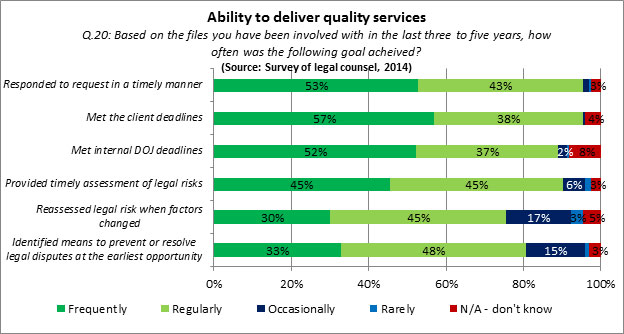
Figure 20 - Text equivalent
Cumulative bar graph showing the results of Q.20 from the PSDI Legal Counsel Survey (2014).
Based on the files you have been involved with in the last three to five years, how often was the following goal achieved:
Responded to request in a timely manner?
| Frequently | 53% |
| Regularly | 43% |
| Occasionally | 1% |
| Rarely | -% |
| N/A – don’t know | 3% |
Met the client deadlines?
| Frequently | 57% |
| Regularly | 38% |
| Occasionally | 1% |
| Rarely | -% |
| N/A – don’t know | 4% |
Met internal DOJ deadlines?
| Frequently | 53% |
| Regularly | 43% |
| Occasionally | 1% |
| Rarely | -% |
| N/A – don’t know | 3% |
Provided timely assessment of legal risks?
| Frequently | 45% |
| Regularly | 45% |
| Occasionally | 6% |
| Rarely | 1% |
| N/A – don’t know | 3% |
Reassessed legal risk when factors changed?
| Frequently | 30% |
| Regularly | 45% |
| Occasionally | 17% |
| Rarely | 3% |
| N/A – don’t know | 5% |
Identified means to prevent or resolve disputes at the earliest opportunity?
| Frequently | 33% |
| Regularly | 48% |
| Occasionally | 15% |
| Rarely | 1% |
| N/A – don’t know | 3% |
4.3.6. Coordination and monitoring efforts
Understanding the coordination and monitoring role of the Portfolio
As noted during interviews, not all files managed by legal counsel affiliated with the Portfolio require extensive monitoring and coordination. This is particularly the case for advisory work, undertaken by some of the DLSUs, that is highly specialized or operational (i.e., emergency preparedness). In these circumstances, the monitoring and coordination role played by the Portfolio is more appropriately targeted to support individual client departments.
As for the coordination of litigation work, the Portfolio has a well-established history in relation to immigration files. As noted by legal counsel who were interviewed, the Portfolio has established tools and processes (such as the SLIC) to support legal counsel involved in litigation files, a need that was, and continues to be, driven by the large volume of files and their distribution among regional offices. In the current Portfolio setting, the NLCT carries on this responsibility. Evaluation findings indicate that beyond the context of immigration files, however, the role of the NLCT appears not to be as clearly articulated. In fact, the actual role of the NLCT appears to be only partially understood by legal counsel affiliated with the Portfolio. As indicated in Figure 21, just over 40% of legal counsel who participated in the legal counsel survey indicated that they had a very good or good overall understanding of the role and mandate of the NLCT.
Figure 21: Level of understanding of role and mandate of NSLT and NLCT by PSDI
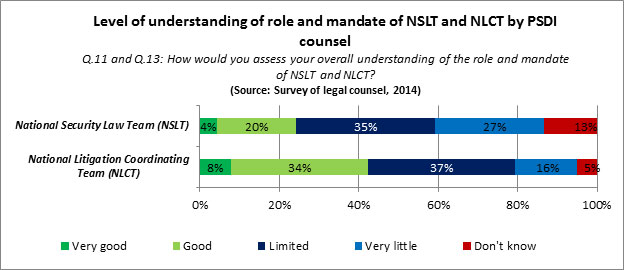
Figure 21 - Text equivalent
Cumulative bar graph showing the results of Qs.11 and 13 from the PSDI Legal Counsel Survey (2014).
How would you assess your overall understanding of the role and mandate of NSLT and NLCT?
National Security Law Team (NSLT)
| Very good | 4% |
| good | 20% |
| Limited | 35% |
| Very little | 27% |
| don’t know | 13% |
National Litigation Coordination Team (NLCT)
| Very good | 8% |
| good | 34% |
| Limited | 37% |
| Very little | 16% |
| don’t know | 5% |
Similarly, the role of the NSLT appears to remain largely unknown to PSDI legal counsel. Only a quarter of survey respondents indicated that they had a very good or good understanding of its role. The fact that this team was only established in 2013, and that it focusses specifically on national security matters, are arguably factors that explain these results. Those counsel whose work centers on other aspects of the Portfolio’s work would likely not be as familiar with its role.
Finally, the functional responsibility of the ADAG PSDI for all advisory work related to national security is also not clearly understood by PSDI counsel, particularly among those who are not in management positions.
The PSDI has 25,000 actively managed files, involving close to 750 legal counsel distributed among the Office of the ADAG, nine DLSUs and six regional offices. Given the breadth of the work, the number of counsel involved and the geographic and expanse of the Portfolio, it is not surprising that there are differences in the levels of understanding about the role of the Portfolio among its counsel. While acknowledging this fact, PSDI counsel could benefit from achieving a greater level of understanding of these different dimensions of the Portfolio’s mandate.
The impact of the NLCT
Evaluation findings indicate that the NLCT has contributed to the effective coordination of immigration files. Central to the achievement of this result is the role that the NLCT has played in managing the Blue Book. Footnote 38 Established in the late 1990s, the Blue Book contains a set of instructions for litigators in all regional offices. It identifies the types of cases that must be referred to the NLCT for consultation and guidance, and under what circumstances the NLCT involves relevant DLSUs and client departments and agencies, whether it is CIC or the CBSA, or any other clients as required. This manual is consistently updated to reflect emerging issues, legislative reforms, or important court decisions. Evaluation findings indicate that the Blue Book is well known across regional offices and that appropriate files are being referred to the NLCT.
As already noted in subsection 4.2.3 of this report, the NLCT also contributes to the management of the law relating to immigration and refugee matters through the weekly calls it holds with members of the SLIC.
Legal counsel interviewed as part of this evaluation noted that the NLCT has played a meaningful role in coordinating a number of non-immigration files. These would typically be high profile and complex files that may involve a number of client departments and agencies. In these cases, the NLCT facilitated the flow of information, including adequate briefings to senior officials within the Department of Justice Canada.
Beyond these achievements, evaluation findings pointed to certain challenges that the NLCT has been facing. When it comes to the selection of files to be coordinated by the NLCT (particularly in non-immigration matters), it appears that the Portfolio has largely used a top-down approach, resulting in some decisions that have not been well understood in DLSUs and regional offices. This, in turn, has led to cases where the value added from the NLCT’s involvement has not been apparent to legal counsel assigned to the file.
It has been suggested that, much like the Blue Book for immigration matters, there should be a clearer process to select non-immigration files to be coordinated by the NLCT. In doing so, it was also suggested that the leadership coordinating these files may benefit from being decentralized, allowing some of the senior litigators with specific areas of expertise to play the coordination role or be predominantly involved in it. This appears particularly relevant when one considers the relatively small size of the NLCT in relation to the volume and range of litigation work in which the Portfolio is involved.
These mixed views on the role of the NLCT were reflected in the results from the survey of legal counsel undertaken as part of this evaluation. Those respondents who had dealt directly with the NLCT were asked to assess its overall contribution in ensuring a consistent approach to litigation file; just over half of them qualified that contribution as being very significant or significant (Figure 22). A slightly greater proportion of respondents from DLSUs (55%) qualified the contribution of the NLCT as being very significant or significant, when compared to respondents from regional offices (49%).
Figure 22: Contribution of the National Litigation Coordination Team
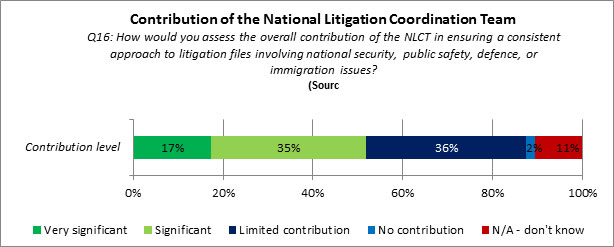
Figure 22 - Text equivalent
Cumulative bar graph showing the results of Q.16 from the PSDI Legal Counsel Survey (2014).
How would you assess the overall contribution of the NLCT in ensuring a consistent approach to litigation files involving national security, public safety, defence or immigration issues?
| Very significant | 17% |
| Significant | 35% |
| Limited contribution | 36% |
| No contribution | 2% |
| Don’t know | 11% |
The impact of the NSLT
During the period covered by the evaluation, the NSLT has provided coordination support on some advisory files related to national security. In these cases, evaluation findings indicate that the Team has provided in-depth knowledge and expertise that have helped ensure the consistency of advice, particularly among those legal counsel serving client departments and agencies directly involved in national security matters. The Team has also provided direct support to the ADAG in fulfilling her functional responsibility for advisory work related to national security. As such, they have developed briefing material for the ADAG, have attended meetings with her, and have followed up as required. This has enhanced the capacity of the ADAG Office to continuously monitor high profile advisory files on national security.
Although some legal counsel consulted as part of this evaluation could address the work performed by the NSLT, evaluation findings confirm that the current reach of this team is fairly limited and its achievements have remained largely unknown. This is reflected in survey findings presented in Figure 23. When legal counsel who had dealt directly with the NSLT were asked to assess its overall contribution, just over 40% of them rated it as very significant or significant. It is worth noting that one in four respondents did not provide an assessment, despite the fact that they had had direct dealings with this team.
Figure 23: Contribution of the National Security Law Team
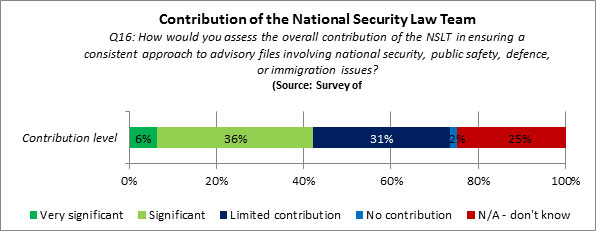
Figure 23 - Text equivalent
Cumulative bar graph showing the results of Q.16 from the PSDI Legal Counsel Survey (2014).
How would you assess the overall contribution of the NSLT in ensuring a consistent approach to advisory files involving national security, public safety, defence or immigration issues?
| Very significant | 6% |
| Significant | 36% |
| Limited contribution | 31% |
| No contribution | 2% |
| Don’t know | 25% |
A concern expressed during interviews conducted as part of this evaluation related to the risk of duplication that may result from having legal counsel conducting advisory work on national security matters in the ADAG Office, while other legal counsel perform similar advisory work in DLSUs that are, in fact, highly specialized in national security matters.
Moreover, much like the NLCT in non-immigration matters, it appears that the selection of files on which the NSLT has been involved has resulted from a top-down decision-making approach, based on the perceived strategic importance attributed to certain files. This, in turn, appears to have contributed to the uncertainty surrounding the actual mandate of the NSLT and the circumstances where the team is expected to engage in coordination activities.
4.3.7. Access to the required support and tools
The evaluation provided an opportunity to assess drivers (other than those related to monitoring and coordination) that contribute to the ability of the Portfolio to provide quality legal services that meet its client needs. Of particular relevance were the support provided by the Public Law Sector, the access to adequate tools, and the ongoing professional development offered to PSDI legal counsel.
Support provided by the Public Law Sector
Some of the specialized units within the Public Law Sector provide critical assistance to PSDI legal counsel, in both DLSUs and regional offices. No less than 87% of legal counsel who participated in the survey indicated that they have had interactions with some of these units. The Constitutional, Administrative, and International Law Section, the Human Rights Law Section, and the Centre for Information and Privacy Law were the units most often consulted by PSDI legal counsel. The vast majority of those who dealt with these units reported being very satisfied or satisfied with the support provided to them.
Findings from the interviews conducted as part of this evaluation confirmed these trends. The support offered by these units was described as being generally efficient and responsive. Considering the nature of the files managed by the Portfolio, there are many questions related to the Charter or the Constitution more generally that must be addressed in a timely manner. The Public Law Sector has largely succeeded in providing this expert advice.
Access to required tools
The Portfolio has established a number of tools and processes that are expected to support the work of individual legal counsel. Some of these have been implemented at the Portfolio or department-wide levels, while others are initiatives specific to a DLSU or a regional office.
PSDI legal counsel who participated in the survey conducted as part of this evaluation were asked to rate some of these tools. The results, as illustrated in Figure 24, confirm that some tools have greater relevancy when it comes to supporting the work of legal counsel.
- Justipedia: Launched during the period covered by the evaluation, Justipedia is the Department of Justice Canada’s legal knowledge portal. Its purpose is to consolidate existing legal knowledge tools in order to create a single national repository. It was piloted in 2011 and became fully operational in February 2012. Survey findings confirm that it is now considered one of the most helpful tools by legal counsel. Close to 70% of survey respondents rated Justipedia as being very useful or useful for their work. Interviews conducted as part of this evaluation noted that one of the current limitations of Justipedia is the fact that it cannot hold secret information, which is often required by PSDI legal counsel.
- Practice groups: One of the primary purposes of Justipedia is to support practice groups, which provide an opportunity for legal counsel to meet on a regular basis to exchange and share knowledge on areas of interest for their practice. Among the many practice groups established throughout the department, a number of them relate specifically to the PSDI Portfolio, such as the Citizenship and Immigration, the Correctional Law, the National Security Law, and the Cyber Security practice groups. Survey findings indicate that these groups were favourably rated in terms of their usefulness. During interviews conducted, practice groups were also perceived as being helpful, particularly in providing a platform for legal counsel in DLSU and regional offices to connect on areas of interest.
Figure 24: Usefulness of tools provided to legal counsel
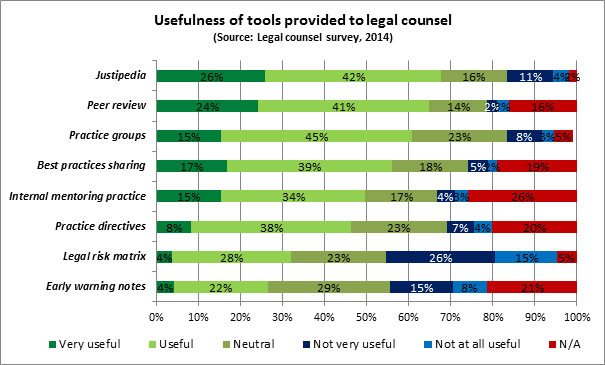
Figure 24 - Text equivalent
Cumulative bar graph showing the results of Q.22 from the PSDI Legal Counsel Survey (2014).
To what extent do you find the following tools, structures and processes to be useful to your work?
Justipedia
| Very useful | 26% |
| Useful | 42% |
| Neutral | 16% |
| Not very useful | 11% |
| Not at all useful | 4% |
| N/A | 1% |
Peer review
| Very useful | 24% |
| Useful | 41% |
| Neutral | 14% |
| Not very useful | 2% |
| Not at all useful | 3% |
| N/A | 16% |
Practice groups
| Very useful | 15% |
| Useful | 45% |
| Neutral | 23% |
| Not very useful | 8% |
| Not at all useful | 3% |
| N/A | 5% |
Best practices sharing
| Very useful | 17% |
| Useful | 39% |
| Neutral | 18% |
| Not very useful | 5% |
| Not at all useful | 2% |
| N/A | 19% |
Internal mentoring practice
| Very useful | 15% |
| Useful | 34% |
| Neutral | 17% |
| Not very useful | 4% |
| Not at all useful | 3% |
| N/A | 26% |
Legal risk matrix
| Very useful | 4% |
| Useful | 28% |
| Neutral | 23% |
| Not very useful | 26% |
| Not at all useful | 15% |
| N/A | 5% |
Early warning notes
| Very useful | 4% |
| Useful | 22% |
| Neutral | 29% |
| Not very useful | 15% |
| Not at all useful | 8% |
| N/A | 21% |
- Peer review: More a process than an actual tool, peer reviews are carried out on an ongoing basis, both formally and informally. Both survey findings and interviews indicate that this process contributes significantly in supporting the work of PSDI legal counsel.
- Legal risk matrix: As Figure 24 indicates, the current matrix that legal counsel are expected to use to communicate legal risks has not been rated favourably. Just over 30% of survey respondents rated the matrix as being very useful (4%) or useful (28%). Notably, the matrix also received the most negative ratings among all tools listed, as 26% of respondents indicated that it was not very useful and 15% indicated that it was not at all useful. Results did not vary significantly between legal counsel operating in a DLSU and those operating in a regional office. Interviews conducted as part of this evaluation, as well as the case studies, largely reflected these survey findings. Legal counsel working with DLSUs constantly assess legal risks through their advisory work. They emphasized the importance of tailoring their approach and their communication strategy to reflect the needs of their clients and the overall organizational culture in which they operate. Using a standardized tool was not seen as being the most adequate approach in order to carry out their role. As for legal counsel operating in regional offices, they have a long history of using the risk assessment matrix in managing their litigation files in iCase. The survey results appear to indicate that the matrix may be serving broader corporate goals for the monitoring and management of resources, rather than actively supporting the work of litigators on individual files.
- Other instruments: While some of the other instruments may assist legal counsel in their daily work, they are also meant to brief senior officials on overall trends in the work of the Portfolio. This is particularly the case of the early warning notes, whose purpose is to specifically alert senior officials of upcoming cases that are particularly complex or sensitive. This explains, in part, the lower rating in terms of usefulness among survey respondents.
Professional development
Access to adequate tools goes a long way in ensuring that legal counsel maintain the knowledge and expertise they require in their specific field of practice. To supplement these, legal counsel can also undertake a number of professional development activities. For instance, the Professional Development Directorate provides a wide range of learning activities to all legal counsel working in the Department of Justice Canada. At the Portfolio level, there is a learning day that is held every year to address issues that are more specific to public safety, defence, and immigration matters. Finally, each DLSU and regional office typically holds ad hoc learning activities throughout the year.
The survey of legal counsel indicates that over two-thirds of respondents (68%) were either very satisfied (10%) or satisfied (58%) with the professional development currently offered. During interviews, it was noted that the diversity in the areas of law covered by the Portfolio makes it challenging to systematically offer relevant training activities. Some legal counsel interviewed as part of this evaluation indicated that the topics covered during the Portfolio’s learning days rarely coincided with their practice. In the case of regional offices, there are strict travel limitations that considerably reduce their access to these activities.
There was a general recognition among managers interviewed as part of this evaluation that while the department can meet a range of professional development needs, it would be beneficial to provide greater access to external learning activities. However, current budgetary constraints limit the ability of the Portfolio to expand the access to these types of learning activities.
Perceived factors affecting quality
Beyond the access to adequate tools and professional development, a number of systemic factors can have a negative impact on the ability of legal counsel to deliver quality legal services. Through two public service employee surveys (2011 and 2014), PSDI legal counsel identified a number of these factors, which are summarized in Figure 25. Footnote 39 Among other things, these results indicate that having to do the same or more with fewer resources is a more significant concern in 2014 compared to 2011. However, high staff turnover is less of a concern in 2014, when compared to 2011.
Figure 25: Factors affecting quality of legal services
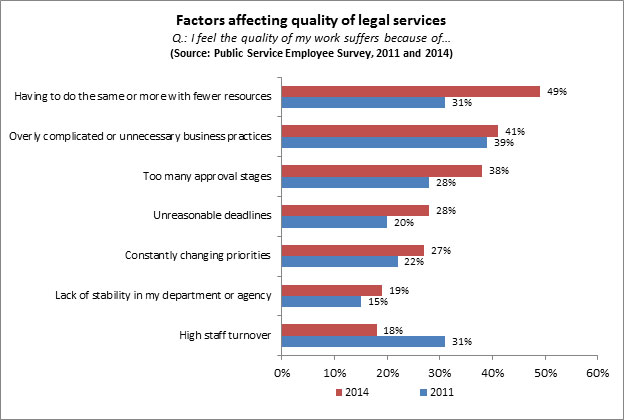
Figure 25 - Text equivalent
Bar graph showing responses to question: I feel the quality of my work suffers because of….
(Source: Public Service Employee Survey, 2011 and 2014)
Having to do the same or more with fewer resources
| 2014 | 49% |
| 2011 | 31% |
Overly complicated or unnecessary business practices
| 2014 | 41% |
| 2011 | 39% |
Too many approval stages
| 2014 | 38% |
| 2011 | 28% |
Unreasonable deadlines
| 2014 | 28% |
| 2011 | 20% |
Constantly changing priorities
| 2014 | 27% |
| 2011 | 22% |
Lack of stability in my department or agency
| 2014 | 19% |
| 2011 | 15% |
High staff turnover
| 2014 | 18% |
| 2011 | 31% |
4.4. Performance — Demonstration of Efficiency and Economy
Evaluation findings described in the preceding subsections of this report indicate that the Portfolio has managed the delivery of an increased level of legal services to client departments and agencies. In doing so, evaluation findings also indicate that the Portfolio has largely met the need for legal assistance required by these clients. This subsection now turns to the question of whether the Portfolio has implemented adequate measures to maximize outcome achievement, and minimize resource use.
The Process Optimization framework
Following the 2012 federal budget, and in conformance with its commitments under the Deficit Reduction Action Plan, the Department of Justice Canada implemented a department-wide initiative known as Process Optimization. The goal of this initiative was to manage the demand and costs of legal service delivery and achieve savings through a number of measures, including a reduction of 72 FTEs employed as legal counsel by the Department. Four portfolios were expected to contribute to the reduction of FTEs including the PSDI Portfolio, with an anticipated reduction of 23 FTEs over a three-year period (2012/13 to 2014/15).
The initial components of Process Optimization are included in Table 6. They cover both advisory and litigation services and they vary in nature. In some cases, the goal is to increase monitoring, which speaks to the organization of the work within DLSUs and regional offices. In other cases, there are specific targets established, such as the benchmarking component applied to immigration files. Finally, the increased reliance on paralegals involves both a recruitment and a training component to enhance the use of these individuals.
| Advisory services | Litigation services |
|---|---|
|
|
During the period covered by the evaluation, the PSDI Portfolio has proceeded with the implementation of a number of initiatives, including more predominantly the following ones:
- Multi-client files: In January 2012, the Portfolio implemented the multi-client process, which applied to all advisory work involving three or more PSDI client departments or agencies. Under this initiative, the heads of all DLSUs involved in a multi-client file were expected to work with a designated person within the ADAG Office to appoint one lead counsel who would be responsible to carry out the assignment. This was to avoid scenarios where each DLSU involved in such a file would assign a lead counsel, leading to a potential “over-lawyering,” or duplication of efforts. Depending on the nature of the file and the extent of the work required, the lead counsel is in essence the file project manager who is expected to assign specific tasks to other legal counsel as required.
- Benchmarking: In April 2013, the Portfolio fully implemented the benchmarking initiative. It was developed in recognition that client departments are under pressure to reduce their legal budgets. The purpose of the initiative was to establish benchmarks or targets in terms of time spent on certain types of litigation so that overall, less time is spent on low- to medium-complexity files. Initially, it covered leave applications heard by the Refugee Protection Division (RPD) of the Immigration and Refugee Board for low complexity and low or medium risk files. In November 2013, the initiative was expanded to also include leave applications heard by the RPD on medium complexity and low or medium risk files. During the same period, the Portfolio launched a pilot project to set guidelines for the maximum amount of time to be spent on the further memorandum of argument in low and medium complexity, and low or medium risk RPD judicial reviews where the government is the respondent.
- Screening of client requests: Heads of DLSUs were asked to negotiate, as applicable, processes to screen out low complexity matters. Instead of assigning a legal counsel, the DLSU was expected to provide templates and precedents that could be used by client representatives in dealing with these files.
Arguably, other activities have been undertaken by the Portfolio, including those related to the monitoring of files, but these do not appear to have been systematically documented.
Results at the time of the evaluation
The Portfolio has made progress on a number of its optimization initiatives, while other results are expected to be realized in the next several years, beyond the time frame covered by this evaluation.
Interviews conducted as part of this evaluation indicate that the multi-client protocol has been implemented and appears to have been reasonably well received by both legal counsel and client departments and agencies. Evaluation findings indicate that this initiative has addressed a perception among client departments and agencies that some files appeared to be over-staffed, raising cost concerns. Legal counsel interviewed as part of this evaluation also noted that the multi-client protocol largely reflected existing practices among a number of DLSUs and, as such, did not require fundamental changes in operational practices.
Administrative data on the benchmarking initiative is showing positive results. During the first phase of the initiative’s implementation, which covered leave applications heard by the RPD for low complexity and low to medium risk files, the proportion of files meeting the set benchmark moved from 58% in 2011/12 to 82% in 2013/14. This has led to a reduction in the number of hours dedicated to these files in 2013/14 that is equivalent to approximately 5 FTEs. While data is only partially available for the other components of this initiative, they appear to also lead to a reduction in the number of hours invested in the targeted types of immigration files.
Evaluation findings also indicate that the screening out of low complexity advisory matters has been implemented in some of the DLSUs included in the Portfolio. Interviews conducted as part of this evaluation confirm that some of the PSDI clients are now managing these types of files with minimum involvement from their DLSU.
Evaluation findings indicate that the Portfolio is intending to focus more on the use of paralegals, as this aspect of the initiative has yet to be fully implemented.
Reductions in FTEs assigned to the Portfolio
Despite the fact that the overall volume of legal services provided by the Portfolio has increased over the period covered by the evaluation, the number of FTEs assigned to the Portfolio has decreased over the later part of that period, which coincided with the implementation of the Process Optimization initiative. As illustrated in Figure 26, the total number of FTEs assigned to the Portfolio decreased by 7%, moving from 796 FTEs at the end of 2012/13 to 740 FTEs as of February 20, 2015. While all sub-components of the Portfolio have seen a reduction in their level of FTEs, the ones most affected have been the ADAG Office (reduction of 25% in FTEs), followed by other services such as Public Law Sector and the Civil Litigation Sector (reduction of 10%), the DLSUs (reduction of 7%), and the regional offices (reduction of 5%).
Figure 26: Level of FTEs per categories of employees
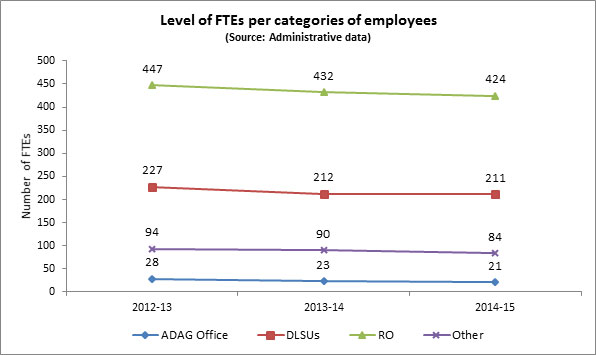
Figure 26 - Text equivalent
Line graph showing the number of employees between 2012-13 and 2014-14 in the PSDI ADAG Office, DLSUs, Regional Offices and Other
| Location | 2012-13 | 2013-14 | 2014-15 |
|---|---|---|---|
| ADAG Office | 28 | 23 | 21 |
| DLSUs | 227 | 212 | 211 |
| Regional offices | 447 | 432 | 424 |
| Other | 94 | 90 | 84 |
There has also been a reduction in the proportion of hours assigned to LA-2s as compared to LA-1s over the course of the evaluation period, particularly in advisory work. The implementation of the Law Practice Model has encouraged managers to assign legal work to the most appropriate level of counsel, where possible, including using the most senior legal counsel on the more complex and high risk matters. The use of paralegals in litigation files has increased as well during the same period, which is another cost-saving measure. A new department-wide initiative allows managers to “borrow” paralegal staff from a cadre of trained individuals ready to work as needed department-wide (and therefore not requiring managers to keep paralegals on staff irrespective of the level of demand for their services). This initiative is another cost-saving measure that will be piloted as part of the changes being implemented through the Legal Services Review in 2015.
Overall achievements
While acknowledging that some of the measures under Process Optimization cannot yet be readily measured in terms of their impact, evaluation findings indicate that the Portfolio has implemented measures that aimed to maximize the achievement of results, while minimizing the use of resources.
- Date modified: