
4. Findings
4.1 Relevance
4.1.1 Alignment with Government Priorities and Federal Roles and Responsibilities
The SHW Initiative is well aligned with federal government priorities related to sexual harassment in the workplace. It is also consistent with federal roles pertaining to assisting those who have experienced sexual harassment in the workplace.
Budget 2018 highlighted that the impact of workplace sexual harassment and gender-based violence (GBV) are significant, particularly for women for whom it can make working difficult, or even impossible. To address these issues, the Budget included targeted measures to combat workplace sexual harassment and GBV. These measures included both improving and increasing legal aid funding across Canada to support those who have experienced SHW, as well as the development of a pan-Canadian outreach program to better inform workers, particularly those most vulnerable, about their rights and how they can access help if they have been harassed in the workplace. The result of the Budget announcement was the establishment of the SHW Initiative, with its two areas of focus (i.e., legal information and advice, and PLEI) that are aligned with the two priorities in Budget 2018.
A review of academic research confirms that the SHW Initiative is consistent with one of the roles that can be played by government in this area, which is to assist those who have experienced SHW. This assistance can be provided through the funding of advice and support for people who have experienced SHW, guidance and education. 8, 9, 10 The other main role for governments identified in the literature is the implementation of laws to prevent future occurrences, which is outside the scope of the SHW Initiative.
Due to the high proportion of people who experience SHW that are women, the SHW Initiative also serves as Justice Canada’s support for other government priorities relating to women and violence against women. This includes pillar four of the Gender Results Framework11 as well as contributing to the Sustainable Development Goals related to GBV and Access to Justice.12
4.1.2 Addressing the Needs of Target Populations
Target populations as originally identified for the SHW Initiative are varied and inclusive. Additional needs of these target populations and additional target populations have emerged and projects have adapted accordingly. Some gaps remain, including supports for psychosocial needs, and access to legal representation, although the latter is outside the scope of the SHW Initiative.
As noted in the SHW Initiative description in Section 2.1, the target populations that could benefit from SHW Initiative’s projects are broad and include many different vulnerable groups. They include people with various socio-demographic characteristics, and employers and employees – specifically those in precarious employment, women in male dominated occupations/workplaces, and seasonal and temporary workers. Through the interviews, case studies and document review conducted for the evaluation, individuals working in the legal community were identified as an additional target population of the SHW Initiative.
Needs of Target Populations
People who have experienced workplace sexual harassment
One in three women in Canada indicate that they have experienced SHW. In addition, 25% of women and 17% of men reported that they had experienced sexual misconduct in their workplace in the previous year.13 The literature reviewed also identified a number of risk factors that could contribute to a person experiencing this type of harassment. This includes vulnerability arising from undocumented status, language barriers, lack of knowledge about their rights, and isolation. Many workplaces also have limited or nonexistent sexual harassment policies, and most supervisors and managers have insufficient training. The prevalence of SHW is also higher for certain populations such as women, people with disabilities, sexual minorities, Indigenous peoples, racialized people, people living in remote areas, and individuals identified as not having status within a country. For example, a 2020 survey conducted by Statistics Canada identified that almost half (47%) of 2SLGBTQI+ workers had personally experienced sexual harassment, compared with just over one-fifth (22%) of non-2SLGBTQI+ workers. The academic literature also found that younger women and women in management positions were more likely to experience SHW.
However, underreporting is common. Some of the reasons why underreporting occurs were identified during the design phase of the SHW Initiative. Reasons include the fear of retaliation, fear of the impact on their career, including career advancement and worsening of workplace conditions, fear of the impact on their livelihood, and the fear of feeling embarrassed or ashamed. Funded recipient organizations noted these reasons for underreporting but also cited other explanations including lack of confidence that their accounts will be dealt with effectively, and the lack of economic resources that may impact their ability to seek legal advice about their options or report the sexual harassment.
For those who have experienced SHW, they need support to better understand and navigate both legal and non-legal options available to them, access to no-barrier legal advice, support/funding to access legal representation when this is needed, and additional supports, such as psychosocial support, and accompaniment throughout the process.
Employers/Employees
In terms of helping address SHW, employers’ needs are related to prevention and human resources management, including the development and application of related policies and protocols, monitoring and enforcement of these policies and protocols, as well as communicating these and their commitment to employees.
Employees need to understand their rights and their role as bystanders to SHW. The need for educating and providing better information to employees regarding sexual harassment was identified by funding recipient organizations and the academic literature reviewed for this evaluation. Approximately one third of employees surveyed as part of Statistics Canada’s 2020 Sexual Misconduct and Gender-based Discrimination at Work infographic indicated that their employer had neither provided them with information on how to identify or report workplace sexual harassment and sexual assault, nor with information on how to confidentially access resources for workplace sexual harassment and sexual assault. It was also noted that it appears that sexual harassment training is lacking in rural workplaces such as on farms.
In terms of the training itself, several funding recipient organizations noted that existing sexual harassment and related training is often dry, culturally uninformed, is disciplinary and top-down, rather than co-constructed and is not organization-specific. They also noted that training needs to be designed to clarify the definition of sexual harassment for participants. It is also essential that the needs of the specific target populations be considered when designing training. For example, the development of multiple language options will help address language barriers. There are also more complex needs that need to be considered when designing training. For example, foreign agricultural workers may face additional barriers related to employment precarity and immigration status that need to be considered in designing and delivering effective training.
Legal Community
Several needs were identified for individuals working in the legal community. These included specialized training in workplace sexual harassment, sensitivity, trauma-informed responses and serving diverse communities. Addressing these needs would support lawyers’ abilities to deliver services to people who have experienced workplace sexual harassment, as well in their day-to-day activities supporting clients in a variety of areas.
Extent to which SHW Initiative Addresses Needs
To better understand the needs of each of the target populations, Justice Canada conducted research and consulted an advisory/expert committee during the planning phase of the SHW Initiative. These steps helped to ensure that the focus of the SHW Initiative and subsequently the projects selected would be as relevant as possible and well positioned to meet the needs of vulnerable populations.
The vulnerable populations identified through research and subsequently targeted during the first CFP included: workers in low-wage and/or precarious jobs; those who provide personal services or rely on tips;14 women, especially those who work in male-dominated industries; youth; Indigenous and racialized women; persons with disabilities; those who identify as 2SLGBTQI+; and newcomer women. The second CFP enabled the SHW Initiative to target more specific workplace sectors.
As previously mentioned, a total of 45 projects have been funded by the SHW Initiative, including four focused on Legal Advice, 28 focused on PLEI and 13 that include both Legal Advice and PLEI. While some funded projects are specific to particular groups such as newcomers or types of workplaces, (i.e., male dominated workplaces), others have a broader target population. This allows for the needs of the general population across Canada to be met, as well as for the inclusion of, and particular focus on many specific vulnerable groups. Funded projects or components of funded projects commonly focused on 2SLGBTQI+ identified persons, persons living in rural areas, persons with disabilities, those employed in male-dominated industries, and migrant women. Additionally, many projects had multiple target populations such as people who experienced SHW and employers, or people who experienced SHW and the legal community.
At the time of the evaluation, projects were in various stages of implementation and reporting, limiting the availability of information; therefore, it is not possible to report the number of projects focusing on each of the target populations. This being said, comprehensive project designs and a variety of activities and ongoing adaptations suggest that projects are responsive to target population needs.
As funding recipients’ understanding of the target population needs evolved and they became aware of additional target populations that could benefit from the project activities, they in turn adapted projects accordingly to meet these needs. Some funding recipients adapted by adding new services and partners to reach and engage these populations. For example, PLEIS was approved for an amendment to their agreement to include a lawyer referral service for clients seeking legal advice and the Atlantic Region Network's RISE project added lawyers to their roster who could assist with immigration components. Although legal representation is beyond the scope of the SHW Initiative, for those clients who want to pursue their alleged harassers legally, some funded organizations adapted to address this need by expanding their networks to develop pro-bono rosters and providing referrals to organizations who could potentially provide legal representation.
While the funding has been valuable and important, given the pervasiveness of SHW, until workplace cultures and norms change, most interviewees noted that the needs of target populations are likely to persist without meaningful, continuous support.
Gaps in Meeting Needs
Despite the adaptations made by projects as noted in the previous section, several gaps were identified. These include:
- Ongoing supports to address psychosocial needs. These ongoing supports include counselling and/or accompaniment throughout the process for complainants of SHW.
- Increased connections with the immigrant and newcomer settlement sectors. While identified as an overall gap, it was noted that multiple funded organizations were able to leverage existing partnerships with other organizations that had different expertise and capacity, specifically for immigrant and newcomers to Canada. These latter organizations were much better positioned to provide services to some of the targeted populations.
- Bilingual resources. For example, l’Association des juristes d'expression française de l'Ontario explained that the extent to which legal resources are available in French depends on the province or territory, but in general, PLEI training, practical tools, and the availability of legal services in French are rare. This situation could also be an issue for English language minority communities in Quebec.
- Access to legal representation. While not every person who has experienced SHW chooses to hold their alleged harasser accountable in the legal system, the limits of legal advice funded by the SHW Initiative were perceived as a gap. As complainants are often financially vulnerable, they are unable to pay for legal representation and unless they can find an organization to help them obtain free legal representation, the gap creates an abrupt end of support.
4.2 Effectiveness
4.2.1 Enabling Access to Legal Information about Rights, Obligations and Responsibilities Related to SHW
Many different types and formats of information were produced to enable targeted populations to access legal information about their rights, obligations and responsibilities. The materials produced are relevant and are viewed as being useful to diverse communities.
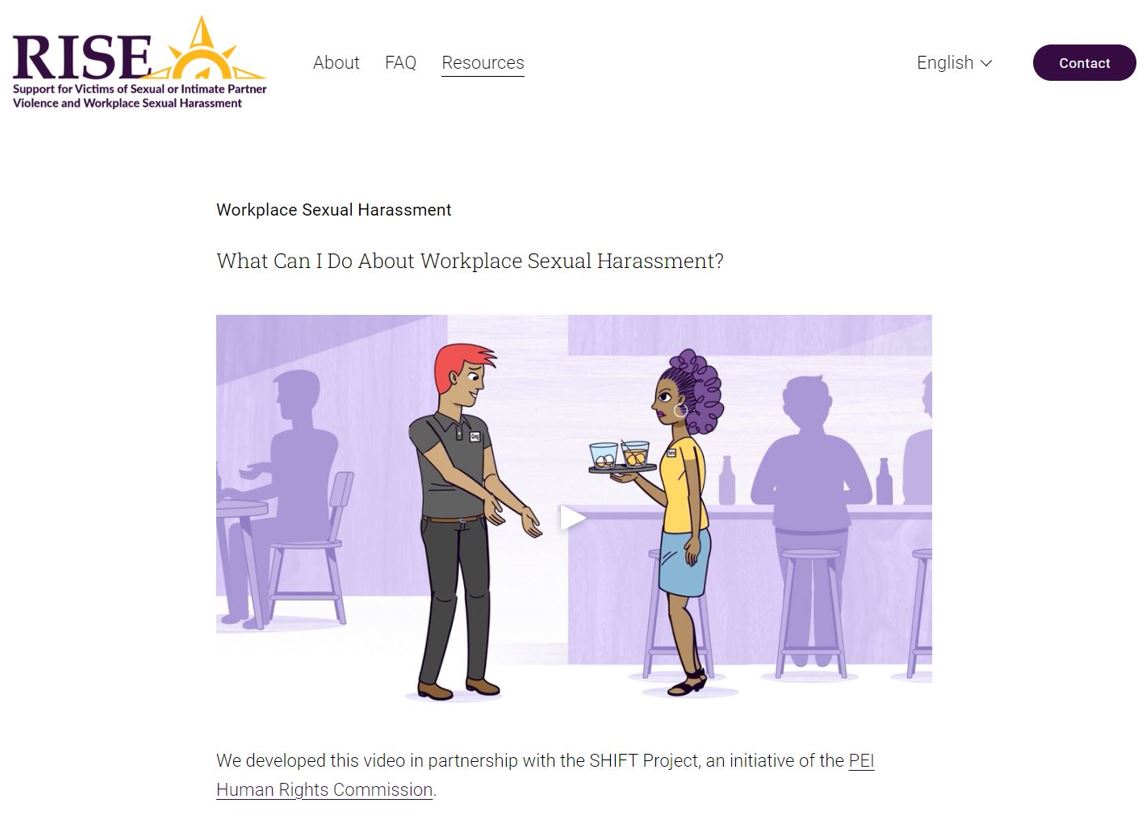
Information materials of different types and in multiple formats were produced to enable target populations to access legal information about their rights, obligations and responsibilities regarding SHW. The most common types of information/educational materials produced included pamphlets, resource lists, summary sheets, policy and procedure guides, information videos and online e-courses (see Figure 2 as an example of information materials that were developed). These materials were distributed through training sessions, workshops/webinars/presentations and campaigns, community walks, and through online platforms.
Figure 2: Example of Information Material Produced through RISE
Text version
The figure is a screenshot of the RISE resources webpage on workplace sexual harassment. The heading states, “What can I do about workplace sexual harassment?” Underneath, there is a screengrab of a video. The text below the video states, “We developed this video in partnership with the SHIFT Project, an initiative of the PEI Human Rights Commission.”
Source: https://www.risepei.com/resources/guide-for-workers
Due to the different ways in which organizations reported on their outcomes, and varied states of project completion and related reporting, it is not possible to report an aggregate number of educational materials or training developed and delivered as part of the SHW initiative. However, many PLEI project funding recipient interviewees mentioned that their legal education materials are being widely distributed through different channels including community organizations, employers, group networks, online, and at public libraries.
All funding recipient interviewees indicated their projects had been successful in providing legal information about rights, obligations and responsibilities related to workplace sexual harassment. Interviewees shared that materials developed were recognized as useful and meaningful by diverse communities, that feedback from users of their services has been very positive, and that lawyers involved have benefitted from participating in trauma-informed training. For example, the RISE project, as part of the case study for the Atlantic Region Network, reported positive feedback from the community about its PLEI services in their most recent project report. The case study on the White Ribbon project also found evidence of positive feedback from participants attending sessions on SHW.
One of the facilitating factors enabling target populations to access legal information was the availability of information in multiple languages, including in the minority official language. Another facilitating factor is the use of or partnerships with trusted intermediaries, such as group-specific community organizations or public libraries. Target populations are more likely to be exposed to PLEI through organizations they already trust and turn to for services and support in other areas of their lives.
Interviewees identified various hindrances to target populations accessing legal information regarding their rights, responsibilities and obligations. For example, lack of internet access, insufficient promotion of information/educational resources available in workplaces and lack of awareness of available resources were all identified as possible impediments. The most mentioned hindrance was discomfort reaching out for services or information. Interviewees explained that if those who have experienced SHW are not comfortable reaching out, then this is a barrier to enabling access to information.
4.2.2 Enabling Access to Legal Advice, Information and Ancillary Services
Projects are facilitating target population access to legal advice and information. Not only is more advice and information available, but projects are increasing the accessibility of existing advice and information, particularly through online resources. Having advice and information available in multiple languages is an important facilitator to access. The main factor hindering access is fear on the part of people who have experienced SHW of being identified and a perceived lack of confidentiality.
As mentioned previously, 17 organizations received funding to provide Legal Advice services. Results of interviews and case studies confirmed that funded projects are enabling complainants to access legal advice and information. Further, evidence suggests that projects are contributing to increasing access to justice as they provide those who have experienced workplace sexual harassment with information on different options available to them. However, some interviewees noted that, for some people who experienced workplace sexual harassment, the number of hours of legal advice that are available, and the extent of the service provided (for example, no legal representation or individual accompaniment/step-by-step support for the person through the recourse they have chosen) may not be sufficient to meet their needs.
Northumberland Community Legal Centre (NCLC) provides legal services to low-income residents of Northumberland County in Ontario. From an initial six collaborating clinics in their original proposal, NCLC’s project grew to include a total of 20 legal clinics from across Ontario, including eight in the South-West, eight in Eastern-Central, and four in Northern Ontario. The collaborating clinics then worked together to take a coordinated approach to producing public legal education materials, hiring staff to deliver legal advice and services to clients, and organizing and delivering educational offerings in their regions.
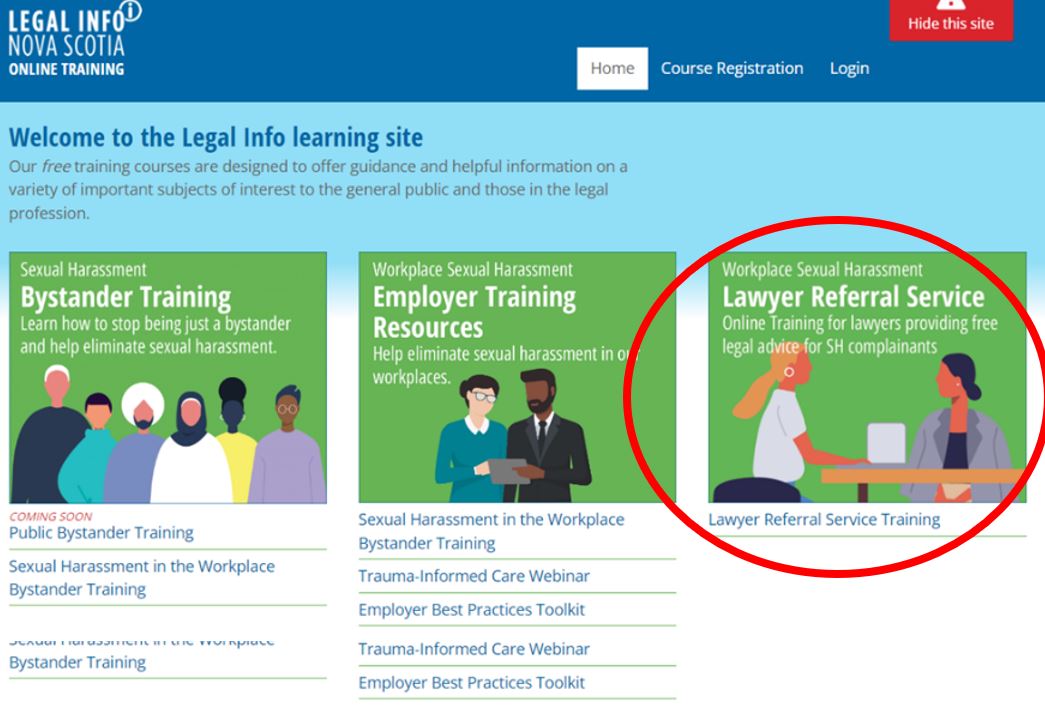
The accessibility and reach of available information, particularly via online resources has also increased. These online resources included websites that provide plain language information about workplace sexual harassment, as done by the Atlantic Region Network's Community Legal Information of Prince Edward Island project, resource apps such as those provided through the Safe Spaces app and the Safe at Work app developed by the Atlantic Region Network's Legal Information Society of Nova Scotia (LISNS) project, trauma-informed information resources made available online, as well as social media and media campaigns. Other non-online resources included lawyer referral programs to provide independent legal advice as well as training for lawyers and legal professionals on providing trauma-informed services.
Figure 3: Example of Online Training for Lawyers Providing Legal Advice
Text version
The figure is a screenshot of the LISNS Legal Info Learning webpage. The heading states, “Welcome to the Legal Info learning site.” The subheading reads, “Our free training courses are designed to offer guidance and helpful information on a variety of important subjects of interest to the general public and those in the legal profession.” The screenshot has different training options, including bystander training (e.g. public bystander training, sexual harassment in the workplace bystander training), employer training resources (e.g. sexual harassment in the workplace bystander training, trauma-informed care webinar, employer best practices toolkit), and lawyer referral service (e.g. lawyer referral service training).
The figure emphasizes the option for lawyer referral service, where the subheading states “online training for lawyers providing free legal advice for SH complainants.”
Source: https://lms.legalinfo.org/
Based on the project information available at the time of the evaluation, it is not possible to report demographic information, sector, or target population of those who were able to access legal advice, information and ancillary services.
As with access to information about rights, obligations and responsibilities mentioned above, one of the facilitating factors that enabled target populations to access legal advice and information included having services and resources available in different languages. Additionally, having information available in multiple languages that target populations can consult, rather than having to speak to someone about their experience, results in less stigma and shame experienced as part of their sexual harassment. For example, RISE (part of CLI) provides services in French and English and their publications are available in Arabic, Chinese, Vietnamese, Spanish, Farsi, Tagalog, French and English.
Several challenges to accessing legal advice and information were noted during interviews. For example, those living in rural and remote communities are hesitant to access advice or report SHW for fear of losing their employment in a community where there is a dearth of employment opportunities and because of the stigma associated with less anonymity in smaller communities. Tied to the lack of anonymity, the Atlantic Region Network case study also noted confidentiality concerns as a hindrance. Clients are hesitant of sharing the name of the person who harassed them or their employer with a lawyer (for the purposes of conflict-of-interest checks), for fear that information will be shared with the person who harassed them and/or their employer and consequently be fired or the harassment worsen. It was also reported that some clients are reluctant to seek legal advice because they mistakenly believe that sharing their experiences with a lawyer will mean they will need to take legal action (taking legal action is not necessarily the desired option for all those who experience workplace sexual harassment).
4.2.3 Impacts of Multi-sectoral and Multi-agency Collaboration
Multi-sectoral and multi-agency collaborations helped increase project outreach and contributed to the achievement of project outcomes. Partnerships were used to connect with more difficult to reach target groups, to refer clients, and to cross-promote services between the collaborating organizations. Knowledge exchange and sharing of resources had a positive impact on outcomes.
The SHW Initiative requested that projects include multi-sectoral and multi-agency collaboration, where appropriate, as “supporting complainants of workplace sexual harassment is complex and requires collaboration across sectors. Multi-sectoral approaches that involve organizations from various segments of society (e.g., non-profit, governmental, for-profit, academia) with complementary sets of expertise (e.g., violence against women, health, and/or justice/law enforcement) are required to address complex social issues like workplace sexual harassment.”15 In response, a majority of Initiative projects included multi-sectoral or multi-agency collaborations. Based on application forms from those projects that were funded, 18 of 28 (64%) indicated that their projects included multi-sectoral and/or multi-agency collaborations. In addition, there is also evidence that some projects that did not begin as multi-sectoral or multi-agency collaborations later established partnerships with other organizations. The rationale provided by interviewees for adding partnerships included improving the ability to reach target populations and increasing the ability to meet client needs, including ongoing psychosocial supports.
Projects that featured collaborations saw positive benefits in terms of efficiency, outreach and outcomes. These benefits are described below.
Efficiency
The PLEAC project received funding to support collaboration and partnerships among Initiative-funded projects. To facilitate the sharing of best practices and knowledge exchange, Initiative-funded organizations participated in learning webinars, meetings, working groups, an online discussion forum and in-person conferences. Bringing organizations together to connect, share and learn from one another helped facilitate opportunities for mutual support and build partnerships among funded organizations. Interview evidence indicates that the collaboration among Initiative-funded projects positively contributed to the efficiency of the projects being delivered by participating organizations. The impact of connections and exchanges made possible via the PLEAC project was reported to have helped support knowledge acquisition and contributed to the development of better materials and delivery of services for clients. Also, connections have made a meaningful difference for smaller or less-resourced organizations working on Initiative projects because these organizations have been able to access and make use of resources openly shared by other projects.
Outreach
Evidence indicates that multi-sectoral and multi-agency collaborations helped increase outreach. While there is no baseline data to determine what outreach would have occurred without multi-sectoral collaborations, most representatives from funded organizations interviewed reported distributing their materials or communicating information about their project via partners, thus expanding their outreach. Projects reached audiences they would not have otherwise been able to access to the same extent without these collaborations. In particular, some projects disseminated their information and/or resources through networks that are quite extensive, including through workers’ unions, chambers of commerce and other association groups. Interviewees underlined that collaborations were critical to increasing the likelihood of reaching isolated and hard to reach target groups. A number of projects shared how collaborating with francophone/anglophone organizations allowed them to broadcast their services to official language minority communities in their region. For example, the RISE project (from the Atlantic Region Network) connected with eleven francophone community partners across PEI to help ensure awareness of its program within francophone communities. These collaborations also resulted in the Community Legal Information (CLI) PEI’s videos on workplace sexual harassment (available on their website) being dubbed in French. Many interviewees also added that partnerships and collaboration helped increase outreach through referrals from one organization to another, and in some cases, cross-promotion.
Outcomes
Evidence suggests that multi-sectoral and multi-agency collaborations helped facilitate project outcomes. Collaborations helped make the following possible:
- Some harder to reach groups could be informed and connected to services.
- Additional lawyers from collaborating organizations could be called upon to assist (including lawyers from diverse communities, lawyers specializing in different areas of law, and lawyers able to speak languages other than English).
- Organizations with different expertise could benefit from each other’s knowledge and expertise and in so doing improve services provided to clients and/or fill each other’s gaps in services (thus, collaboratively providing more robust or complete wraparound services for people who have experienced SHW).
- Resource sharing and in-kind arrangements that were established allowed for more efficient use of resources and the strengthening of project capacity to deliver their project.
- Collaborations between English and French language organizations meant that services (such as workshops) could be made available in French for francophone communities.
- Collaborations with organizations with ties to certain target groups meant that resources and materials could be developed using language familiar to these target groups and, in some cases, could be translated in different languages to be more accessible to a larger number of people.
4.3 Design and Delivery
4.3.1 Challenges and Best Practices in Implementation and Delivery
The evaluation explored the challenges and best practices in implementation and delivery of the SHW Initiative and individual projects.
The main challenge facing the SHW Initiative was COVID-19, which affected project timelines and design. Best practices included requiring projects to adopt a trauma-informed approach, apply GBA Plus in project design, and encourage the involvement of/collaboration with organizations already trusted by target populations.
Challenges
COVID-19 pandemic. The planning and implementation phases of many of the Initiative-funded projects coincided with the COVID-19 pandemic. The impact of the pandemic was significant and manifold, and individual projects experienced a variety of challenges. Projects were forced to modify their designs to accommodate online delivery, and the uncertainty of the pandemic environment meant that some employment sectors were hit harder than others. This contributed to difficulties related to staffing, and stay-at-home orders also limited possibilities for outreach and networking. In particular, the lack of high-speed internet in rural/remote areas limited the ability to reach some target populations. Virtual delivery of services was also seen as less impactful than in-person, especially related to education, awareness and legal advice. Finally, many project representatives noted that the pandemic drew attention away from SHW as employers were consumed with responding to pandemic-related concerns.
Reaching intended target populations. Challenges related to reaching the intended target populations were noted, as follows:
Many projects, including one led by the Public Legal Information Association of Newfoundland and Labrador (PLIAN), noted that engaging employers in training has been an important challenge. PLIAN shared that employers have indicated that they do not feel comfortable having someone come in and speak about sexual harassment in their workplace as doing so could suggest that their workplace has a problem with sexual harassment. In response, PLIAN has been trying to reframe employer thinking around SHW in a way to have them associate SHW more strongly with a concern of workplace safety, an investment in employees, and a sign of employer commitment to a healthy workplace culture.
- Underreporting. Fears surrounding reporting SHW persist due to fears of negative consequences – namely, both the experienced and perceived social stigma16 and the possibility of losing one’s employment. These fears were heightened during the COVID-19 pandemic. The interrelation of housing insecurity, food insecurity, financial need, employment, racism, other forms of discrimination, and systemic inequality contribute to making it very difficult for those who have experienced workplace sexual harassment to come forward.
- Employer participation in training. Some interviewees noted that employers are hesitant to attend SHW training due to concerns about how their attendance might be negatively perceived by others.
Best Practices
Interviewees, including experts, noted many best practices with respect to how the SHW Initiative was implemented and delivered. These include requiring or encouraging the following within projects:
- Using a trauma-informed approach, demonstrating consideration for cultural sensitivity, and, including multi-sectoral and/or multi-agency collaboration.
- Requiring funding recipients to provide information on how the project would integrate GBA Plus.
- Having lead involvement from and/or ongoing collaboration and engagement with organizations that have strong relational connections with targeted groups. This reflects best practices and the “nothing about us without us” approach.
A few interviewees also noted that Justice Canada allowing flexibility in project delivery (e.g., allowing projects to make modifications to original project plans to adapt to evolving client needs and/or changes in the environment, including COVID-19) was an important best practice.
There are also best practices noted in terms of individual project delivery. Many were identified through interviews with project representatives and emerged from case studies. Those that recurred across multiple interviews were noted in the following areas:
Approach to service delivery
- Providing services from a client-centered perspective and supporting clients in a holistic way, such as ensuring client autonomy, providing referrals by way of warm handoffs, where the referring organization personally introduces the client to another service provider, results in a positive experience for those who have experienced workplace sexual harassment and increases the impact of the activities.
Delivering training
- Training that highlights “grey areas” of SHW rather than the use of blatant examples is most effective as this is where there is the most confusion and uncertainty among the general public on what constitutes SHW.
- Providing continuous training for lawyers and other service providers, and tools to support them in carrying out this work.
- Providing bystander training to help change workplace culture by training staff in how they can act as agents in addressing SHW in their workplace.
Providing legal advice
- Providing access to legal advice from non-local lawyers, as some people who experience SHW live in small communities and may prefer not to deal with be connected with a local lawyer for reasons of anonymity and concerns for confidentiality;
- Providing help to approach the workplace human resources department. Some of the most successful outcomes are seen when clients, who are still amid a difficult situation, are provided with assistance to approach their workplace human resources department. The emphasis here is on early intervention rather than waiting for situations to escalate into more serious cases.
4.3.2 GBA Plus Consideration in Planning and Delivery
GBA Plus was a requirement for all projects in the planning phase. Some projects integrated GBA Plus into their project delivery, but it is difficult to confirm whether GBA Plus (as opposed to seeking a diversity of participants) was used to inform the project delivery of most funded projects.
The anticipatory CFP for the SHW Initiative highlighted that GBA Plus was an important component of the SHW Initiative and noted that applicants would be required to describe how their projects would integrate GBA Plus in its planning and implementation. This requirement was intended to help ensure that funding recipients be responsive, inclusive and reflective of diverse experiences in the design and implementation of their projects. Consequently, projects would more effectively reach diverse groups, as well as meet the needs of diverse groups through greater recognition of their experiences and the deliberate removal of barriers these groups may face in accessing services.
However, interviews with representatives of Initiative-funded projects revealed a mixed understanding of GBA Plus, limiting its application. In instances where funded projects had a strong understanding of GBA Plus, it was used in project design, such as by partnering with organizations led by or well connected with targeted vulnerable and equity-deserving populations, or engaging in consultations with community members. These organizations also used GBA Plus in implementation, for example by being responsive to different intersectional needs and reflecting this in their reporting. For many others, however, a common response to enquiries about how a project had integrated GBA Plus was ‘our resources/services are open and available to everyone regardless of identity’. This demonstrates a misunderstanding of GBA Plus, which is not identity-blind but rather considers sex, gender, race, ethnicity, religion, age, mental or physical disability and other identity factors to address how the intersection among these factors can influence the way diverse persons experience policies, initiatives, and services.17
All interviewees were able to highlight some identity intersections that may make some persons more susceptible to experiencing SHW – this implied an awareness of research and/or consultations having been undertaken by project delivery organizations. In terms of GBA Plus informing the development of project materials or project delivery, many project interviewees noted having designed their resources to be in plain language and having translated their SHW resources into a number of different languages to be accessible to more community members. Some project recipients interviewed also noted consulting organizations serving diverse communities to ensure that the activities and resources developed through their projects would be representative of and meaningful for various populations targeted. For example, PLEIS and LISNS from the Atlantic Region Network indicated that they held such consultations with Status of Women Nova Scotia and with plain language advisors who were 2SLGBTQI+ and BIPOC to ensure that their material would be as useful and meaningful as possible for diverse identities by way of these identities being reflected in their materials.
4.4 Efficiency
While there is limited information about the efficiency of the SHW Initiative, funding organizations that were already delivering PLEI, as well as collaborations between organizations to expand reach and services, were seen as efficient.
Two key components of the SHW Initiative were seen to increase efficiency. First, regarding the PLEI component, funding organizations that were already providing education and outreach information was seen as efficient. These organizations were well positioned to expand the topics and reach of their PLEI materials, to raise awareness of the issue of SHW and connect target populations with existing and new partners. Second, as mentioned in the previous section (4.2.3), another key component of the SHW Initiative was to promote multi-sectoral collaborations amongst projects. Many projects featured these types of collaborations, and this was seen by almost all interviewee respondents to not only contribute to the achievement of outcomes but to also have a positive impact on the efficiency of Initiative-funded projects.
Finally, the knowledge-sharing forum led by PLEAC was mentioned by many interviewees as a valuable and a worthwhile investment, since recipients of project funding are often too focused on their work to conduct knowledge-sharing activities on their own. This was especially important during the COVID-19 pandemic, as many projects were faced with having to redesign their activities to suit virtual delivery. All groups faced a common and difficult challenge with the pandemic, and this likely helped motivate more participants to attend PLEAC’s first, and other early scheduled online gatherings. While this early engagement may have been born of necessity, the connections made between organizations and the establishment of working groups were seen by interviewees as positively contributing to the achievement of Initiative outcomes and increasing project efficiencies.
- Date modified: