
Quarterly Financial Report for the quarter ended December 31, 2024
Table of Contents
- 1. Introduction
- 2. Highlights of Fiscal Quarter and Fiscal Year to Date Results
- 3. Risks and Uncertainties
- 4. Significant Changes in Relation to Operations, Personnel and Programs
- 5. Statement of Authorities (unaudited)
- 6. Departmental Budgetary Expenditures by Standard Object (unaudited)
- 7. Glossary
1. Introduction
This quarterly financial report has been prepared by management as required by section 65.1 of the Financial Administration Act (FAA) and in the form and manner prescribed by the Treasury Board. The report should be read in conjunction with the 2023-24 and 2024-25 Main Estimates, the 2023-24 Supplementary Estimates (A), as well as the 2023-24 and 2024-25 Supplementary Estimates (B). The Departmental Audit Committee (DAC) has reviewed the report, but no external audit or review has been conducted.
The glossary (Section 7) contains definitions for key financial terms that are hyperlinked in the text.
1.1 Raison d’être
The Department of Justice Canada supports the dual roles of the Minister of Justice and the Attorney General of Canada.
Under Canada’s legal system, the administration of justice is an area of shared jurisdiction between the federal government and the provinces and territories. The Department supports the Minister of Justice’s responsibilities for statutes and areas of law that fall under federal jurisdiction by ensuring a bilingual and bijural national legal framework, principally within the following domains: criminal justice (including justice for victims of crime and youth criminal justice), family justice, access to justice, Indigenous justice, public law, and international private law. This responsibility is fulfilled through the development of laws, justice policies, programs and services for Canadians. The Minister is the legal advisor to Cabinet and ensures that the administration of public affairs is in accordance with the law.
The Department also supports the role of the Attorney General of Canada as the chief law officer of the Crown. In carrying out this role, the Attorney General represents the Crown and not individual departments and agencies and, therefore, seeks to protect interests for the whole of the Government of Canada.
1.2 Basis of Presentation
This quarterly report has been prepared by management using an expenditure basis of accounting. The accompanying Statement of Authorities includes the Department’s spending authorities granted by Parliament, and those used by the Department consistent with the Main Estimates. This quarterly report has been prepared using a special purpose financial reporting framework designed to meet financial information needs with respect to the use of spending authorities.
The authority of Parliament is required before moneys can be spent by the Government. Approvals are given in the form of annually approved limits through appropriation acts or through legislation in the form of statutory spending authority for specific purposes.
The Department uses the full accrual method of accounting to prepare and present its annual departmental financial statements, which are part of the Departmental Results Report process. However, the spending authorities voted by Parliament remain on an expenditure basis.
Although the Department has implemented an advanced billing process, revenues are reported when they are earned rather than when they are collected, to ensure consistency of presentation and comparability with prior year reports.
1.3 Department of Justice Financial Structure
The Department of Justice financial structure is comprised of the following budgetary authorities:
- Vote 1 – Operating Expenditures;
- Vote 5 – Grants and Contributions; and
- Statutory authorities related to contributions to the Employee Benefit Plan (EBP), salary and motor car allowances for the Minister of Justice and Attorney General of Canada.
As the primary legal services provider to other government departments and agencies, the Department of Justice collects and spends revenue generated by these legal services as part of its Vote 1 authority. The Department of Justice also has the authority to spend revenues collected for providing internal administrative support services to other government departments. In departmental reporting, these revenues offset total departmental authorities and expenditures.
The primary recipients of the Department’s Vote 5 (Grants and Contributions) are Provincial and Territorial governments. Approximately 70% of the Vote 5 funding is related to cost-shared agreements with these recipients, which are usually accounted for in the last quarter of the fiscal year upon receipt of financial claims statements. As a result, a large proportion of expenditures in Vote 5 tend to occur in the fourth quarter.
2. Highlights of Fiscal Quarter and Fiscal Year to Date Results
This section highlights the significant items that contributed to the net increase in resources available for the year and net changes in actual expenditures for the quarter ended December 31, 2024. For both periods ending December 31, the net budgetary authorities (excluding Vote-Netted Revenue (VNR)) provided to the Department include, where applicable: Main Estimates, Supplementary Estimates, and funding received from Treasury Board Central Votes for Compensation Adjustments and the Operating Budget Carry Forward from the previous fiscal year.
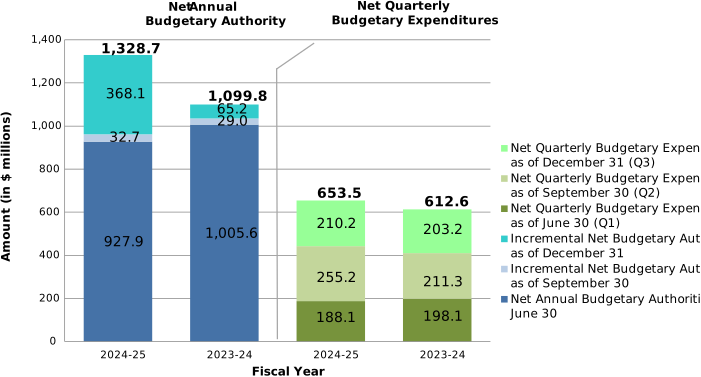
During the third quarter ended December 31, 2024, the Department was granted additional authorities totaling $368.1 million, which includes funding from the 2024-25 Supplementary Estimates (B) and Compensation Adjustments. During the third quarter of the previous fiscal year, the Department was granted additional authorities totaling $65.2 million, which includes funding from the 2023-24 Supplementary Estimates (B) and Compensation Adjustments.
Graph 1 outlines the Department’s net budgetary authorities and expenditures.
Graph 1: Comparison of Annual Budgetary Authorities and Quarterly Expenditures as of December 31, 2024, and December 31, 2023
Graph 1: Comparison of Annual Budgetary Authorities and Quarterly Expenditures as of December 31, 2024, and December 31, 2023 – Text version
The bar graph shows the Department’s annual net budgetary authorities and quarterly net budgetary expenditures for the quarters ending December 31, September 30 and June 30 for fiscal years 2024-25 and 2023-24.
Net budgetary authorities in fiscal year 2024-25 totaled $1,328.7M on December 31, $960.6M on September 30 and $927.9M on June 30, which represents an increase of $32.7M during the second quarter and $368.1M during the third quarter. In the previous fiscal year, net budgetary authorities totaled $1,099.8M on December 31, $1,034.6M on September 30 and $1,005.6M on June 30, which represents an increase of $29.0M during the second quarter and $65.2M during the third quarter.
Net budgetary expenditures in fiscal year 2024-25 for the quarters ending December 31, September 30 and June 30 were $210.2M, $255.2M and $188.1M, respectively, totaling $653.5M year-to-date as of December 31, 2024. In the previous fiscal year, net budgetary expenditures for the quarters ending December 31, September 30 and June 30 were $203.2M, $211.3M and $198.1M, respectively, totaling $612.6M year-to-date as of December 31, 2023.
Rounding differences may occur.
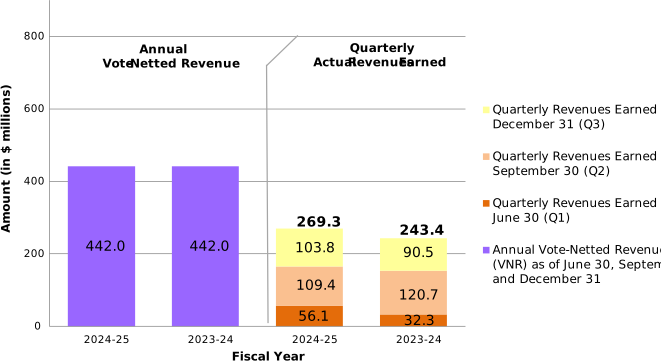
Graph 2 outlines the Department’s Vote-Netted Revenue (VNR) and respendable revenues earned.
Graph 2: Comparison of Annual Vote-Netted Revenue and Quarterly Revenues Earned as of December 31, 2024, and December 31, 2023
Graph 2: Comparison of Annual Vote-Netted Revenue and Quarterly Revenues Earned as of December 31, 2024, and December 31, 2023 – Text version
The bar graph shows the Department’s annual vote-netted revenue authority and the quarterly actual revenues earned for the quarters ending December 31, September 30 and June 30 for fiscal years 2024-25 and 2023-24.
Vote-netted revenue authority in fiscal year 2024-25 totaled $442.0M on December 31, September 30 and June 30. In the previous fiscal year, vote-netted revenue authority totaled $442.0M on December 31, September 30 and June 30.
Revenues earned in fiscal year 2024-25 for the quarters ending December 31, September 30 and June 30 were $103.8M, $109.4M and $56.1M, respectively, totaling $269.3M year-to-date as of December 31, 2024. In the previous fiscal year, revenues earned for the quarters ending December 31, September 30 and June 30 were $90.5M, $120.7M and $32.3M, respectively, totaling $243.4M year-to-date as of December 31, 2023.
Rounding differences may occur.
2.1 Significant Changes to Authorities
(Please refer to the Statement of Authorities table presented in Section 5.)
When compared to the third quarter of the previous fiscal year, the total net budgetary authorities available for 2024-25 increased by $228.9 million, from $1,099.8 million in 2023-24 to $1,328.7 million in 2024-25. This comprises:
- Vote 1 – Operating Expenditures increased by $169.7 million
- Vote 5 – Grants and Contributions increased by $66.8 million
- Statutory authorities decreased by $7.6 million
The increase in authorities is mainly explained by the funding accessed through the 2024-25 Supplementary Estimates (B) which was mostly sourced from Budget 2024 and the funding related to the recent signing of the collective agreement for the Law Practitioner group and revised rates of pay for unrepresented employees of the Law Management group.
| Changes to voted and statutory authorities observed between 2024-25 and 2023-24 (in millions of dollars) |
Vote 1 – Operating Expenditures | Vote 5 – Grants and Contributions | Statutory authorities | Total |
|---|---|---|---|---|
| Net increases of $253.4 million | ||||
| Funding for compensation adjustments relating to recent wage increases of various groups, namely for the Law Practitioner and Law Management groups | 162.8 | 0.0 | 1.8 | 164.6 |
| Funding for Immigration and Refugee Legal Aid (Budget 2024 and sunsetting of funding from Budget 2023) | 0.0 | 28.1 | 0.0 | 28.1 |
| Funding for Criminal Legal Aid (Budget 2024 and sunsetting of funding from Budget 2022) | 0.0 | 20.0 | 0.0 | 20.0 |
| Funding to respond to the National Inquiry into Missing and Murdered Indigenous Women and Girls’ Final Report: Increasing Access to Culturally Grounded and Indigenous-Led Victim Services (Budget 2023) | 0.2 | 8.9 | 0.1 | 9.2 |
| Funding for the Public Inquiry into Foreign Interference in Federal Electoral Processes and Democratic Institutions (Budget 2024) | 6.9 | 0.0 | 1.3 | 8.2 |
| Funding for victims and survivors of hate crimes (Budget 2024) | 0.0 | 4.9 | 0.0 | 4.9 |
| Funding to support government-wide legislative and regulatory initiatives (Fall Economic Statement 2022) | 3.0 | 0.0 | 0.8 | 3.8 |
| Funding from the Operating Budget Carry Forward | 3.7 | 0.0 | 0.0 | 3.7 |
| Funding for the Action Plan for Official Languages 2023-2028 (Budget 2023) | 0.0 | 3.7 | 0.0 | 3.7 |
| Funding for the Tenant Protection Fund (Budget 2024) | 0.0 | 3.0 | 0.0 | 3.0 |
| Funding for resourcing departments and agencies to meet national security and intelligence review requirements (Budget 2023) | 1.4 | 0.0 | 0.4 | 1.8 |
| Funding to expand the use of Impact of Race and Culture Assessments for Black and other racialized Canadians (Budget 2024) | 0.0 | 1.6 | 0.0 | 1.6 |
| Funding for the implementation of the United Nations Declaration on the Rights of Indigenous Peoples Act (reprofile of funds from a previous year) | 0.0 | 0.5 | 0.0 | 0.5 |
| Funding to advance the National Action Plan to End Gender-Based Violence (Budget 2021) | 0.0 | 0.3 | 0.0 | 0.3 |
| Decreases of $24.5 million | ||||
| Refocusing Government Spending (Budget 2023 reductions) | (5.1) | (1.1) | (0.5) | (6.7) |
| Sunsetting of funding for Bringing Innovation to Regulations through the Implementation of the Three Sectorial Roadmaps: Agri-Food and Aquaculture, Health & Biosciences and Transportation (Budget 2019) | (2.3) | 0.0 | (0.6) | (2.9) |
| Funding to continue supporting the development and early implementation of the Indigenous Justice Strategy (Budget 2024 and sunsetting of funding from Budget 2021 and Budget 2019) | 0.0 | (2.0) | 0.0 | (2.0) |
| Funding for the Office of the Independent Special Interlocutor for Missing Children and Unmarked Graves and Burial Sites associated with Indian Residential Schools (Budget 2022 and reprofile of funds from a previous year) | (1.1) | 0.0 | (0.6) | (1.7) |
| Funding for Gladue Principles – Systemic and Community-led Responses to Address Overrepresentation of Indigenous People in the Criminal Justice System (Fall Economic Statement 2020) | 0.0 | (1.0) | 0.0 | (1.0) |
| Funding to provide legal support and awareness to address workplace sexual harassment (Budget 2024 and sunsetting of funding from Budget 2018) | 0.1 | (0.8) | 0.0 | (0.7) |
| Other technical adjustments, namely a decrease to the EBP in accordance with the Treasury Board Secretariat prescribed annual rate adjustment | 0.1 | 0.7 | (10.3) | (9.5) |
| Total | 169.7 | 66.8 | (7.6) | 228.9 |
2.2 Significant Changes to Budgetary Expenditures and Revenues
(Please refer to the Departmental Budgetary Expenditures by Standard Object table presented in Section 6.)
Total year-to-date net budgetary expenditures increased from $612.6 million in 2023-24 to $653.5 million in 2024-25. This net increase of $40.9 million consists of changes associated with the following items:
| Changes to expenditures and revenues (2024-25 compared to 2023-24) |
$ millions |
|---|---|
| Expenditures by Standard Object | |
| Personnel: the increase in salaries is mainly related to an increase in the workforce and to compensation adjustments relating to the ratification of various collective agreements. | 59.7 |
| Information: the increase is mostly related to an increase in data and database access services, mostly related to timing of payments compared to prior year. | 0.9 |
| Professional and special services: the decrease is mainly related to decreases in payments for expert witness and translation services. | (1.1) |
| Acquisition of machinery and equipment: the decrease is mainly related to decreases in purchases of computer equipment (such as laptops and peripherals) and payments for the replacement of the electronic security system. | (1.8) |
| Transfer payments: the increase is related to the timing of interim payments in accordance with the different contribution agreements. | 9.7 |
| Other standard objects: a net decrease attributable to minor changes in expenditures, such as decreases in transportation and communications (including travel and relocation), repair and maintenance, utilities, materials and supplies, which were partially offset by increases in other subsidies and payments. | (0.6) |
| Revenues netted against expenditures | |
| Revenue: an increase in respendable revenues earned, that offset expenditures, due to timing differences in the finalization of agreements with client departments, the processing of revenues in the financial system, and an increase in demand for legal services. | (25.9) |
| Total increase in net budgetary expenditures | 40.9 |
3. Risks and Uncertainties
The Department of Justice Canada’s operating context is ever evolving. Legal work has become increasingly complex and crosscutting, and the practice of law is dynamic. The Department must remain ready to respond to the accelerated pace at which new policy issues emerge or unfold. The broad and diverse scope of justice issues and the multi-tiered nature of Canada’s justice system require the involvement and collaboration of many partners and stakeholders.
A portion of the Department’s funding comes from revenues generated through the provision of services to other client departments. The other portion comes from appropriations voted by Parliament, which are subject to reductions as announced in recent federal budgets. Factors that put additional financial pressure on the Department include delays in revenue collection and pay increases resulting from ratified collective agreements, when timing of payments to employees precedes the supply of appropriations and/or when payment amounts exceed the funding being appropriated. To mitigate these financial risks, the Department monitors its business volumes and its financial situation closely. This includes rigorous management of revenues, expenditures, forecasting and commitment monitoring. Moreover, the Department works closely with client departments to identify changing requirements and their impacts.
Ongoing technological advancements, especially in the sharing and management of information, make new ways of communicating and working possible. At the same time, these advancements create additional demands and pressures. The latest forms of technologies are increasing the pace of change. Organizations must manage rapidly growing volumes and forms of electronic information. New legislative policy or program responses may be required to address these innovative technologies while respecting the privacy and security of Canadians.
The Department regularly monitors and identifies strategic risks that may affect the delivery of the Department’s mandate and expected results. Strategic risks that the Department is currently managing include risk related to external relationship management, as well as internally focused risks concerning cybersecurity, employee wellness, data and information, and the workplace of the future. In aggregate, these risks may have a financial impact on the Department. For more information, refer to the 2024-25 Departmental Plan.
4. Significant Changes in Relation to Operations, Personnel and Programs
During the third quarter of 2024-25, the following changes in personnel occurred:
- Alain Langlois was appointed to the position of Assistant Deputy Minister of Public Safety, Defence and Immigration Portfolio, effective October 15, 2024;
- Michael Sousa was appointed to the position of Assistant Deputy Minister of Business and Regulatory Law Portfolio, effective October 15, 2024;
- Owen Ripley was appointed to the position of Senior Assistant Deputy Minister of the Policy Sector, effective October 15, 2024; and
- Sarah Geh was appointed to the position of Assistant Deputy Minister of the Public Law and Legislative Services Sector, effective November 21, 2024.
Approval by Senior Officials
Approved by:
Isabelle Jacques
Acting Deputy Minister of Justice and
Deputy Attorney General of Canada
Bill Kroll, CPA, CMA
Chief Financial Officer and
Assistant Deputy Minister, Management Sector
Ottawa, Canada
February 24, 2025
5. Statement of Authorities (unaudited)
Department of Justice
Quarterly Financial Report
For the quarter ended December 31, 2024
Statement of authorities (unaudited)
(in thousands of dollars)
| Fiscal Year 2024-2025 | Fiscal Year 2023-2024 | |||||
|---|---|---|---|---|---|---|
| Total available for use for the year ending March 31, 2025Footnote * of Table | Used during the quarter ended December 31, 2024 | Year to date used at quarter-end | Total available for use for the year ending March 31, 2024Footnote * of Table | Used during the quarter ended December 31, 2023 | Year to date used at quarter-end | |
| Vote 1 – Net Operating Expenditures | 507,333 | 100,860 | 354,649 | 337,538 | 102,904 | 317,904 |
| Vote 5 – Grants and Contributions | 729,172 | 86,451 | 230,104 | 662,365 | 75,574 | 220,414 |
| Budgetary Statutory Authorities | ||||||
| Contributions to employee benefit plans | 92,114 | 22,886 | 68,658 | 99,797 | 24,737 | 74,211 |
| Minister of Justice and Attorney General of Canada – Salary and motor car allowance | 99 | 25 | 75 | 95 | 25 | 73 |
| Spending of proceeds from the disposal of surplus Crown assets | 3 | 0 | 0 | 2 | 0 | 0 |
| Total Budgetary Statutory Authorities | 92,216 | 22,911 | 68,733 | 99,894 | 24,762 | 74,284 |
| Total Authorities | 1,328,721 | 210,222 | 653,486 | 1,099,797 | 203,240 | 612,602 |
6. Departmental Budgetary Expenditures by Standard Object (unaudited)
Department of Justice
Quarterly Financial Report
For the quarter ended December 31, 2024
Departmental budgetary expenditures by Standard Object (unaudited)
(in thousands of dollars)
| Fiscal Year 2024-2025 | Fiscal Year 2023-2024 | |||||
|---|---|---|---|---|---|---|
| Planned expenditures for the year ending March 31, 2025Footnote * of Table | Expended during the quarter ended December 31, 2024 | Year to date used at quarter-end | Planned expenditures for the year ending March 31, 2024Footnote * of Table | Expended during the quarter ended December 31, 2023 | Year to date used at quarter-end | |
| Expenditures | ||||||
| Personnel | 945,517 | 208,593 | 642,546 | 786,709 | 197,838 | 582,895 |
| Transportation and communications | 8,190 | 2,614 | 5,860 | 7,797 | 2,812 | 6,332 |
| Information | 4,795 | 1,284 | 3,341 | 4,125 | 716 | 2,401 |
| Professional and special services | 54,208 | 11,750 | 27,932 | 46,428 | 10,663 | 29,048 |
| Rentals | 11,166 | 1,890 | 6,890 | 12,112 | 2,565 | 6,892 |
| Repair and maintenance | 3,208 | 304 | 728 | 4,761 | 760 | 948 |
| Utilities, materials and supplies | 2,824 | 461 | 1,194 | 2,741 | 615 | 1,638 |
| Acquisition of machinery and equipment | 9,049 | 749 | 1,647 | 5,267 | 1,646 | 3,406 |
| Transfer payments | 729,172 | 86,451 | 230,104 | 662,365 | 75,574 | 220,414 |
| Other subsidies and payments | 2,592 | (9) | 2,560 | 9,492 | 530 | 2,058 |
| Total gross budgetary expenditures | 1,770,721 | 314,087 | 922,802 | 1,541,797 | 293,719 | 856,032 |
| Less: Revenues netted against expenditures | (442,000) | (103,865) | (269,316) | (442,000) | (90,479) | (243,430) |
| Total Net Budgetary Expenditures | 1,328,721 | 210,222 | 653,486 | 1,099,797 | 203,240 | 612,602 |
7. Glossary
- Spending authorities are approvals from Parliament for individual government organizations to spend up to specific amounts. Spending authority is provided in two ways:
- Annual Appropriation Acts that specify the amounts and broad purposes for which funds can be spent; and
- Other specific statutes that authorize payments and set out the amounts and time periods for those payments.
- Bijural
- Relates to the coexistence and interaction of two legal systems or legal traditions in a given legal framework. In Canada, this relates to Quebec civil law and Canadian common law, taking into account other sources of federal law, including Indigenous rules and customs.
- Budget Implementation Vote
- Treasury Board central vote for new measures or initiatives announced in the Federal Budget. The central vote facilitates timely availability of supply for Budget measures to be carried out in the upcoming fiscal year.
- Compensation Adjustments
- Treasury Board central vote that allocates supplementary funds for adjustments made to terms and conditions of service or employment of the federal public administration as a result of collective bargaining.
- Deferred Revenues
- An amount received or recorded as receivable but not yet earned and meanwhile carried forward to be taken into income in future periods.
- Employee Benefit Plan (EBP)
- A statutory item that includes employer costs for the Public Service Superannuation Plan, the Canada and the Quebec Pension Plans, Death Benefits, and the Employment Insurance accounts. Expressed as a percentage of salary, the EBP rate is changed every year as directed by the Treasury Board Secretariat.
- Full Accrual Method of Accounting
- Costs are reported based on their consumption. Revenues are reported when earned. The Department uses this method of accounting to prepare and present its annual departmental financial statements. The quarterly reports are prepared using a special purpose financial reporting framework.
- Government-wide Initiatives
- Subject to the approval of the Treasury Board, to supplement other appropriations in support of the implementation of strategic management initiatives in the public service of Canada.
- Main Estimates
- Each year, the government prepares estimates in support of its request to Parliament for authority to spend public funds. This request is formalized through the introduction of appropriation bills in Parliament. In support of the Appropriation Act, the Main Estimates identify the spending authorities (Votes) and amounts to be included in subsequent appropriation bills. Parliament is asked to approve these Votes to enable the government to proceed with its spending plans.
- Operating Budget Carry Forward (OBCF)
- A Treasury Board centrally managed vote that permits departments to bring forward eligible lapsing funds from one fiscal year to the next in an amount up to five percent of the operating budgets contained in their Main Estimates. (See also Voted and statutory appropriations.)
- Reference level
- The amount of funding that the Treasury Board has approved for departments and agencies to carry out policies and programs for each year of the planning period.
- Respendable Revenues Collected
- Represents revenues that the department has specific authority from Parliament to respend which may be comprised of deferred revenues and revenues netted against expenditures.
- Respendable Revenues Earned
- Represents revenues that are recognized when they are earned (usually when services are rendered).
- Reprofile
- Realignment of resources to be spent in specific years, even though the overall amount spent on an initiative may remain the same.
- Special Purpose Financial Reporting Framework
- The Quarterly Financial Report requirements and structure as defined in the GC 4400 Departmental Quarterly Financial Report.
- Standard Objects
- A system in accounting that classifies and summarizes records by categories, such as type of goods or services acquired, for monitoring and reporting.
- Sunsetting
- The end of temporary funding.
- Supplementary Estimates
- The President of the Treasury Board tables three Supplementary Estimates (in May, in late October or early November, and in February) to obtain the authority of Parliament to adjust the government’s expenditure plan set out in the Main estimates for that fiscal year. Supplementary Estimates serve two purposes. First, they seek authority for revised spending levels that Parliament will be asked to approve in an Appropriation Act. Second, they provide Parliament with information on changes in the estimated expenditures to be made under the authority of statutes previously passed by Parliament. Each Supplementary Estimates document is identified alphabetically (A, B, C).
- Voted and Statutory Appropriations
- Expenditures made by government require the authority of Parliament. That authority is provided in two ways: annual Appropriation Acts or Supply Bills specify the amounts and broad purposes for which funds can be spent; and other specific statutes authorize payments and set out the amounts and time periods for those payments. The amounts approved in appropriation acts are referred to as voted amounts, and the expenditure authorities provided through other statutes are called statutory authorities.
- Vote 1 – Operating Expenditures
- A vote that covers most day-to-day expenses, such as salaries and utilities.
- Vote 5 – Grants and Contributions
- A vote used when grants and/or contributions expenditures equal or exceed $5 million.
- Vote-Netted Revenue
- The authority by which the Department of Justice has permission to collect and spend revenue earned from the provision of legal and internal services within government.
- Date modified: