
2019-20 Departmental Plan
Additional Information
Corporate Information
Organizational Profile
- Appropriate minister:
- David Lametti, P.C., M.P.
- Institutional head:
- Nathalie G. Drouin, Ad. E.
- Ministerial portfolio:
- Justice
- Enabling instrument:
- Department of Justice Act
- Year of incorporation/commencement:
- 1868
- Raison d’être, mandate and role: who we are and what we do
- “Raison d’être, mandate and role: who we are and what we do” is available on the Department of Justice’s website.
Reporting Framework
The Department of Justice Department Results Framework and Program Inventory of record for 2019-20 are shown below:
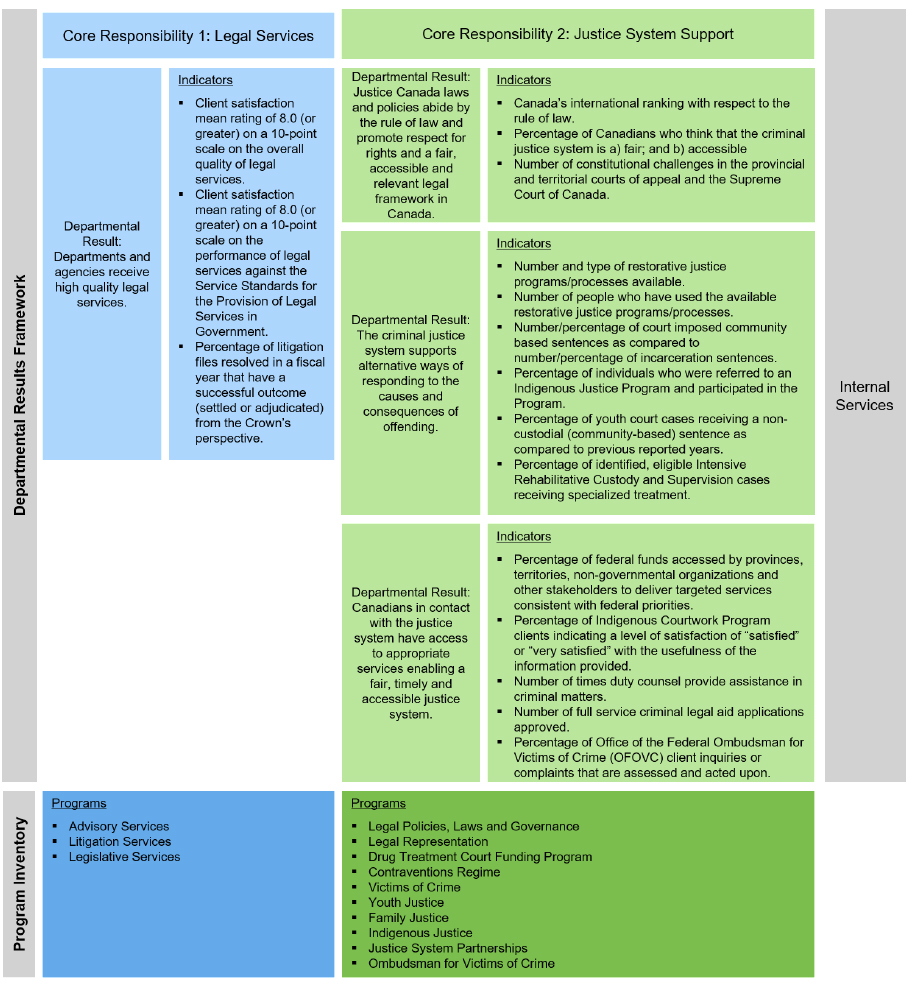
Text version - Departmental Results Framework and Program Inventory
Core Responsibility 1: Legal Services
Departmental Results Framework
Departmental Result: Departments and agencies receive high quality legal services.
Indicators
- Client satisfaction mean rating of 8.0 (or greater) on a 10-point scale on the overall quality of legal services.
- Client satisfaction mean rating of 8.0 (or greater) on a 10-point scale on the performance of legal services against the Service Standards for the Provision of Legal Services in Government.
- Percentage of litigation files resolved in a fiscal year that have a successful outcome (settled or adjudicated) from the Crown’s perspective.
Program Inventory
Programs
- Advisory Services
- Litigation Services
- Legislative Services
Core Responsibility 2: Justice System Support
Departmental Result: Justice Canada laws and policies abide by the rule of law and promote respect for rights and a fair, accessible and relevant legal framework in Canada.
Indicators
- Canada’s international ranking with respect to the rule of law.
- Percentage of Canadians who think that the criminal justice system is a) fair; and b) accessible.
- Number of constitutional challenges in the provincial and territorial courts of appeal and the Supreme Court of Canada.
Departmental Result: The criminal justice system supports alternative ways of responding to the causes and consequences of offending.
Indicators
- Number and type of restorative justice programs/processes available.
- Number of people who have used the available restorative justice programs/processes.
- Number/percentage of court imposed community based sentences as compared to number/percentage of incarceration sentences.
- Percentage of individuals who were referred to an Indigenous Justice Program and participated in the Program.
- Percentage of youth court cases receiving a non-custodial (community-based) sentence as compared to previous reported years.
- Percentage of identified, eligible Intensive Rehabilitative Custody and Supervision cases receiving specialized treatment.
Departmental Result: Canadians in contact with the justice system have access to appropriate services enabling a fair, timely and accessible justice system.
Indicators
- Percentage of federal funds accessed by provinces, territories, non-governmental organizations and other stakeholders to deliver targeted services consistent with federal priorities.
- Percentage of Indigenous Courtwork Program clients indicating a level of satisfaction of “satisfied” or “very satisfied” with the usefulness of the information provided.
- Number of times duty counsel provide assistance in criminal matters.
- Number of full service criminal legal aid applications approved.
- Percentage of Office of the Federal Ombudsman for Victims of Crime (OFOVC) client inquiries or complaints that are assessed and acted upon.
Program Inventory
Programs
- Legal Policies, Laws and Governance
- Legal Representation
- Drug Treatment Court Funding Program
- Contraventions Regime
- Victims of Crime
- Youth Justice
- Family Justice
- Indigenous Justice
- Justice System Partnerships
- Ombudsman for Victims of Crime
Supporting Information on the Program Inventory
Supporting information on planned expenditures, human resources, and results related to the Department’s Program Inventory is available in the GC InfoBase.
Supplementary Information Tables
Supporting information on planned expenditures, human resources, and results related to the Department’s Program Inventory is available in the GC InfoBase.
- Departmental Sustainable Development Strategy
- Details on transfer payment programs of $5 million or more
- Disclosure of transfer payment programs under $5 million
- Gender-based analysis plus
Federal Tax Expenditures
The tax system can be used to achieve public policy objectives through the application of special measures such as low tax rates, exemptions, deductions, deferrals and credits. The Department of Finance Canada publishes cost estimates and projections for these measures each year in the Report on Federal Tax Expenditures. This report also provides detailed background information on tax expenditures, including descriptions, objectives, historical information and references to related federal spending programs, as well as evaluations, research papers and gender-based analysis. The tax measures presented in this report are the responsibility of the Minister of Finance.
Organizational Contact Information
Public Inquiries
Communications Branch
Telephone: 613-957-4222
TDD/TTY: 613-992-4556
Email: webadmin@justice.gc.ca
Media Inquiries
Communications Branch
Telephone: 613-957-4207
Email: media@justice.gc.ca
- Date modified: