
Justice in Official Languages Newsletter No. 20 — Transition and Innovation, Summer 2024
New Priorities of the Access to Justice in Both Official Languages Support Fund for 2023–2028
Access to Justice in Both Official Languages Support Fund
Launched in 2003 by the Department of Justice Canada (Justice Canada), the Support Fund is a grants and contributions program designed to facilitate access to justice in the minority official language (English in Quebec and French in the rest of Canada). The Support Fund provides funding for activities that build the capacity of justice stakeholders to develop solutions to help the legal community and OLMC members exercise their rights in the official language of their choice.
The Support Fund in figures:
- Funds announced for 2023–2028: $15.8 million
- Number of projects funded in 2023–2024: 73
- Organizations funded in 2023–2024:
- 7 educational or training institutions
- 37 non-profit organizations
- 6 provinces and territories
- Total investments from 2003 to 2023: $155 million
The Support Fund is Justice Canada’s most significant positive measure to enhance the vitality of OLMCs, support their development and promote the full recognition and use of English and French in Canadian society. It has been included in every action plan for official languages of the Government of Canada, the latest being the Action Plan on Official Languages 2023–2028: Protection-Promotion-Collaboration, announced on April 26, 2023.
The Support Fund provides financing to a full range of projects, such as the creation of legal and linguistic tools, workshops and training for jurists and other bilingual stakeholders in the justice system, and the development of teaching materials and legal information for the general public. It also provides core funding to associations of French-speaking common law jurists and other flagship organizations serving the justice sector in official language minority communities.
New Action Plan for Official Languages
- It extends all the investments of the previous action plan, the Action Plan for Official Languages – 2018-2023: Investing in Our Future, which expired on March 31, 2023. That plan totalled $2.7 billion over five years, an amount that has now become ongoing, permanent funding.
- It represents $1.4 billion over five years in new investments in the form of 32 new or enhanced measures to be implemented under four pillars: Francophone immigration, official language learning, community development and government leading by example.
- It brings the total Government of Canada investment in official languages for the 2023–2028 period up to $4.1 billion. This is the largest official languages investment ever made by a Canadian government in the history of the country.
For more information, see Action Plan for Official Languages 2023–2028: Protection-Promotion-Collaboration.
Investment Priorities for 2023–2028
The Support Fund’s investment priorities are reviewed every five years, coinciding with the government’s action plans for official languages. The strategic vision for investment now has two priorities: support for OLMCs and support for the justice system. In addition, investments will be used to support the collection of evidence-based data and to promote equity, diversity and inclusion more consistently. This last aspect is a way of serving minorities in more ways than one, especially when it comes to language.
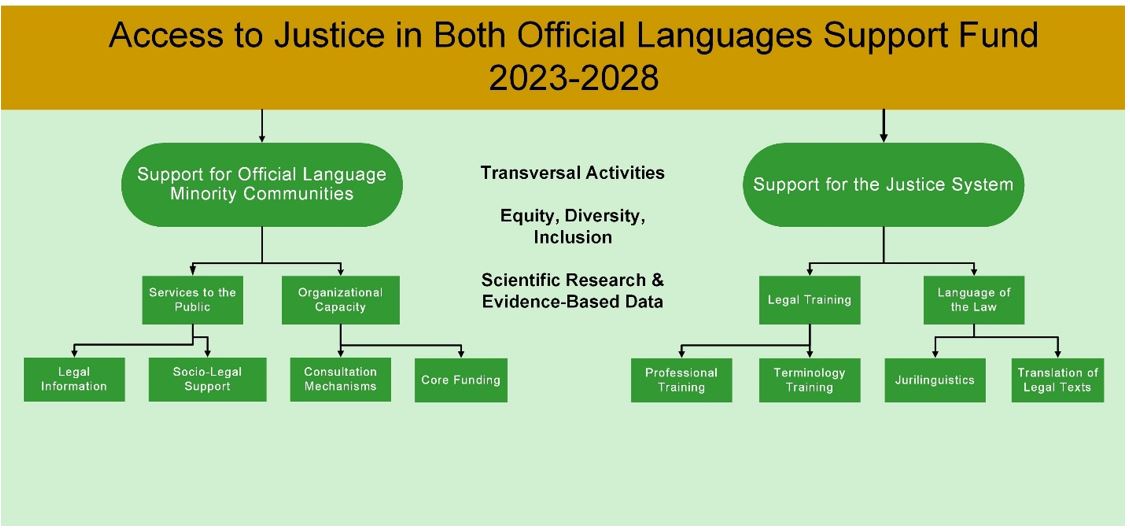
This chart provides an overview of Justice Canada’s Access to Justice in Both Official Languages Support Fund’s strategic vision for 2023-2028. It is arranged as follows:
Support for Official Language Minority Communities
- Services to the Public
- Legal Information
- Socio-Legal Support
- Organizational Capacity
- Consultation Mechanisms
- Core Funding
Support for the Justice System
- Legal Training
- Professional Training
- Terminology Training
- Language of the Law
- Jurilinguistics
- Translation of Legal Texts
Transversal Activities
- Equity, Diversity, Inclusion
- Scientific Research and Evidence-Based Data
Support for OLMCs—Spotlight on Socio-legal Support
This first priority aims to enhance the vitality of communities by focusing on activities related to delivering services to the public. This priority involves the community as a key link between litigants and Justice Canada.
The basic premise of access to justice in both official languages is that individuals should have access, in their own language, to information about their rights and obligations. The Support Fund’s partners have a wealth of experience in sharing legal information with members of the community. This priority underpins the Support Fund’s commitment to French-speaking and English-speaking litigants.
New for 2023–2028 is the introduction of socio-legal support (SLS) to its range of services. SLS involves recognizing that various categories of people can receive legal information specially adapted to their situation. This is especially true for the most marginalized or vulnerable members of our communities. To assert their rights and navigate the justice system, these people must have access to support that does more than merely provide factual information on their rights and obligations. The Support Fund will provide funding for projects designed to achieve these aims.
Support for the Justice System
This second priority aims to strengthen the bilingual capacity of the justice system through legal training and the promotion of the language of law.
Legal training includes terminology training as well as professional training for stakeholders of the justice system. These stakeholders include lawyers and other professionals such as court registrars, legal translators, court interpreters, probation officers and provincially appointed judges.
The shortage of professionals able to work in a minority official language is being felt across the country. Among these professionals, there is a marked shortage of court interpreters and legal translators. Justice Canada will work with post-secondary institutions and the provinces and territories to address this shortage.
Lastly, the final component of support for the justice system concerns the language of law. Its goal is to promote the language industry to foster growth in the areas of jurilinguistics and the translation of decisions and other legal texts. Note that the translation of decisions is supplementary to the responsibilities of the provinces and territories in this area, and that the decisions translated are those that have been identified as having a high jurisprudential value.
It is also noteworthy that Canadian jurilinguistic centres have been working in the background for a long time with their pioneering work in legal terminology. Consistent legal terminology in English and French is essential to providing justice in both official languages. Justice Canada has been a proud partner of the centres since 2003, as evidenced by the existence of the Support Fund, and it continues to believe that developing the language of the law requires adequate funding for the centres’ work and fair recognition of their contribution to access to justice in both official languages (see the next article, “How the Access to Justice in Both Official Languages Support Fund Is Supporting the Translation of Decisions”).
The priorities for 2023–2028 also reflect the changing values of Canadian society and best practices in public policy. OLMCs have obviously changed since the creation of the Support Fund in 2003. As a result, projects that focus on the benefits of promoting diversity and inclusion will be encouraged.
Lastly, the Department is also leveraging an increase in scientific research and, in the same vein, is inviting Support Fund recipients to compile and share evidence-based data on their work. These will enable decision makers to make public policy decisions based on objective data.
The Department is inviting OLMC organizations to apply for funding.Footnote 1 Applications are being evaluated on an ongoing basis. Examples of funded projects that align with the priorities for 2023–2028 will be featured in future issues of the Newsletter. Stay tuned!
How the Access to Justice in Both Official Languages Support Fund Is Supporting the Translation of Decisions
The Department of Justice Canada added a legal translation component to the Support Fund in 2018. This component, which focuses on the translation of decisions of national interest from provincial and territorial appellate and superior courts,Footnote 2 responds to a need long expressed by members of the OLMC legal community, which has had to deal with a lack of decisions drafted in the minority official language of their province or territory.
Since the creation of this component in 2018, 125 decisions have been translated each year thanks to funding from the Support Fund. These judgments, translated by partners such as the Société québécoise d’information juridique, the Centre de traduction et de terminologie juridiques and the Centre de traduction et de documentation juridiques, are available on their websites, as well as on the websites of CanLII and Jurisource. Unilingual court decisions selected for translation come from both Quebec (French-English translation) and the other provinces and territories (English-French translation). Decisions relate mainly to family law and criminal law.
In addition to reducing barriers to access to justice for OLMCs, the translation of precedent-setting decisions from provincial and territorial appellate and superior courts serves to make Canadian case law more consistent by making these decisions available to everyone, regardless of language.
As part of Action Plan for Official 2023–2028: Protection-Promotion-Collaboration, the legal translation component of the Support Fund has been enhanced to include the translation of legal texts and other educational resources, such as rules of courts and practice directions. This component is now one of the strategic activities to promote the language of law, which falls under the Support Fund’s priority of support for the justice system (see the previous article, “New Priorities of the Access to Justice in Both Official Languages Support Fund for 2023–2028”).
Minority Official Language Education Rights: the Supreme Court of Canada Rules in Favour of the Commission scolaire francophone des Territoires du Nord-Ouest

The Supreme Court of Canada, Ottawa, Ontario.
On December 8, 2023, the Supreme Court of Canada (SCC) rendered its decision (2023 SCC 31) in the case involving the Commission scolaire francophone des Territoires du Nord-Ouest (CSFTNO) and the Minister of Education of the Northwest Territories (the Minister).
Legal issue
This case involved the interpretation of section 23 of the Canadian Charter of Rights and Freedoms (the Charter), which deals with the constitutional right to education in a public school in the minority official language of a province or territory. The SCC had to determine how the Minister should exercise her discretion to decide which “non-rights holder” children (children who do not have the constitutional right to attend a minority-language school according to the criteria set out in s. 23 of the Charter) should be allowed to attend a French-language public school in the Northwest Territories (NWT).
Background and Judicial History
Parents living in the NWT wanted their children to be educated in a French public school, even though neither they nor their children were “rights holders” under section 23 of the Charter and did not qualify under a directive issued by the Government of the NWT. The parents asked the Minister to exercise her discretion and admit the children, but she refused. The CSFTNO and the parents applied to the Supreme Court of the NWT for judicial review of this decision, and they won. The decision was appealed. The Court of Appeal for the NWT allowed the appeal and restored the Minister’s decision. The case was brought before the SCC, which reversed the decision of the Court of Appeal for the NWT and set aside its orders.
Decision and Reasons for Decision
Following the approach prescribed in Doré v. Barreau du Québec (2012 SCC 12), the SCC concluded that the Minister’s decision was unreasonable. In making her decision, the Minister had to take into account the values enshrined in section 23 of the Charter in the exercise of her discretionary power. However, section 23 of the Charter is at once preventive, remedial and unifying. The Minister had to consider the fact that admitting children of non–rights holder parents could have an impact on the preservation and vitality of the OLMC. In this case, the Minister did not give proportionate consideration to the values of section 23 of the Charter and the interests of the government. A number of factors showed that admitting the children in question would be beneficial to the vitality of the OLMC, including the support provided by the CSFTNO to the parents, the fact that each child had a strong knowledge of French and significant ties with the OLMC, and the parents’ commitment to learning the language.
The SCC allowed the appeal and set aside the orders of the Court of Appeal for the NWT, with costs. Since the children of the appellants had since been admitted to a Franco-ténoise minority school or had moved away, there was no need to restore the decision of the Supreme Court of the NWT.
Did You Know?
Departmental Network of Coordinators Responsible for the Implementation of Section 41 of the Official Languages Act
The Official Languages Directorate (OLAD) of Justice Canada coordinates the activities of the Departmental Network of Coordinators Responsible for the Implementation of Section 41 (Network 41). Established under section 41 of the OLA, Network 41 is one of the pillars of the implementation of this section within the Department of Justice Canada. Managed by the Justice in Official Languages (JOL) team, Network 41 is made up of program and policy coordinators and regional coordinators who form an internal resource group at Justice Canada. Network 41 ensures liaison between the Department of Justice and OLMC organizations across Canada to help implement section 41 of the OLA. Network 41 enables the exchange of information on departmental issues affecting the vitality of these communities and the promotion of English and French in Canadian society. It contributes to departmental leadership in official languages by fostering personalized contact with OLMCs at the regional level.
In the course of their work, members of Network 41 establish ties with OLMCs, and share their priorities. Network 41 coordinators are available to inform OLMC members about the programs and services provided by Justice Canada.
Program and Policy Coordinators
Program and policy coordinators are in charge of coordinating the implementation of section 41 of the OLA within their respective initiatives. Their role as coordinators is, among other things, to ensure liaison with OLMCs across Canada, in collaboration with the regional coordinators, and to establish ties with other program and policy coordinators.
Representatives of the following initiatives and programs and policies make up Network 41:
- Access to Justice in Both Official Languages Support Fund
- Victims Fund
- Canadian Family Justice Fund
- Contraventions Act Fund
- Youth Justice Fund
- Justice Partnership and Innovation Program
- Communications Branch
- Criminal Law Policy Section
- Evaluation Division
- Family Law and Youth Justice Policy Section
- Legal Aid Directorate
- Policy Centre for Victim Issues
Regional Coordinators
Regional coordinators are Justice Canada employees, part of whose duties is to see that section 41 of the OLA is implemented in the department’s regional offices. Regional coordinators work in close collaboration with the JOL team, the Department’s program and policy coordinators, as well as their counterparts in the other departments in their respective regions. They must also establish ties with community organizations. As regional coordinators, they participate mainly in raising awareness, in interdepartmental networks in their regions and in events organized by community organizations, such as the annual general meetings of the Associations de juristes d’expression française (AJEF).
Review on Official Languages
Each year, the coordinators participate in the preparation of Justice Canada’s Review on Official Languages. All federal institutions must participate in this exercise. The information collected through this process is provided to the Treasury Board Secretariat’s Official Languages Centre of Excellence (OLCE) and Canadian Heritage and is then used to prepare the Annual Report on Official Languages, the Best Practices Digests for Part VII and various other tools to support federal institutions with the implementation of Part VII of the OLA.
To contact the coordinators of Justice Canada’s Network 41, go to Official Languages Act (OLA) Network 41 (justice.gc.ca).
Key Appointments
French-speaking Legal Leaders Appointed to the Supreme Court of Canada and the Senate of Canada
The year 2023 was marked by key appointments for the French-speaking legal community. These include the appointment of two founders of French-speaking jurists’ associations to key positions.
The Honourable Mary T. Moreau, Co-founder of the Association des juristes d’expression française de l’Alberta (AJEFA), was appointed to the Supreme Court of Canada on November 6, 2023
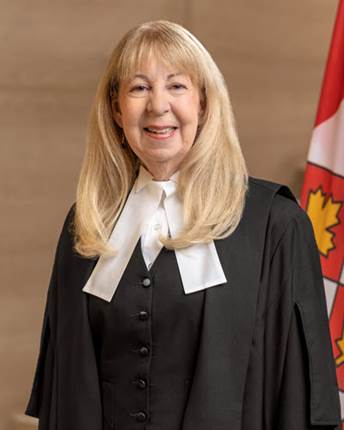
The Honourable Mary T. Moreau, Co-founder of the Association des juristes d’expression française de l’Alberta (AJEFA) standing before the Alberta flag.
Born in Edmonton, Alberta, Justice Moreau completed her Bachelor of Laws at the University of Alberta in 1979, after taking part in the common law / civil law exchange program at the Université de Sherbrooke in 1977. She was called to the Law Society of Alberta in 1980 and appointed a judge of the Court of King’s Bench of Alberta in 1994. She was also appointed a deputy judge of the Supreme Court of Yukon in 1996 and of the Supreme Court of the Northwest Territories in 2005. In 2017, she was appointed Chief Justice of the Court of King’s Bench of Alberta.
Throughout her career, the Franco-Albertan judge has been very active in the area of access to justice in both official languages. As a lawyer, she litigated several landmark cases involving minority language rights and the Canadian Charter of Rights and Freedoms. She notably co-founded the AJEFA in 1990. As Chief Justice of the Court of King’s Bench of Alberta, she made a significant contribution to promoting the use of the French language in the administration of justice.
In 1999, she was the recipient of the Prix Jean-Louis-Lebel, an award presented periodically by the AJEFA to a jurist who has demonstrated exceptional dedication to the advancement of the Francophonie in Alberta. She also received an honorary Doctor of Laws degree from the University of Alberta in 2019 and, in November 2023, she received the Lifetime Achievement Award from Women in Law Leadership.
To learn more about Justice Moreau, see Supreme Court of Canada - Biography - Mary T. Moreau.
Réjean Aucoin, Founder of the Association des juristes d’expression française de la Nouvelle-Écosse (AJEFNE), was appointed to the Senate of Canada on October 31, 2023

A headshot of Réjean Aucoin, Founder of the Association des juristes d’expression française de la Nouvelle-Écosse (AJEFNE).
A native of Chéticamp, Mr. Aucoin is known as a strong defender of language rights by the Acadian community in Nova Scotia. He holds a Bachelor of Social Work and a Bachelor of Laws from the Université de Moncton. After more than 30 years as a lawyer, he was appointed King’s Counsel in 2014. Prior to practising law, Mr. Aucoin worked as a journalist, radio producer, writer and community development officer. He also served as a part-time member of the Parole Board of Canada. He founded the AJEFNE in 1994.
His work and his community engagement have won him numerous distinctions, including the Community Development Award from the Nova Scotia Branch of the Canadian Bar Association and the 2017 Lawyer of the year Award of the AJEFNE. This award is presented by the AJEFNE to an individual who has helped promote access to legal services in French for the Acadian, Francophone and Francophile population of Nova Scotia.
To learn more about Senator Aucoin, see Senator Réjean Aucoin (sencanada.ca).
The JOL team would like to congratulate Judge Moreau and Senator Aucoin on their appointments.
Advisory Committee on Access to Justice in Both Official Languages
The annual meeting of the Advisory Committee on Access to Justice in Both Official Languages (Advisory Committee) was held on May 29, 2024 in Canmore, Alberta. A number of key stakeholders were present.
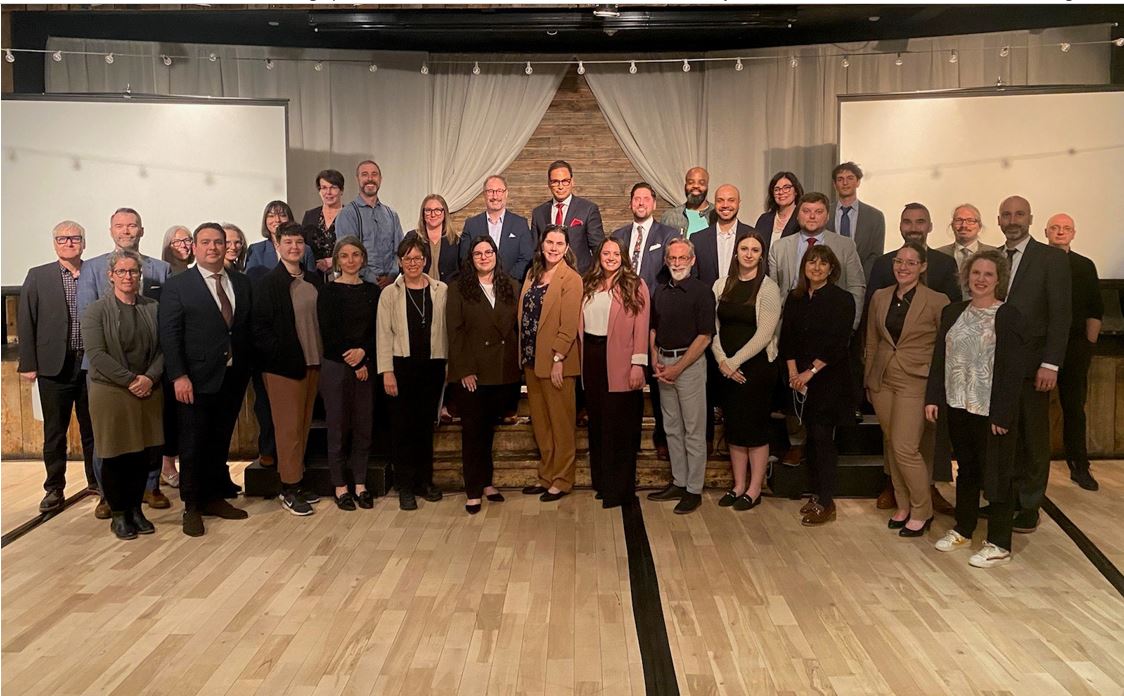
A group of 33 people who participated in the Advisory Committee on Access to Justice in Both Official Languages standing together in a conference room at their annual meeting in Canmore, Alberta.
To find out more about the Advisory Committee, see Advisory Committee on Access to Justice in Both Official Languages.
Announcements
Retirement of Robert Doyle
The JOL team would like to acknowledge Robert Doyle’s retirement and, above all, his invaluable contribution to access to justice in both official languages in Canada over the past two decades.
Mr. Doyle was senior counsel in the Ottawa office of the Public Prosecution Service of Canada (PPSC). He began his public service career as a federal Crown prosecutor in 1999 with the PPSC’s precursor, the Federal Prosecution Service.
Among other key roles, he was the national coordinator of the Federal-Provincial-Territorial Heads of Prosecutions Committee and, for several years, the PPSC’s official languages co-champion. Mr. Doyle also served as a member of the Federal-Provincial-Territorial Working Group on Access to Justice in Both Official Languages for more than 17 years. His enthusiasm and active participation in this Working Group are certainly worthy of mention.
Mr. Doyle is a specialist in legal issues relating to language rights in criminal and penal matters, and a leader in the advancement and implementation of these rights across Canada. He leaves behind an inspiring legacy and a solid foundation. On June 1, 2024, the Association des juristes d’expression française de l’Ontario awarded him the 2024 Order of Merit in recognition of his major contribution to access to justice in French in Ontario.
Mr. Doyle, we would like to extend our heartfelt thanks to you and wish you a wonderful, enjoyable retirement!
New Policy on Francophone Immigration
On January 16, 2024, the Minister of Immigration, Refugees and Citizenship Canada unveiled the brand new Policy on Francophone Immigration, in accordance with the modernized OLA. It aims to enhance the vitality and long-term prosperity of Francophone and Acadian minority communities, and to define a path towards restoring and increasing their demographic weight within the framework of a fair, equitable and non-discriminatory immigration system.
To find out more, see Policy on Francophone Immigration: Policy on Francophone Immigration
If you do not receive the Newsletter electronically, add your email address to our distribution list and become a subscriber!
Justice in Official Languages
Official Languages Directorate
Public Law and Legislative Services Sector
Department of Justice Canada
- Date modified: