
Introduction
1. Background
In 2021, the Canadian Legal Problems Survey (CLPS) was conducted to delve into the profound legal challenges individuals face in their daily lives, exploring their approaches to resolution and the resulting impacts on their lives. Spearheaded by Statistics Canada on behalf of Justice Canada and other federal departments, the CLPS represents the latest installment in a series of legal-needs surveys conducted in Canada.
To complement the quantitative data gathered through the CLPS, a comprehensive qualitative dimension was introduced. This involved engaging community-based researchers to conduct a series of qualitative studies, strategically exploring and documenting the experiences of specific populations across Canada grappling with serious legal problems.
This research study, conducted between March and December 2023, presents a nuanced and in-depth qualitative examination of the legal challenges faced by Ontario’s older population over the last three to five years. It is crucial to recognize that some participants reported repercussions from serious problems that had occurred prior to this time frame that continue to negatively impact their lives. It sheds light on the unique experiences of seniors and illuminates the strategies they employed to navigate these issues. This report aims to contribute valuable insights to a comprehensive understanding of seniors’ unmet legal needs, assisting government agencies and other service providers in developing tailored policies to address the identified needs of seniors.
2. Research Methods
Throughout the summer and fall of 2023, we conducted a total of 26 individual interviews with older adults and facilitated four focus groups – comprising one group with older adults and three with seniors’ advocates.
To enlist participants, we disseminated a call for participation through various channels across Ontario. We recruited older adults through well-established networks, including ACE’s direct membership, Ontario’s community legal-clinic system, community-based organizations serving seniors, and seniors’ housing organizations. Our community partners played a crucial role in disseminating recruitment information. The majority of our recruitment efforts leveraged social media, direct emails, and a dedicated page on www.acelaw.ca. The recruitment information clearly stated that translation and interpretation would be provided during the interview if requested.
The recruitment process presented unexpected challenges, likely attributable to the timing of the initial call for participation during the 2023 summer months, the English-only availability of the recruitment materials, and the lingering apprehension to attend public settings among seniors due to the ongoing COVID-19 pandemic. Some prospective participants did not respond to scheduling requests, while others failed to attend scheduled interviews. Our recruitment outreach continued throughout the April to December 2023 study period, with the final recruitment drive in December proving highly successful, resulting in the majority of interviews being conducted during that time.
Participants were given the flexibility to choose interviews in-person, or by phone or Zoom, thereby fostering inclusivity and providing a comprehensive understanding of diverse communities. Most interviews involved two interviewers and all were conducted exclusively in English. Recordings of interviews were made with the participants’ consent. These recordings were transcribed and facilitated post-interview verification of key details and quotes for use in this report.
Eligibility criteria for the study consisted of Ontario residency, age 55 years or older, experience with at least one serious legal problem in the past three to five years, and the ability to conduct the interview in English or with an interpreter.
Among the 26 interviews, one participant was excluded due to age verification challenges and conflicting responses on the eligibility criteria, resulting in the inclusion of 25 individual interviews and four focus groups in our research.
Participants received written consent forms and the interview questions beforehand. Consent was obtained in written or oral form prior to the interviews.
The semi-structured interviews followed the interview guide (see Appendix), exploring various aspects of serious legal problems, resolution strategies, current statuses, and the subsequent economic, social, and health consequences. While most participants freely shared their stories, others required gentle guidance back to the structured questions to ensure coverage of key points and clarity on details, considering variations in recall.
Demographic questions were posed at the conclusion of each interview.
Individual interviews averaged an hour, while focus groups extended to approximately two hours. Compensation, typically an honorarium, was provided to all participants, with one exception requesting a grocery card to avoid a corresponding reduction of social assistance payments.
The transcribed interview audio recordings were redacted and cleansed of any identifying information before they were systematically coded to extract main study themes and key insights.
3. Participants’ Demographic Profiles
Participants’ Demographic Profiles
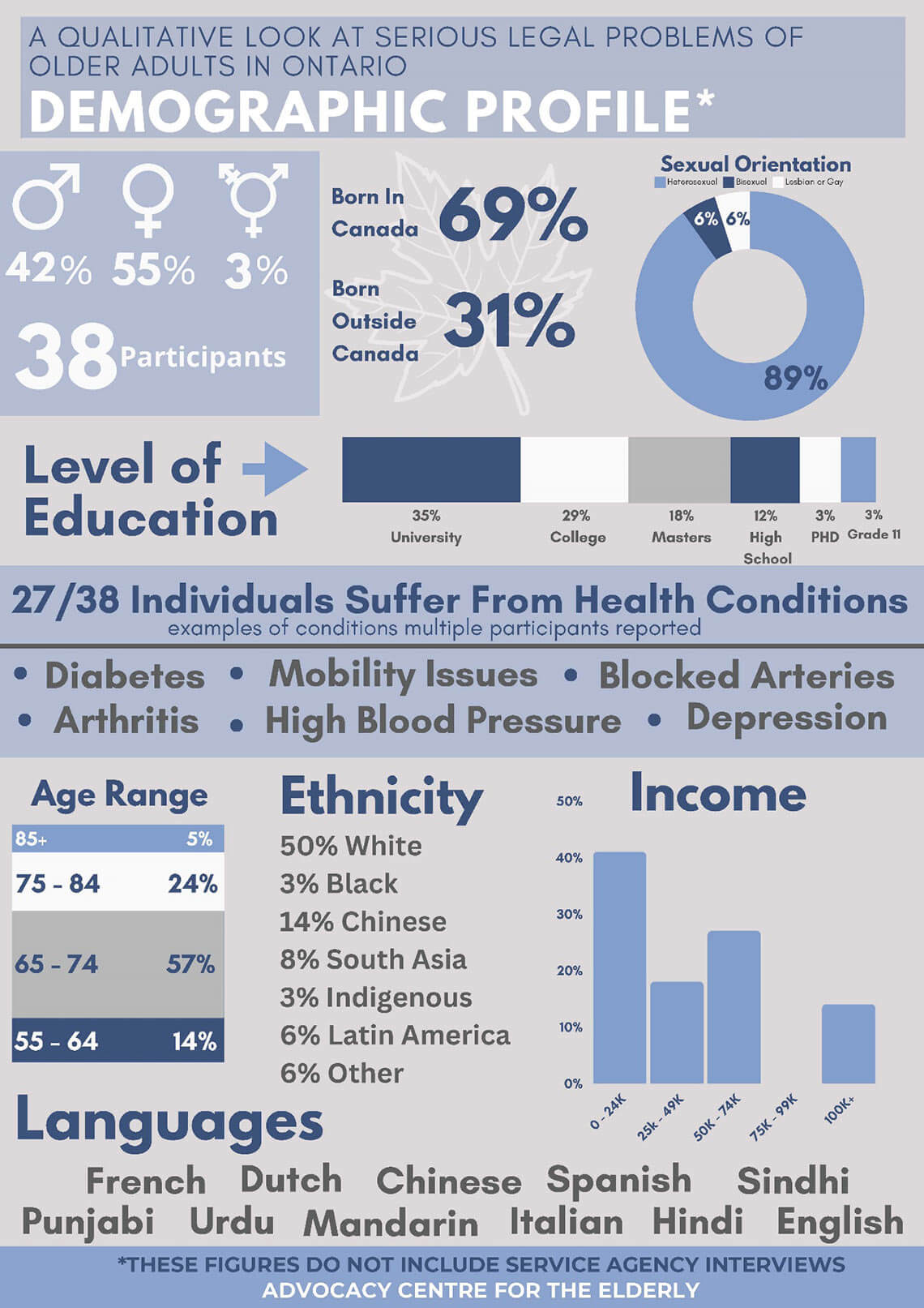
Text version
This image outlines the demographics of the participants in the Qualitative Look at Serious Legal Problems of Older Adults in Ontario study. The information here is a high level visual summary of these demographics of the 38 participants, 42% identified as male, 55% as female and 3% as other.
69% of participants were born in Canada and 31% were born outside of Canada.
89% indicated their sexual orientation as heterosexual, 6% as bisexual and 6% as lesbian or gay.
Participants indicated their level of education as follows: 35% University, 29% College, 18% Masters, 12% High School, 3% PHd and 3% Grade 11.
27 of the 38 individuals suffer from health conditions. Examples of conditions multiple participants reported included diabetes, arthritis, mobility issues, high blood pressure, blocked arteries and depression.
5% of participants were 85 years of age or older, 24% were between 75 and 84 years of age, 57% were between 65 and 74 years of age and finally 14% were between 55 and 64 years of age.
Ethnicities of participants included: 50% White, 5% Black, 14% Chinese, 8% South Asia, 3% Indigenous, 6% Latin American and 6% Other.
33% of participants indicated they made $24 thousand in annual income or less, 13% indicated between $25 and $49 thousand, 30% indicated between $50 and $74 thousand, 4% indicated an between $75 and $99 thousand and finally, 20% indicated an annual income of over $100 thousand.
The languages spoken by participants included French, Dutch, Chinese, Spanish, Sindhi, Punjabi, Urdu, Manderin, Italian, Hindi and English.
Note: These figures do not include service agency interviews.
4. List of Acronyms
- CERB
- Canada Emergency Response Benefit
- CPP
- Canada Pension Plan
- CPP-D
- Canada Pension Plan – Disability
- CBSA
- Canadian Border Services Agency
- CLPS
- Canadian Legal Problems Survey
- CRA
- Canadian Revenue Agency
- CLEO
- Community Legal Education Ontario
- HSARB
- Health Services Appeal and Review Board
- HVAC
- Heating, Ventilation and Air Conditioning
- HCCSS
- Home and Community Care Support Services
- IFHP
- Interim Federal Health Program
- LTB
- Landlord and Tenant Board
- LSO
- Law Society of Ontario
- LTC
- Long-Term Care
- MAiD
- Medical Assistance in Dying
- MP
- Member of Parliament
- MPP
- Member of Provincial Parliament
- OAS
- Old Age Security
- OFL
- Ontario Federation of Labour
- OHIP
- Ontario Health Insurance Program
- ODSP
- Ontario Disability Support Program
- OHRT
- Ontario Human Rights Tribunal
- PSW
- Personal Support Workers
- PTSD
- Post-Traumatic Stress Disorder
- RECO
- Real Estate Council of Ontario
- RGI
- Rent Geared to Income
- RHRA
- Retirement Homes Regulatory Authority
- RTA
- Residential Tenancies Act
- WSIB
- Workplace Safety and Insurance Board
- Date modified: