
4. Overview of Resources
1. Introduction
In order to make expenditures, the government must receive Parliament’s approval, either through previously adopted legislation or, on an annual basis, through the introduction and passage of appropriation bills. Prior to the introduction of each appropriation bill, the President of the Treasury Board tables an Estimates publication (Main or Supplementary) before Parliament to provide information and details on spending authorities sought. The Estimates consist of three parts.
Part I of the Estimates process is the Government Expenditure Plan.Footnote 3 It provides a summary and highlights of year-over-year changes in departmental spending and transfer payments in order to provide perspective on the major issues influencing government planned spending.
Part II of the Estimates process is the Main Estimates, known traditionally as the “Blue Book”. It directly supports the appropriation acts for the Main Estimates. The publication provides a listing of the resources required by individual departments and agencies for the upcoming fiscal year in order to deliver the programs for which they are responsible. It identifies the spending authorities (votes) and the amounts to be included in subsequent appropriation bills that Parliament will be asked to approve to enable the government to proceed with its spending plans.
Part III of the Estimates process is the Departmental Expenditure Plans, which consist of two documents: Departmental Plans (DP) and Departmental Results Reports (DRR).
- DPs are expenditure plans for each appropriated department and agency (excluding Crown corporations). They describe departmental priorities, strategic outcomes, programs, expected results and associated resource requirements, covering a three-year period beginning with the year indicated in the title of the report.
- DRRs are individual department and agency accounts of actual performance, for the most recently completed fiscal year, against the plans, priorities and expected results set out in their respective DPs. DRRs inform parliamentarians and Canadians of the results achieved by government organizations for Canadians.
- DPs and DRRs are tabled before Parliament by the President of the Treasury Board and are referred to parliamentary committees to be studied.
2. 2025-26 Financial Resources
The Department of Justice Canada’s total estimated spending authority for 2025-26 is based on Main Estimates 2025-26 and amounts to $1,697.1 million. Of that, $1,170.1 million was received through the Voted and Statutory Authority and $527.0 million in Vote-Netted Revenue to allow the Department to collect revenue from other government departments and agencies for all types of legal services delivered, including advisory, litigation, and legislative/regulatory drafting.
2.1. Justice Estimated Spending by Vote
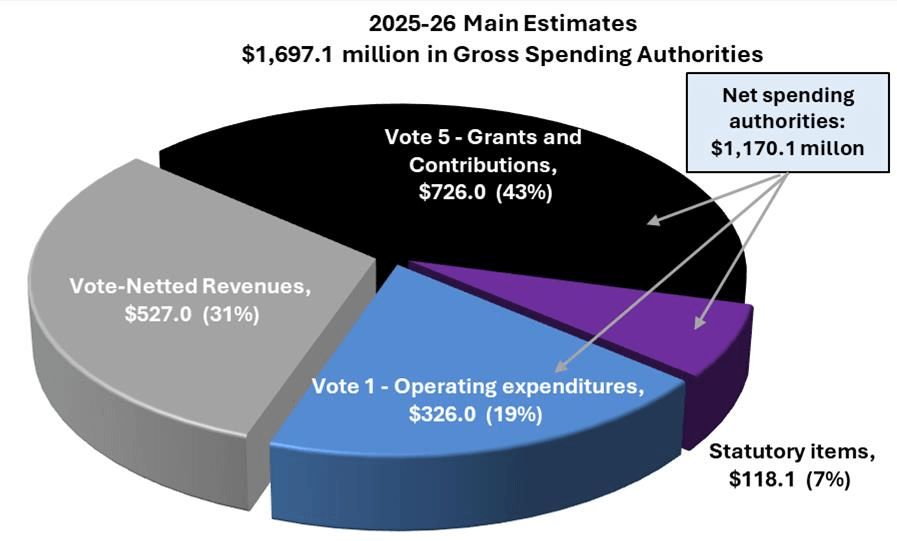
2025-26 Main Estimates: $1,697.1 million in Gross Spending Authorities – Text version
2025-26 Main Estimates: $1,697.1 million in Gross Spending Authorities
The pie chart shows the Department’s total spending authorities in millions of dollars, based on the 2025-26 Main Estimates.
Total gross spending authorities are $1,697.1 million. This includes Vote-Netted Revenues of $527.0 million (31% of the chart) and $1,170.1 million of the following budgetary authorities: Vote 5 – Grants and Contributions of $726.0 million (43% of the chart), Vote 1 – Operating expenditures of $326.0 million (19% of the chart), and Statutory items of $118.1 million (7% of the chart).
2.2. Operating Resources (Vote 1)
Operating resources in the amount of $326.0 million, supplemented by revenues of $527.0 million, account for approximately 50 percent of the Department’s total estimated spending authority. These resources pay for salaries and other operating costs such as training, travel, service contracts, maintenance, and supplies.
2.3. Grants and Contributions (Vote 5)
Grants and contributions account for $726.0 million, 43 percent of the overall spending authority. Contribution programs related to Youth Justice and Legal Aid account for approximately 71 percent of the total grants and contributions. Grants and Contributions are funding that is transferred to provincial and territorial governments, Indigenous organizations, as well as non-governmental organizations and private recipients.
2.4. Statutory Resources
Statutory resources amount to $118.1 million, most of which are for the Employee Benefit Plan.
3. Justice Estimated Vote 5 (Grants and Contributions) Spending by Programs
The Department of Justice provides funding to community organizations and other levels of government that are working to support its mandate, mission and values. The Department’s funding programs are designed to support Indigenous communities, victims of crime, people with low incomes, families, and young people. The Department also supports projects that help Canadians understand the law and access the justice system in both official languages.
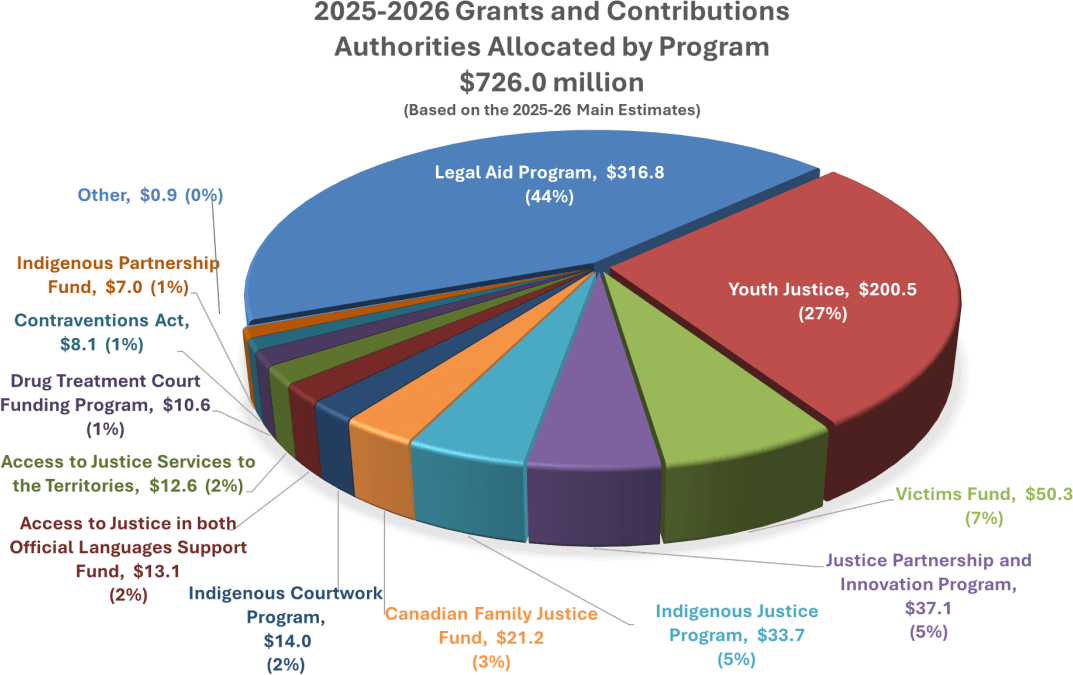
2025-2026 Grants and Contributions Authorities Allocated by Program $726.0 million (Based on the 2025-26 Main Estimates) – Text version
2025-2026 Grants and Contributions Authorities Allocated by Program $726.0 million (Based on the 2025-26 Main Estimates)
The pie chart shows the Department’s Grants and Contributions authorities for 2025-26 in millions of dollars, based on the 2025-26 Main Estimates.
Total Grants and Contributions of $726.0 million are distributed by program as follows:
- Legal Aid Program ($316.8 million or 44% of the chart);
- Youth Justice ($200.5 million or 27% of the chart);
- Victims Fund ($50.3 million or 7% of the chart);
- Justice Partnership and Innovation Program ($37.1 million or 5% of the chart);
- Indigenous Justice Program ($33.7 million or 5% of the chart);
- Canadian Family Justice Fund ($21.2 million or 3% of the chart);
- Indigenous Courtwork Program ($14.0 million or 2% of the chart);
- Access to Justice in both Official Languages Support Fund ($13.1 million or 2% of the chart);
- Access to Justice Services to the Territories ($12.6 million or 2% of the chart);
- Drug Treatment Court Funding Program ($10.6 million or 1% of the chart);
- Contraventions Act ($8.1 million or 1% of the chart);
- Indigenous Partnership Fund ($7.0 million or 1% of the chart); and,
- Other ($0.9 million or 0% of the chart).
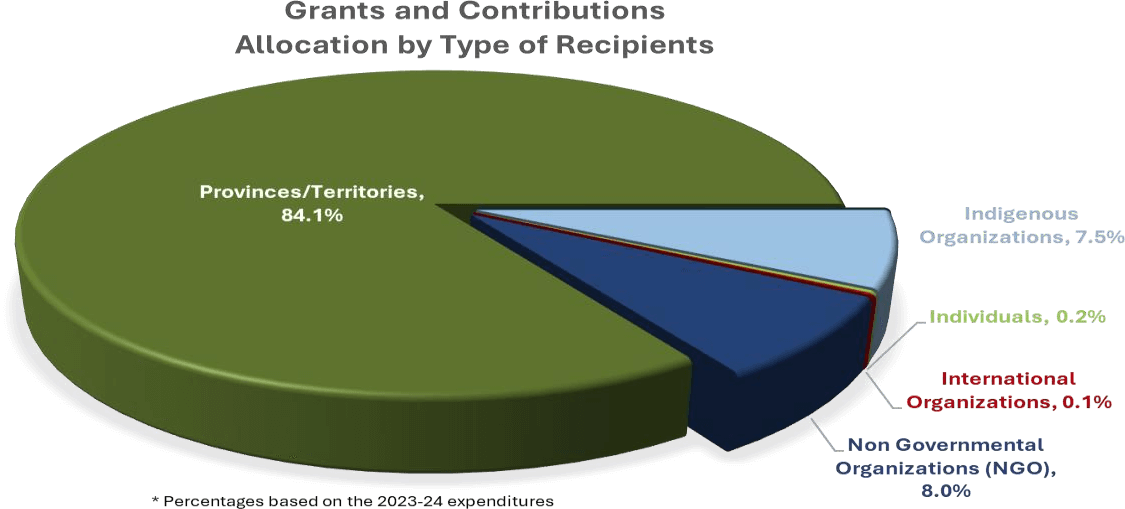
Grants and Contributions Allocation by Type of Recipients – Text version
Grants and Contributions Allocation by Type of Recipients
The pie chart shows the Department’s Grants and Contributions spending by type of recipient as a percentage of 2023-24 expenditures.
Provinces/Territories represent 84.1% of the chart, Non-Governmental Organizations (NGO) represent 8.0% of the chart, Indigenous Organizations represent 7.5% of the chart, Individuals represent 0.2% of the chart, and International Organizations represent 0.1% of the chart.
3.1. Legal Aid Program ($316.8 million)
The Legal Aid Program consists of five components and delivers funding through contribution agreements. The five components are described below.
a. Criminal Legal Aid ($222.3 million)
Criminal legal aid funding provides access to legal services for economically disadvantaged persons in Canada. It promotes access to justice and helps to ensure that the Canadian justice system is fair, efficient and accessible.
Responsibility for the provision of criminal justice is divided between the federal government, under its constitutional authority for criminal law and procedure, and the provincial governments, under their authority for the administration of justice and for property and civil rights. While provinces and territories are responsible for the delivery of legal aid services, the Department provides contribution funding towards the cost of adult and youth criminal legal aid services in the provinces, and criminal and civil legal aid services in the territories. Canada’s contribution covers about one-third of total national costs.
The annual federal criminal legal aid base funding to the provinces is $136.8 million on an ongoing basis. To assist jurisdictions in the delivery of criminal legal aid services, Budget 2024 provided additional funding of $440.0 million over five years starting in 2024-25, increasing total funding to the provinces in 2025-26 to $222.3 million. The legal aid funding to the territories is captured under the Access to Justice Services Agreements.
b. Immigration and Refugee Legal Aid ($83.1 million)
Immigration and refugee legal aid funding is provided to the eight jurisdictions that deliver such services: British Columbia, Alberta, Manitoba, Quebec, Ontario, New Brunswick, Nova Scotia, and Newfoundland and Labrador.
Immigration and refugee legal aid supports fair, effective, and efficient decision-making on asylum and certain immigration claims by helping individuals present the relevant facts of their case in a clear and intelligible manner. Further, ensuring claimants feel that they have experienced a fair process helps to decrease the number of costly appeals, both at the Immigration and Refugee Board, and at the Federal Court, which in turn contributes to the fairness and efficiency of the asylum system.
Since 2015-16, immigration and refugee legal aid funding has been increased each year in an effort to address increased demand. Since 2019-20, the federal government has provided up to $55 million annually and $83.1 million in 2023-24 in an attempt to cover 100 percent of anticipated costs. Budget 2024 announced an additional $273.7 million over five years starting in 2024-25 and $43.5 million ongoing, increasing funding in 2025-26 to $83.1 million, and raising ongoing funding to $55 million annually, beginning in 2026-27.
c. Legal Advice for Complainants of Workplace Sexual Harassment ($5.0 million)
The Legal Advice for Complainants of Workplace Sexual Harassment component of the Legal Aid Program supports projects that provide legal information, advice, and ancillary services to persons who have experienced sexual harassment in the workplace, regardless of their economic status. Funding was available from 2019-20 to 2023-24 and Budget 2024 renewed funding over three years starting in 2024-25.
d. State-Funded Counsel ($3.4 million)
The State-Funded Counsel component of the Legal Aid Program supports proceedings involving national security issues, including terrorism-related cases, and proceedings where the Federal Crown has been ordered to fund counsel by a court. This includes orders for defence counsel granted in serious federal cases where counsel is necessary to ensure a fair trial and where the accused lacks the resources to pay for counsel and is ineligible for criminal legal aid, and orders for amicus curiae.
e. Impact of Race and Culture Assessments ($3.0 million)
The Legal Aid Program’s Impact of Race and Culture Assessments (IRCAs) initiative addresses the over-representation of Black and other racialized individuals in the criminal justice system by providing reports to help justice professionals better understand how poverty, marginalization, racism, and social exclusion have contributed to an individual’s contact with the criminal justice system. The Department contributes to the cost of preparing IRCA reports in seven jurisdictions (Nova Scotia, Ontario, British Columbia, Manitoba, Newfoundland and Labrador, New Brunswick and Yukon). The program also funds organizations to train IRCA assessors and to provide continuing professional development courses to justice system professionals.
3.2. Youth Justice ($200.5 million)
The Department supports three youth justice funding programs.
a. Youth Justice Services Funding Program ($185.0 million)
The Youth Justice Services Funding Program is a cost-shared contribution program with all provinces and territories for the delivery of youth justice services. The objective of the Program is to support the policy directions of the Youth Criminal Justice Act. Priority funding areas include diversion/extrajudicial measures and extrajudicial sanctions programs; rehabilitative and reintegration services; judicial interim release programs; reports and assessments; intensive support and supervision and attendance programs; and conferencing and other community-based sanctions.
b. Intensive Rehabilitative Custody and Supervision Program ($11.0 million)
The Intensive Rehabilitative Custody and Supervision Program provides funding to provinces and territories to ensure they have the capacity to assess and provide specialized therapeutic treatment to young persons with mental health issues who have committed serious violent offences and are sentenced to an intensive rehabilitative custody and supervision order as per paragraph 42(2)(r) and subsection 42(7) of the Youth Criminal Justice Act. When resources permit, the Program also supports provinces and territories in providing treatment to young persons with mental health issues who have committed violent offences but were not sentenced under the aforementioned provisions.
c. Youth Justice Fund ($4.5 million)
The Youth Justice Fund is a discretionary demand-driven grants and contributions program that supports projects that encourage a more effective youth justice system, respond to emerging youth justice issues, and enable greater citizen and community participation in the youth justice system. The Fund supports the development, implementation, and evaluation of pilot projects that provide programming and services for youth in conflict with the law. It supports professional development activities, such as training and conferences, for justice professionals and youth service providers. Additionally, it funds research on the youth justice system and related youth justice issues. Community organizations, Indigenous organizations, educational institutions, other levels of government, and individuals are all eligible for funding.
3.3. Victims Fund ($50.3 million)
The Victims Fund provides grants and contributions funding to victims of crime, provinces, territories, and non-governmental organizations to develop or enhance victim services and to research victim-related issues.
The Fund provides support to a wide range of organizations and types of victims. For example, the Fund supports Child Advocacy Centres, which address the needs of children, youth, and their families in cases where abuse is suspected, by providing child-friendly facilities where they can seek services, ideally under one roof. The Fund also supports provincial and territorial victims services and supports projects that help victims of various types of crime, such as human trafficking and sexual assault, among others. The Fund supports Family Information Liaison Units and community-based supports for families of missing and murdered Indigenous women or girls and supports projects related to victims and survivors of hate crimes (new in 2024-25) for which funding of $29.5 million over six years was announced in Budget 2024.
Two elements of the Fund also provide support directly to individual victims. The Victims Abroad component provides financial assistance to Canadians who are victims of serious violent crime abroad and who do not have other means. The Parole component provides financial assistance to federally registered victims who wish to attend the parole hearings of their offenders.
3.4. Justice Partnership and Innovation Program ($37.1 million)
The Justice Partnership and Innovation Program provides resources to facilitate access to justice through various means, including the development of new approaches, the dissemination of law-related information, and the testing of pilot projects. The overall goal of the Program is to contribute to increasing access to the Canadian justice system and strengthening the Canadian legal framework. The Program’s components include the Family Violence Initiative; core funding for Public Legal Education and Information organizations; the Public Legal Education and Information – Workplace Sexual Harassment component; Community Justice Centres; Independent Legal Advice and Other Justice System Supports for Victims of Intimate Partner Violence; Legal Services and Supports for Racialized Communities; and, new in 2024-25, legal information and advice under the Tenant Protection Fund, for which funding of $15 million over five years was announced in Budget 2024.
3.5. Indigenous Justice Program ($33.7 million)
Operating since 1991, the Indigenous Justice Program (IJP) is a federally led initiative delivered in partnership with all provinces and territories aimed at addressing the overrepresentation of Indigenous people in the criminal justice system, both as offenders and as victims. Through its Community-Based Justice Fund, the IJP directly supports 214 community justice programs in roughly 650 communities across the country. Funded programs work to address root causes of crime and deliver programming that reflects the justice values, traditions, and culture of their communities. Their activities can fall at any point along the justice continuum including prevention, pre-charge diversion, post-charge diversion, post-sentence, and reintegration. Programs also deliver civil and family mediation services to prevent and address conflict among community members. In providing alternatives to mainstream justice processes, these programs use restorative and traditional Indigenous justice processes that focus on repairing harm and bringing together the victim, the offender, and the community. IJP programs work in close partnership with justice officials, including police, the Crown, and judges. Furthermore, under its Community-Based Fund, the IJP has dedicated funding for the provision of Gladue Casework/Aftercare supports for individuals who have had a Gladue Report, to enhance the capacity of Indigenous communities to provide community-based sentencing and options.
The Capacity-Building Fund supports capacity-building efforts in Indigenous communities, particularly those building increased knowledge and skills for the establishment and management of community-based justice programs.
Budget 2024 announced $41.4 million over five years and $8.3 million ongoing for the Indigenous Justice Program, to renew Budget 2021 funding for Program Integrity and Civil and Family Mediation programming. Civil and Family Mediation funding supports Indigenous communities in resolving conflicts to prevent their escalation (including those involving at-risk youth), and in providing opportunities for parents to resolve their disputes more peacefully.
The IJP is also delivering time-limited funding ending March 31, 2027, to support capacity-building and engagement throughout the development and initial implementation of the Indigenous Justice Strategy, and project funding to address the Call to Action 50 (CTA 50). Project funding for CTA 50 will support the development, use and understanding of Indigenous laws and access to justice in accordance with the unique cultures of Indigenous peoples in Canada.
3.6. Canadian Family Justice Fund ($21.2 million)
The Canadian Family Justice Fund facilitates access to the family justice system for families experiencing separation and divorce through various services, programs, and information resources. The Fund addresses the following priorities: fostering federal, provincial and territorial collaboration; supporting the well-being of family members; reaching diverse and underserved populations; supporting alternatives to court for family law matters; and improving and streamlining family justice system links/processes.
The Fund comprises two components. The Family Justice Activities component supports provincial and territorial programs and services assisting families experiencing separation and divorce. Examples include parent information programs, mediation, administrative child support recalculation, and maintenance enforcement programs. The Projects component supports provincial and territorial governments, not-for-profit organizations, associations, academic institutions, and individuals. Examples of activities include informing Canadians about family law issues and developing new strategies, models, and tools intended to improve access to family justice. The fund also includes a time-limited component that provides support for Supervised Parenting Time Services (ending March 31, 2026).
3.7. Indigenous Courtwork Program ($14.0 million)
The Department contributes funding through the Indigenous Courtwork Program (ICW) to all provinces and territories (with the exception of Newfoundland and Labrador) for the provision of Indigenous Courtwork services in justice proceedings. ICW has two funding streams:
- Stream 1: Funding is provided directly to the provinces on a 50:50 cost-shared basis, and to territories through Access to Justice Service Agreements (with no cost-sharing requirement).
- Stream 2: Funding has no cost-sharing requirement and can be provided directly to Indigenous organizations for time-limited projects that meet the mandate of the ICW.
The ICW’s objective is to ensure that Indigenous people in contact with the justice system (whether as accused persons, victims, witnesses, or family members) have access to fair, equitable, and culturally relevant treatment throughout the justice process. Indigenous Courtworkers assist offenders by ensuring that they understand the process, including their rights, as well as any responsibilities and/or direction given by the court. In addition, as “friends of the Court”, Indigenous Courtworkers provide the court with information needed for sentencing and bail purposes, and connect victims, witnesses, and family members to culturally safe assistance and resources.
The Indigenous Courtwork Program received ongoing funding through Fall Economic Statement 2020 to support the development of Gladue reports, and through Budget 2024 for family courtwork services to support Indigenous persons involved with family court/child protection proceedings.
Annually, approximately 230 Indigenous Courtworkers provide services to over 75,000 Indigenous adults and youth involved with the justice system (as accused persons, victims, witnesses, and family members) in 450 communities across Canada.
3.8. Access to Justice in Both Official Languages Support Fund ($13.1 million)
The Access to Justice in Both Official Languages Support Fund provides funding for projects facilitating access to justice in both official languages through various means, such as the creation of legal and linguistic tools, workshops and training for bilingual lawyers and justice system stakeholders, the development of training materials and the provision of public legal education and information. The activities and projects are aligned with the Government’s commitment to advancing the equality of status and use of English and French by enhancing the vitality of English and French linguistic minority communities and supporting their development, taking into account their uniqueness, diversity, and historical and cultural contributions to Canadian society, and fostering the full recognition and use of both English and French in Canadian society. The Support Fund is part of Canada’s Action Plan for Official Languages 2023-2028: Protection-Promotion-Collaboration.
3.9. Access to Justice Services Agreements for the Territories ($12.6 million)
The Access to Justice Services Agreements are contribution agreements between the federal government and Canada’s three territories. They are the means by which the federal government supports the territories in delivering access to justice-related services, which include legal aid (both criminal and civil), Indigenous courtwork services, and public legal education and information. The Agreements provide consolidated program funding for each of these three program areas. This consolidated approach ensures accountability, while allowing the territories the flexibility to deliver justice-related programs that respond to the unique needs and circumstances of their communities. Budget 2024 provided additional funding of $440 million over five years for legal aid starting in 2024-25, increasing the total criminal legal aid funding provided to the territories in 2025-26 through these agreements from $5.6 million to $10.1 million.
3.10. Drug Treatment Court Funding Program ($10.6 million)
The Drug Treatment Court Funding Program contributes funding to participating provinces and territories for the development, delivery, expansion and evaluation of drug treatment courts. These are dedicated courts with the objective of reducing crime committed as a result of a substance use disorder through court-monitored treatment and community services support. Drug treatment courts provide an alternative to incarceration for eligible adult offenders. The Drug Treatment Court Funding Program is part of the Canadian Drugs and Substances Strategy.
The provinces and territories continue to implement the incremental funding of $28 million over five years, and $7 million a year ongoing, received for the program through Budget 2021 to support the operation, expansion and creation of drug treatment courts.
3.11. Implementation of Official Languages Requirements under the Contraventions Act ($8.1 million)
The Contraventions Act provides an alternative to the summary conviction process as set out in Part XXVII of the Criminal Code for the prosecution of federal regulatory offences that are minor in nature. This is accomplished by designating these offences as “contraventions” and allowing for their prosecution through a ticketing scheme. This approach ensures a more effective application of federal statutes and reduces the workload of the courts by allowing for the voluntary payment of fines in lieu of prosecuting these offences through the Criminal Code summary conviction process.
The Contraventions Act Fund provides funding to provinces, territories and municipalities who, on behalf of the federal government, administer federal contraventions through ticketing regimes. The Fund supports measures to ensure that the language rights provided by sections 530 and 530.1 of the Criminal Code and Part IV of the Official Languages Act, for persons who are prosecuted for contraventions of federal statutes or regulations, are respected. Such measures include the hiring of bilingual staff, language training, and bilingual signage and documentation.
3.12. Indigenous Partnership Fund ($7.0 million)
The United Nations Declaration on the Rights of Indigenous Peoples Act (UN Declaration Act) received Royal Assent on June 21, 2021, and is a key building block in recognizing, respecting, protecting, and fulfilling the rights of Indigenous peoples, including rights to self-determination and self-governance. The Indigenous Partnership Fund facilitates consultation and cooperation with Indigenous peoples in implementing the UN Declaration and the UN Declaration Act. Specifically, it supports consultation and cooperation between the Department of Justice and/or Government of Canada and Indigenous governments and organizations on three legislated requirements: 1) Measures to ensure that the laws, programs and policies of Canada are consistent with the UN Declaration; 2) Development, implementation, monitoring, review and updating of an action plan to achieve the objectives of the UN Declaration; and, 3) Development of annual reports on progress.
3.13. Other ($0.9 million)
This category is used for presentation purposes in the chart and groups the following programs with annual contributions under $5.0 million.
a. Hague Conference on Private International Law ($0.3 million)
The purpose of the Hague Conference is to work for the progressive unification of the rules of private international law. The Department pays an annual assessed contribution to enable Canada to meet its financial obligations to the Conference, as well as to help fulfil Canada’s international policy objectives by participating in the work of the organization. The unification of private international law has great importance, both in a national and international context, particularly because it facilitates the resolution of disputes involving two or more jurisdictions that may have conflicting legal rules relating to various private law matters. The development of uniform legislation reduces the risks of such conflicts.
b. Integrated Market Enforcement Teams Reserve Fund ($0.2 million)
The Integrated Market Enforcement Teams Reserve Fund funds extraordinary prosecution expenses incurred in integrated market enforcement team-generated cases of national significance being prosecuted by provincial attorneys general. These Teams are special RCMP-led units that investigate capital markets fraud.
The Reserve Fund provides funding for expenses incurred as a result of (1) exceptional court ordered disclosure; (2) specialized contracts, for example, forensic experts and language/interpretation; and (3) technical and/or equipment requirements including scanning equipment, computers, and audio/video technology.
c. International Institute for the Unification of Private Law (UNIDROIT) ($0.2 million)
The purpose of UNIDROIT is to examine ways of harmonizing and coordinating the private law of States and groups of States, and to gradually prepare for the adoption by the various States of uniform rules of private law. The Department pays an annual assessed contribution to enable Canada to meet its financial obligations to UNIDROIT, as well as to help fulfil Canada’s international policy objectives by participating in the work of the organization.
d. Special Advocates Program ($0.1 million)
The Special Advocates Program was established to support the Minister of Justice in implementing the 2008 amendments to the Immigration and Refugee Protection Act. These amendments created a special advocates regime, which ensures a Canadian Charter of Rights and Freedoms compliant procedure for removing inadmissible non-Canadians from Canada while using and protecting national security information. Special advocates are appointed by a court or tribunal to protect the interests of named persons during in camera Immigration and Refugee Protection Act Division 9 proceedings. Infrequently, these proceedings are used to permit the use of national security information to determine detention and the substantive merits of admissibility proceedings.
The Program ensures that the Minister of Justice meets the following requirements of the amended Act: establishing a list of persons who may be appointed as special advocates; publishing the list in a manner that facilitates public access to it; and ensuring that special advocates are provided with adequate administrative support and resources.
e. European Commission for Democracy through Law – Venice Commission ($0.1 million)
The European Commission for Democracy through Law (known as the Venice Commission because it meets in Venice) is a legal advisory body established in 1990 under the Council of Europe. The Commission has expanded to include a Sub-Commission on Latin America and the provision of advice to North Africa. The Commission is an important body in the effort to maintain and promote democracy and the rule of law in the face of a rising populist tide. Canada was an observer at the Commission beginning in 1990. In 2019, Canada became a full member. The Department pays an annual assessed contribution to enable Canada to meet its financial obligations to the Commission as well as to help fulfil Canada’s international policy objectives by participating in the work of the organization.
4. Human Resources
(Full-Time Equivalents (FTEs) as of March31, 2025)
The Department’s workforce, as of March 31, 2025, was comprised of 5,656 FTEs. Approximately 64 percent of the FTEs are in the National Capital Region. The breakdown per region is presented in the map below.
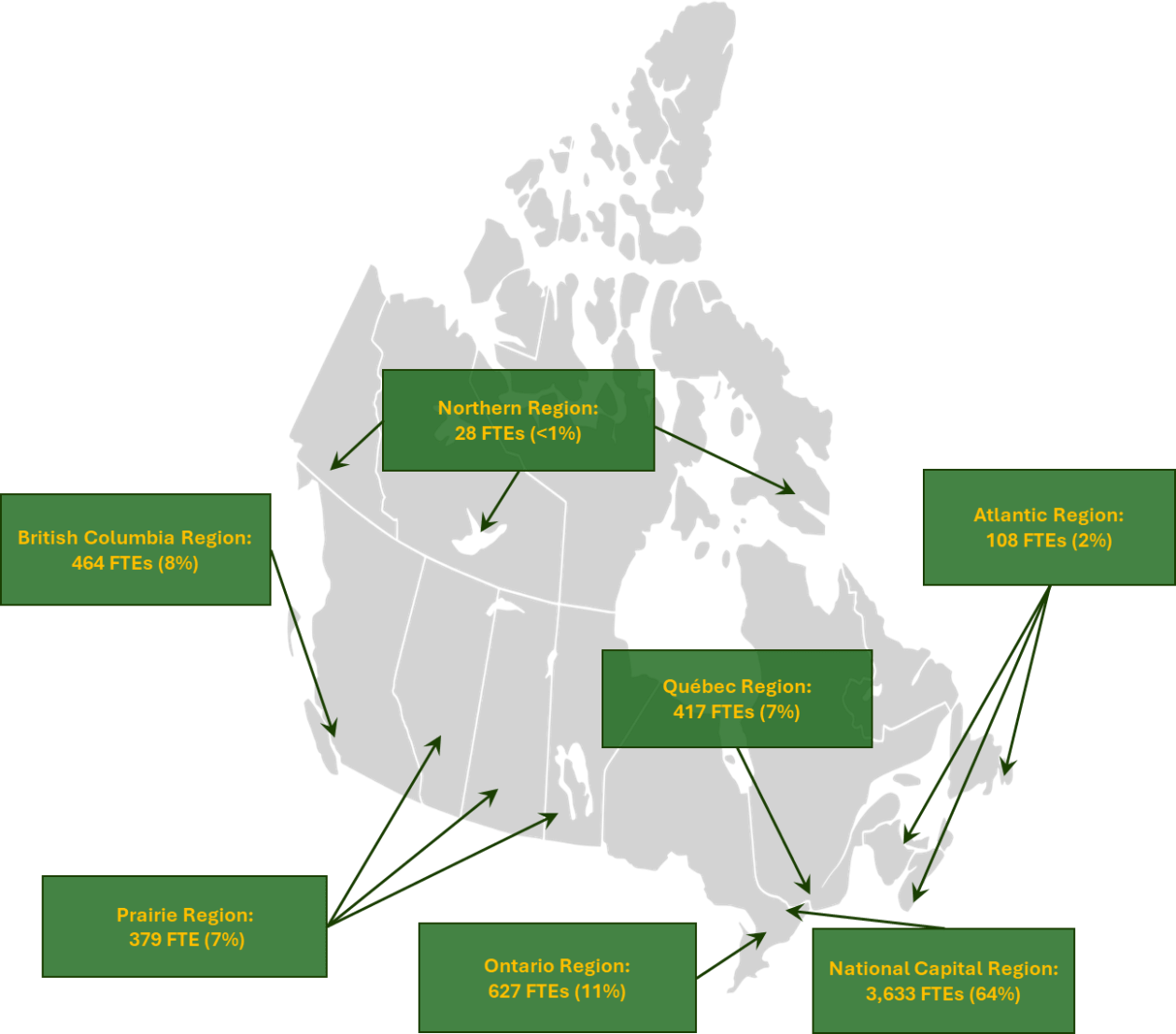
Text version
The map of Canada shows the breakdown of Full-Time Equivalents (FTEs) across the different regions, expressed in the number of FTEs and as a percentage of total FTEs, with arrows pointing to the approximate geographical locations of the regional offices.
The right side of the map shows that the National Capital Region counts 3,633 FTEs or 64% of the total human resources and the Atlantic Region counts 108 FTEs or 2%. Towards the center of the map, the Québec Region counts 417 FTEs or 7%, the Ontario Region counts 627 FTEs or 11%, and the Northern Region counts 28 FTEs or under 1%. The left side of the map shows that the British Columbia Region counts 464 FTEs or 8% and the Prairie Region counts 379 FTEs or 7%.
5. Glossary
Appropriation acts: An appropriation act begins as a supply bill (sometimes referred to as a money bill). Once the bill is approved by Parliament and then granted royal assent, it becomes an appropriation act. The appropriation act is the vehicle through which expenditures from the Consolidated Revenue Fund are authorized in order to pay for government programs and services. Both the Main Estimates and the Supplementary Estimates require appropriation acts.
Authorities: Spending authorities are approvals from Parliament for individual government organizations to spend up to specific amounts. Spending authority is provided in two ways:
- Annual Appropriation Acts that specify the amounts and broad purposes for which funds can be spent; and
- Other specific statutes that authorize payments and set out the amounts and time periods for those payments.
Employee Benefit Plan (EBP): A statutory item that includes employer costs for the Public Service Superannuation Plan, the Canada and the Quebec Pension Plans, Death Benefits, and the Employment Insurance accounts. Expressed as a percentage of salary, the EBP rate is changed every year as directed by the Treasury Board Secretariat.
Full-Time Equivalent: A measure of the extent to which an employee represents a full person-year charge against a departmental budget. Full-time equivalents are calculated as a ratio of assigned hours of work to scheduled hours of work. Scheduled hours of work are set out in collective agreements.
Voted and Statutory Appropriations: Expenditures made by government require the authority of Parliament. That authority is provided in two ways: annual Appropriation Acts or Supply Bills specify the amounts and broad purposes for which funds can be spent; and other specific statutes authorize payments and set out the amounts and time periods for those payments. The amounts approved in appropriation acts are referred to as voted amounts, and the expenditure authorities provided through other statutes are called statutory authorities.
- Vote 1 – Operating Expenditures: A vote that covers most day-to-day expenses, such as salaries and utilities.
- Vote 5 – Grants and Contributions: A vote used when grants and/or contributions expenditures equal or exceed $5.0 million.
- Grant: A transfer payment subject to pre-established eligibility and other entitlement criteria. A grant is not subject to being accounted for by a recipient nor normally subject to audit by the Department. The recipient may be required to report on results achieved.
- Contribution: A transfer payment subject to performance conditions specified in a funding agreement. A contribution is to be accounted for and is subject to audit.
Vote-Netted Revenue: The authority by which the Department of Justice has permission to collect and spend revenue earned from the provision of legal and internal services within government.
- Date modified: