
What We Heard from Practitioners
During the IJS Wave 1 engagements, we spoke with a broad cross-section of practitioners representing national, regional and community-based organizations both Indigenous-service directed and Indigenous led. We heard from federal and provincial governments, justice agencies, tribal governments and Indigenous councils, community-based restorative justice groups, practitioners working in prevention and education, legal experts and Indigenous law advocates across the country. Consistently throughout the discussions, practitioners spoke to the need for a broader, societal understanding of the effects of colonialism on Indigenous nations and peoples. They stressed the need to re-vamp current funding models to better support First Nations, Métis and Inuit communities as a whole and for holistic and individually focused programs and services for Indigenous people involved in the justice systems.
“I think it's really important to acknowledge the context of the impact of colonialism on communities and individual accountability is important, but also to acknowledge that people's involvement with the justice system come out of those experiences of colonialism, including poverty.”
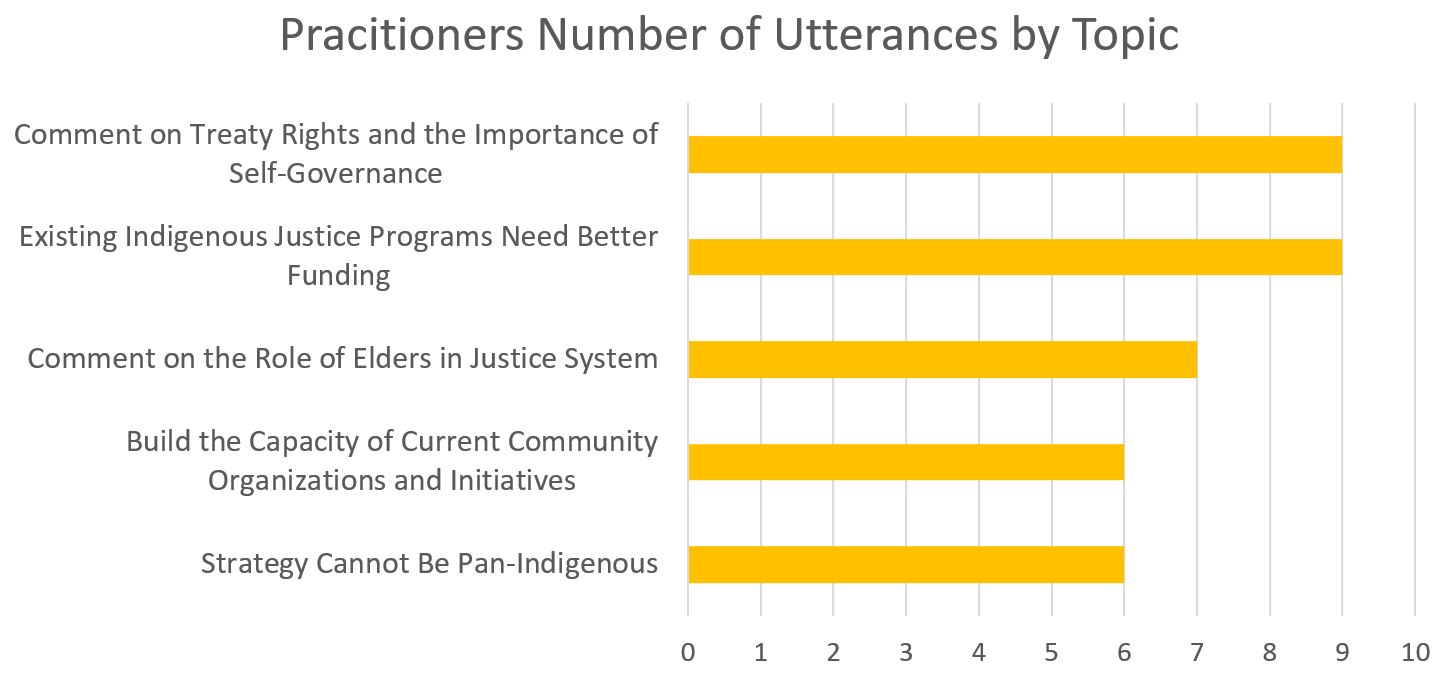
Text version
Bar chart representing the number of times 5 common themes were raised during engagement sessions with practitioners:
- Comment on treaty rights and the importance of self-governance: 9 times
- Existing Indigenous justice programs need better funding: 9 times
- Comment on the role of Elders in the justice system: 7 times
- Build the capacity of current community organizations and initiatives: 6 times
- Strategy cannot be pan-Indigenous: 6 times
Amongst practitioners, there is far-reaching recognition that unmet social determinants of justice (i.e. lack of economic stability, limited access to education, diminished access to healthcare, loss of connection to community, destruction of the physical environment) are the underlying cause of over-representation of Indigenous people in the criminal justice system. In response, the majority of professionals made pleas for consistent and long-term funding for community-based prevention and diversion programs, as well as healing opportunities for both victims and those returning to their community post-incarceration.
Ideally, practitioners would like to see an expansion of the Indigenous Court Worker Program and implementation of wrap-around legal services that offer personalized, linguistically and culturally appropriate pre-charge, in process and aftercare supports. There is a clear need for more Indigenous court navigators to assist individuals throughout the court process, the immediate formation of ‘care committees’ to advocate for individuals post-incarceration, as well as revisions to Gladue Report structures to include a strengths-based, Healing Plan section.
With regard to Gladue reporting, many professionals agree the quality and depth of reports is lacking; they are especially concerned that, due to this inconsistency, judges are not giving Gladue Reports full weight when making sentencing decisions. Practitioners note a clear discrepancy in use, value and outcomes for those utilizing Gladue Reports and believe this system requires serious revision.
Of equal importance, practitioners also see the need for well-funded programs that focus on healing and wellness, some see Section 81 of the Corrections and Conditional Release Act as a good start, but would like to see broader implementation of Healing Lodges in all justice institutions as well as more accessible, culturally appropriate Land-based programming.
“One of the things I'm thinking about is not so much lawyers but mediators and facilitators. You know to have those individuals working with our Indigenous processes because then you have a different kind of a mindset. You don't have an adversarial mindset. You have a more of a community healing restorative perception in those processes.”
During both Wave 1 Theme 1 and 2 dialogues, practitioners shared their experiences in assisting clients throughout myriad justice processes. They described the burnout that results when the level of individual care is so high, and articulated how best practices need to be formalized and expanded rather than depending on underfunded and overworked Indigenous organizations to do the work of justice. Despite their exhaustive efforts, practitioners wholeheartedly shared organizational best practices and stories of individuals who triumphed over their circumstances to become advocates and supporters of others involved in the justice system. In every case, at the core of each story we heard, was a sense of hope and the knowledge that when Indigenous people work together a more responsive, equitable system of justice can be created.
- Date modified: