
What We Heard Across All Meetings
Understanding that the ideas and insights shared throughout the dialogue sessions were deeply interconnected is important. As such, separating out themes and topics is difficult, because the interconnectedness of the systems at work is a major motif that we heard consistently during our conversations. What follows is an attempt to draw out common topics from the meetings, and to present them in a way that allows the reader to understand the iterative nature of what was learned.
There were many themes and topics that were addressed by meeting participants regardless of distinction and demographic. Across all meetings with the many regions, distinctions, and diversity groups that attended dialogue sessions, the following themes were heard the most often – both across meetings and within each meeting:
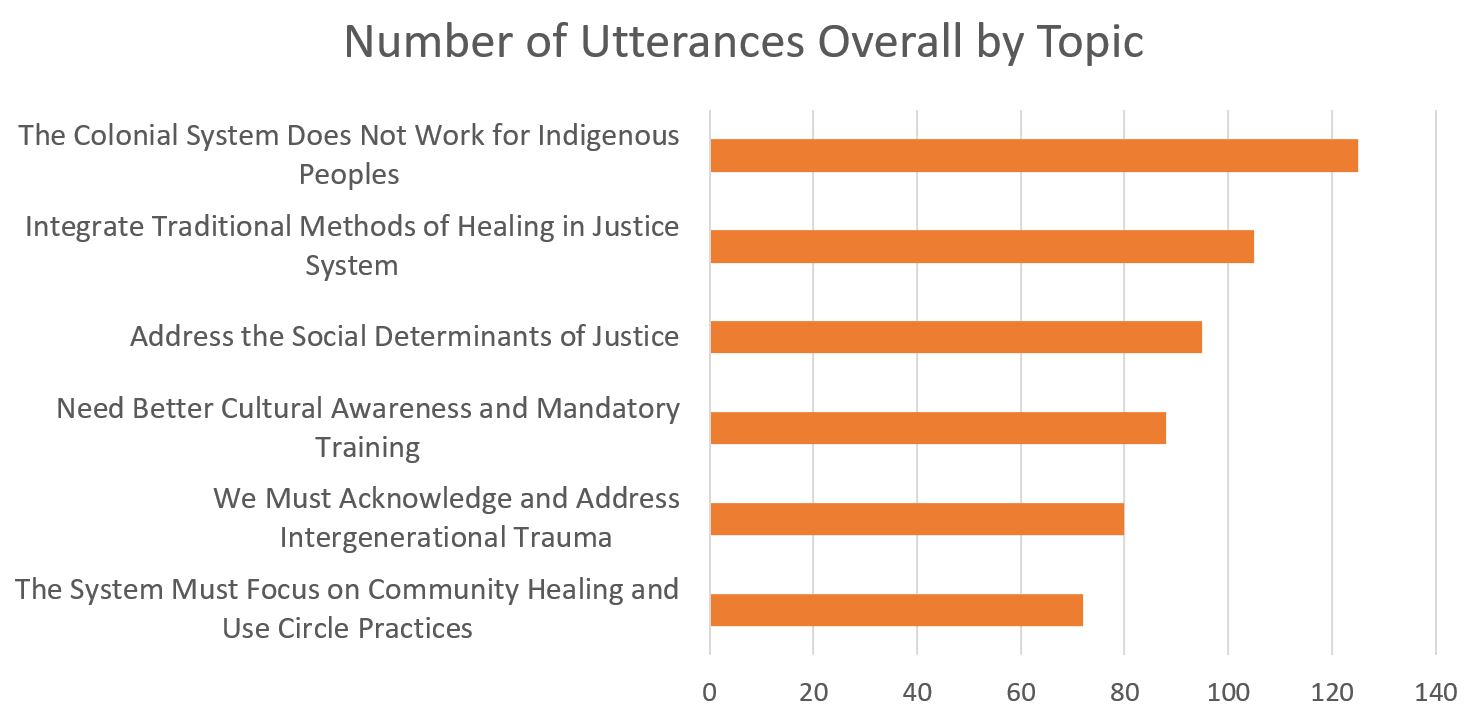
The graphic below illustrates the number of times the six main themes were raised by a participant throughout all 26 dialogue sessions that took place between November 2022 and March 2023:
Text version
Bar chart presenting the number of times 6 main themes were raised by participants across all engagement sessions:
- The colonial system does not work for Indigenous peoples: 125 times
- Integrate traditional methods of healing in the justice system: 105 times
- Address the social determinants of justice: 95 times
- Need better cultural awareness and mandatory training: 88 times
- We must acknowledge and address intergenerational trauma: 80 times
- The system must focus on community healing and use circle practices: 72 times
The colonial system does not work for Indigenous people and their needs and cannot be “adapted” to suit Indigenous communities. There is a need for community-based justice solutions that focus on restorative justice rather than punishment and isolation from community. Justice must also be holistic and take social determinants of justice into account.
Participants urged Justice Canada to think about justice holistically. Specifically, it was stressed that the journey of the accused, the victim(s), and the community must be taken into account, starting from point of contact with the justice system all the way through to release and reintegration. Additionally, all those systems and needs must work together to maximize healing and restore balance.
“There are strong benefits of the native court workers that are on the ground and in the court rooms, access to meaningful lawyers and meaningful consultation about your charges. But the system, as it's laid out in Canada, if you commit a crime, it's no longer about the victim. It's about the crime against the Queen. So that's why we work with the Crown and that's why it's taken out of the victim's hands and put it as a crime against the Queen. So, it energetically does not align with any of our protocols being Indigenous. When crime happens, the first crime is the crime against themselves. The second is the crime from the person most harmed. And then it goes to community. And it's also the responsibility of community to say what happened, that this failure happened...”
Many voices made it clear that the current operation of the colonial justice system does not consider the underlying social factors that led to involvement in the criminal justice system, nor the intergenerational trauma and systemic racism that Indigenous populations face across the country. In particular, we heard that child welfare and family services, police services and interactions with police, addictions, housing, and employment and education opportunities are all interconnected with justice and need to be addressed holistically. While interventions such as Gladue Reports and diversion programs try to consider these aspects, we heard from participants that they are offered and utilized inconsistently across the country and only provide a temporary and narrow solution to a broader issue.
“There is a need to hand back jurisdiction to communities, jurisdiction over child welfare, jurisdiction over education, over childcare, over our ability to provide for ourselves through hunting and fishing and things like that, that have us less reliant (sic) on colonial systems of income or things. Just all of those things need to be addressed. And sometimes it's very, very frustrating to see how siloed the criminal justice system is apart from all of these other things that, when people come in and talk to me like we can't hide from the fact that this person desperately needs to see a doctor, yes, they have their conditions that we're trying to work on with bail and probation, but this person is in desperate need of the basics in life.”
Community circles were among the most commonly cited forms of traditional healing and culturally appropriate justice models. Overall, there were calls for justice matters to remain within the purview and control of the community, rather than being passed to a colonial justice system that removes offenders from their communities and brings them into confrontation with non-Indigenous worldviews. Many participants suggested that when transgressions occur, communities are best positioned to hear from offenders, victims, witnesses, and legal experts without re-traumatizing the people involved in the incident. Moreover, it is through the communal process of hearing and understanding the circumstances that the community can collectively help decide on a best course of action.
We heard many stories of great success with sentencing circles and healing circles when transgressions occur in communities. In some cases, court judges have sat in circles and participated in the process, and feedback from those experiences has indicated that Indigenous court workers do see the benefits of incorporating Indigenous restorative processes into a colonial criminal justice process.
“Sometimes it takes a lot of effort to get out of that colonial view and to go back to an Indigenous view on how we work within the Indigenous communities for the benefit and the well-being of our community members. And it is very different from mainstream justice. When we sit in a circle, and so please pardon my colonial words, but if somebody had committed a crime and we're sitting in a circle and there's a judge and there's police officers and people making statements and we have also the victim and the offender sitting in the circle and each have their own support person, because it's important to recognize that everybody has a right to be supported no matter who they are. Sitting in a circle ensures (sic) nobody has more say or is more important than the other, including the victim and the offender.”
There was also a call for more funding and space to be made for Indigenous court workers. This recommendation came with a caveat that these workers ought not to replace the need for training and education for non-Indigenous members of the court system. Many participants voiced frustration that lawyers are not exposed to Indigenous law during law school, and that the requirement to focus solely on colonial law perpetuates the supremacy of the colonial legal system.
“Speaking as someone who's worked in the courts in (sic) my own community, having Indigenous specific victim services and where that's not available, making sure that victim support services, which are often housed in courthouses, but just wherever they're housed, to make sure that they're of course going to be trauma-informed, but trauma-informed through an Indigenous lens in a way that can support Indigenous peoples.”
There needs to be more integration of traditional ceremonies and medicines in every aspect of the criminal justice system.
Participants spoke about the need to develop an IJS that centres around Indigenous ways of understanding and supporting community healing. In many cases, these recommendations included calls for a restorative justice model that focuses on connection to culture, spending time on traditional lands, and helping both offenders and victims return to a state of balance within themselves and within community.
“I do know that the Aboriginal offenders currently within the system don't get the same or don't have the same opportunities and have to fight twice as hard in order to be able to access the ceremonies that they so desperately need, because a lot of them don't have that. A lot of them, because of the intergenerational trauma, they don't have that same opportunity to be connected with their culture and therefore their ceremonies and their traditions.”
Participants felt that a greater emphasis on holistic care and healing would prevent recidivism and help offenders reintegrate into their communities after an incident has occurred. Justice Canada was also reminded that traditions and cultures differ between nations, regions and distinctions, and that it is critical that solutions be flexible enough to adapt to the needs of each community and nation. For example, First Nations frequently cited that having an eagle feather in courtrooms, and opening up spaces for both victims and accused to smudge during hearings would make the colonial justice system feel more inclusive. It is important to note that efforts to include ceremony would need to respect a regional and distinctions-based approach.
“We also incorporate the seven teachings into that. And when we work with the healing wheel plan, we look at the mental health, the spiritual, the physical and the emotional. So, when we work with each quadrant with our clients, it shows where they're lacking or where they're not, where they haven't learned or they haven't experienced. And we work right, we start from their grassroots level. And then we kind of work our way because we need to find out that root, that's what brought them in today or why are they repeat offenders?
“It's more than just a program. It's going back to the land, practicing or sharing ceremonies and reconnecting with your spirits so that you gain that identity as an Indigenous person and to be proud. Because with pride comes that understanding and that knowledge of these are my ancestors. The ground that I walk on has been walked on by my ancestors.”
There must be an acknowledgement of intergenerational trauma as a major contributing factor to the overrepresentation of Indigenous people in the justice system and addressing this must ensure that the justice system does not re-traumatize people who interact with it.
The social determinants of interactions with the criminal justice system were top of mind for almost all participants across all regions, distinctions, and demographics. Those we spoke with were vocal about the impacts of intergenerational trauma on Indigenous communities and individuals from coast to coast to coast, and adamant that the IJS should both address the existing trauma, and ensure that future interactions with the justice system do not re-traumatize people—whether they be accused, victims, witnesses, family members or support workers. It was asserted that ongoing disconnection from cultural practices, loss of language, separation from traditional lands and territories, disruption of family and community values, and lingering effects of Residential Schools, Day Schools, and the Sixties Scoop all play a fundamental role in the overrepresentation of Indigenous people in the Canadian justice system.
“I know I see a lot of underlying issues of addictions, poverty, lack of support, generational impact from (sic) residential school because I'm still impacted. We're all impacted one way or another. Trauma, mental health, there's so many things that the youth are facing, and it's kind of hard to work with them and to work with the families. Something that I think we all face.”
The potential of the criminal justice system to re-traumatize all those associated with it was a recurring theme. While many participants discussed the trauma associated with being charged with a crime or being a victim of a crime (and subsequently needing police support to give statements and to attend court), other attendees stressed that court workers and Elders that support Indigenous people in the criminal justice system are also at risk of being re-traumatized.
A greater emphasis on educating the Canadian public regarding Indigenous laws and Indigenous world views was seen as one way to alleviate some of the strain on Indigenous court workers. Hiring more court workers, Gladue writers, and other supports for individuals that have to interact with the justice system, was also recommended as a short-term solution. Ideally, most participants believed that keeping justice matters within community and finding ways to divert people away from corrections facilities would be the most beneficial ways of reducing re-traumatization.
“The prison system is a system that is colonial, that was brought over by the colonists. And so how do you have an Indigenous justice system that doesn't continue to perpetuate the trauma of the colonial prison? And having gone into the prisons, it's not a pretty and fun place for people. Security trumps everything. And there are good people who are doing good things in there, and I'm not trying to take away from that, but the people who go in there come out more traumatized than they were before. And staff themselves feel traumatized by the roles that they have to play within the prison system.”
Cultural Safety and Awareness Training must be implemented across all aspects of the justice system, and the training must be both regionally appropriate and distinctions-based.
While there was an acknowledgement by participants that cultural sensitivity and awareness training is provided to some people working within the justice system, it was widely agreed that the training is insufficient, that not enough people are exposed to the training, and that the training is too general. In particular, participants spoke to the need for much more widespread education and exposure of Indigenous history, worldviews, cultures, and issues across all sectors of the criminal justice system—and throughout Canada more generally.
“The Indigenous justice strategy should begin in school, regardless of your career. It should be a common component of all training in all universities. Everyone should have to know and be aware about it. Also, police force recruitment should be heavily saturated with Indigenous representation and training, along with lawyers and courthouse staff, so from the very beginning with police to corrections officers, parole officers, etc., they need to have trauma-informed training and they need to have an education on Canada's colonial history as part of this trauma-informed training.”
There was general agreement that while everyone should have some cultural awareness education, those working in the justice system need much more training and require region-specific training. Inuit and Métis participants noted that often cultural awareness training focuses on First Nations experiences and information and overlooks the unique history and culture of other distinctions. These groups urged that cultural awareness training should include specific information regarding all three distinctions to ensure equitable treatment in the system.
An emphasis on training police services on regional differences was also heard throughout the meetings. As police are often the first point of contact between an individual and the criminal justice system, it is imperative that they understand the territories they are policing and the socio-cultural and historical implications of the people living on that land. Many attendees called for a return to community-based policing, with a focus on police integrating into the communities that they are in, and attending feasts, ceremonies, and community events.
- Date modified: