
Access to Justice Services Agreements Evaluation
1. INTRODUCTION
Since 1997, the federal government and the three territories (Nunavut[4], Northwest Territories [NWT] and Yukon) have entered into Access to Justice Services Agreements (AJAs) that provide federal support for legal aid[5], Aboriginal Courtwork[6] (ACW) and public legal education and information[7] (PLEI) services in each territory. These consolidated agreements replaced individual agreements for each of the aforementioned program areas. The Department of Justice Canada administers each agreement on behalf of the Government of Canada. The current agreements have been in place since April 2007.
1.1 Context
In the past, the Department of Justice has provided performance information on the AJAs to Treasury Board Secretariat through its Departmental Performance Report. Justice has also undertaken evaluations of its investments in legal aid services, ACW and PLEI investments; however, the AJA funding agreements, that is the consolidated arrangements by which the funds are provided to the territories, have never been evaluated.
The AJAs constitute a sub-sub activity within the Department of Justice Program Activity Architecture.
1.2 Objectives of the Evaluation
The most recent evaluations of the Legal Aid Program (LAP), the ACW Program and the Justice Partnership and Innovation Program (JPIP) (which provides funding to PLEI organizations in each of the provinces), establish the relevance, effectiveness, efficiency and economy of these funding programs. The primary purpose of the AJA evaluation is to consider these results in light of the territorial context, and to examine the relevance and performance of the consolidated agreement as an alternative to three separate funding agreements. The evaluation primarily covers the 2006/07 to 2010/11 period; however, as annual claims from 2010/11 are not yet available for all three jurisdictions, data from 2005/06 is used for comparative purposes.The program is in support of the Department’s mission to ensure that Canada is a just and law-abiding society with an accessible, efficient and fair system of justice.
1.3 Definition of Terms
For the purpose of this document, “access to justice services” refers to legal aid and ACW and PLEI services, as defined in the AJAs as presented below:
- Legal aid:
- In the context of the AJAs, legal aid refers to
“
legal advice and representation provided through any delivery model, including all duty counsel[8] and Brydges services[9], by a member of the bar of the territory or a person otherwise authorized by law to provide legal advice and representation in relation to any of the matters referred to
” in the agreements. The AJAs address criminal and civil legal aid as specified in their terms and conditions. The LAP is a national program, supported in each of the provinces through separate funding agreements. In the territories, legal aid forms one of the program components within the AJAs. - ACW:
- In the context of the AJAs, ACW refers to “
services that provide counselling to eligible Aboriginal persons and the provision of legal advice where authorized by law, in relation to court procedures, rights under the law and availability of legal aid or other resources and referral thereto of eligible persons
”. The ACW Program seeks to ensure that Aboriginal people charged with criminal offences receive fair, equitable and culturally sensitive treatment before the criminal justice system. It is a national program, supported in each of the provinces through separate funding agreements. In the territories, ACW services form one of the program components within the AJAs. - PLEI:
- In the context of the AJAs, PLEI refers to “
an activity that seeks in a systematic way to provide people with the opportunity to obtain information about the law and the justice system in a form that is timely and appropriate to their needs, but does not include advocacy or representation on behalf of individuals, nor the provision of legal advice
”. PLEI organizations are funded through JPIP funding in the provinces. In the territories, PLEI forms one of the program components within the AJAs.
2. PROGRAM DESCRIPTION
2.1 Program Rationale and History
In 1997, at the request of the territories, the federal government established AJAs that provide federal support for legal aid and ACW and PLEI services in each territory. Agreements have been in place in the NWT and Yukon since 1997 and in Nunavut since its creation in 1999.
The AJAs are consolidated agreements replacing individual agreements for each of the three aforementioned program areas. The agreements operate under the recognition of the respective responsibilities that federal and territorial governments have for the administration of justice and justice services.
The agreements address the territories’ request for greater flexibility to meet the unique needs and circumstances (geographical, cultural and linguistic) in their jurisdiction as well as to ensure that the Department of Justice supports access to justice services for all northern Canadians.
The purpose of consolidation is to enable greater flexibility for territories in providing services in accordance with their role and responsibilities for the management and administration of justice services. Given the unique and diverse demographic, cultural and geographic contexts and fiscal frameworks of each territory, the flexibility of the AJAs supports a more responsive approach to the three program components. For example, the capacity for non-governmental organizational service delivery for programs such as ACW and PLEI in northern communities is limited. Given the small size of many northern communities, it is difficult to justify, and logistically provide, separate specialized programs and services. Consolidation offers the potential for greater efficiency, flexibility and effectiveness compared with having separate contribution agreements for each program component. It may also streamline accountability requirements in a way that is more appropriate and reflective of northern justice administrative and service delivery models.
2.2 Program Logic
2.2.1 Goals and Objectives
Recognizing the unique circumstances of Canada’s territories, the current goal of the AJAs is to support the provision of improved legal aid and ACW and PLEI services in the territories.
The objectives of the AJAs are as follows:
- Consolidate federal contribution funding for territorial legal aid (criminal and civil), ACW and PLEI services under one agreement.
- Support the territories in responding to access to justice services needs to address population and territorial delivery circumstances.
- Provide financial, administrative and program flexibility to access to justice services, recognizing the unique circumstances of the North.
- Implement financial reporting and accountability requirements more appropriate and reflective of territorial justice administration and service delivery models.
- Support the responsibilities of the federal and territorial governments in maintaining minimum levels of service.
2.2.2 Expected Impacts
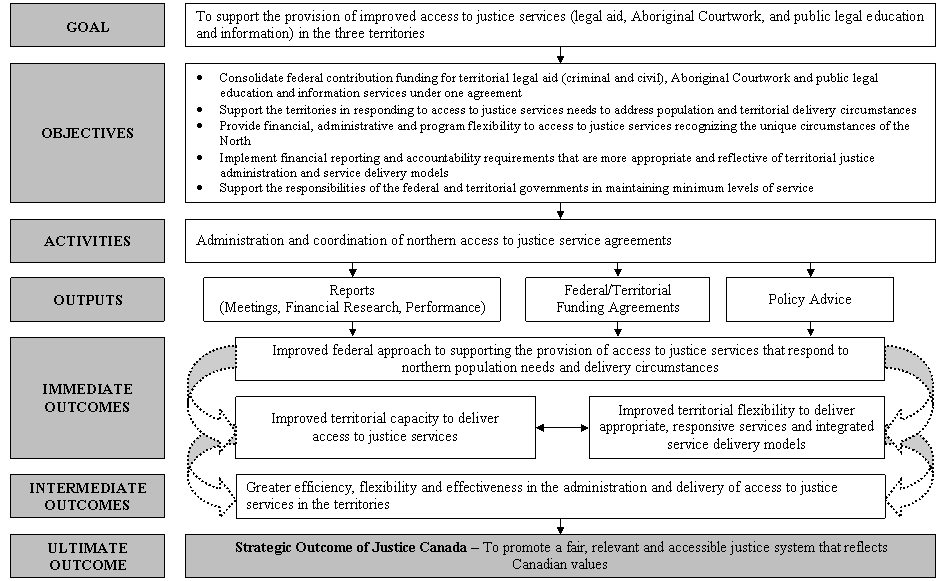
The AJA Logic Model depicts the activities, outputs and expected results of the AJAs. Figure 1 presents a graphic depiction of the AJA Logic Model.
2.3 Delivery Models
Territorial governments are key partners and work in collaboration with the Department of Justice Canada on improving access to justice services in the territories. Through the single agreement approach provided by the AJAs, Justice’s contribution supports the territories in the design and delivery of “access to justice services” which are appropriate to the northern context and population needs. Service delivery models for AJA service components vary for each territory.
The NWT has an integrated territorial model of service delivery. The NWT Legal Services Board (LSB) oversees the administration of legal aid and ACW and PLEI services. All legal aid lawyers and Aboriginal courtworkers are employees of the Government of the NWT.
Nunavut now has an arms-length, integrated model of service delivery through the Nunavut LSB, although initially services were delivered by the territorial government. All legal aid and ACW and PLEI services are delivered through one of three law clinics located in Cambridge Bay, Rankin Inlet and Iqaluit.
Yukon allocates AJA funds to separate third-party delivery agencies. Legal aid is provided by the Yukon Legal Services Society, which has three law clinics across the territory. Yukon Justice oversees the activities of ACW services, which are delivered by six different delivery centres. Finally, the Yukon Public Legal Education Association provides PLEI services out of an office located in Whitehorse.
2.4 Resources
The allocations to each territory are specified in Table 1.
| Legal Aid | ACW | PLEI | Total | |
|---|---|---|---|---|
| Yukon | $864,119 | $158,028 | $70,000 | $1,092,147 |
| NWT | $1,704,154 | $198,173 | $70,000 | $1,972,327 |
| Nunavut | $1,489,683 | $232,436 | $70,000 | $1,792,119 |
| Total | $4,057,956 | $588,637 | $210,000 | $4,856,593 |
Funding is apportioned to the three territories, with the provision that the total amount of the federal contribution shall not exceed 70% of total AJA expenditures for each territory. As is evident in the above table, legal aid is the major contribution investment area.
The Senior Director, Policy Implementation Directorate, Programs Branch of the Policy Sector is accountable for the overall management and direction of the AJAs and works in collaboration with each specific program area on issues of common interest to ensure national program consistency and minimum standards.
The AJAs are administered by Programs Branch staff. Table 2 provides an overview of the Department’s human resources (full-time equivalents) dedicated to the administration of the AJAs, as indicated by program representatives.
| Position | FTE |
|---|---|
| Senior Director, Policy Implementation Directorate | 0.15 |
| Senior Policy Analyst, Policy Implementation Directorate | 0.75 |
| Policy Analyst, Policy Implementation Directorate | 0.25 |
| Financial Advisor, Grants and Contributions Financial Services | 0.5 |
| Financial Administrator, Grants and Contributions Financial Services | 0.3 |
-
[1] The Department of Justice Canada administers the LAP, which provides ongoing support for criminal legal aid services in the provinces (funding for criminal and civil legal aid in the territories is provided through the Access to Justice Agreements) that ensure economically disadvantaged persons have access to the justice system.
-
[2] The Department of Justice Canada administers the ACW Program that assists Aboriginal people in obtaining fair, just, equitable and culturally sensitive treatment in the criminal justice system.
-
[3] The Department of Justice Canada supports PLEI activities that advance public understanding of the law and legal issues, thereby facilitating a fair, efficient and accessible justice system, in accordance with the November 2009 Policy on Public Legal Education and Information.
-
[4] Nunavut was created on April 1, 1999.
-
[5] The Department of Justice Canada administers the Legal Aid Program, which provides contributions to the provinces for criminal legal aid (funding for criminal and civil legal aid in the territories is provided through the Access to Justice Agreements) . Federal funding for civil legal aid in the provinces is provided primarily through the Canada Social Transfer, which is the responsibility of the Department of Finance.
-
[6] The Department of Justice Canada administers the ACW Program that assists Aboriginal people in obtaining fair, just, equitable and culturally sensitive treatment in the criminal justice system.
-
[7] The Department of Justice Canada supports PLEI activities that advance public understanding of the law and legal issues, thereby facilitating a fair, efficient and accessible justice system, in accordance with the November 2009 Policy on Public Legal Education and Information.
-
[8] Duty counsel refers to legal services provided without charge by a lawyer, generally provided at court or place of detention. Most often, the services provided are brief, and pertain to provision of summary advice or representation at a first appearance or plea court.
-
[9] Brydges duty counsel: any individual who has been arrested or detained has the right to be informed by the police of the availability of legal aid and duty counsel. A toll-free line is generally available for immediate advice.
- Date modified: