
Litigation Branch Evaluation Final Report
2. Profile of the Litigation Branch
The Litigation Branch is one of the specialized groups within Justice that provide legal services to departments and agencies to help them meet their policy and programming priorities and advance the overall objectives of the federal government. Through this program activity, the Department also provides legal services to the Justice Portfolio and supports the Minister as legal advisor to the Cabinet on complex, “whole-of-government” issues. The ADAG Litigation is responsible for the coordination of litigation that involves the Federal Crown in all provinces and territories, under both the civil and common law legal traditions. In addition, the ADAG Litigation must ensure that the Federal Crown fulfills its official languages obligations. A detailed logic model for the Litigation Branch, illustrating the relationship between the Branch’s planned activities and its expected results, is found in Appendix A.
2.1. Structure and Services
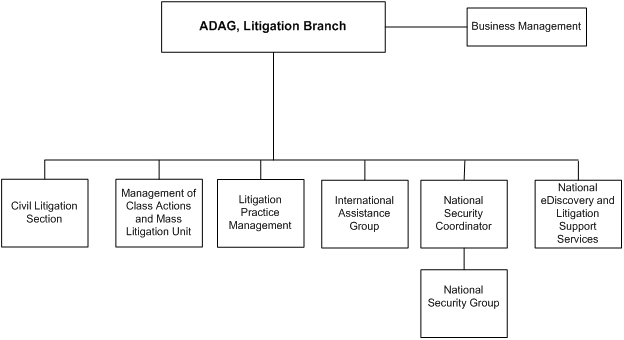
The organizational structure of the Litigation Branch is shown in Figure 1. The Branch is led by the ADAG Litigation. All units of the Litigation Branch were included in the evaluation with the exception of Business Management. Although Business Management supports the ADAG Litigation and the Litigation Branch’s activities by providing executive leadership, Business Management is a corporate function, which is outside the scope of evaluation for legal services.
Figure 1: Organizational Chart for the Litigation Branch
Organizational Chart for the Litigation Branch - Text equivalent
The ADAG, Litigation Branch is responsible for the Branch.
The following seven entities report directly to the ADAG, Litigation Branch: Business Management, Civil Litigation Section, Management of Class Actions and Mass Litigation Unit, Litigation Practice Management, International Assistance Group, National Security Coordinator, and National eDiscovery and Litigation Support Services.
The National Security Group falls under the National Security Coordinator.
ADAG Litigation
The ADAG Litigation is the government’s chief legal advisor in matters affecting litigation by or against the Crown. In addition to overseeing the work of the Litigation Branch, the ADAG Litigation provides substantive and strategic advice to the Minister of Justice, Deputy Minister (DM) Team, and the Privy Council Office (PCO) on any issues arising from the conduct of litigation. As well, the ADAG Litigation coordinates litigation involving the Federal Crown in all provinces and territories.
Civil Litigation Section (CLS)
CLS provides legal advice, legal policy advice and litigation services to federal departments and agencies. Counsel provide legal advice on potentially litigious issues, as well as legal policy advice on possible policy or legislative solutions to issues that have or may come before the courts. Counsel appear before all levels of provincial and federal courts, federal and provincial administrative tribunals, parliamentary committees, and international tribunals.
The responsibility for providing litigation services to the federal government is shared by CLS and the regional offices. The regional offices are responsible primarily for handling litigation within their own regions, Footnote 2 while the Section handles litigation within its geographic region (the Ottawa Region, which contains Eastern and Northeastern Ontario). When a case is commenced in a region and is considered by the ADAG Litigation to be of national significance, he will confer with the Regional Director General and may either require that his office be part of the direct reporting obligation of regional litigation counsel, or, occasionally, have carriage of the litigation transferred to CLS. The Section will also manage litigation when a region does not have the necessary expertise, such as national security or official language cases in certain regions. Unlike the regional offices, CLS is not organized by portfolios. All of its activities fall under the responsibility of the ADAG Litigation.
The CLS counsel work closely with counsel in DLSUs on litigation matters. In cases where CLS counsel is litigating the case, the DLSU counsel provide litigation support to them, as the DLSU counsel would have greater familiarity with the client department/agency’s structure, policies and programs. Some areas of specialized litigation work are conducted by specific DLSUs that independently manage their litigation files. For example, employment matters before the Public Service Labour Relations and Employment Board and related judicial review in the Federal Court are handled by Treasury Board Legal Services. Footnote 3 These DLSUs are only required to consult with the head of the CLS in the event that the different departmental stakeholders have conflicting points of view about the instructions to be issued for a particular matter.
Management of Class Actions and Mass Litigation Unit (MCAMLU)
This unit of the Branch monitors and manages class actions where the Federal Crown is a defendant or a third party to the action. In addition, it monitors cases that may have an impact on the Federal Crown, such as class actions in which principles of broad application are at issue, class actions where the Crown could be a member of the class, or non-class actions that could have implications for class actions.
MCAMLU's role in monitoring and managing these cases is to ensure the coordination and consistency of legal positions taken by the federal government and to consider the potential implications of such legal positions on other litigation, legislation or policy initiatives before they are advanced. The Unit also shares information on standards and best practices, and works to develop expertise among counsel in handling class action cases through training and other activities. In addition, the MCAMLU is involved in the litigation of some high-profile or politically sensitive national class actions. Specific activities of the Unit include:
- participating in monthly teleconferences among counsel involved in class actions to share information on best practices and develop consistent legal positions;
- reviewing documents before they are filed with the court to ensure consistent positions are taken;
- collecting filed documents and developing standardized precedent materials;
- participating on working groups that study and make recommendations on key class action issues;
- monitoring and tracking class actions involving or with the potential to involve the Federal Crown and significant non-class action matters that have implications for class actions; and
- litigating class actions, either by serving as lead counsel or by providing expert advice and litigation support to regional counsel as a member of the litigation team. Footnote 4
In any given year, the Unit monitors cases across Canada, as most jurisdictions will have at least one ongoing class action that falls under its purview. The Unit also works with many federal departments/agencies, as single class actions often involve more than one department/agency. There are, in essence, three roles in which the MCAMLU may be involved:
- passive monitoring of cases being handled in the regional offices;
- proactive monitoring of particularly sensitive cases by means of direct participation as a member of the litigation team; and
- carriage of certain high-profile national class actions as lead counsel.
Often, these national class actions are managed in collaboration with regional counsel. The formation of national litigation teams facilitates the development of comprehensive and coordinated responses that permit the management of interlocking and conflicting class action claims that may be commenced in different provinces and/or territories. DLSU counsel also are frequently involved as litigation team members. In these circumstances, their primary responsibility is to ensure that communications to the clients about the teams’ strategy and litigation requirements are clear and consistent, and that instructions are received on a timely basis after appropriate consultation with the client. MCAMLU counsel also, on an exceptional basis, may lead certain aspects of a file (examination or pleading) when certain points of law have been addressed in other jurisdictions or before the Supreme Court of Canada.
Litigation Practice Management Centre (LPMC)
The LPMC’s core responsibilities relate to managing the Agent Affairs Program (AAP) — a national program created to strengthen the Department’s ability to deliver effective and responsive legal services to the Government of Canada through appointing and managing legal agents. Legal agents are private sector law firms or practitioners retained by or under the authority of the Minister of Justice to provide legal services to the Government of Canada and to act on behalf of the Minister of Justice and Attorney General of Canada. Decisions to outsource legal work are based on established criteria such as geographically remote areas, situations in which there are conflicts of interest, considerations related to the capacity and availability (workload-related issues) of Justice counsel, and considerations with respect to situations in which special expertise is required.
The LPMC supports the ADAG Litigation and DM of Justice in establishing and operating the management control framework that governs the outsourcing of legal work, including the selection and appointment of legal agents and the management of agent activities and costs. In accordance with the established framework, the LPMC ensures that Justice Canada conducts due diligence in its decisions to outsource legal work, and that the processes relating to the sourcing, selection, appointment and management of legal agents promote openness, fairness and transparency, and value for money.
The LPMC also supports the ADAG Litigation on a wide range of projects and issues that relate to the delivery of legal services. These include identifying and organizing specific and targeted training sessions, as well as the planning and delivery of the National Litigation Conference that occurs every 18 months.
International Assistance Group (IAG)
The IAG carries out the functions assigned to the Minister of Justice as the central authority for Canada under the Extradition Act and the Mutual Legal Assistance in Criminal Matters Act (MLACMA), and provides advice to the Minister on his or her responsibilities under these statutes. The Group reviews and coordinates extradition and mutual legal assistance requests made to Canada, as well as those made by Canada to other countries. It maintains a bilateral extradition relationship with over 80 countries and has bilateral mutual legal assistance treaties with 35 countries, as well as a number of international tribunals, including the International Criminal Court.
Litigation under the Extradition Act and theMLACMA is conducted by Department of Justice counsel in the region where the litigation arises. Where litigation arises in Ottawa-Gatineau or Northeastern Ontario, it is conducted by members of the IAG. The Group also supports Canada’s participation in the Financial Action Task Force on Money Laundering, the international body responsible for setting anti-money laundering and anti-terrorist financing standards to which Canada subscribes. The IAG has one foreign liaison officer in Brussels.
More specifically, the Group’s activities include:
- providing general advice to the Department about both statutes and their operation;
- receiving all requests for extradition and mutual legal assistance made by foreign states to Canada (incoming requests);
- assisting Canadian police and prosecution services to make extradition and mutual legal assistance requests to other countries and communicating with foreign countries in relation to the execution of these requests (outgoing requests);
- reviewing both incoming and outgoing requests to ensure they satisfy all legal requirements;
- issuing required authorizations under the legislation on behalf of the Minister of Justice;
- managing and coordinating all international assistance requests to and from Canada;
- for mutual legal assistance requests, consulting with government departments or agencies that hold information or evidence that is relevant to the requests to determine if it can be provided without a court order;
- directing and guiding Justice Canada counsel in the regions and provincial prosecution services who conduct litigation in the area of international assistance;
- conducting extradition and mutual legal assistance litigation in the Ottawa-Gatineau area, as well as in Northeastern Ontario;
- preparing extensive legal advice and draft letters of decision for the Minister in support of his statutory obligation to personally decide surrender on incoming extradition cases;
- fostering relations with Canada’s extradition and mutual legal assistance partners; and
- providing training in the area of international assistance.
The IAG also engages in several policy-related activities, such as:
- developing policies related to extradition and mutual legal assistance requests in consultation with other sections within Justice or interested government departments/agencies. For example, IAG developed a policy with respect to situations where the testimony of a Canadian government employee is sought in a foreign proceeding;
- coordinating with other departments and agencies to ensure that national security interests will not be adversely affected by the testimony, and working with the requesting nation on imposing any necessary conditions on the testimony (such as restricting questioning to certain matters); and
- participating in negotiations of international agreements or treaties that involve, or might impact, extradition and mutual legal assistance requests. In addition, IAG supports Canada’s participation in relevant international fora, such as the Cross-Border Crime Forum, the Financial Action Task Force on Money Laundering, the Organization of American States, the Mutual Legal Assistance and Extradition Network, and meetings of the Lyon/Roma Group of the G8.
National Security Group (NSG) and National Security Coordinator (NSC)
The NSG serves as a central coordinating office for section 38 of the Canada Evidence Act (CEA), which creates a process intended to deal with the protection of sensitive or potentially injurious information. More specifically, the NSG:
- responds to general inquiries about the operation of section 38;
- receives notices under section 38 on behalf of the AGC;
- coordinates the government’s response to section 38 notices, which includes consulting with affected departments/agencies;
- decides whether, when, and to whom section 38 proceedings should be disclosed;
- provides legal advice to the NSC and the ADAG Litigation on whether information that is the subject of a section 38 notice should be disclosed;
- communicates the decision of the NSC and the ADAG Litigation to the party making the section 38 notice; and
- instructs the civil litigator on applications brought under section 38 and, on occasion, litigates the matter before the court.
The NSG counsel draw on their experience to provide independent legal advice to clients on security and intelligence (S&I) related issues, and coordinate the Justice Emergency Team — a network of counsel who participate in exercises, provide advice in emergency situations, and develop tools/resources related to emergency management. The staff members of the NSG engage in outreach and training to increase awareness of key S&I legal issues as they arise, particularly in the context of section 38 of the CEA.
The NSG also supports the NSC, a Senior General Counsel position reporting to the ADAG Litigation. The NSC is responsible for the promotion of strategic leadership and the efficient coordination and integration of the Department’s S&I-related litigation, advice and policy-related work. On behalf of the NSC, the NSG serves as the interface between the PCO and Justice on matters pertaining to senior-level S&I committees, and prepares the briefing material for these committees. In furtherance of its coordination mandate, the NSG performs the secretariat function for two key S&I-related committees: the National Security and Intelligence Committee (NSIC), an internal body, and the DM Subcommittee on National Security Legal Issues, an interdepartmental committee.
National eDiscovery and Litigation Support Services
National eDiscovery and Litigation Support Services support the ADAG Litigation in all aspects of litigation support services and technology. This includes the provision of litigation support tools and processes, as well as electronic discovery (eDiscovery), disclosure strategy, and practice in litigation. National eDiscovery and Litigation Support Services are responsible for:
- developing and implementing the Department’s litigation support and eDiscovery strategy;
- establishing a single point of access for discovery, eDiscovery, and disclosure resources and services;
- providing advice to senior government officials and Ministers on eDiscovery issues and strategy; and
- providing training and learning activities related to discovery, eDiscovery and disclosure.
2.2. National Litigation Committee (NLC)
The NLC is the senior advisory body for all litigation, regardless of court level. The ADAG Litigation chairs the Committee and standing members include the ADAGs and Assistant Deputy Ministers (ADMs) who represent the portfolios, representatives of the sections of the Litigation Branch, chairpersons of the regional offices’ litigation committees, the coordinators of appeals to the Supreme Court of Canada, and representatives of the Policy and Public Law Sectors of Justice Canada.
The Committee serves a coordination and advisory role. It monitors significant litigation in which the Federal Crown is a party or in which the government might intervene, as well as trends in litigation. The NLC provides a forum to discuss legal positions before they are taken in court to ensure that the AGC’s positions are consistent nationally and take due consideration of government policies. The Committee reviews all recommendations to appeal to the Supreme Court of Canada as well as key pleadings and facta before they are filed in court. It also makes recommendations to the Minister and DM of Justice on whether to intervene in important cases. In addition, the Committee provides oversight to ensure that legal risk is appropriately managed. The matters brought to the attention of the NLC come largely from the regional offices’ litigation committees and the Litigation Branch.
The NLC monitors significant litigation which could have an important impact on the law or the government’s interests. The Committee also makes recommendations to the Minister and DM of Justice concerning matters such as interventions and submission on any important case, regardless of the level of court.
The Committee provides a forum for resolution of divergent views on legal issues to ensure that the Department of Justice speaks with one voice, that arguments advanced by departmental counsel or agents on behalf of the AGC are consistent, and that the policy concerns of the government, the AGC and client departments receive due consideration.
2.3. Resources
Table 1 presents the actual expenditures of the Litigation Branch for its operations over the last six fiscal years. Footnote 5 During this period, the expenditures of the Branch increased 31%. As shown below, this change is due to a 42% increase in salaries, as expenditures for operations and maintenance have declined (also by 42%).
| 2008/09 | 2009/10 | 2010/11 | 2011/12 | 2012/13 | 2013/14 | |
|---|---|---|---|---|---|---|
| Salary before EBP | 13,998,434 | 16,908,137 | 18,761,303 | 18,872,798 | 18,878,161 | 19,940,591 |
| EBP @ 20% | 2,799,687 | 3,381,627 | 3,752,261 | 3,774,560 | 3,775,632 | 3,988,118 |
| Subtotal: salary expenditures |
16,798,121 | 20,289,764 | 22,513,564 | 22,647,358 | 22,653,793 | 23,928,709 |
| Operating and maintenance | 2,555,710 | 2,495,744 | 2,764,000 | 2,772,435 | 1,614,688 | 1,486,064 |
| Total annual expenditures | 19,353,831 | 22,785,508 | 25,277,564 | 25,419,792 | 24,268,481 | 25,414,773 |
Source: Data provided by Litigation Branch.
As of March 31, 2014, the Litigation Branch had a total of just over 200 full-time equivalents (FTEs) in the categories shown in Table 2 .
| Category | ADAG Litigation Footnote 6 | CLS | LPMC | MCAMLU | eDiscovery | IAG | NSG | Total |
|---|---|---|---|---|---|---|---|---|
| Counsel | 7.87 | 38.94 | 3.0 | 5.75 | 6.64 | 19.95 | 12.02 | 94.17 |
| Paralegals | 1.13 | 16.79 | 1.00 | 3.96 | 5.88 | 9.11 | 9.33 | 47.20 |
| Administration | 5.94 | 30.00 | 7.03 | 3.17 | 3.00 | 6.69 | 3.00 | 58.83 |
| Total FTEs | 14.93 | 85.73 | 11.03 | 12.88 | 15.53 | 35.75 | 24.35 | 200.20 |
Source: Litigation Branch
Note: Business Management Office staff is included under ADAG Litigation.
- Date modified: