Evaluation of the Youth Justice Initiative
2 Initiative Profile
2.1 Description
The YJI was established to support the implementation of the Youth Criminal Justice Act (YCJA) through funding to maintain programs and services, and respond to new and emerging youth justice issues. See Appendix A for the program logic model.
2.1.1 Initiative Objectives
The YJI is a multi-faceted approach to youth justice. The ultimate objective of the YJI is to foster a fairer, more effective youth justice system. This is defined as:
- Increase the use of extrajudicial measures (EJM);
- Appropriate use of courts by youth justice officials;
- Appropriate use of custody by judges;
- Responses by youth justice officials that are proportionate to the severity of the offence and the degree of responsibility of the offender; and
- Enhanced rehabilitative and re-integrative opportunities.
2.1.2 Initiative Components
The three YJI funding components reflect the shared authority between federal and provincial/territorial governments over the youth justice system in Canada, and provide funding to the provinces, territories and other organizations to support the legislative and policy objectives of the YCJA.
The YJI consists of three funding components and one policy component:
- Youth Justice Services Funding Program (YJSFP) - provides funding to provinces and territories to support a range of high priority youth justice services and programs that are consistent with the federal policy objectives contained in the YCJA. More specifically, these funding agreements support and promote an appropriate range of programs and services that:
- encourage accountability measures for unlawful behaviour that are proportionate and timely;
- encourage effective rehabilitation and reintegration of young persons into their communities;
- target the formal court process to the most serious offences; and
- target custody to the most serious offences.
- diversion/EJM and extrajudicial sanctions (EJS) programs;
- rehabilitative and reintegration services, including programs that address linguistic, gender, ethnic and cultural differences and respond to the needs of Indigenous young persons;
- judicial interim release programs;
- reports and assessments;
- intensive support and supervision and attendance programs; and
- conferencing and other community-based sanctions.
- Intensive Rehabilitative Custody and Supervision (IRCS) Program - provides funding to provinces and territories to support an ongoing capacity to perform assessments and provide intensive and specialized services associated with IRCS court orders and other exceptional cases involving youth with mental health needs who have been sentenced for an offence in which they caused or attempted to cause serious bodily harm. IRCS has four funding components:
- Part A (Basic Capacity): provides funding to all provinces and territories for the purposes of establishing and/or maintaining a minimum capacity to provide specialized mental health assessments and treatment plans for violent youth with mental health needs;
- Part B (Court Orders): provides case specific funding to provinces and territories to provide therapeutic programs and services as required by youth who receive an IRCS sentence under the Act. The sentence option pertains to youth convicted of murder, attempted murder, manslaughter or aggravated sexual assault, as well as youth convicted of a third serious violent offence and who are suffering from mental health issues;Footnote 8
- Part C (Exceptional Cases): In 2008-09, IRCS funding was extended to provide funding for exceptional cases (i.e., not ordered by the court) of where a youth caused or attempted to cause serious bodily harmFootnote 9 and has been diagnosed with mental illness or disorder; and
- Part D (Project Funding): funds special projects on an annual basis that address issues of relevance to youth justice.
- Youth Justice Fund (YJF) - provides grants and contribution funding to non-governmental, Indigenous and community-based organizations, individuals, and other levels of government in order to respond to emerging youth justice issues, enable greater citizen/community participation in the youth justice system and help achieve a fair and accessible youth justice system. Proposals for projects are submitted by prospective organizations, and reviewed by YJF staff for eligibility, as appropriate to YJI objectives and priorities. Projects may include pilot projects for youth in conflict with the law, professional development activities and research and evaluations related to the youth justice system.
- Policy Development, Monitoring and Support is provided by the Policy Unit of the YJI which is situated within the Youth and Indigenous Justice Division of the Family Law and Youth Justice Section. The overall objectives of this component of the YJI are to facilitate knowledge and information-sharing amongst the various stakeholders. This component consists of policy development, research and, liaison and outreach.
Programs and services that are funded by the YJI occur at various stages of the youth justice continuum, from front-end diversion (i.e: EJM) to assessment and treatment as part of community-based and custodial sentences (Figure 1). The continuum identifies the key stakeholders in the youth justice system (police, Crown, court and youth themselves) and the youth justice systems stages. YJI-funded programs and services come into play across the continuum, although the mandate does not include prevention.
Figure 1: Youth Justice Continuum
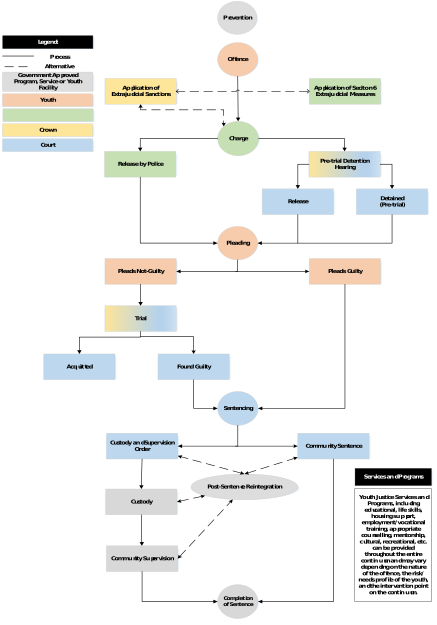
Figure 1: Youth Justice Continuum – Text version
Figure 1: Youth Justice Continuum
This diagram illustrates the stages of the youth justice continuum and the different stakeholders involved, which are the police, Crown, court and youth.
Youth Justice Services and Programs, include educational, life skills, housing support, employment/vocational training, appropriate counselling, mentorship, cultural, recreation, etc., and can be provided throughout the entire continuum and may vary depending on the nature of the offence, the risk/needs profile of the youth, and the intervention point on the continuum.
The continuum diagram begins with the Prevention stage, which is identified as a government approved service, program, or youth facility. The stage is not attached to the rest of the youth justice process.
The diagram shows two alternative procedures can be taken after the youth commits an Offence, which are: an Application of Section 6 Extrajudicial Measures by the police, or an Application of Extrajudicial Sanctions by the Crown. The Application of Extrajudicial Sanctions can occur as an alternative procedure after the Offence, or after the youth have been charged. The diagram indicates that as an alternative procedure, the youth can be Charged after the Application of the Extrajudicial Sanctions.
After the youth has been charged, the diagram indicates that the youth will either be released by the police or there will be a Pre-Trial Detention Hearing. The two possible outcomes of the pre-trial detention hearing are that the youth is released or detained by the court. After either being released by police, released or detained by the court, the next step depicted in the diagram is “pleading”.
The youth either pleads not guilty or pleads guilty.
- If the youth Pleads Not Guilty, they will enter trial after which the youth will either be Acquitted or Found Guilty by the court.
- If the youth is Found Guilty or Pleads Guilty, they will enter the Sentencing process by the court.
For sentencing, the court can order a Community Sentence or a Custody and Supervision Order. Following the Custody and Supervision Order, the youth enters the Custody stage, and then the Community Supervision stage.
The Post-Sentence Reintegration stage occurs simultaneously throughout all of the following stages: Community Sentence, Custody and Supervision Order, Custody, and Community Supervision.
The last stage of the youth justice continuum is the Completion of Sentence stage. This stage follows after either the Community Sentence stage or the Community Supervision stage.
The Custody stage, Community Supervision stage, Post-Sentence Reintegration stage, and Completion of Sentence stage all involve government approved programs, services, or youth facilities.
2.1.3 Resources for the Initiative
Total resources for the YJI are approximately $160M annually for the five-year period from 2015-16 to 2019-20, with the majority of funds allocated as grants and contributions (Gs&Cs) funding through the three components of the YJI. The YJSFP accounts for approximately 90% of the Gs&Cs funding available to the YJI.
| Year | 2015-16 | 2016-17 | 2017-18 | 2018-19 | 2019-20 | Total |
|---|---|---|---|---|---|---|
| Gs&Cs | $157,245,415 | $157,245,415 | $157,245,415 | $157,245,415 | $157,245,415 | $786,227,075 |
| SalaryFootnote * of Table 1 | $2,239,189 | $2,193,318 | $2,698,709 | $2,325,164 | $2,478,351 | $11,934,731 |
| O&M | $417,601 | $238,596 | $364,526 | $496,416 | $700,375 | $2,217,514 |
| Total | $159,902,205 | $159,677,329 | $160,308,650 | $160,066,995 | $160,424,141 | $800,379,320 |
- Date modified: