
Introduction
Background
In Canada, responsibility for criminal justice is shared between the federal government for criminal law making and criminal procedure and the provincial and territorial governments for the administration of the justice system, outside of criminal prosecutions in the territories which are a federal responsibility. Given these authorities under the Constitution, both levels of government have a mutual interest in working together to ensure a fair, relevant, and accessible system of justice.
Legal aid is one component of the legal system and it is essential to fulfilling the government’s obligations under the Canadian Charter of Rights and Freedoms including the right to a fair trial (section 11(d)); to life, liberty and security (section 7) and to equal protection and equal benefit of the law (section 15). Legal aid helps to ensure effective and fair representation in the criminal justice system and it is necessary to address the imbalance of power by ensuring that economically disadvantaged individuals have equal access to justice in our society.
Legal Aid Program
There are 13 recognized legal aid plans in Canada, the organizations responsible for providing legal aid services to those who cannot afford a lawyer. The federal government supports legal aid services in the provinces and territories through two sources. The Department of Justice Canada’s (Justice Canada) Legal Aid Program provides funding to all provinces for criminal legal aid through contribution agreements. There are also agreements to support immigration and refugee (I&R) legal aid in seven provinces: Alberta, British Columbia, Manitoba, Newfoundland and Labrador, Ontario, Quebec and Nova Scotia. In Nova Scotia, I&R legal aid is provided by a legal service clinic. The federal government also supports criminal and civil legal aid in the territories through consolidated Access to Justice Services Agreements.Footnote 1 Federal support for civil legal aid in the provinces is covered under the Canada Social Transfer (CST), which is a block transfer payment provided to each province and territory for health care, postsecondary education, social assistance and social services. Civil legal aid is an eligible expenditure under the CST.Footnote 2
While policy development related to criminal legal aid is a shared federal/provincial/territorial responsibility, each province and territory is responsible for the delivery of legal aid services based on their own policies and procedures. This report provides national level statisticsFootnote 3 on revenues, expenditures, personnel, and caseloads from legal aid service providers across Canada. Justice Canada has produced the Legal Aid in Canada report since 2016-17, and this is the seventh annual edition. This year’s report includes data from the 2022-23 fiscal year, as well as trend data from the past five years.
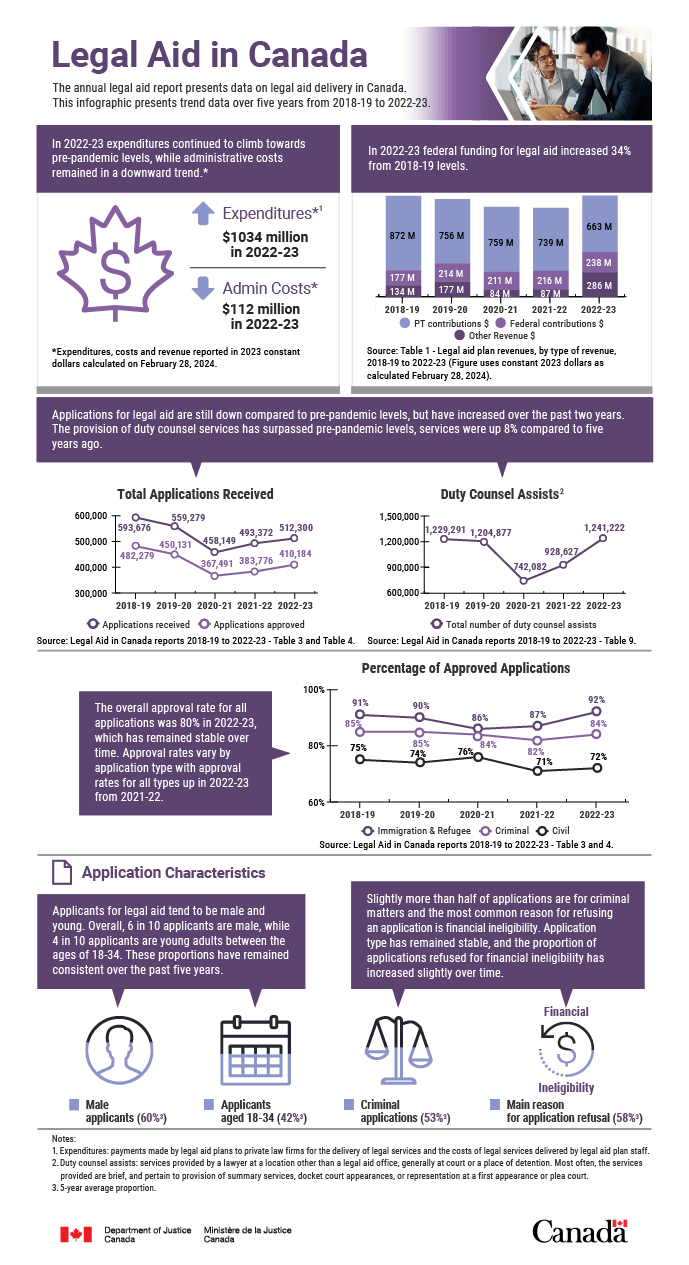
In 2022-23 the remaining pandemic public health measures were removed and courts had largely resumed normal operations. Despite the return to normal, the justice system continued to experience the repercussions from the pandemic on the already overtaxed system, with reports of growing backlogs and longer case processing times.Footnote 4Footnote 5Footnote 6 In the legal aid context, data from 2022-23 show that the legal aid system has continued to show signs of recovery, with duty counsel and I&R services even surpassing pre-pandemic levels in terms of case volumes and expenditures.
The data collection for Legal Aid in Canada is done at a national level; however, some legal aid plans may be unable to report all or some data elements in certain years. Due to these limitations, Canada-level totals may not include all provinces and territories, which is noted where applicable.
- Date modified: