
Immigration and refugee legal aid
Refugee claimants have the right, under the Immigration and Refugee Protection Act (IRPA), to be represented at I&R proceedings. Through the Legal Aid Program, the federal government contributes annual funding in eight provinces where I&R legal aid services are provided (British Columbia, Alberta, Manitoba, Ontario, Quebec, New Brunswick, Nova Scotia, and Newfoundland and Labrador). I&R matters are primarily proceedings of persons (individuals, or principal applicants and family) involved in the refugee determination system under the provisions of IRPA but also include some other immigration proceedings under the IRPA, such as immigration detention hearings and removal order appeals. I&R legal aid covers the provision of legal advice, assistance and representation for immigration or refugee proceedings before the Immigration and Refugee Board of Canada (IRB), the Federal Court, or Immigration, Refugees and Citizenship Canada officials on post-determination actions.
There were over 70,000 I&R legal aid certificates issued in 2023-24, a 52% increase from last year
Table 16 shows the volume of I&R legal aid cases as well as expenditures for I&R legal aid for 2023-24, including cases and expenditures carried over from previous fiscal years for matters that are ongoing. In 2023-24, there were 71,935 legal aid cases, with 6,937Footnote 23 carried over from previous fiscal years in the provinces that reported these data, for a total of 78,872 cases. A majority of cases (current and previous fiscal years) were handled by private bar lawyers (81%), while 16% were handled in specialized clinics, and 3% were handled by staff lawyers. Sixty-seven percent of expenditures from the current (2023-24) and previous fiscal years related to I&R legal aid were associated with private bar certificates.
Newfoundland and Labrador had the highest proportion of staff lawyers working on I&R matters (97%) in 2023-24, while in all other jurisdictions I&R legal aid cases were mostly handled by private bar lawyers. New Brunswick, Nova Scotia, Ontario, and Quebec are the only jurisdictions with cases handled through specialized clinics, which account for 100% of previous and current fiscal caseloadsFootnote 24 in New Brunswick, 93% in Nova Scotia, 16% in Ontario, and 14% in Quebec (Table 16).
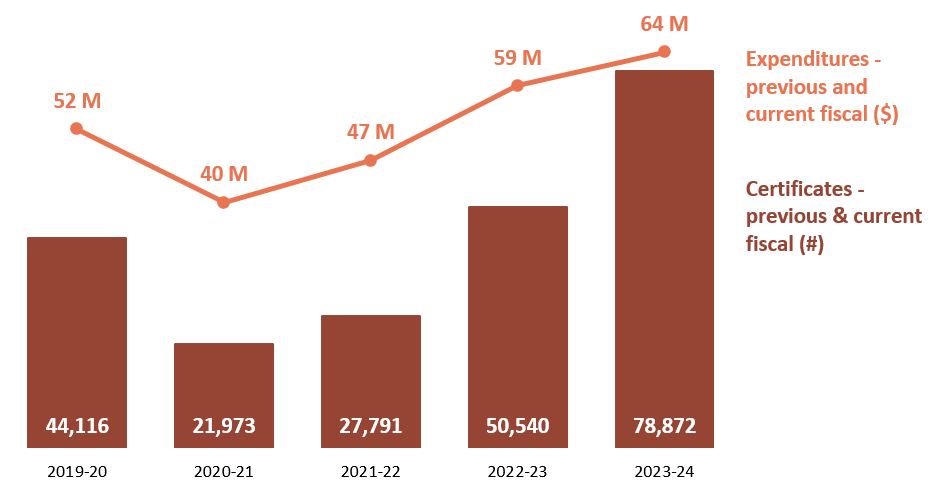
Figure 20 shows the trends in I&R legal aid caseload volumes and expenditures over the past five years. The number of previous and current fiscal year cases has continued to climb over the past three years from a low of 21,973 during the onset of the pandemic in 2020-21. In 2023-24 previous and current fiscal year cases have surged beyond pre-pandemic levels,Footnote 25 with cases up 53% from last year, and 75% compared to 2019-20. Similarly, expenditures (using constant 2024 dollars for comparison) have followed the same upward trend over the past three years. In 2023-24, expenditures were up 42% from last year and 65% compared to 2019-20.
Figure 20
Immigration and refugee legal aid caseloads and expenditures continued an upwards trend in 2023-24, increasing by roughly 50% compared to 2022-23.
Text version
This is a bar graph showing five dark orange vertical bars and one medium orange line superimposed over the bars. The legend says that the dark orange bars indicate “cases – previous and current fiscal (#)” while the medium orange line indicates “expenditures – previous and current fiscal ($).”
The horizontal axis shows years: 2019-20, 2020-21, 2021-22, 2022-23, 2023-24.
Reading the graph from left to right, it goes as follows:
For 2019-20, the dark orange bar shows 44,116 while the medium orange line decreases slightly to $52 million.
For 2020-21, the dark orange bar shows 21,973 while the medium orange line drops to $39 million.
For 2021-22, the dark orange bar shows 27,791 while the medium orange line increases to $ 47 million.
For 2022-23, the dark orange bar shows 50,540 while the medium orange line increases to $ 60 million.
For 2023-24, the tallest dark orange bar shows 46,574 while the medium orange line is at $85 million.
Source: Table 16 - Immigration and refugee legal aid number of certificates and expenditures, 2019-20 to 2023-24. (Figure uses constant 2024 dollars as calculated July 7, 2025).
- Date modified: